Curriculum Overview and IEP Tracker 8th Grade Social Work Small-Group Curriculum
Understanding Anxiety: Your Brain, Your Body, Your Choices
10 Weeks | 30 Min/Session
Students R & L
Core Purpose & Clinical Approach
This evidence-informed curriculum moves beyond generic coping tips to teach 8th graders what anxiety is, why it happens, how it affects the brain and nervous system, what maintains it, and how it is treated (CBT, ERP, and medication). Grounded in CBT, SEL, inhibitory learning, and neurodiversity-affirming care.
Trauma-Informed & Neurodiversity Lens
Anxiety and legitimate accessibility or sensory needs can coexist. Not all avoidance is irrational or maladaptive. Participation is structured without forcing personal disclosure. We clearly separate established neuroscience from simplified metaphors (e.g., calling the amygdala an "alarm system" is a metaphor for threat-detection circuitry).
10-Week Scope & Sequence
Week
Lesson Title
Core Psychoeducation & Skill Focus
Wk 1
Healthy Stress vs Disorders
Pre-assessment; healthy nervousness vs. everyday anxiety vs. clinical disorders; personal school triggers.
Wk 2
Brain and Nervous System
Amygdala, prefrontal cortex, sympathetic/parasympathetic systems, fight-flight-freeze, body mapping.
Wk 3
The Avoidance Trap
Negative reinforcement & the anxiety cycle; distinguishing avoidance from legitimate accessibility needs.
Wk 4
The CBT Triangle
Bidirectional links between thoughts, feelings, and behaviors; mapping realistic 8th-grade scenarios.
Wk 5
Spotting Thinking Traps
Cognitive distortions (catastrophizing, mind reading, all-or-nothing); flexible thinking & evidence checks.
Wk 6
Evidence Based Coping Tools
Physiological sigh (vagal brake), 5-4-3-2-1 grounding, PMR, and cognitive self-talk comparison.
Wk 7
Therapy and Medication Facts
CBT, ERP, ACT, and SSRIs/SNRIs; neurobiology of treatment; medication myths vs. facts.
Wk 8
Self Advocacy in Action
Requesting processing time, clarification, or breaks; navigating middle school social anxiety scenarios.
Wk 9
Building Bravery Ladders
Gradual exposure, inhibitory learning, SUDS ratings (0–10), and step-by-step action plans.
Wk 10
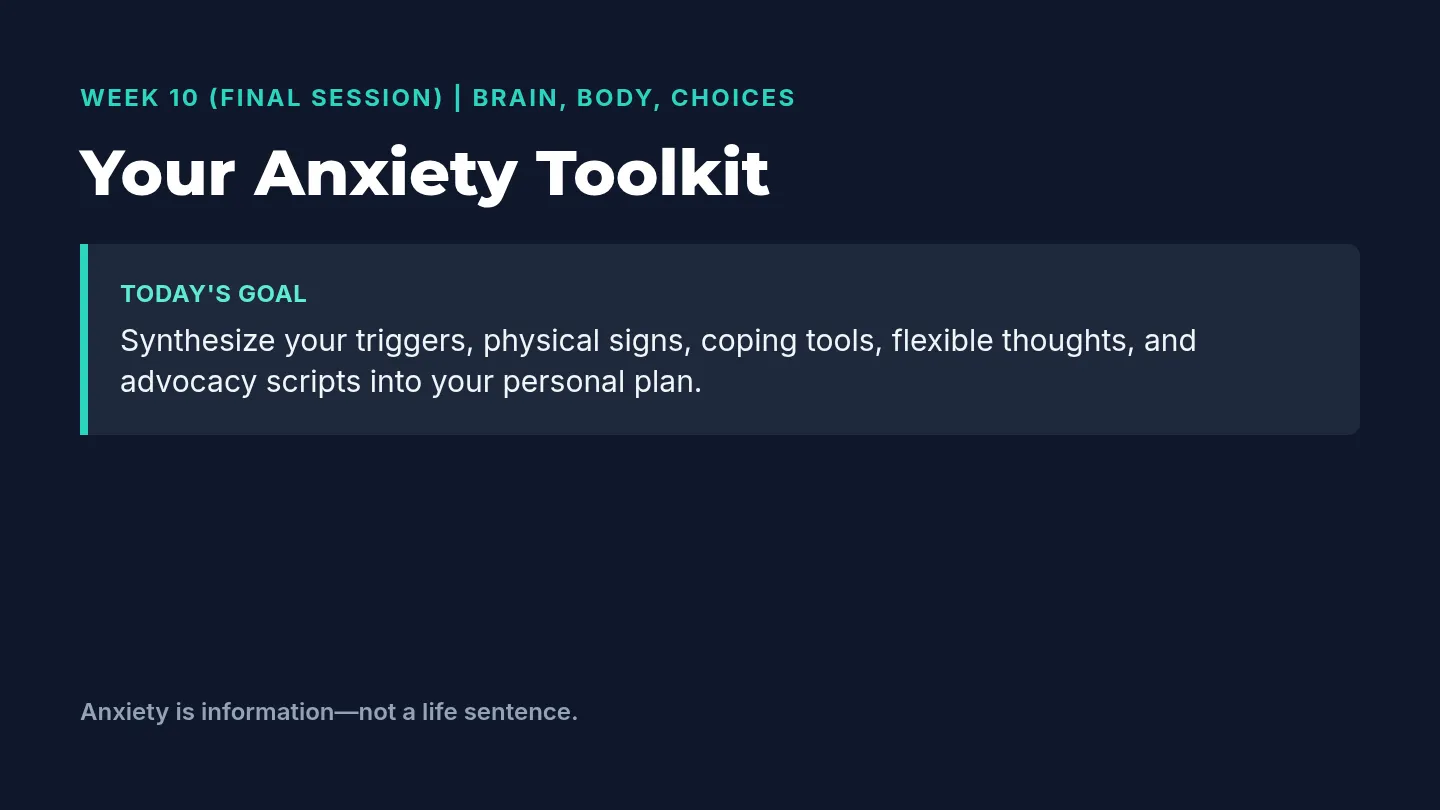
Your Anxiety Toolkit
Post-assessment; individualized Anxiety Management Plan; relapse prevention and growth review.
IEP Alignment Summary (Tracked Weekly on Page 2)
Student R (Anxiety Management & Self-Advocacy)
Obj 1: Identify 3+ school triggers & 3+ physical signs (4/5 sessions).Obj 2: Independently select & use coping strategy (3/5 opps).Obj 3: Appropriately request support via agreed method (3/5 opps).
Student L (Flexible Thinking, Engagement & Advocacy)
Obj 1: Initiate/respond/maintain 2+ peer interactions/session (4/5 wks).Obj 2: Use specific coping strategy to counter negative thoughts (4/5 opps).Obj 3: Identify 1+ weekly real-life self-advocacy moment (3/5 wks).
Facilitator Clinical Record
Weekly IEP Data Collection Tracker (Students R & L)
Prompt Key: I =Independent | V =Verbal | G =Gestural | N/O =Not Observed
Measurement Rule: Record N/O if an opportunity did not occur or was not presented—never score an unpresented opportunity as unsuccessful. Keep Student L's counselor-observed data separate from her 5-target weekly self-reflection score.
Student R: Anxiety Management & Self-Advocacy
Wk/Date
Triggers (≥3)
Signs (≥3)
Coping (Used/Opps)
Support Req (Used/Opps)
Prompt
Anx (1–5)
Notes / N/O Reason
W1: ___
W2: ___
W3: ___
W4: ___
W5: ___
W6: ___
W7: ___
W8: ___
W9: ___
W10: __
Student L: Flexible Thinking, Peer Engagement & Self-Advocacy
| Wk/Date | Peer Interact (Cnt | ≥2?) | Coping vs Thought | Advocacy Ex. (Y/N/NO) | Self-Reflect (/5 | ≥4) | Prompt | Counselor Obs. / Notes |
| --- | --- | --- | --- | --- | --- | --- |
| W1: ___ | | | | | | |
| W2: ___ | | | | | | |
| W3: ___ | | | | | | |
| W4: ___ | | | | | | |
| W5: ___ | | | | | | |
| W6: ___ | | | | | | |
| W7: ___ | | | | | | |
| W8: ___ | | | | | | |
| W9: ___ | | | | | | |
| W10: __ | | | | | | |
Student L's 5 Consistent Self-Reflection Targets (Rated 1–5 Weekly; ≥3 = Target Met): (1) Flexible Thinking, (2) Classroom Engagement, (3) Peer Interactions, (4) Coping Strategy vs. Unhelpful Thought, (5) Self-Advocacy.
Pre Post Knowledge Assessment Understanding Anxiety: Your Brain, Your Body, Your Choices
Anxiety Knowledge Check
[ ] Pre-Check (Week 1) [ ] Post-Check (Week 10)
Name: _______________________________ Date: _____________________
Directions: Circle the best answer for Questions 1–8, and write a brief response for Questions 9–10. On the Pre-Check, it is completely normal not to know some answers yet!
1. What separates everyday anxiety from an anxiety disorder?
A. Feeling nervous before a big presentation
B. Having physical symptoms like a fast heartbeat
C. Persistent fear that impairs daily school or social life
D. Disliking loud or crowded hallways
2. Which brain region rapidly detects potential threats?
A. Prefrontal cortex
B. Amygdala
C. Cerebellum
D. Hippocampus
3. Why does avoiding an anxiety trigger make anxiety stronger over time?
A. It permanently damages the nervous system
B. Short-term relief teaches the brain the trigger was truly dangerous
C. It uses up too much oxygen in the bloodstream
D. Friends will stop talking to you
4. Which is a legitimate accessibility need rather than avoidance?
A. Never speaking in any class all semester
B. Using noise-reducing headphones during independent work
C. Skipping school every time there is a quiz
D. Refusing to look at a teacher's feedback
5. In the CBT Triangle, which three parts constantly influence each other?
A. Diet, Sleep, and Exercise
B. Friends, Teachers, and Parents
C. Thoughts, Feelings, and Behaviors
D. Past, Present, and Future
6. Assuming a friend is mad at you without evidence is called:
A. Mind reading
B. Grounding
C. Inhibitory learning
D. Negative reinforcement
7. How does a "physiological sigh" (double inhale, long exhale) calm the body?
A. It stops the amygdala from ever firing again
B. The long exhale activates the parasympathetic vagal brake
C. It forces you to forget what made you anxious
D. It raises adrenaline to burn off stress
8. Which statement about anxiety medication (like SSRIs) is TRUE?
A. Medication changes your personality
B. Medication works instantly on day one
C. Medication is only for people who refuse therapy
D. Medication adjusts neurotransmitter signaling over weeks
9. Explain one way the sympathetic and parasympathetic nervous systems work together.
10. Write one respectful self-advocacy sentence you could use if you feel overwhelmed in class.
Score (Facilitator Use): _____ / 10 Confidential Small-Group Assessment
Facilitator Reference
Knowledge Check: Answer Key & Clinical Notes
Pre/Post Comparison Tool
Item
Answer
Scientific & Clinical Rationale
Q1
C
Clinical anxiety disorders are defined by persistence, intensity disproportionate to actual threat, and functional impairment in school, home, or social domains.
Q2
B
The amygdala rapidly processes threat cues and initiates the stress response before the prefrontal cortex finishes deliberative evaluation.
Q3
B
Negative reinforcement: escaping/avoiding removes distress immediately, which reinforces the brain's prediction that the situation was dangerous.
Q4
B
Sensory accommodations (like noise-reducing headphones) support nervous system regulation and access to learning, rather than escaping a task.
Q5
C
Cognitive Behavioral Therapy (CBT) models how thoughts, emotions/physical feelings, and behaviors bidirectionally influence one another.
Q6
A
Mind reading is a cognitive distortion where a person assumes they know others' negative judgments without objective evidence.
Q7
B
Extended exhalations stimulate the vagus nerve, slowing heart rate via the parasympathetic "rest-and-digest" branch.
Q8
D
SSRIs/SNRIs modulate serotonin/norepinephrine signaling gradually (typically 4–6 weeks); they do not alter personality and are often paired with CBT.
Open-Response Scoring Guide (1 Point Each)
Q9 (Autonomic Balance):
Award 1 pt if student accurately notes that the sympathetic system mobilizes energy/alertness for challenge or threat, and the parasympathetic system slows heart rate and restores calm afterward.
Q10 (Self-Advocacy):
Award 1 pt if student writes a clear, respectful request for a specific support (e.g., processing time, clarification, brief break, written instructions) without self-deprecation.
Administration Note: Do not grade the Week 1 Pre-Check for a score in front of students. Frame it as a "baseline map" so they can see how much their brain-science knowledge grows by Week 10.
Week 1 Facilitator Guide Week 1 of 10 | Facilitator Lesson Plan
Healthy Stress vs. Anxiety Disorders
30 Minutes
Student Learning Objective: I can explain the difference between healthy nervousness, everyday anxiety, and an anxiety disorder, and identify at least three school-related triggers.
Warm-Up Question: "Think of a time your heart beat faster before something important (like a game, test, or speaking up). Did that feeling help you, get in your way, or both?"
30-Minute Session Pacing
Time
Segment
Facilitator Actions & Student Engagement
0–5 min
Norms & Warm-Up
Establish confidentiality, "pass or pause" self-advocacy signal, and respect. Discuss warm-up question (invite L to respond to R's idea).
5–11 min
Pre-Check
Administer Anxiety Knowledge Check (Pre) . Reassure students it is ungraded and purely to see what we already know vs. will learn.
11–18 min
Psychoeducation
Deliver script below comparing Healthy Nervousness, Everyday Anxiety, and Anxiety Disorders using the 3-column chart on Page 1 of the workbook.
18–26 min
Interactive Activity
Trigger Mapping & Peer Exchange: Students identify 3–4 school triggers on their worksheet, then compare 1 common vs. 1 unique trigger together.
26–30 min
Reflection & Practice
Complete Week 1 Self-Reflection sheet and assign Between-Session Trigger Log (notice 1 trigger without judging it).
Facilitator Psychoeducation Script
"In 8th grade, people throw around the word 'anxiety' for everything—from 'I'm anxious about my math quiz' to 'I have an anxiety disorder.' Today we're separating those three states scientifically."
"First is healthy nervousness . Imagine you're about to take a free throw or present a slide. Your brain releases a small burst of adrenaline. It sharpens focus and fades as soon as the event ends. That's actually helpful."
"Second is everyday anxiety —worry about uncertain future outcomes, like starting high school or wondering if a friend is upset. It's uncomfortable, but you can still go to class and get things done."
"Third is a clinical anxiety disorder . Research shows an anxiety disorder isn't just 'worrying too much'—it's when the brain's threat-detection system fires intensely, persists for months, and blocks you from doing things you value, like participating in class or hanging out with peers. And here's the key: feeling anxious is not a character flaw, and anxiety disorders are highly treatable. "
Research vs. Metaphor Note: Explain to students that calling anxiety a "false alarm" is a helpful metaphor, while established research defines disorders by persistence, disproportionate threat appraisal, and functional impairment .
Week 1: Clinical Notes, Autism Lens & IEP Prompts
Facilitator Reference
Background Information for Student Q&A
Prevalence & Etiology: Roughly 1 in 3 adolescents (ages 13–18) experience an anxiety disorder (NIMH). Etiology is biopsychosocial: genetics/temperament, learned experiences, and environmental stressors (academic pressure, social evaluation, sensory overload) interact.
Autism & Neurodiversity Lens: Why This Week Can Be Harder
For autistic 8th graders, unpredictable schedule changes, sensory overload (fluorescent lights, loud hallways), and social masking keep the nervous system closer to its threshold all day. That means everyday school demands can trigger a much stronger stress response—not because the student is "overreacting," but because their sensory and predictability load is already high.
Discussion Questions (Choose 3–5 based on pacing)
Why do you think humans evolved to feel nervousness before big challenges? What would happen if we felt zero stress?
Where is the line between "I'm stressed about this project" and "anxiety is running my schedule"?
What are common middle school triggers (sensory, routine, or social) that adults sometimes underestimate?
Why might someone hide their anxiety at school instead of asking a teacher for help?
If two students have the exact same trigger (like cold-calling), why might their reactions look totally different?
Differentiation for Anxious, Overwhelmed, or Withdrawn Students
No Forced Disclosure: Allow students to pick from sample 8th-grade triggers if sharing personal triggers feels too vulnerable.Processing Time & Signal: Give a 10-second silent "think-write" pause before speaking, and establish a non-verbal "pass or pause" cue.
Week 1 Objective-Specific IEP Data Collection Prompts
Student R:
Obj 1 (Triggers): Count school triggers R writes/shares (Target: ≥3). Mark N/O for physical signs (taught Wk 2).Obj 2 (Coping): Note if R independently uses a strategy during pre-check; else N/O.Obj 3 (Advocacy): Prompt: "Use your signal if you need extra time."
Student L:
Obj 1 (Peer Engagement): Tally L's initiations/responses during Trigger Peer Exchange (Target: ≥2).Obj 2 (Coping vs. Thought): Note if L counters self-doubt during Pre-Check; else N/O.Obj 3 (Advocacy): Collect L's 5-target Self-Reflection Sheet (Page 2).
Answer Key Note (Workbook): Healthy Nervousness = short-term, focus-boosting; Everyday Anxiety = moderate worry, manageable; Anxiety Disorder = persistent, intense, impairs daily functioning.
Week 1 Student Workbook Week 1 | Brain, Body, Choices
Healthy Stress vs. Anxiety Disorders
Name: ___________________ Date: ____________
Today's Goal: Understand the difference between healthy nervousness, everyday anxiety, and anxiety disorders, and map my own school-related triggers.
1. The Three States of Stress & Anxiety
Healthy Nervousness
Everyday Anxiety
Anxiety Disorder
What it is:
A short-term burst of alertness before a clear challenge (quiz, game, speech).
Impact:
Sharpens focus; fades quickly once the event is over.
|
What it is:
Worry about uncertain future events (grades, fitting in, transitions).
Impact:
Uncomfortable, but you can still attend class and complete tasks.
|
What it is:
Intense, persistent threat alarm that lasts months and feels hard to shut off.
Impact:
Blocks daily life—causing you to avoid class, peers, or activities you value.
|
2. School-Related Anxiety Trigger Identification
A trigger is a situation, demand, or sensory environment that signals your brain to ramp up alertness. Identify at least 3–4 school triggers below (examples: cold-calling, timed tests, group work, noisy hallways, unclear instructions).
Trigger 1 (Academic / Classroom):
Trigger 2 (Social / Peer Interaction):
Trigger 3 (Sensory / Environment):
Trigger 4 (Other School Situation):
3. Peer Exchange (With Your Group Partner)
Share one trigger you feel comfortable discussing. Write one thing you both have in common or one thing you learned from your partner:
Remember: Having triggers does not mean something is wrong with you—it means your nervous system is paying attention.
Week 1 | Check-In & Practice
Weekly Self-Reflection
Name: ___________________
1. Right now, my anxiety level in group is: (Circle one)
1
2
3
4
5
2. Weekly Skill Targets (Circle 1–5 for each target)
Scale: 1 = Not yet | 2 = Trying with help | 3 = Met target | 4 = Consistent | 5 = Strong & independent
Weekly Target
My Rating
Flexible Thinking: I stayed open to new ideas or different perspectives today.1 2 3 4 5
Classroom Engagement: I participated in group tasks or discussions.1 2 3 4 5
Peer Interactions: I initiated, responded to, or maintained conversation with my peer.1 2 3 4 5
Coping vs. Unhelpful Thought: I used a calming or focus strategy when needed.1 2 3 4 5
Self-Advocacy: This week, I asked for help, clarification, or time instead of staying silent.1 2 3 4 5
3. One moment this week when I asked for help, clarification, or support (or wish I had):
Between-Session Practice: Notice Without Judging
Once before next week's group, notice a moment when your stress rises at school. Jot down what happened and whether it felt like healthy nervousness or anxiety:
Next Week: How Your Brain & Nervous System Create Physical Symptoms
Week 1 Lesson Slides Week 1 | Brain, Body, Choices
Healthy Stress vs. Anxiety Disorders
Today's Goal
Understand the difference between healthy nervousness, everyday anxiety, and clinical anxiety disorders—and map your school triggers.
Group Norms: Confidentiality Respect & Choice "Pass or Pause" Signal
Warm-Up Question
Think of a time your heart beat faster before something important (a game, quiz, or speaking up).
Did that feeling help you, get in your way, or both?
Brain Science
The Three States of Stress & Anxiety
Healthy Nervousness
Short-term burst of adrenaline before a clear challenge.
Sharpens focus and fades when it ends.
Everyday Anxiety
Worry about uncertain future events (grades, peers, transitions).
Uncomfortable, but you still get things done.
Anxiety Disorder
Intense threat alarm that persists for months and feels hard to shut off.
Blocks school, friends, or daily choices.
Key Fact: Feeling anxious is not a character flaw—and anxiety disorders are highly treatable.
Science vs. Metaphor
Separating Facts from Shortcuts
Helpful Metaphor
Calling anxiety a "false alarm" helps us picture a sensitive threat detector.
Established Research
Clinical disorders are defined by persistence, disproportionate threat appraisal, and daily impairment.
Autism & Neurodiversity Lens
Why School Stress Hits Harder for Autistic Brains
1. Sensory & Routine Load: Loud hallways, bright lights, and surprise schedule changes keep the nervous system near its limit all day.
2. Not "Overreacting": When your baseline load is already high, small demands can tip the alarm faster.
Your Turn
Trigger Mapping & Peer Exchange
1. Write 3–4 school triggers on your Week 1 worksheet (academic, social, or sensory).
2. Share one trigger you feel comfortable discussing with your partner.
3. Complete your Week 1 Self-Reflection.
Between-Session Practice: Notice Without Judging
Catch one stress spike this week and label it: Healthy Nervousness or Anxiety.
Week 2 Facilitator Guide Week 2 of 10 | Facilitator Lesson Plan
Brain and Nervous System
30 Minutes
Student Learning Objective: I can explain how the amygdala, prefrontal cortex, and autonomic nervous system create fight, flight, or freeze responses, and identify at least three physical signs of anxiety in my body.
Warm-Up Question: "If a smoke alarm goes off because you burned toast, is the alarm broken—or doing its job too sensitively? How does that compare to your brain during a pop quiz?"
30-Minute Session Pacing
Time
Segment
Facilitator Actions & Student Engagement
0–4 min
Check-In & Warm-Up
Review Week 1 Trigger Log (optional share). Discuss the smoke-alarm warm-up question together.
4–13 min
Psychoeducation
Walk through the Brain & Nervous System diagram and Fight-Flight-Freeze chart (Workbook Page 1).
13–22 min
Body Map Activity
Physical Signs Body Map (Page 2): Students mark 3+ physical signs on the body diagram, then compare 1 physical cue with their partner.
22–26 min
Coping Connection
Brief physiological reset: try 2 slow exhales together to feel the parasympathetic "brake" in real time.
26–30 min
Reflection & Practice
Complete Week 2 Self-Reflection (Page 3) and assign Between-Session Body Signal Check.
Facilitator Psychoeducation Script
"When you notice a sudden threat—or a social threat like being called on—a tiny almond-shaped region called the amygdala acts first. It's faster than your prefrontal cortex (the thinking, planning front part of your brain). That's why your heart races before you even finish thinking, 'Wait, I actually know this answer.'"
"Your sympathetic nervous system hits the gas pedal: adrenaline and cortisol surge, heart rate and breathing speed up, blood flows to big muscles, and digestion slows down (hello, stomachaches). Meanwhile, your parasympathetic nervous system is the brake pedal that restores calm once the threat passes."
"Depending on the situation, your nervous system chooses Fight (snapping or arguing), Flight (wanting to leave the room), or Freeze (mind going blank, unable to speak). None of these mean you're weak—they are automatic survival reflexes."
Research vs. Metaphor Note: "Gas pedal / brake pedal" and "smoke alarm" are metaphors. Scientifically, the sympathetic and parasympathetic branches of the autonomic nervous system (ANS) continuously co-regulate heart rate, respiration, and arousal via the vagus nerve and HPA axis.
Week 2: Clinical Notes, Autism Lens & IEP Prompts
Facilitator Reference
Background Information for Student Q&A
Why Freeze & Stomachaches Happen: During intense threat, dorsal vagal circuitry can temporarily inhibit speech and recall ("blank mind"). Meanwhile, sympathetic activation diverts blood from the GI tract (nausea/butterflies) and shallow breathing lowers CO2 (dizziness).
Autism & Neurodiversity Lens: Why This Week Can Be Harder
Many autistic students experience differences in interoception —the brain's ability to notice subtle internal body cues (like rising heart rate or tension) until they suddenly hit an 8/10. Combined with heightened sensory gating, fight/flight/freeze or autistic shutdowns can feel like they arrive "out of nowhere," making early body-signal spotting harder without concrete checklists.
Discussion Questions
Why is it actually useful that the amygdala reacts faster than the prefrontal cortex in physical danger?
When does that same speed become frustrating in a middle school classroom?
Which response—fight, flight, or freeze—do teachers most often misunderstand as "bad behavior" or "not trying"?
Why do physical symptoms like a stomachache or sweaty palms feel so convincing that something is wrong?
How does knowing "this is just adrenaline" change how you react to a racing heart?
Differentiation & Trauma-Informed Supports
Interoception Support: Offer the word bank on Page 2 so students who struggle to sense subtle internal cues can circle observable signs (e.g., clenched jaw, tapping feet, blank mind).Structured Partnering: Provide a sentence frame: "One signal my body gives me is ______, and it usually shows up during ______."
Week 2 Objective-Specific IEP Data Collection Prompts
Student R:
Obj 1 (Physical Signs & Triggers): Count physical signs R labels on Body Map (≥3) + triggers (≥3).Obj 2 (Coping): Note if R participates in the 2-exhale reset independently or with prompting.Obj 3 (Advocacy): Observe if R requests clarification on brain terms.
Student L:
Obj 1 (Peer Engagement): Tally initiations/responses when comparing Body Maps with R (≥2).Obj 2 (Coping vs. Thought): Ask: "What's one helpful thought when your brain freezes?" Obj 3 (Advocacy): Collect L's 5-target Self-Reflection Sheet (Page 3).
Facilitator Key (Body Map): Common signs include racing heart, shallow breathing, tense jaw/shoulders, stomachache/nausea, sweaty palms, shaky legs, warm face, and "blank mind."
Week 2 Student Workbook Week 2 | Brain, Body, Choices
Your Brain & Nervous System
Name: ___________________ Date: ____________
1. Threat Detection vs. Thinking Brain
Prefrontal Cortex Amygdala Brainstem → Body
Amygdala = Fast threat detectorPrefrontal Cortex = Logic, planning & perspective
Autonomic Nervous System (ANS)
Your ANS runs automatic body functions (heart rate, breathing, digestion) using two branches:
Sympathetic ("Gas Pedal")
Releases adrenaline; speeds heart & breathing; sharpens focus for action.
Parasympathetic ("Brake Pedal")
Activates vagus nerve; slows heart rate; restores digestion & calm.
2. Fight, Flight, or Freeze in Middle School
Response
What It Does in the Body
What It Looks Like at School
FIGHT
Surges energy to confront or push back against perceived threat.
Snapping at a partner, arguing over a grade, feeling suddenly irritable or defensive.
FLIGHT
Pushes muscles to escape or get away from the stressful situation.
Asking for the restroom during presentations, rushing work, avoiding the cafeteria.
FREEZE
Conserves energy and pauses movement/speech when threat feels overwhelming.
Mind going blank when called on, staring at a blank test page, unable to speak up.
Quick Check: Which response (Fight, Flight, or Freeze) do you notice most in yourself at school?
Science Note: Fight, flight, and freeze are automatic survival reflexes—not choices or character flaws.
Week 2 | Activity
Physical Signs of Anxiety Body Map
Name: ___________________
Directions: Circle or draw on the body outline where you feel stress or anxiety. Then write at least 3–4 physical signs in the blank boxes and connect them to the matching school trigger.
Head / Mind Sign:
Chest / Breathing Sign:
Stomach / Gut Sign:
Shoulders / Neck / Jaw:
Hands / Legs / Energy:
School Trigger That Starts This:
Common Physical Signs (Optional Reference): Racing heart, shallow breathing, tight chest, stomachache/butterflies, warm face, tense shoulders, jaw clenching, sweaty palms, shaky legs, mind going blank.
Partner Comparison: Share one physical sign with your partner. What is one similarity or difference?
Key Takeaway: Physical symptoms are early warning data from your nervous system—not proof that you are in danger.
Week 2 | Check-In & Practice
Weekly Self-Reflection
Name: ___________________
1. Right now, my anxiety level in group is: (Circle one)
1
2
3
4
5
2. Weekly Skill Targets (Circle 1–5 for each target)
Scale: 1 = Not yet | 2 = Trying with help | 3 = Met target | 4 = Consistent | 5 = Strong & independent
Weekly Target
My Rating
Flexible Thinking: I stayed open to new ideas or perspectives today.1 2 3 4 5
Classroom Engagement: I participated in group tasks or discussions.1 2 3 4 5
Peer Interactions: I initiated, responded to, or maintained conversation with my peer.1 2 3 4 5
Coping vs. Unhelpful Thought: I used a calming or focus strategy when needed.1 2 3 4 5
Self-Advocacy: This week, I asked for help, clarification, or time instead of staying silent.1 2 3 4 5
3. One moment this week when I asked for help, clarification, or support (or wish I had):
Between-Session Practice: Body Signal Spotter
Catch one physical sign of stress during the school week and label it silently: "That's my sympathetic system firing." Note what you noticed:
Next Week: Why Avoidance Feels Good Now—and Stronger Later
Week 2 Lesson Slides Week 2 | Brain, Body, Choices
Your Brain & Nervous System
Today's Goal
Explain how the amygdala, prefrontal cortex, and nervous system create fight, flight, or freeze—and map 3+ physical signs in your body.
Physical symptoms are data—not danger.
Warm-Up Question
If a smoke alarm goes off because you burned toast, is the alarm broken—or doing its job too sensitively?
How does that compare to your brain during a pop quiz or cold-call?
Neuroscience
Two Brain Systems & Two Pedals
Amygdala + Sympathetic
Fast threat detector. Fires before your thinking brain finishes analyzing.
Gas Pedal: Adrenaline surges, heart & breathing speed up, digestion slows.
Prefrontal Cortex + Parasympathetic
Logic, planning, and perspective. Slower, but sees the full picture.
Brake Pedal: Vagus nerve slows heart rate and restores calm.
Research Note: "Gas/brake pedals" is a metaphor for autonomic nervous system (ANS) co-regulation.
Survival Reflexes
Fight, Flight, or Freeze at School
FIGHT
Snapping at a partner, arguing, or feeling suddenly irritable.
FLIGHT
Asking for the restroom, rushing work, or avoiding loud rooms.
FREEZE
Mind going completely blank when called on or staring at a test.
Autism & Neurodiversity Lens
Interoception & Sudden Shutdowns
1. Interoception Differences: Many autistic brains don't notice small body signals (2/10 or 3/10) until stress suddenly hits 8/10.
2. Why Checklists Help: Using a visual Body Map helps you spot clues earlier—before freeze or shutdown takes over.
Activity
Physical Signs Body Map
1. Mark 3–4 physical signs on your Body Map (Workbook Page 2).
2. Compare one physical cue with your partner.
3. Practice 2 slow exhales together to feel the parasympathetic brake.
Between-Session Practice: Body Signal Spotter
Catch one physical sign this week and tell yourself: "That's my sympathetic system firing."
Week 3 Facilitator Guide Week 3 of 10 | Facilitator Lesson Plan
The Avoidance Trap
30 Minutes
Student Learning Objective: I can explain how avoidance strengthens anxiety over time through negative reinforcement, and tell the difference between avoidance and a legitimate accessibility need.
Warm-Up Question: "If you skip a hard assignment or stay silent in class because you feel nervous, how do you feel 5 minutes later? How do you feel the next time that same class happens?"
30-Minute Session Pacing
Time
Segment
Facilitator Actions & Student Engagement
0–4 min
Check-In & Warm-Up
Review Week 2 Body Signal Spotter. Discuss the 5-minutes-later vs. next-time warm-up question.
4–13 min
Psychoeducation
Teach the Anxiety & Avoidance Cycle (negative reinforcement) and Safety Behaviors using Workbook Page 1.
13–23 min
Sorting & Peer Debate
Avoidance vs. Accessibility Activity: Students evaluate 4 middle school scenarios together, deciding if each is avoidance, a legitimate accessibility need, or both.
23–26 min
Debrief
Connect to self-advocacy: how accommodations help us participate , whereas avoidance pulls us away .
26–30 min
Reflection & Practice
Complete Week 3 Self-Reflection (Page 2) and assign "Tiny Stay-In" practice.
Facilitator Psychoeducation Script
"Here is why anxiety is so sticky: when a trigger hits, your distress spikes. If you avoid it—like putting your head down, leaving for the nurse, or staying completely silent—your anxiety drops fast . In psychology, that's called negative reinforcement : removing something uncomfortable rewards your brain."
"The problem? Your amygdala doesn't learn 'I handled it.' It learns, 'Whoa, good thing we escaped—that must have been truly dangerous!' So next time, the alarm fires even louder."
"At the same time, not all stepping back is avoidance . If a student uses noise-reducing headphones because loud echoing hallways cause sensory overload, or asks for written directions because they need processing time, that is a legitimate accessibility need —it helps them stay engaged."
Research vs. Metaphor Note: "The Avoidance Trap" is a clinical metaphor; the underlying mechanism is operant conditioning via negative reinforcement (Mowrer's two-factor theory).
Week 3: Clinical Notes, Autism Lens & IEP Prompts
Facilitator Reference
Background Information & Answer Key
Scenario Key (Workbook Page 1): (1) Headphones during quiet work = Accessibility Need ; (2) Skipping every Tuesday for presentations = Avoidance ; (3) Requesting 10s processing time = Accessibility Need ; (4) Pretending to look for a pencil so partner talks = Avoidance .
Autism & Neurodiversity Lens: Why This Week Can Be Harder
Autistic students are frequently mislabeled as "avoidant" when they are actually engaging in sensory self-protection (e.g., stepping out of a painfully loud pep rally or avoiding bright, crowded cafeterias). Unlike irrational anxiety avoidance, sensory pain does not habituate through exposure—so validating sensory accommodations is essential while still gently addressing fear-based task avoidance.
Discussion Questions
Why does avoidance feel like the smartest choice in the moment?
What are subtle ways 8th graders avoid things while still sitting in their desks?
How can you tell if a support (like headphones or extra time) helps you participate vs. escape?
If a friend is stuck in an avoidance loop, why does telling them "just do it" usually backfire?
What is one small situation where staying in the room for 2 extra minutes could teach your brain something new?
Differentiation & Trauma-Informed Supports
Validate Without Shaming: Frame avoidance as a clever short-term survival strategy with an unintended long-term cost.Protect Accommodations: Never pressure a student to give up a genuine sensory or processing accommodation as "avoidance."
Week 3 Objective-Specific IEP Data Collection Prompts
Student R:
Obj 1 (Triggers & Signs): Name 3 triggers/physical signs that tempt him to avoid a task.Obj 2 (Coping): Observe if R uses a coping strategy before/during the scenario debate.Obj 3 (Advocacy): Prompt: "Use your signal if you need processing time."
Student L:
Obj 1 (Peer Engagement): Tally L's initiations/responses during the 4-scenario debate (≥2).Obj 2 (Coping vs. Thought): Pair one unhelpful avoidance thought with a coping strategy.Obj 3 (Advocacy): Review L's weekly real-life advocacy example on Page 2.
Key Principle: Accommodations widen access; avoidance shrinks your world.
Week 3 Student Workbook Week 3 | Brain, Body, Choices
The Avoidance Trap
Name: ___________________ Date: ____________
1. How Negative Reinforcement Keeps Anxiety Going
1. Trigger Pop quiz / Group work 2. Distress Spikes Amygdala fires alarm 3. Avoidance Leave / Stay silent 4. Short-Term Relief Brain feels instant reward 5. Stronger Alarm Later "Good thing we escaped!"
2. Avoidance vs. Legitimate Accessibility Needs
Not every step back is avoidance! Discuss each scenario with your partner. Decide whether it is Avoidance (pulling away from a task) or an Accessibility Need (a tool/support that helps you stay engaged), and explain why.
Middle School Scenario
Category
Why? (Your Reasoning)
Using noise-reducing headphones during independent quiet work because hallway noise is overwhelming.
Asking to go to the nurse every Tuesday right before science lab presentations.
Asking a teacher for 10 seconds of processing time or written directions before answering.
Pretending to organize your backpack so your group partner does all the talking.
Key Idea: Accessibility tools widen your participation; avoidance shrinks it.
Week 3 | Check-In & Practice
Weekly Self-Reflection
Name: ___________________
1. Right now, my anxiety level in group is: (Circle one)
1
2
3
4
5
2. Weekly Skill Targets (Circle 1–5 for each target)
Scale: 1 = Not yet | 2 = Trying with help | 3 = Met target | 4 = Consistent | 5 = Strong & independent
Weekly Target
My Rating
Flexible Thinking: I stayed open to new ideas or perspectives today.1 2 3 4 5
Classroom Engagement: I participated in group tasks or discussions.1 2 3 4 5
Peer Interactions: I initiated, responded to, or maintained conversation with my peer.1 2 3 4 5
Coping vs. Unhelpful Thought: I used a calming or focus strategy when needed.1 2 3 4 5
Self-Advocacy: This week, I asked for help, clarification, or time instead of staying silent.1 2 3 4 5
3. One moment this week when I asked for help, clarification, or support (or wish I had):
Between-Session Practice: One Tiny "Stay-In"
Pick one low-stakes moment this week where you usually pull back (e.g., staying in a group chat, raising your hand once, asking a clarifying question). Stay in for 1–2 minutes longer and note what happened:
Next Week: How Thoughts, Feelings, and Behaviors Shape Each Other (The CBT Triangle)
Week 3 Lesson Slides Week 3 | Brain, Body, Choices
The Avoidance Trap
Today's Goal
Explain why avoidance makes anxiety stronger over time—and separate avoidance from legitimate accessibility needs.
Accommodations widen access; avoidance shrinks your world.
Warm-Up Question
If you skip a hard task or stay silent in class because you feel nervous:
How do you feel 5 minutes later?
How do you feel the next time that class happens?
How Anxiety Grows
Negative Reinforcement in 4 Steps
Step 1
Trigger
Distress spikes when a demand hits.
Step 2
Avoidance
Leave, stay silent, or hide.
Step 3
Fast Relief
Removing distress rewards the brain.
Step 4
Louder Alarm
Brain learns: "Good thing we escaped!"
Science Note: "The Avoidance Trap" is a metaphor for operant negative reinforcement.
Neurodiversity-Affirming Care
Not All Stepping Back Is Avoidance
Accessibility Need
A tool or support (headphones, written directions, 10s processing time) that helps you stay engaged .
Avoidance
Pulling away from a task or class completely to get instant relief from discomfort.
Autism & Neurodiversity Lens
Sensory Self-Protection vs. Avoidance
1. Sensory Pain Is Real: Stepping out of a painfully loud pep rally or using headphones is sensory self-protection —not irrational avoidance.
2. Respecting Your Needs: Sensory pain doesn't fade by "pushing through," so accommodations stay protected.
Partner Debate
Sort the 4 School Scenarios
1. Discuss each scenario on Workbook Page 1 with your partner.
2. Decide: Avoidance, Accessibility Need, or Both—and explain why.
3. Complete your Week 3 Self-Reflection.
Between-Session Practice: One Tiny "Stay-In"
Stay in one low-stakes moment for 1–2 extra minutes this week and notice what happens.
Week 4 Facilitator Guide Week 4 of 10 | Facilitator Lesson Plan
The CBT Triangle
30 Minutes
Student Learning Objective: I can map how thoughts, feelings/body sensations, and behaviors influence one another in a situation, and show how shifting one corner changes the cycle.
Warm-Up Question: "Two 8th graders both get a 'See me after class' note on a paper. One feels curious; the other feels terrified. What changed between the exact same event and their two different reactions?"
30-Minute Session Pacing
Time
Segment
Facilitator Actions & Student Engagement
0–4 min
Check-In & Warm-Up
Review Week 3 "Tiny Stay-In." Discuss the "See me after class" warm-up prompt.
4–12 min
Psychoeducation
Introduce the Cognitive Behavioral Therapy (CBT) Triangle using Workbook Page 1. Emphasize bidirectional arrows.
12–22 min
Triangle Mapping
Scenario Lab: Students map Scenario A together, then collaborate to "Shift One Corner" on Scenario B.
22–26 min
Peer Feedback
Students compare which corner (Thought or Behavior) feels easiest to shift first in real school life.
26–30 min
Reflection & Practice
Complete Week 4 Self-Reflection (Page 2) and assign Between-Session Triangle Spotter.
Facilitator Psychoeducation Script
"Cognitive Behavioral Therapy (CBT) is one of the most researched treatments for anxiety. Its core insight is that in any stressful situation, three things are constantly talking to each other: your Thoughts (what your brain predicts), your Feelings (emotions + body sensations), and your Behaviors (what you do or avoid)."
"Notice the arrows go in both directions. We can't always snap our fingers and turn off an anxious feeling. But we can choose a slightly different behavior—like staying in the room or asking a question—or test a more balanced thought. When you shift one corner, the other two corners shift too."
Research vs. Metaphor Note: The "triangle" is a visual model; empirical CBT research demonstrates reciprocal causation between cognitive appraisals, physiological arousal, and behavioral avoidance/approach.
Week 4: Clinical Notes, Autism Lens & IEP Prompts
Facilitator Reference
Background Information & Scenario Key
Not "Toxic Positivity": CBT is about accurate, flexible thoughts ("This might be awkward, and I can still get through it"). Scenario A Key: Thought: "They're mad at me" → Feeling: Tight chest, worried → Behavior: Checking phone 10x. Shift: "They might be at practice" → put phone away.
Autism & Neurodiversity Lens: Why This Week Can Be Harder
Up to half of autistic individuals experience alexithymia —difficulty identifying and putting single-word emotion labels on internal feelings in the moment. In addition, literal, bottom-up thinkers may find abstract "thought vs. feeling" distinctions confusing. Using concrete body sensations ("tight chest" or "hot face") in the Feelings corner works much better than forcing emotion vocabulary.
Discussion Questions
Why is it hard to change a "Feeling" directly by telling yourself "Stop being anxious"?
How can changing a Behavior (like taking a slow breath or asking for clarification) change your Thoughts?
What is the difference between a realistic thought and a fake positive thought?
Which corner of the triangle do you usually notice first when you're stressed at school?
How might two friends interpret the exact same hallway look or unanswered text differently?
Differentiation & Trauma-Informed Supports
Concrete Feelings Support: Allow students to write body sensations ("stomachache, 4/5 stress") in the Feelings box if emotion words feel hard to access.Third-Person Scenarios: Use the printed fictional scenarios before asking students to map a personal moment.
Week 4 Objective-Specific IEP Data Collection Prompts
Student R:
Obj 1 (Triggers & Signs): Note physical signs R identifies in the Feeling corner (≥3).Obj 2 (Coping): Observe if R selects a behavioral coping shift during Scenario B.Obj 3 (Advocacy): Prompt R to ask for clarification if unsure whether an item is a thought or feeling.
Student L:
Obj 1 (Peer Engagement): Tally L's initiations/responses when co-solving Scenario B with R (≥2).Obj 2 (Coping vs. Thought): Observe L generating a balanced counter-thought in the Shift box.Obj 3 (Advocacy): Collect L's 5-target Self-Reflection Sheet (Page 2).
Key Principle: You don't have to control every thought—just shift one corner of the triangle.
Week 4 Student Workbook Week 4 | Brain, Body, Choices
The CBT Triangle Worksheet
Name: ___________________ Date: ____________
THOUGHTS FEELINGS BEHAVIORS
Thoughts: What your brain predicts or tells you ("Everyone will laugh if I mess up").
Feelings: Emotions + body sensations (anxious, embarrassed, tight chest, sweaty palms).
Behaviors: What you actually do or avoid (stay silent, ask for time, leave the room).
1. Scenario A: Left on "Read"
You texted a friend about partnering up for a science project 2 hours ago. They read it and haven't replied.
Anxious Thought:
Feelings & Body Signs:
Likely Behavior:
2. Scenario B: Cold-Called in English Class
The teacher calls your name to share your opinion on a chapter. Your mind blanks for a second.
Unhelpful Loop (Thought → Feeling → Behavior):
Shift One Corner (New Thought OR New Behavior):
Key Idea: Shifting just one corner—a balanced thought or a small brave action—changes the whole triangle.
Week 4 | Check-In & Practice
Weekly Self-Reflection
Name: ___________________
1. Right now, my anxiety level in group is: (Circle one)
1
2
3
4
5
2. Weekly Skill Targets (Circle 1–5 for each target)
Scale: 1 = Not yet | 2 = Trying with help | 3 = Met target | 4 = Consistent | 5 = Strong & independent
Weekly Target
My Rating
Flexible Thinking: I stayed open to new ideas or perspectives today.1 2 3 4 5
Classroom Engagement: I participated in group tasks or discussions.1 2 3 4 5
Peer Interactions: I initiated, responded to, or maintained conversation with my peer.1 2 3 4 5
Coping vs. Unhelpful Thought: I used a calming or focus strategy when needed.1 2 3 4 5
Self-Advocacy: This week, I asked for help, clarification, or time instead of staying silent.1 2 3 4 5
3. One moment this week when I asked for help, clarification, or support (or wish I had):
Between-Session Practice: Triangle Spotter
Notice one moment this week where an anxious thought popped up. Write down the thought and one small shift you tried:
Next Week: Spotting Common Thinking Traps & Practicing Flexible Thinking
Week 4 Lesson Slides Week 4 | Brain, Body, Choices
The CBT Triangle
Today's Goal
Map how thoughts, feelings, and behaviors influence each other—and see how shifting one corner changes the cycle.
You don't have to control every thought—just shift one corner.
Warm-Up Question
Two 8th graders both get a "See me after class" note on a paper. One feels curious; the other feels terrified.
What changed between the exact same event and their two different reactions?
Cognitive Behavioral Therapy
Three Corners Talking Together
THOUGHTS
What your brain predicts or interprets ("Everyone will judge me").
FEELINGS
Emotions + body sensations (anxious, tight chest, sweaty palms).
BEHAVIORS
What you do or avoid (stay silent, ask for time, leave).
Arrows go in BOTH directions: changing a thought or behavior shifts the feeling.
Key Distinction
CBT Is Not "Toxic Positivity"
Fake Positive
"Everything will be 100% easy and amazing!"
Balanced & Flexible
"This might feel awkward, and I can still get through it."
Autism & Neurodiversity Lens
When Naming Feelings Is Hard (Alexithymia)
1. Alexithymia: Many autistic brains find it tough to put one-word emotion labels on internal feelings in the moment.
2. Concrete Workaround: Putting body sensations ("tight chest, 4/5 stress") in the Feelings corner works just as well!
Scenario Lab
Map & Shift One Corner
1. Map Scenario A (Left on "Read") together on Workbook Page 1.
2. Partner up on Scenario B (Cold-Called) to design one Thought or Behavior shift.
3. Complete your Week 4 Self-Reflection.
Between-Session Practice: Triangle Spotter
Catch one anxious thought this week and test one small shift.
Week 5 Facilitator Guide Week 5 of 10 | Facilitator Lesson Plan
Spotting Thinking Traps
30 Minutes
Student Learning Objective: I can identify common thinking traps (cognitive distortions) and use evidence-based questions to build a more flexible, balanced thought.
Warm-Up Question: "If you fail one pop quiz and your brain immediately says, 'I'm going to fail 8th grade,' is your brain reporting a fact or making a prediction?"
30-Minute Session Pacing
Time
Segment
Facilitator Actions & Student Engagement
0–4 min
Check-In & Warm-Up
Review Week 4 Triangle Spotter. Discuss fact vs. prediction warm-up.
4–11 min
Psychoeducation
Explain cognitive distortions ("thinking traps") and why anxious brains default to worst-case predictions.
11–22 min
Card Deck Challenge
Thinking Traps Cards: Students draw 3 cards each, identify the trap in a school scenario, and coach each other using the card's counter-question.
22–26 min
Reframing Practice
Students complete the 3-step Evidence Check on Workbook Page 1.
26–30 min
Reflection & Practice
Complete Week 5 Self-Reflection (Page 2) and assign Trap Catcher practice.
Facilitator Psychoeducation Script
"When your amygdala is on high alert, it nudges your thinking brain to scan for danger. That creates mental shortcuts called cognitive distortions —or 'thinking traps.' They feel 100% true in the moment, even when they're exaggerated."
"For example, Catastrophizing jumps straight to the worst-case outcome. Mind Reading assumes you know someone is judging you without asking. All-or-Nothing Thinking says if something isn't perfect, it's a total failure. Today we're practicing flexible thinking : treating anxious thoughts like hypotheses to test, not facts to obey."
Research vs. Metaphor Note: "Thinking traps" is a student-friendly metaphor for cognitive distortions / maladaptive appraisal biases identified by Aaron Beck and David Burns in CBT research.
Week 5: Clinical Notes, Autism Lens & IEP Prompts
Facilitator Reference
Background Information & Workbook Key
Workbook Page 1 Key: (1) "Everyone noticed my voice shake and thinks I'm weird" = Mind Reading + Catastrophizing ; (2) "I got a C on one lab so I'm terrible at science" = All-or-Nothing / Overgeneralization .
Autism & Neurodiversity Lens: Why This Week Can Be Harder
All-or-nothing thinking often overlaps with an autistic brain's natural preference for clear rules and predictability. In addition, if an autistic teen has experienced real peer rejection or miscommunication in the past, "Mind Reading" can feel like learned self-protection rather than a random error. Validate past experiences while asking: "Is there more than one possible explanation right now?"
Discussion Questions
Which thinking trap shows up most often for 8th graders on social media or in hallways?
Why does "Emotional Reasoning" ("I feel embarrassed, so I must have done something stupid") feel so convincing?
What is the difference between "being realistic" and "catastrophizing"?
How does asking "What would I tell a friend who had this thought?" help you step outside the trap?
Can a thought be partly true and still be a thinking trap? Give an example.
Differentiation & Trauma-Informed Supports
Card Scaffolding: Let students keep the Thinking Traps Identification Cards face-up on the table as a visual reference.Low-Stakes Coaching: Practice reframing the card's fictional thought before reframing a personal thought.
Week 5 Objective-Specific IEP Data Collection Prompts
Student R:
Obj 1 (Triggers/Signs): Note triggers/physical signs R links to his top thinking trap.Obj 2 (Coping): Observe R using positive self-talk / reframing on Workbook Page 1.Obj 3 (Advocacy): Prompt R to ask for clarification if two cards seem similar.
Student L:
Obj 1 (Peer Engagement): Tally L's initiations/responses while coaching R on card scenarios (≥2).Obj 2 (Coping vs. Thought): Observe L countering an unhelpful thought with a flexible reframe.Obj 3 (Advocacy): Collect L's 5-target Self-Reflection Sheet (Page 2).
Key Principle: Thoughts are hypotheses, not orders.
Week 5 Student Workbook Week 5 | Brain, Body, Choices
Spotting Thinking Traps
Name: ___________________ Date: ____________
Flexible Thinking Rule: Treat anxious thoughts like a hypothesis to test—not a guaranteed fact.
1. Name the Trap & Reframe It
Thought A: "My voice shook during my presentation. Everyone noticed and thinks I'm weird."
Which Thinking Trap(s)?
Balanced / Flexible Thought:
Thought B: "I got a C on one science lab, so I'm terrible at science and going to fail."
Which Thinking Trap(s)?
Balanced / Flexible Thought:
2. Your Turn: 3-Step Evidence Check
Pick one common anxious thought from your Thinking Traps cards (or one of your own) and run it through the 3 steps:
Step 1 — What is the exact anxious thought & trap name?
Step 2 — What evidence is FOR this thought vs. AGAINST it?
Step 3 — What is a realistic, helpful thought I could tell myself instead?
Tip: A balanced thought doesn't have to be fake-happy—it just has to be fair and accurate.
Week 5 | Check-In & Practice
Weekly Self-Reflection
Name: ___________________
1. Right now, my anxiety level in group is: (Circle one)
1
2
3
4
5
2. Weekly Skill Targets (Circle 1–5 for each target)
Scale: 1 = Not yet | 2 = Trying with help | 3 = Met target | 4 = Consistent | 5 = Strong & independent
Weekly Target
My Rating
Flexible Thinking: I stayed open to new ideas or perspectives today.1 2 3 4 5
Classroom Engagement: I participated in group tasks or discussions.1 2 3 4 5
Peer Interactions: I initiated, responded to, or maintained conversation with my peer.1 2 3 4 5
Coping vs. Unhelpful Thought: I used a calming or focus strategy when needed.1 2 3 4 5
Self-Advocacy: This week, I asked for help, clarification, or time instead of staying silent.1 2 3 4 5
3. One moment this week when I asked for help, clarification, or support (or wish I had):
Between-Session Practice: Trap Catcher
Catch one thinking trap during the week, name it, and write down your flexible reframe:
Next Week: Comparing Evidence-Based Coping Strategies & How They Work
Thinking Traps Identification Cards Week 5 Printable Card Deck
Thinking Traps Identification Cards
Cut along dashed lines
Trap 1
Catastrophizing
Jumping straight to the absolute worst-case disaster as if it is guaranteed.
Ex: "If I stutter on this slide, my whole grade is ruined."
Counter: "What is the most realistic outcome, not just the worst one?"
Trap 2
Mind Reading
Assuming you know what others are thinking—and that it's negative—without proof.
Ex: "They didn't smile in the hall, so they're mad at me."
Counter: "What are 2 other reasons they might look distracted?"
Trap 3
All-or-Nothing Thinking
Seeing things in extremes: either 100% perfect or a total failure.
Ex: "If I don't get an A, I'm terrible at this subject."
Counter: "Where is the gray area between 'perfect' and 'disaster'?"
Trap 4
Emotional Reasoning
Treating an intense feeling as proof that a situation is actually unsafe or true.
Ex: "I feel super nervous, so something bad must be about to happen."
Counter: "Feelings are real signals, not always accurate predictors."
Trap 5
Fortune Telling
Predicting the future negatively before you have even tried.
Ex: "If I join that table at lunch, it'll be super awkward."
Counter: "How could I test this prediction as a 2-minute experiment?"
Trap 6
Mental Filtering
Zooming in on one small mistake while ignoring everything that went well.
Ex: "I answered 4 questions right, but I stumbled on #5."
Counter: "What else happened today that I'm leaving out?"
Trap 7
"Should" Statements
Pressuring yourself with rigid rules that create guilt or shame.
Ex: "I shouldn't need extra time or feel nervous in 8th grade."
Counter: "What would I say to a close friend in this exact spot?"
Trap 8
Overgeneralization
Using one tough moment to conclude it will "always" or "never" happen.
Ex: "Group projects always go badly for me."
Counter: "Is this truly 'always,' or just this one specific time?"
Understanding Anxiety: Your Brain, Your Body, Your Choices | Week 5
Week 5 Lesson Slides Week 5 | Brain, Body, Choices
Spotting Thinking Traps
Today's Goal
Spot common cognitive distortions (thinking traps) and use evidence-based questions to build flexible thoughts.
Thoughts are hypotheses to test—not orders to obey.
Warm-Up Question
You fail one pop quiz, and your brain immediately says: "I'm going to fail 8th grade."
Is your brain reporting a fact—or making a prediction?
Cognitive Distortions
4 Common Middle School Traps
Catastrophizing
Jumping straight to the worst-case disaster as if it's guaranteed.
Mind Reading
Assuming others are judging you negatively without actual proof.
All-or-Nothing
Seeing things in extremes: either 100% perfect or a total failure.
Emotional Reasoning
Treating an intense feeling as proof that something bad is true.
Research Note: "Thinking traps" is a metaphor for CBT cognitive appraisal biases.
Flexible Thinking
The 3-Step Evidence Check
Step 1: Name the exact anxious thought and the trap.
Step 2: Check the evidence FOR it vs. AGAINST it.
Step 3: Build a fair, balanced thought (not fake-happy).
Autism & Neurodiversity Lens
Pattern-Seeking & Real Social History
1. Black-and-White Rules: Autistic brains often prefer clear, predictable rules—which can make gray-area thinking feel harder.
2. Learned Protection: If you've been misunderstood by peers before, "Mind Reading" can feel protective. Ask: "Is there more than one explanation today?"
Card Deck Challenge
Thinking Traps Cards
1. Draw 3 Thinking Traps cards each and read the school example.
2. Coach your partner using the card's counter-question.
3. Complete the 3-Step Evidence Check and Self-Reflection.
Between-Session Practice: Trap Catcher
Catch one thinking trap this week, name it, and write your flexible reframe.
Week 6 Facilitator Guide Week 6 of 10 | Facilitator Lesson Plan
Evidence-Based Coping Tools
30 Minutes
Student Learning Objective: I can compare how physiological and cognitive coping strategies work in the nervous system and select an effective tool for specific school situations.
Warm-Up Question: "Have you ever been told 'just take a deep breath' when you were stressed—and felt annoyed? Why do you think generic advice sometimes flops?"
30-Minute Session Pacing
Time
Segment
Facilitator Actions & Student Engagement
0–4 min
Check-In & Warm-Up
Review Week 5 Trap Catcher. Discuss why "just calm down" feels unhelpful.
4–12 min
Psychoeducation
Compare Bottom-Up (body-to-brain) vs. Top-Down (brain-to-body) tools using the Coping-Skills Menu (Workbook Page 1).
12–22 min
Live Strategy Lab
Test & Rate: Practice 3 rounds together: (1) Physiological Sigh, (2) 5-4-3-2-1 Grounding, (3) Stealth PMR. Students rate and discuss with partner.
22–26 min
Classroom Match
Students choose their #1 "stealth" tool for class and #1 tool for high-stress moments.
26–30 min
Reflection & Practice
Complete Week 6 Self-Reflection (Page 2) and assign Strategy Field Test.
Facilitator Psychoeducation Script
"Coping tools aren't magic spells that erase stress—they are nervous system regulators that lower arousal enough so your prefrontal cortex can come back online. We split them into two groups."
"Bottom-Up tools start in the body. For example, a Physiological Sigh (two quick inhales through the nose, one long slow exhale through the mouth) pops open tiny air sacs in your lungs and stimulates the vagus nerve, slowing heart rate within 2–3 cycles. Progressive Muscle Relaxation (PMR) —tensing and releasing hands or shoulders—discharges physical adrenaline."
"Top-Down tools start in the brain, like 5-4-3-2-1 Grounding (pulling attention out of 'what-if' worry into present sensory facts) and Realistic Self-Talk . Different moments need different tools!"
Research vs. Metaphor Note: Physiological sighs (Balban et al., 2023, Cell Reports Medicine ) and vagally mediated heart-rate deceleration during extended exhalation are well-documented physiological mechanisms.
Week 6: Clinical Notes, Autism Lens & IEP Prompts
Facilitator Reference
Background Information for Student Q&A
Regulation vs. Avoidance: Coping tools help you stay engaged —not guarantee 0% anxiety. Doing 2 sighs to open a Chromebook is regulation; hiding in the hall for 20 minutes is avoidance.
Autism & Neurodiversity Lens: Why This Week Can Be Harder
Traditional "sit completely still and focus on your breath" advice can feel uncomfortable or even dysregulating for autistic students with sensory or interoceptive differences. Validate that stimming (rhythmic movement, hand fidgets, rocking), deep pressure, or stepping into a quiet sensory corner are legitimate, effective bottom-up nervous system regulators—not behaviors to suppress.
Discussion Questions
Why is it helpful to have both "bottom-up" (body) and "top-down" (thinking) tools?
Which strategy felt easiest to do in a crowded classroom without anyone noticing?
When your anxiety is at a 4 or 5 out of 5, is it easier to use a thinking tool or a body tool first? Why?
How is using a coping skill to stay in class different from using a distraction to avoid class?
What would you say to a peer who says, "I tried deep breathing once and it didn't work"?
Differentiation & Trauma-Informed Supports
Eyes-Open & Movement Options: Never require eyes closed or sitting motionless; offer stealth fidgets or foot-pressing PMR.
Week 6 Objective-Specific IEP Data Collection Prompts
Student R:
Obj 1 (Triggers/Signs): Ask R which physical sign each strategy targets.Obj 2 (Coping — Key Week!): Prompt R to independently select and demonstrate 1 preferred strategy.Obj 3 (Advocacy): Note if R requests a pause or switches tools if uncomfortable.
Student L:
Obj 1 (Peer Engagement): Tally L's initiations/responses when comparing Strategy Lab ratings (≥2).Obj 2 (Coping vs. Thought): Pair a coping tool with a realistic self-talk phrase on Page 1.Obj 3 (Advocacy): Collect L's 5-target Self-Reflection Sheet (Page 2).
Key Principle: Regulate the body first, then engage the thinking brain.
Week 6 Student Workbook Week 6 | Brain, Body, Choices
Coping-Skills Menu & Comparison
Name: ___________________ Date: ____________
1. How Evidence-Based Coping Tools Work
Strategy
Type
How It Works in Your Nervous System
Best School Moment
Physiological Sigh
(2 inhales + long exhale)
Bottom-Up
(Body)
Re-inflates lung alveoli and stimulates the vagus nerve, slowing heart rate within 2–3 breaths.
Before a test, quiz, or speaking up in class.
Stealth PMR
(Tense 5s, release 10s)
Bottom-Up
(Body)
Discharges muscle tension and signals safety to the brainstem; invisible under a desk.
Sitting in class when restless, tense, or shaky.
5-4-3-2-1 Grounding
(Sensory scan)
Top-Down
(Attention)
Redirects prefrontal attention away from future "what-ifs" into present sensory facts.
When mind is racing or feeling disconnected.
Balanced Self-Talk
(Evidence reframe)
Top-Down
(Cognitive)
Engages the prefrontal cortex to reality-test amygdala threat predictions.
After a mistake or during social worry.
2. Live Strategy Testing Log
We will test three strategies together. Rate how calm/focused your body felt afterward (1 = Didn't help, 5 = Really helped) and jot a quick note:
Physiological Sigh (3x)
5-4-3-2-1 Grounding
Stealth PMR (Hands/Feet)
My #1 "Stealth" Classroom Strategy + Pairing Self-Talk Phrase:
Goal of Coping: Not to feel 0% nervous, but to stay in the room and make your own choices.
Week 6 | Check-In & Practice
Weekly Self-Reflection
Name: ___________________
1. Right now, my anxiety level in group is: (Circle one)
1
2
3
4
5
2. Weekly Skill Targets (Circle 1–5 for each target)
Scale: 1 = Not yet | 2 = Trying with help | 3 = Met target | 4 = Consistent | 5 = Strong & independent
Weekly Target
My Rating
Flexible Thinking: I stayed open to new ideas or perspectives today.1 2 3 4 5
Classroom Engagement: I participated in group tasks or discussions.1 2 3 4 5
Peer Interactions: I initiated, responded to, or maintained conversation with my peer.1 2 3 4 5
Coping vs. Unhelpful Thought: I used a calming or focus strategy when needed.1 2 3 4 5
Self-Advocacy: This week, I asked for help, clarification, or time instead of staying silent.1 2 3 4 5
3. One moment this week when I asked for help, clarification, or support (or wish I had):
Between-Session Practice: Strategy Field Test
Use your #1 stealth strategy once before a real school task this week. Note what you tried and how it went:
Next Week: Mental Health Treatment Options & Anxiety Medication Facts
Week 6 Lesson Slides Week 6 | Brain, Body, Choices
Evidence-Based Coping Tools
Today's Goal
Compare how body-first and brain-first coping tools work in your nervous system—and test which ones fit school best.
Regulate the body first, then engage the thinking brain.
Warm-Up Question
Have you ever been told "just take a deep breath" when you were stressed—and felt annoyed?
Why do you think generic advice sometimes flops?
Nervous System Regulation
Bottom-Up vs. Top-Down Tools
Bottom-Up (Body → Brain)
Physiological Sigh: 2 quick nose inhales + 1 long exhale stimulates the vagus nerve.
Stealth PMR: Tense and release hands/feet under your desk to discharge adrenaline.
Top-Down (Brain → Body)
5-4-3-2-1 Grounding: Pulls attention out of "what-ifs" into present sensory facts.
Balanced Self-Talk: Uses prefrontal cortex to reality-test threat predictions.
Goal: Not 0% anxiety—just lowering arousal enough to stay engaged.
Important Check
Regulation vs. Avoidance
Healthy Regulation
Taking 2 physiological sighs so you can open your Chromebook and start.
Safety Behavior / Avoidance
Spending 20 minutes breathing in the hall to escape the whole assignment.
Autism & Neurodiversity Lens
Stimming & Sensory Regulation Are Real Tools
1. Beyond "Sit Still & Breathe": Sitting motionless can feel dysregulating for autistic brains.
2. Stimming Works: Rhythmic movement, hand fidgets, deep pressure, and sensory resets are legitimate bottom-up regulators.
Live Strategy Lab
Test & Rate 3 Tools
1. Practice Physiological Sigh, 5-4-3-2-1 Grounding, and Stealth PMR together.
2. Rate each 1–5 on Workbook Page 1 and compare with your partner.
3. Pick your #1 "stealth" classroom tool + pairing self-talk phrase.
Between-Session Practice: Strategy Field Test
Use your #1 stealth tool once before a real school task this week.
Week 7 Facilitator Guide Week 7 of 10 | Facilitator Lesson Plan
Therapy and Medication Facts
30 Minutes
Student Learning Objective: I can compare evidence-based therapies (CBT, ERP, ACT) and anxiety medications (SSRIs/SNRIs) using accurate scientific facts instead of myths.
Warm-Up Question: "If someone has asthma or nearsightedness, we don't tell them 'just try harder to breathe or see.' Why do people sometimes treat mental health care differently?"
30-Minute Session Pacing
Time
Segment
Facilitator Actions & Student Engagement
0–4 min
Check-In & Warm-Up
Review Week 6 Strategy Field Test. Discuss the asthma/glasses stigma warm-up.
4–13 min
Psychoeducation
Walk through the Treatment Options Comparison Chart (CBT, ERP, ACT, SSRIs/SNRIs, Lifestyle Supports) on Workbook Page 1.
13–22 min
Myths vs. Facts
Partner Quiz: Students evaluate 6 Medication Myths vs. Facts statements together, then check answers and discuss surprises.
22–26 min
Empowerment
Discuss how therapy and medication work together (e.g., meds lower the volume; therapy teaches the skills).
26–30 min
Reflection & Practice
Complete Week 7 Self-Reflection (Page 2) and assign Myth-Buster Takeaway.
Facilitator Psychoeducation Script
"When anxiety becomes a clinical disorder, willpower alone isn't the treatment—just like willpower isn't the treatment for a broken bone. Research gives us two main evidence-based tools: psychotherapy and medication ."
"In CBT and ERP (Exposure and Response Prevention) , you retrain your amygdala through gradual practice and flexible thinking. In ACT (Acceptance and Commitment Therapy) , you learn to carry anxious feelings without letting them steer your choices."
"First-line anxiety medications—usually SSRIs (Selective Serotonin Reuptake Inhibitors) or SNRIs —work gradually over 4–6 weeks by helping neurons keep calming neurotransmitters like serotonin available longer. They don't change your personality or erase normal feelings; for many teens, they simply turn the alarm volume down enough so therapy and school feel doable."
Scope of Practice Note: School social workers provide objective psychoeducation; never prescribe, recommend starting/stopping medication, or give medical advice—refer medical questions to pediatricians/psychiatrists.
Week 7: Clinical Notes, Autism Lens & IEP Prompts
Facilitator Reference
Medication Myths vs. Facts — Facilitator Answer Key
"SSRIs change your personality / make you a robot." → MYTH. They reduce excessive threat reactivity; you still feel normal emotions."Anxiety medications usually take 4–6 weeks." → FACT. Receptor adaptation takes weeks, not hours."If you take medication, you don't need therapy." → MYTH. Combined CBT + SSRI is often most effective."Never stop an SSRI suddenly without a doctor." → FACT. Gradual tapering prevents discontinuation symptoms."Needing medication means you failed at coping." → MYTH. Treatment is healthcare, not weakness."Doctors monitor side effects and adjust doses." → FACT. Prescribers start low, go slow, and check in.
Autism & Neurodiversity Lens: Why This Week Matters
Standard CBT often needs autism-informed adaptations (concrete visuals, honoring stimming, separating sensory overload from anxiety). Additionally, autistic youth can be more sensitive to medication side effects (such as activation or restlessness), so prescribers typically "start low and go slow." Medication targets co-occurring anxiety—never autism itself.
Discussion Questions
Which myth about therapy or medication have you heard most often from peers or social media?
Why do you think combining therapy and medication works better for some people than either one alone?
What is the difference between "being cured so you never feel nervous" and "having manageable anxiety"?
If a friend was nervous about starting therapy, what accurate fact could you share?
What questions would a smart 8th grader want to ask a doctor or therapist before starting a treatment?
Week 7 Objective-Specific IEP Data Collection Prompts
Student R:
Obj 1 (Triggers/Signs): Note if R links treatment options to reducing specific school triggers.Obj 2 (Coping): Observe if R uses a calming strategy if medical topics feel uncomfortable.Obj 3 (Advocacy): Prompt R to ask a clarifying question about any unfamiliar term.
Student L:
Obj 1 (Peer Engagement): Tally L's initiations/responses during the Myths vs. Facts quiz (≥2).Obj 2 (Coping vs. Thought): Ask L how facts can counter a stigma-based negative thought.Obj 3 (Advocacy): Collect L's 5-target Self-Reflection Sheet (Page 2).
Key Principle: Anxiety is treatable, and seeking help is an informed, courageous choice.
Week 7 Student Workbook Week 7 | Brain, Body, Choices
Treatment & Medication Facts
Name: ___________________ Date: ____________
1. Evidence-Based Mental Health Treatment Options
Treatment Option
How It Works
Best For / Key Note
CBT (Cognitive Behavioral Therapy)
Teaches how thoughts, feelings, and behaviors connect; challenges thinking traps and reduces avoidance.
First-line therapy for generalized and social anxiety.
ERP (Exposure & Response Prevention)
Gradually faces feared situations in safe steps so the amygdala learns the threat is manageable.
Gold-standard for phobias, panic, and OCD.
ACT (Acceptance & Commitment Therapy)
Builds psychological flexibility—making room for uncomfortable feelings while acting on your values.
Great when worry feels sticky or repetitive.
SSRIs / SNRIs (Medications)
Prescribed by a doctor; adjust serotonin/norepinephrine signaling over 4–6 weeks to lower alarm volume.
Often paired with CBT for moderate-to-severe anxiety.
Sleep, Movement & Accommodations
Supports baseline nervous system stability and reduces unnecessary sensory/processing overload.
Essential foundation alongside therapy or meds.
2. Anxiety Medication: Myths vs. Facts
With your partner, circle MYTH or FACT for each statement and jot down one reason why:
Statement
Your Answer
Reasoning / Fact
1. SSRIs change your personality and make you a robot.
MYTH / FACT
2. Anxiety medications usually take 4–6 weeks to work fully.
MYTH / FACT
3. If you take medication, you don't need therapy or skills.
MYTH / FACT
4. You should never stop an SSRI suddenly without a doctor.
MYTH / FACT
5. Needing medication means you failed at coping.
MYTH / FACT
6. Doctors monitor side effects and adjust doses carefully.
MYTH / FACT
Remember: Getting support for your brain is just as normal and valid as getting glasses or an inhaler.
Week 7 | Check-In & Practice
Weekly Self-Reflection
Name: ___________________
1. Right now, my anxiety level in group is: (Circle one)
1
2
3
4
5
2. Weekly Skill Targets (Circle 1–5 for each target)
Scale: 1 = Not yet | 2 = Trying with help | 3 = Met target | 4 = Consistent | 5 = Strong & independent
Weekly Target
My Rating
Flexible Thinking: I stayed open to new ideas or perspectives today.1 2 3 4 5
Classroom Engagement: I participated in group tasks or discussions.1 2 3 4 5
Peer Interactions: I initiated, responded to, or maintained conversation with my peer.1 2 3 4 5
Coping vs. Unhelpful Thought: I used a calming or focus strategy when needed.1 2 3 4 5
Self-Advocacy: This week, I asked for help, clarification, or time instead of staying silent.1 2 3 4 5
3. One moment this week when I asked for help, clarification, or support (or wish I had):
Between-Session Practice: Myth-Buster Takeaway
Write down one fact from today that surprised you or that you think more 8th graders should know:
Next Week: Self-Advocacy & Navigating Middle School Social Situations
Week 7 Lesson Slides Week 7 | Brain, Body, Choices
Therapy & Medication Facts
Today's Goal
Compare evidence-based therapies (CBT, ERP, ACT) and anxiety medications (SSRIs/SNRIs) using science—not myths.
Getting support for your brain is just as valid as glasses or an inhaler.
Warm-Up Question
If someone has asthma or nearsightedness, we don't tell them "just try harder to breathe or see."
Why do people sometimes treat mental health care differently?
Evidence-Based Therapy
Three Research-Backed Therapies
CBT
Maps thoughts, feelings, and behaviors; tests thinking traps and reduces avoidance.
ERP
Gradually faces feared triggers in safe steps so the amygdala learns safety.
ACT
Builds flexibility—making room for discomfort while acting on your values.
Privacy Note: No one is expected to share personal or family medical history.
How Medication Works
SSRIs & SNRIs: The Real Science
Neurotransmitter Signaling: Helps neurons keep calming messengers (like serotonin) available longer.
Gradual Timeline: Typically takes 4–6 weeks for receptors to adapt—not an instant switch.
Teamwork with Therapy: Medication lowers the alarm volume; therapy teaches lifelong skills.
Autism & Neurodiversity Lens
Autism-Informed Therapy & Meds
1. Adapted Therapy: Good therapy respects sensory needs and stimming instead of trying to "fix" autism.
2. Start Low, Go Slow: Autistic brains can be more sensitive to medication side effects—and meds treat anxiety, never autism itself.
Partner Quiz
Medication Myths vs. Facts
1. Evaluate all 6 statements on Workbook Page 1 with your partner.
2. Circle MYTH or FACT and write one reason why.
3. Check answers together and complete Week 7 Self-Reflection.
Between-Session Practice: Myth-Buster Takeaway
Write down one fact from today that more 8th graders should know.
Week 8 Facilitator Guide Week 8 of 10 | Facilitator Lesson Plan
Self-Advocacy in Action
30 Minutes
Student Learning Objective: I can advocate for processing time, clarification, or support using clear sentence starters, and practice navigating middle school social anxiety scenarios.
Warm-Up Question: "When you're confused by an assignment or overwhelmed in class, what usually happens if you stay completely silent versus if you speak up or send a quick signal?"
30-Minute Session Pacing
Time
Segment
Facilitator Actions & Student Engagement
0–4 min
Check-In & Warm-Up
Review Week 7 Myth-Buster Takeaway. Discuss the silence vs. speaking-up warm-up.
4–10 min
Psychoeducation
Teach assertive self-advocacy (clear, respectful, specific) and why social anxiety overestimates peer judgment ("spotlight effect").
10–21 min
Card Role-Play
Scenario + Starter Cards: Students draw 2 Social Anxiety Scenario Cards each, pair them with a Self-Advocacy Sentence Starter Card, and role-play/coach each other.
21–26 min
Personal Plan
Complete My Self-Advocacy Plan on Workbook Page 1 (choosing preferred classroom & peer scripts).
26–30 min
Reflection & Practice
Complete Week 8 Self-Reflection (Page 2) and assign Real-Life Advocacy Challenge.
Facilitator Psychoeducation Script
"In middle school, social anxiety convinces your brain of the spotlight effect —the illusion that everyone in the room is staring at you and judging every word. Research shows peers actually notice far less than our amygdala predicts."
"Self-advocacy means communicating what your brain or body needs so you can stay engaged—like asking for 10 seconds of processing time, clarifying directions, or using a quiet break signal. Advocacy doesn't have to be loud or confrontational; it can be a quiet email, a sticky note, or a two-sentence script."
Research vs. Metaphor Note: The "spotlight effect" is an empirically documented cognitive bias (Gilovich et al., 2000) in which people overestimate how much others notice their appearance or anxiety.
Week 8: Clinical Notes, Autism Lens & IEP Prompts
Facilitator Reference
Background Information for Student Q&A
Neurodiversity-Affirming Advocacy: Different brains process spoken instructions, sensory input, and social pacing differently. Requesting written directions or extra processing time is smart self-knowledge—not making excuses.
Autism & Neurodiversity Lens: Why This Week Can Be Harder
Autistic teens often spend enormous energy masking (camouflaging stress, forcing eye contact, or hiding confusion) to avoid standing out, which leads to exhaustion and burnout. Furthermore, verbal processing delays make spontaneous speaking harder under pressure. Non-verbal signals, sticky notes, and pre-written scripts reduce masking load and make advocacy accessible.
Discussion Questions
Why does staying silent when confused often create more anxiety by the end of class?
Which feels harder to advocate for: academic help from a teacher, or setting a boundary/joining in with peers?
How does a written or non-verbal advocacy option (like a sticky note or signal) lower the barrier?
What is the difference between apologizing for needing support ("Sorry I'm annoying") vs. stating a need clearly?
How can you use the spotlight effect research the next time you feel awkward?
Differentiation & Trauma-Informed Supports
Graduated Role-Play: If live acting feels overwhelming, let students read the scenario aloud and simply point to or read the sentence starter card as a first step.
Week 8 Objective-Specific IEP Data Collection Prompts
Student R:
Obj 1 (Triggers/Signs): Identify 3 social/classroom triggers that require advocacy.Obj 2 (Coping): Observe R using a coping strategy before role-playing a scenario.Obj 3 (Advocacy — Key Week!): Record R's use of a support-request method during role-play.
Student L:
Obj 1 (Peer Engagement — Key Week!): Tally L's initiations, responses, and follow-ups during partner role-play (≥2).Obj 2 (Coping vs. Thought): Observe L countering a social-anxiety thought with a starter card.Obj 3 (Advocacy): Collect L's 5-target Self-Reflection Sheet (Page 2).
Key Principle: Clear advocacy is a skill anyone can practice—starting with one sentence.
Week 8 Student Workbook Week 8 | Brain, Body, Choices
Self-Advocacy in Action
Name: ___________________ Date: ____________
The Spotlight Effect: Our brains overestimate how much peers notice our nervousness. Clear self-advocacy helps you stay engaged without guessing or hiding.
1. Social Anxiety Scenario & Starter Card Practice
Pick two Social Anxiety Scenario Cards with your partner. Record the scenario, the Self-Advocacy Starter you chose, and one coping tool you could pair with it:
Scenario 1 (Card # & Topic):
My Advocacy Script + Coping Tool:
Scenario 2 (Card # & Topic):
My Advocacy Script + Coping Tool:
2. My Go-To School Advocacy Scripts
With a Teacher (Processing Time / Clarification / Break):
With a Peer (Joining In / Group Work / Setting a Pace):
Tip: You can advocate verbally, on a sticky note, or via a quick email after class.
Week 8 | Check-In & Practice
Weekly Self-Reflection
Name: ___________________
1. Right now, my anxiety level in group is: (Circle one)
1
2
3
4
5
2. Weekly Skill Targets (Circle 1–5 for each target)
Scale: 1 = Not yet | 2 = Trying with help | 3 = Met target | 4 = Consistent | 5 = Strong & independent
Weekly Target
My Rating
Flexible Thinking: I stayed open to new ideas or perspectives today.1 2 3 4 5
Classroom Engagement: I participated in group tasks or discussions.1 2 3 4 5
Peer Interactions: I initiated, responded to, or maintained conversation with my peer.1 2 3 4 5
Coping vs. Unhelpful Thought: I used a calming or focus strategy when needed.1 2 3 4 5
Self-Advocacy: This week, I asked for help, clarification, or time instead of staying silent.1 2 3 4 5
3. One moment this week when I asked for help, clarification, or support (or wish I had):
Between-Session Practice: One Real-Life Advocacy Moment
Use one of your sentence starters (or a sticky note/email) once before next week. Record what you asked for and how the person responded:
Next Week: Gradual Exposure & Building Bravery Ladders
Self Advocacy and Scenario Cards Week 8 Printable Card Set (Page 1 of 2)
Self-Advocacy Sentence Starter Cards
Cut along dashed lines
Processing Time
When Called On Suddenly
"I'm still organizing my thought—could you come back to me in 30 seconds?"
Or non-verbal: Tap your desk card / raise 1 finger for "need a moment."
Clarification
When Directions Feel Unclear
"I want to make sure I start this right. Could you repeat step two, or point me to the written instructions?"
Tip: Asking early prevents 20 minutes of silent stress.
Reset Break
When Nervous System Spikes
"I'm feeling overloaded right now. May I step into the hall for 2 minutes to reset and come right back?"
Remember: A planned 2-minute reset helps you return and finish.
Sensory / Access
When Noise or Pace Overwhelms
"I focus better with less background noise. May I put on my headphones during independent work?"
Note: Sensory tools support access—they are not avoidance.
Peer Group Work
Dividing Roles Fairly
"I'm good at organizing the slides or research—if I handle that part, do you want to present the intro?"
Tip: Offering a clear role keeps you engaged with peers.
Joining Peers
Entering a Conversation
"Hey, are you guys talking about [topic/class]? What did you think of...?"
Tip: Asking a simple question takes pressure off having a big speech.
Understanding Anxiety: Your Brain, Your Body, Your Choices | Week 8
Week 8 Printable Card Set (Page 2 of 2)
Middle School Social Anxiety Scenarios
Cut along dashed lines
Scenario 1
Partnering Up in Science
The teacher says, "Find a partner in the next 60 seconds." Everyone starts walking across the room, and your stomach drops.
Prompt: What coping tool + starter could you use right now?
Scenario 2
Mistake in Front of Class
You mispronounce a word while reading aloud in English. One kid giggles, and your face feels hot.
Prompt: How does the "spotlight effect" apply, and what is your next move?
Scenario 3
Lost on a Multi-Step Lab
The teacher gave fast verbal instructions, and everyone else already started. You don't want to look "behind" by raising your hand.
Prompt: Choose an advocacy script (verbal or quiet) to get unstuck.
Scenario 4
Lunch Table Hesitation
Your usual friend is absent today. You see two acquaintances sitting at a table, and your brain predicts, "It'll be awkward if I sit there."
Prompt: Name the thinking trap + pick a low-pressure opener.
Scenario 5
Group Chat Misunderstanding
Someone replies "k." to your idea in a school project group chat. You start worrying they hate your idea.
Prompt: Challenge the mind-reading trap and decide how to respond.
Scenario 6
Sensory Overload in Hallway
After a loud fire drill, you walk into math class with a pounding heart and can't focus on the warm-up problem.
Prompt: Pair a bottom-up calming tool with a respectful teacher request.
Understanding Anxiety: Your Brain, Your Body, Your Choices | Week 8
Week 8 Lesson Slides Week 8 | Brain, Body, Choices
Self-Advocacy in Action
Today's Goal
Practice requesting processing time, clarification, or support—and navigate middle school social anxiety scenarios.
Clear advocacy is a skill anyone can practice—starting with one sentence.
Warm-Up Question
When you're confused by an assignment or overwhelmed in class:
What happens if you stay completely silent versus if you speak up or send a quick signal?
Social Anxiety Science
The Spotlight Effect
What Your Amygdala Predicts
"Everyone in the room is staring at me and noticing every nervous moment."
What Research Shows
Peers notice far less than we assume—most people are focused on their own tasks.
Neurodiversity-Affirming Tools
Four Ways to Advocate Without Shame
Processing Time: "Could you come back to me in 30 seconds?"
Clarification: "Could you repeat step two or point to the directions?"
2-Minute Reset: "May I step out for 2 minutes to reset and come right back?"
Quiet Options: Desk signal, sticky note, or quick email after class.
Autism & Neurodiversity Lens
Masking vs. Authentic Advocacy
1. The Cost of Masking: Hiding stress or forcing eye contact all day drains energy fast.
2. Accessible Scripts: Pre-written cards, sticky notes, and non-verbal signals let you ask for what you need without spontaneous speaking pressure.
Card Role-Play
Scenario + Sentence Starter Cards
1. Draw 2 Social Anxiety Scenario Cards each.
2. Pair each scenario with a Sentence Starter Card and practice with your partner.
3. Write your Go-To Scripts on Workbook Page 1.
Between-Session Practice: One Real-Life Advocacy Moment
Use one starter script (or a sticky note/email) once before next week's group.
Week 9 Facilitator Guide Week 9 of 10 | Facilitator Lesson Plan
Building Bravery Ladders
30 Minutes
Student Learning Objective: I can use Subjective Units of Distress (SUDS, 0–10) to break an intimidating school goal into small, manageable gradual exposure steps.
Warm-Up Question: "If you haven't swum all winter, is it easier to jump straight into an icy deep end or wade in one step at a time? Why does your brain work the same way?"
30-Minute Session Pacing
Time
Segment
Facilitator Actions & Student Engagement
0–4 min
Check-In & Warm-Up
Review Week 8 Real-Life Advocacy Moment. Discuss the "wading in" warm-up.
4–12 min
Psychoeducation
Teach Gradual Exposure, Inhibitory Learning, and the 0–10 SUDS scale (Workbook Page 1).
12–23 min
Ladder Workshop
Build Your Ladder: Students pick 1 school goal (e.g., speaking in class) and create 5 rungs from SUDS 2 to SUDS 8, sharing Rung 1–2 with their partner for feedback.
23–26 min
Safety Check
Pair each rung with a coping tool or advocacy script so students feel equipped.
26–30 min
Reflection & Practice
Complete Week 9 Self-Reflection (Page 2) and assign trying Rung 1 before Week 10.
Facilitator Psychoeducation Script
"In Week 3, we learned that avoidance teaches your amygdala that a situation is dangerous. Gradual exposure is the exact opposite—it's how we retrain your brain."
"Research on inhibitory learning (Craske et al.) shows that exposure doesn't erase your old fear memory; instead, it builds a new, stronger safety memory on top of it: 'My heart raced, I felt awkward, and I survived it.' Using a Bravery Ladder , we rank steps from 0 (total calm) to 10 (max distress) and start around a 2 or 3—uncomfortable enough to learn, manageable enough to stay."
Research vs. Metaphor Note: "Bravery Ladder" is a metaphor for a fear/exposure hierarchy ; inhibitory learning theory explains how expectancy violation updates threat predictions.
Week 9: Clinical Notes, Autism Lens & IEP Prompts
Facilitator Reference
Background Information & Sample Ladder
Sample School Speaking Ladder: Rung 1 (SUDS 2): Nod/eye contact → Rung 2 (SUDS 4): Share with 1 partner → Rung 3 (SUDS 5): Ask teacher 1-on-1 → Rung 4 (SUDS 7): Read short prepared sentence → Rung 5 (SUDS 8): Answer open question.
Autism & Neurodiversity Lens: Why This Week Can Be Harder
Exposure ladders must never target sensory pain (like tolerating painful noise) or force an autistic student to suppress stimming or mask. For autistic teens, anxiety-driven goals work best when steps are predictable and concrete (e.g., knowing exactly what to say or when the step ends) and when sensory accommodations stay in place during the exposure.
Discussion Questions
Why is starting at a SUDS 2 or 3 much more effective than forcing yourself straight to a 9?
What does your brain learn if you stay in a SUDS 4 moment until it drops to a 2?
How is a bravery ladder different from forcing someone into an overwhelming sensory environment?
If Rung 1 feels too easy, what does that tell you? If it feels too hard, how can you split it into a Rung 0.5?
How can coping skills and self-advocacy support you while climbing a ladder?
Differentiation & Trauma-Informed Supports
Student Choice: Students choose their own target goal so they feel ownership, never coercion.
Week 9 Objective-Specific IEP Data Collection Prompts
Student R:
Obj 1 (Triggers/Signs): Note triggers/signs R anticipates at each ladder rung.Obj 2 (Coping): Have R pair a coping tool with Rungs 1–3.Obj 3 (Advocacy): Ask R what support request he could use if a rung spikes above SUDS 7.
Student L:
Obj 1 (Peer Engagement): Tally L's initiations/responses when brainstorming rungs with R (≥2).Obj 2 (Coping vs. Thought): Observe L pairing a coping strategy with an unhelpful prediction.Obj 3 (Advocacy): Collect L's 5-target Self-Reflection Sheet (Page 2).
Key Principle: Courage isn't feeling zero fear—it's taking one small step while your brain learns you're capable.
Week 9 Student Workbook Week 9 | Brain, Body, Choices
Gradual Exposure: Bravery Ladder
Name: ___________________ Date: ____________
SUDS Scale (Subjective Units of Distress): Rate how challenging each step feels from 0 to 10
0–2: Very Mild
3–4: Uncomfortable
5–6: Moderate Stretch
7–8: Hard Challenge
9–10: Overwhelming
My School Goal (Top of the Ladder — something anxiety currently makes hard):
Climb From the Bottom Up (Start at Rung 1)
Rung 5 (Top Goal)
Rung 4 (Stretch)
Rung 3 (Medium)
Rung 2 (Small Step)
Rung 1 (Start Here)
Coping Tool + Self-Advocacy Backup Plan for Rung 1:
Inhibitory Learning: Every time you stay with a small step, you build a new safety memory in your brain.
Week 9 | Check-In & Practice
Weekly Self-Reflection
Name: ___________________
1. Right now, my anxiety level in group is: (Circle one)
1
2
3
4
5
2. Weekly Skill Targets (Circle 1–5 for each target)
Scale: 1 = Not yet | 2 = Trying with help | 3 = Met target | 4 = Consistent | 5 = Strong & independent
Weekly Target
My Rating
Flexible Thinking: I stayed open to new ideas or perspectives today.1 2 3 4 5
Classroom Engagement: I participated in group tasks or discussions.1 2 3 4 5
Peer Interactions: I initiated, responded to, or maintained conversation with my peer.1 2 3 4 5
Coping vs. Unhelpful Thought: I used a calming or focus strategy when needed.1 2 3 4 5
Self-Advocacy: This week, I asked for help, clarification, or time instead of staying silent.1 2 3 4 5
3. One moment this week when I asked for help, clarification, or support (or wish I had):
Between-Session Practice: Try Rung 1
Attempt Rung 1 of your Bravery Ladder once before our final session. Record your SUDS before, during, and what your brain learned:
Next Week (Final Session): Your Individualized Anxiety Toolkit & Post-Check
Week 9 Lesson Slides Week 9 | Brain, Body, Choices
Building Bravery Ladders
Today's Goal
Use SUDS ratings (0–10) to break an intimidating school goal into small, manageable gradual exposure steps.
Courage isn't zero fear—it's taking one small step while your brain learns.
Warm-Up Question
If you haven't swum all winter, is it easier to jump straight into an icy deep end or wade in one step at a time?
Why does your brain's threat system work the exact same way?
Exposure Science
Inhibitory Learning Theory
1. Gradual exposure doesn't erase old fear memories—it builds a new, stronger safety memory on top of them.
2. Staying in a manageable challenge teaches your amygdala: "My heart raced, and I handled it."
Measuring Challenge
SUDS Scale (0 to 10)
0–2
Very Mild
3–4
Sweet Spot to Start
5–6
Moderate Stretch
7–8
Hard Challenge
9–10
Too Steep Right Now
Autism & Neurodiversity Lens
Predictable Steps, Never Sensory Pain
1. Sensory Boundaries: Ladders never force you into painful noise or tell you to stop stimming.
2. Concrete & Predictable: Steps work best when you know the exact script, time limit, and keep your accommodations.
Ladder Workshop
Build Your 5-Rung Ladder
1. Choose one school goal you want to make easier.
2. Fill in Rungs 1–5 from SUDS 2 up to SUDS 8 on Workbook Page 1.
3. Pair Rung 1 with a coping tool and advocacy backup plan.
Between-Session Practice: Try Rung 1
Attempt Rung 1 once before our final session and notice what your brain learns.
Week 10 Facilitator Guide Week 10 of 10 | Final Facilitator Lesson Plan
Your Anxiety Toolkit
30 Minutes
Student Learning Objective: I can synthesize my triggers, physical signs, coping tools, flexible thoughts, and self-advocacy scripts into an individualized Anxiety Management Plan.
Warm-Up Question: "Looking back to Week 1, what is one thing you understand about your brain or anxiety now that you wish you had known at the start of 8th grade?"
30-Minute Session Pacing
Time
Segment
Facilitator Actions & Student Engagement
0–4 min
Check-In & Warm-Up
Celebrate Rung 1 attempts from Week 9. Discuss the Week 1-to-10 growth warm-up.
4–10 min
Post-Check
Administer Anxiety Knowledge Check (Post) so students can see their mastery growth.
10–15 min
Psychoeducation
Deliver script on maintenance, normal stress spikes during transitions (like high school), and relapse prevention.
15–25 min
Toolkit Synthesis
Individualized Anxiety Plan: Students complete their 1-page Toolkit (Page 1), then share 2 favorite tools/scripts with their peer.
25–30 min
Closing Celebration
Complete Week 10 Final Self-Reflection (Page 2) and acknowledge specific strengths observed in both students.
Facilitator Psychoeducation Script
"Finishing this 10-week group doesn't mean you will never feel anxious again—remember, a nervous system without stress wouldn't keep you safe or sharp! Especially during big transitions like finals or starting high school, your amygdala will naturally fire louder for a bit."
"What's different now is that you have the manual . You know why your heart races, how avoidance sneaks in, how to test thinking traps, how to use your vagal brake, how therapy and medication work, and how to advocate for what you need. A tough day isn't 'back to square one'—it's just a signal to open your toolkit."
Research vs. Metaphor Note: Relapse prevention in CBT distinguishes a temporary lapse (expected stress spike during transitions) from a full relapse (returning to chronic avoidance).
Week 10: Clinical Notes, Autism Lens & IEP Prompts
Facilitator Reference
Post-Assessment & Continuity Notes
Compare Week 1 Pre-Check and Week 10 Post-Check scores privately with each student to reinforce self-efficacy. Remind both students how to request a booster check-in later in the semester.
Autism & Neurodiversity Lens: Building a Dual-Support Toolkit
For autistic 8th graders transitioning to high school, a sustainable toolkit honors both anxiety management and neurodivergent accessibility—including sensory tools, predictable routines, stimming/movement breaks, and written advocacy scripts. Goal: thriving as your authentic neurodivergent self, not masking harder.
Discussion Questions
Which concept from the past 10 weeks changed how you think about anxiety the most?
When anxiety spikes during high school transition next year, what is the very first tool you'll reach for?
What is one way you've noticed your partner grow or contribute during this group?
How do you tell the difference between a normal stressful week and a time to ask an adult for extra support?
What advice would you give to a 7th grader who feels overwhelmed by school anxiety?
Differentiation & Trauma-Informed Supports
Transition Sensitivity: Endings can trigger anxiety. Keep the tone grounded, forward-looking, and clear about ongoing school support.
Week 10 Objective-Specific IEP Data Collection Prompts
Student R:
Obj 1 (Triggers & Signs): Verify R lists ≥3 triggers and ≥3 physical signs on his Final Toolkit.Obj 2 (Coping): Record independent selection of go-to coping tools.Obj 3 (Advocacy): Verify R's preferred support-request method is written in his Toolkit.
Student L:
Obj 1 (Peer Engagement): Tally L's initiations/responses during Toolkit sharing (≥2).Obj 2 (Coping vs. Thought): Verify L pairs coping + flexible reframe in Toolkit.Obj 3 (Advocacy): Collect Week 10 Self-Reflection & summarize 10-week IEP progress.
Key Principle: Anxiety is information—not a life sentence. You have the brain science and the choices.
Final Anxiety Student Toolkit Week 10 | Understanding Anxiety: Your Brain, Your Body, Your Choices
My Individualized Anxiety Toolkit
Name: ___________________ Date: ____________
1. My Top 3+ School Triggers
2. My Top 3+ Physical Early Warning Signs
3. My Best Bottom-Up (Body) Tools
For lowering heart rate / adrenaline in class:
4. My Best Top-Down (Thinking) Tools
Trap I watch for + my go-to balanced reframe:
5. My Self-Advocacy Scripts & Legitimate Accommodations
How I ask for processing time, clarification, sensory tools, or a brief reset:
6. My Next Bravery Ladder Step
7. Trusted Adults / Support Team at School
Keep this page! A tough day doesn't erase your progress—it's just a cue to open your toolkit.
Week 10 | Final Check-In
Final Self-Reflection & Growth Summary
Name: ___________________
1. Right now, my anxiety level in group is: (Circle one)
1
2
3
4
5
2. Weekly Skill Targets (Circle 1–5 for each target)
Scale: 1 = Not yet | 2 = Trying with help | 3 = Met target | 4 = Consistent | 5 = Strong & independent
Weekly Target
My Rating
Flexible Thinking: I stayed open to new ideas or perspectives today.1 2 3 4 5
Classroom Engagement: I participated in group tasks or discussions.1 2 3 4 5
Peer Interactions: I initiated, responded to, or maintained conversation with my peer.1 2 3 4 5
Coping vs. Unhelpful Thought: I used a calming or focus strategy when needed.1 2 3 4 5
Self-Advocacy: This week, I asked for help, clarification, or time instead of staying silent.1 2 3 4 5
3. One moment this week when I asked for help, clarification, or support:
10-Week Reflection: What I'm Most Proud Of
Write one skill, mindset shift, or brave moment from the past 10 weeks you want to carry into high school:
Congratulations on completing Understanding Anxiety: Your Brain, Your Body, Your Choices!
Week 10 Lesson Slides Week 10 (Final Session) | Brain, Body, Choices
Your Anxiety Toolkit
Today's Goal
Synthesize your triggers, physical signs, coping tools, flexible thoughts, and advocacy scripts into your personal plan.
Anxiety is information—not a life sentence.
Warm-Up Reflection
Looking back to Week 1:
What is one thing you understand about your brain or anxiety now that you wish you had known at the start of 8th grade?
Looking Ahead
Lapse vs. Relapse
Normal Stress Spike (Lapse)
During finals or starting high school, your amygdala naturally fires louder for a bit.
You Have the Manual
A tough day isn't "square one"—it's just a cue to open your toolkit.
Your 1-Page Plan
What Goes in Your Toolkit
1–2. Top 3+ School Triggers & Early Physical Signs
3–4. Best Body (Bottom-Up) & Thinking (Top-Down) Tools
5. Self-Advocacy Scripts & Accommodations
6–7. Next Bravery Ladder Step & Trusted Adults
Autism & Neurodiversity Lens
A Dual-Support High School Toolkit
1. Both Matter: Your toolkit protects both anxiety skills and neurodivergent sensory/processing accommodations.
2. Authentic Thriving: The goal for high school isn't masking harder—it's knowing your brain and owning your choices.
Closing Celebration
Share & Celebrate Growth
1. Complete the Post-Check so you can see how much your brain-science knowledge grew.
2. Share 2 favorite tools or scripts from your Toolkit with your partner.
3. Complete your Final Self-Reflection.
Remember
You know your brain, you know your body, and you have choices.