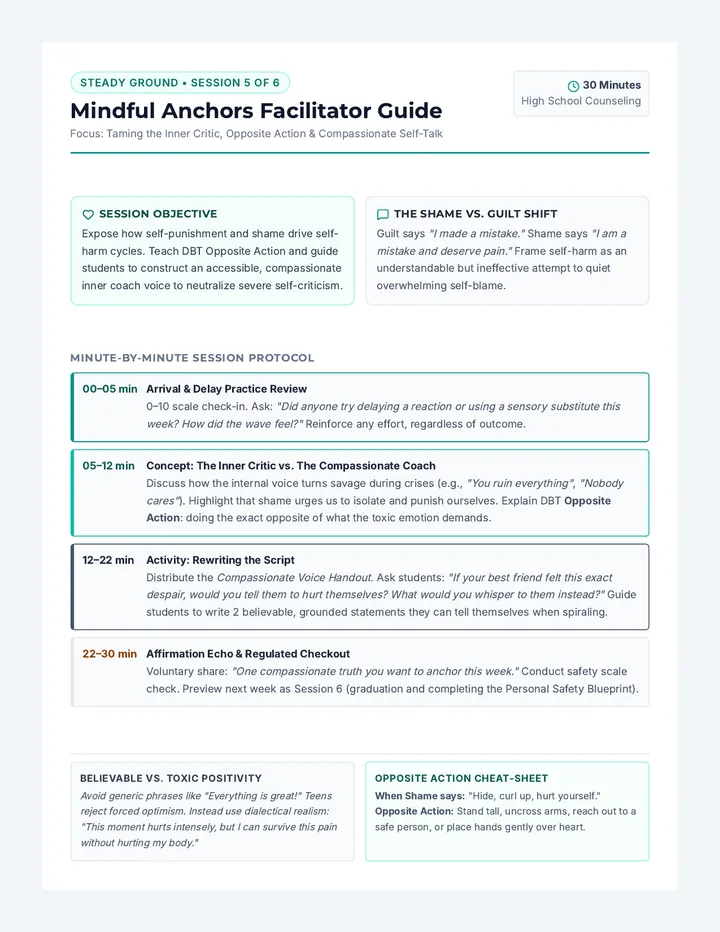
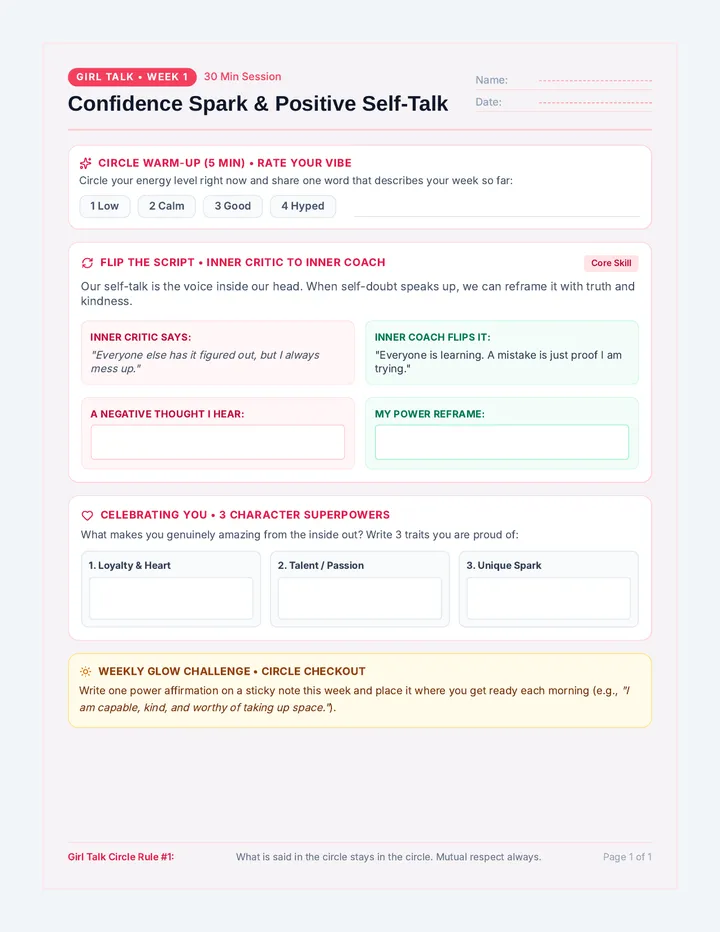
Basecamp Facilitation Guide Basecamp Facilitation Guide
Re-entry Support for Medical Absences & Anxiety
Session Objectives
Establish the classroom as a predictable "safe base."
Reduce the "Missing Work Mountain" psychological barrier.
Implement non-verbal signals for communication.
Identify sensory grounding techniques for acute anxiety.
The "Work Avoidance" Connection
For students who have missed significant instruction, work avoidance is often a protective mechanism. The thought of "catching up" triggers the flight/freeze response.
Strategy:
Explicitly pause all "missing work" deadlines during this session. Focus solely on existence in the room before performance in the room.
Target Student
9th Grade / High School
Re-entry from medical leave
Duration
30–45 Minute 1-on-1
Materials Needed
• Comfort Navigator Slides
• My Comfort Map Notebook
• Signal Cards
The Facilitation Path
1
The Gentle Entry (First 5 Mins)
Meet the student outside the room or at the door. Avoid questions about "how they are feeling" (which focuses on anxiety). Focus on "Welcome back, I'm glad you're here."
"I've set up a 'Basecamp' spot for us today. We're not doing regular classwork yet—we're just getting settled."
2
Mapping the Safe Base (10 Mins)
Use the Comfort Navigator Slides . Discuss the physical layout of the room. Identify a 'Safe Spot' (a desk near an exit, a back corner, etc.) where they feel least 'on display.'
Key Question: "Where in this room do you feel like you can 'disappear' if you need a minute?"
3
Non-Verbal Safety (10 Mins)
Introduce the Signal Cards . Anxiety often makes speaking difficult (the 'frozen' state). Give the student permission to use these cards instead of raising their hand.
Green: "I'm OK"
Yellow: "Need a minute"
Red: "Need to step out"
4
The Work Mountain Triage (10 Mins)
Open the My Comfort Map Notebook . Look at the "Missing Work" section. Pick ONE task that is low-stakes (e.g., a simple reflection or one vocabulary page).
Commitment: "Everything else stays 'paused' until we conquer this one tiny hill."
Success today is measured by the student staying in the room, not the quantity of work completed.
Basecamp Navigator Slides Classroom Basecamp
Finding your footing, one step at a time.
The #1 Goal Today
Success today isn't about finishing a pile of work.
Success is you being here and finding a way to feel comfortable in this space.
Mapping the Room
1
Where do you feel safest sitting?
2
What is the "exit plan" if things feel heavy?
3
Who are the people you trust here?
Think of this classroom like a basecamp. It’s where you rest, recharge, and prepare.
Signals vs. Words
Anxiety can make it hard to find words. That's okay. Use these cards instead of raising your hand.
I'm Good
Keep working.
Need a Minute
Feeling heavy.
Break Needed
Need to step out.
The "Work Mountain"
Looking at everything you've missed can feel like a giant mountain. It's scary.
"We aren't climbing it today. We're just looking at the map."
One Tiny Hill
Let’s pick one small thing to finish today. Something easy that feels doable.
You've got this.
Basecamp Navigator Workbook Basecamp Navigator
Finding your footing in the classroom
Name
Date
Part 1: Mapping My Basecamp
A basecamp is where you feel settled. Use the space below to sketch a quick map of the classroom and mark your "Safe Spots."
Sketch Room Map Here
Entrance
Exit
My primary "Safe Base" desk is located...
I feel best sitting here because...
Anchor Strategy
If the room feels too loud or busy, I can look at my "Anchor Point" (a specific poster, a window view, or my hands) and take 3 deep breaths.
My Anchor Point:
Part 2: The Work Mountain
Missing work can feel like a mountain blocking your view. We aren't climbing it today. We're just looking at the terrain.
The Mountain (Big Stuff)
What's weighing on you the most? List 3 big tasks here, then we'll "pause" them for now.
One Tiny Hill (Today)
What is one very small, easy thing you can do right now? (e.g., one vocab page, just the title of a paper, etc.)
Once this is done, you're finished for today!
My Signal Card Reminder
Keep your signal cards on the corner of your desk. No words needed.
Basecamp Signal Cards Basecamp Signal Cards
Cut these cards out and keep them in a stack or taped to the corner of the student's desk. They allow for non-verbal check-ins to reduce performance anxiety during class.
I'm Good
I feel comfortable and can keep working as I am.
Need a Minute
I'm feeling a bit overwhelmed. I might need a quick quiet break.
Break Needed
I need to step out or speak with a teacher privately.
Teacher Tip:
When you see a Yellow or Red card, acknowledge it with a simple nod or a "thank you for letting me know." Avoid drawing class-wide attention. For a Red card, follow the pre-arranged exit plan (e.g., hallway walk, counselor visit).
Tiny Hill Tracker Tiny Hill Tracker
Breaking the "Missing Work Mountain" into manageable steps
How to use this tracker:
Every morning or period, look at the "Mountain" of missing work with your teacher.
Pick ONE small, specific task (The Tiny Hill).
Focus only on that task. Ignore the rest of the mountain for now.
When you finish, check the box and celebrate the win!
Date The "Tiny Hill" (One Small Task) Done?
|
| | |
|
| | |
|
| | |
|
| | |
|
Quick Reset Reminder
If the mountain feels big again: Focus on your feet. Feel them on the floor. Take 3 slow breaths. Look at your anchor point. Then, come back to your Tiny Hill.
Calm Chaos Slides Calm in the Chaos
Mastering the Art of Self-Regulation
The Alarm System
Anxiety is like a smoke alarm in your body. It's trying to protect you from danger.
The problem? Sometimes the alarm goes off when there's no fire —just a little steam from a hot shower.
"Your body is trying to help, but it's overreacting."
Where do you feel it?
Fast Heart
Heart racing or pounding.
Short Breath
Tight chest or fast breathing.
Heat/Sweat
Feeling hot or sweaty palms.
"Identifying the feeling is the first step to calming it."
The 5-4-3-2-1 Technique
5
See
4
Touch
3
Hear
2
Smell
1
Taste
This forces your brain to switch from Internal Panic to External Reality.
Low-Profile Grounding
Ways to calm down without anyone noticing:
Box Breathing
In for 4, hold for 4, out for 4, hold for 4. Repeat under your breath.
Muscle Tense
Tense your toes or calves for 5 seconds, then release. Notice the relax.
Your Toolkit
Not every tool works for everyone. Today, we're going to build your custom toolkit of 3 tools that work for YOU.
Let's build it.
Grounding Toolkit Worksheet Grounding Toolkit
Building your "In-the-Moment" survival kit
Navigator Name
Date
Phase 1: Detecting the Alarm
Where does anxiety start in your body? Draw or circle the spots where you feel it most (e.g., tight chest, shaky hands, stomach knots).
The First Sign:
The Hardest Part:
When I feel this, I know my alarm is going off.
Phase 2: Choosing Your Tools
Choose 3 tools you want to try this week. Describe how you'll use them in class.
1
Tool Name (e.g., Box Breathing, 5-4-3-2-1, Tense/Release):
How I'll do this without anyone noticing:
2
Tool Name:
How I'll do this without anyone noticing:
3
Tool Name:
How I'll do this without anyone noticing:
Emergency Exit Clause
If the tools don't work and the alarm is too loud, what is the plan?
Calm Chaos Teacher Guide Calm Chaos Facilitation Guide
Physiological Regulation & Grounding Tools
Session Objectives
Identify physiological symptoms of the fight-flight-freeze response.
Normalize anxiety as a biological survival mechanism (The Alarm System).
Practice discreet grounding techniques for the classroom.
Select 3 "First-Line" tools for a personalized toolkit.
The Biological Context
High school students often feel "crazy" or "weak" for their anxiety. Reframing it as an overactive amygdala (the smoke alarm) removes the shame and makes it a technical problem to be managed, not a character flaw.
Key Concept
Interoception
Building the ability to notice internal body states before they become a full panic attack.
Duration
40 Minute 1-on-1 or Small Group
Materials Needed
• Calm Chaos Slides
• Grounding Toolkit Worksheet
• Optional: Fidget tools (discreet)
Step-by-Step Delivery
1
The Body Scan (10 Mins)
Use the Calm Chaos Slides . Guide the student through identifying where their alarm sounds first. Is it a stomach ache? Heavy chest? Cold hands?
"Your body is a high-tech machine. We're just checking the dashboard sensors."
2
The 5-4-3-2-1 Demo (10 Mins)
Perform this live with the student. Start with 5 things you can see right now. Encourage them to find small details (the texture of the wall, a speck of dust).
Focus: The goal is distraction from the internal loop.
3
Stealth Practice (10 Mins)
Practice Box Breathing and Muscle Tense/Release . Emphasize that these are "invisible" tools. The student should feel empowered that they can regulate themselves without anyone watching knowing.
4
The Toolkit Selection (10 Mins)
Complete the Grounding Toolkit Worksheet . Ensure they pick tools they actually feel comfortable using. If 5-4-3-2-1 feels "too much," suggest something simpler like "The 2-Breath Reset."
Success is identifying the alarm before it reaches peak volume.
Self Advocacy Scripts The Script Book
Communication templates for self-advocacy
Why scripts?
Anxiety often makes it hard to think of the "right words" in the moment. These scripts are pre-written tools you can use to communicate your needs clearly and professionally without the stress of starting from scratch.
Email Templates
Scenario: Returning after an absence
Subject: Quick check-in - [Your Name]
Dear [Teacher Name],
I am returning to class today after being away. I'm feeling a bit overwhelmed by the work I missed. I am working on a "Tiny Hill" plan to catch up slowly. Could we briefly chat after class about which 1-2 assignments are most important for me to focus on first?
Thank you,
[Your Name]
Scenario: Needing an extension due to anxiety
Subject: Extension request - [Your Name] - [Assignment Name]
Dear [Teacher Name],
I am working hard on the [Assignment Name], but I've been feeling quite anxious lately and it's making it hard to finish on time. Would it be possible to have an extra [number] days to complete this? I want to make sure I do my best work.
Best regards,
[Your Name]
In-Person Scripts
The "Need a Break" Script
"Excuse me, [Teacher Name], I'm feeling a bit overwhelmed right now. Can I step into the hallway for 5 minutes to use my grounding tools?"
The "Clarification" Script
"I missed the instruction for this part. Could you help me understand the first step so I can get started?"
My Custom Script
Write a script for a situation that makes YOU most anxious (e.g., asking to work alone, telling a friend you can't hang out today).
Finding Voice Slides Finding My Voice
Building the courage to ask for what you need.
The Anxiety Barrier
When we feel anxious, our brain often says:
"I'll just look stupid."
"The teacher will be mad."
"I should just figure it out alone."
Self-advocacy isn't complaining.
It's partnering with your teachers for your success.
Two Ways to Speak Up
The Email Strategy
• Great for when words feel "stuck."
• Gives you time to edit.
• Creates a paper trail.
The Face-to-Face
• Best for urgent needs.
• Good for building relationships.
• Uses pre-written scripts.
The Professional Email
Subject: Request/Question - [Your Name]
Dear [Name],
1. Context: "I'm working on..." or "I missed..."
2. Problem: "I'm feeling a bit stuck on..."
3. Ask: "Can I have an extra day?" or "Can we chat?"
Best regards, [Your Name]
Simple. Clear. Respectful.
Pulling the Cord
Sometimes, you just need to step out. Use your script:
"I'm feeling a bit overwhelmed. Can I step into the hall for 5 minutes?"
Practice Today
We're going to pick one situation that's coming up this week and write the script for it together.
Let's write it.
Finding Voice Teacher Guide Voice Facilitation Guide
Self-Advocacy & Communication Skills
Session Objectives
Differentiate between assertive and passive communication.
Practice using structured scripts for teacher interactions.
Draft "Anxiety-Friendly" emails for academic needs.
Build confidence in requesting classroom accommodations.
The "Ask" Anxiety
Many students with anxiety view asking for help as a sign of failure or "bothering" the teacher. This session reframes advocacy as professional communication —a key skill for college and careers.
Key Skill
Drafting & Reviewing
Encourage the student to save scripts in their phone notes for quick access during high-stress moments.
Duration
30–45 Minute 1-on-1
Materials
• Finding Voice Slides
• Self Advocacy Scripts
• Student Chromebook/Laptop
Instructional Flow
1
The Reframing (5 Mins)
Discuss the "Anxiety Barrier" (Slide 2). Ask the student: "What’s the scariest part about talking to a teacher?" Validate that these feelings are normal but often based on "false alarms."
2
Email Mechanics (15 Mins)
Review the **Self Advocacy Scripts**. Have the student open their email and actually draft a real check-in to one of their teachers. Focus on the tone: professional, not apologetic.
Check for: Clear subject lines, specific requests (e.g., "extra 2 days" instead of "more time"), and a professional sign-off.
3
Roleplay: The Hallway Script (15 Mins)
Practice the "Emergency Exit" script. You play the teacher, they play the student. Practice until they can say the 2-sentence request without excessive hesitating.
"It’s okay if your voice shakes. The goal is the request, not the performance."
Empowering a student to speak for themselves is the ultimate anti-anxiety tool.
Social Safety Slides Social Safety Nets
Navigating the high school social scene with confidence.
The Spotlight Effect
Ever feel like everyone is staring at you the moment you walk into the cafeteria?
That's called the Spotlight Effect. We overestimate how much people notice our appearance or mistakes.
Reality Check:
"Most people are too worried about their own spotlight to notice yours."
Safe Zones
Transitions (hallways, lunch) are the hardest. You need "In-Between" spaces.
The Library
Quiet, structured, and low-pressure.
Teacher's Room
A pre-arranged spot for a quiet lunch.
The Far Wing
A hallway with less foot traffic.
Finding Your Anchors
You don't need to be friends with everyone. You just need 1 or 2 "Safe People" in your classes or at lunch.
The Quiet Peer
The person who is happy to work silently alongside you.
The Welcoming Peer
The person who always says "hi" and makes room at the table.
The "Hi-Bye" Strategy
Keep it short. You don't have to have a deep conversation.
The Hallway Pass
"Hey! Hope you're doing good. Catch you later!"
The Work Partner
"Excited to work on this. Did you see the instructions for part two?"
Building Your Net
Today, we're going to identify 3 safe spaces and 2 safe people to help you navigate the week.
Let's map it out.
Social Safety Workbook Social Safety Map
Navigating the social maze with a plan.
Name
Date
1. The Spotlight Reality Check
List two times this week you felt like "everyone was watching." Then, try to write the Reality Check (what was actually happening?).
Moment 1
"I felt everyone watching when..."
Reality Check
Moment 2
"I felt everyone watching when..."
Reality Check
2. My Safe Zones
Safe Zones are places you can go to recharge between classes or during lunch. Pick 3 zones for your schedule.
Zone A
Example: Library
Zone B
Example: Room 204
Zone C
Example: Art Wing
3. My Peer Anchors
List 2 people you feel "okay" around. They don't have to be best friends—just people who feel safe.
1
Name:
I see them in (Period/Place):
2
Name:
I see them in (Period/Place):
"You aren't trying to be the loudest person in the room. You're just trying to be a person in the room."
Social Safety Teacher Guide Social Safety Facilitation Guide
Navigating Peer Dynamics & Transitions
Session Objectives
Deconstruct the "Spotlight Effect" (egocentric bias).
Identify Safe Zones for transitions and lunch.
Identify Peer Anchors (supportive or neutral peers).
Practice "Hi-Bye" scripts for hallway interactions.
High-Anxiety Transitions
The cafeteria and hallways are the most daunting spaces because they are unstructured. Success in this session is about adding structure to those spaces through planning and visualization.
Key Metaphor
The Safety Net
A safety net doesn't stop the fall, but it catches you before you hit the ground. Peer anchors and safe zones are that net.
Duration
30–40 Minute 1-on-1
Materials
• Social Safety Slides
• Social Safety Workbook
• School Map (Optional)
Instructional Flow
1
Spotlight Reality Check (10 Mins)
Review Slide 2. Ask the student to recall a moment they felt "exposed." Use the workbook to contrast their Perception (everyone is judging me) with Reality (everyone is looking at their phones or talking to friends).
2
Mapping Safe Zones (10 Mins)
Focus on unstructured time. If they don't have a place to sit at lunch, identify a teacher who allows students in their room or a quiet corner of the library. Success is having a destination.
3
Anchor Selection (10 Mins)
Help them identify "Peer Anchors." This isn't about popularity. Look for Predictable students. Students who are consistent and kind/neutral provide a stabilizing presence in a busy room.
4
Hallway Roleplay (5 Mins)
Practice a "Hi-Bye." Many students with anxiety avoid eye contact, which can feel alienating. Practice a simple "Hey, good to see you" while walking—emphasizing that they don't have to stop walking.
Social anxiety is managed by reducing the unknown. A plan provides that certainty.
Scenario Challenge Cards Scenario Challenge Cards
Rehearsing real-life school situations
Cut these cards out. Use them with a teacher or trusted peer to practice your scripts and grounding tools in a "safe lab" before you use them in the real world.
Advocacy
The Missing Work Chat
A teacher asks to talk to you about several missing assignments after class. You're feeling overwhelmed and "frozen."
Goal:
Use your "Tiny Hill" script to ask for a prioritized list.
Social
The Hallway Pass
You're walking down a crowded hallway and see an acquaintance coming toward you. You feel the "Spotlight Effect."
Goal:
Practice a "Hi-Bye" without stopping your walk.
Classroom
The Group Project
The teacher announces a group project. You don't know who to partner with and feel your heart start to race.
Goal:
Practice 5-4-3-2-1 grounding, then use an advocacy script to ask the teacher for a partner.
Emergency
The Sensory Overload
The classroom is very loud, there's a sub today, and you feel like you're about to have a panic attack.
Goal:
Practice using your "Emergency Exit" script to step into the hall.
Confidence Booster:
It's okay to "fail" in the lab. That's why we're here! Re-do a scenario as many times as you need until it feels slightly easier.
Confidence Lab Teacher Guide Confidence Lab Facilitation Guide
Rehearsal & Muscle Memory for School Situations
Session Objectives
Bridge the gap between knowing skills and using them.
Build muscle memory for social and academic requests.
Reduce the physiological response to common school stressors.
Practice resilience when a social interaction doesn't go perfectly.
The Safe Lab Environment
Roleplaying can itself be anxiety-inducing. Frame this session not as a "performance" but as an experiment. If the student gets stuck, pause, breathe, and try a different line.
Core Strategy
The "Pause & Rewind"
Allow the student to call "pause" at any time during a roleplay to check their script or use a grounding tool.
Duration
30–45 Minute 1-on-1
Materials
• Scenario Challenge Cards
• Self Advocacy Scripts
• Grounding Toolkit Worksheet
Instructional Flow
1
Warm-Up: The Low-Stakes Scenario (5 Mins)
Start with a very simple social scenario, like saying "hi" in the hallway. This builds initial momentum and reduces the fear of roleplaying itself.
2
The Script Selection (10 Mins)
Have the student pick one Scenario Challenge Card that feels most relevant to their upcoming week. Before roleplaying, let them find the matching script from their Script Book or grounding tool from their Toolkit .
3
The Rehearsal (20 Mins)
Act out the scenario. You play the teacher or peer. Crucial: Be supportive but realistic. Don't make the interaction "too easy," but don't overwhelm them either.
"Let's try that again, but this time, take a deep breath before you start your first line."
4
The Post-Lab Debrief (5 Mins)
Ask: "On a scale of 1-10, how anxious did that feel during the roleplay? How does it feel now?" Focus on the sense of mastery and being prepared.
Practice doesn't make perfect—it makes familiar. Familiarity kills anxiety.
Confidence Lab Slides Confidence Lab
Testing and refining your navigator skills.
The Safety of the Lab
In a science lab, you test things to see what happens. You don't have to be perfect.
This is a safe space to practice hard conversations before they happen for real.
"Mistakes in the lab are just more data for the next experiment."
Muscle Memory
Athletes and musicians practice the same move a thousand times so they don't have to "think" during the big game.
We're building Social Muscle Memory.
When your body is anxious, your brain "freezes." Practice helps you act anyway because your muscles know the routine.
Lab Rules
Pause & Rewind
You can stop the roleplay at any time to try again.
No Judgment
This is for you , not for a grade or an audience.
Small Steps
We start easy and work our way up.
Today's Experiment
Pick a Scenario Card.
1. Read the situation.
2. Find your matching script.
3. Rehearse with your lab partner (Teacher).
Ready to Experiment?
Every time you practice, you're becoming a stronger navigator.
Let's get started.
Test Day Slides Test Day Tactics
Navigating assessments with a calm mind.
The Memory Trap
Anxiety is like having 100 tabs open in your brain. It takes up all your Working Memory.
When you're anxious during a test, you can't access the info you studied because your brain is busy "worrying."
"We need to close the 'worry tabs' so you can think clearly."
The "Brain Dump"
Strategy #1: Offload immediately.
The moment the test starts, write down everything you're worried about forgetting on the back of the page or scrap paper.
• Formulas or dates
• Vocabulary words
• Your "I can do this" mantra
When You Get Stuck
It's going to happen. Here is your tactical plan:
The Pivot
Skip it. Move to an easy question to build momentum.
The Reset
Put your pencil down. Take 3 deep breaths. Re-center.
The Logic
Narrow it down to 2 choices. Make an educated guess.
Grades are Data
A test score is just data. It tells us what you know today.
"Your worth is not a percentage on a paper."
Blueprint Time
Let’s build your personalized Test Day Blueprint to follow before your next big assessment.
Let's build it.
Test Day Blueprint Worksheet Test Day Blueprint
Your tactical plan for assessment success
Navigator Name
Target Test Date
1. Pre-Test Power Up
What will you do in the 10 minutes before the test to "close the worry tabs" in your brain?
Regulation Strategy
(e.g., Box breathing, listening to one song, 5-4-3-2-1)
My Power Mantra
(e.g., "This test is just data," "I am more than a score")
2. The Brain Dump List
When you get the paper, what are the top 3 things you want to "dump" onto the page immediately so you don't have to keep them in your head?
1
2
3
3. My "If-Then" Tactics
"If I see a question I have NO idea how to answer..."
Then I will:
"If I feel my heart starting to race mid-test..."
Then I will:
The Hand-In Routine
After you hand in the test, your brain needs a "Cool Down." What is your post-test reward or reset?
Test Day Tactics Teacher Guide Test Day Facilitation Guide
Cognitive Offloading & Acute Anxiety Management
Session Objectives
Understand the impact of Working Memory on test performance.
Practice the "Brain Dump" technique for cognitive offloading.
Develop a personalized pre-test routine for physiological regulation.
Implement "Momentum Building" strategies for navigating "stuck" moments.
Cognitive Reframing
The goal of this session is to reframe tests from "threats" to "data collection points." By providing tactical tools, we give the student a sense of agency that counters the "frozen" state often triggered by high-stakes assessments.
Key Tactic
Cognitive Offloading
Moving information from the vulnerable working memory to a physical space (the paper) as soon as the test begins.
Duration
30–45 Minute 1-on-1
Materials
• Test Day Slides
• Test Day Blueprint Worksheet
• Sample test or practice sheet
Instructional Flow
1
The Memory Trap (10 Mins)
Review Slide 2. Explain that "blanking" during a test isn't a lack of knowledge, but a full working memory. Use the "100 browser tabs" analogy to help the student visualize their internal state.
2
The Brain Dump Practice (10 Mins)
Model a brain dump using a mock scenario. Show how to quickly jot down formulas or key facts the moment the clock starts. Practice this with a specific subject the student is currently taking.
Tip: Encourage the student to also include a "Grounding Phrase" (e.g., "Just data") in their dump list.
3
The Blueprint Build (15 Mins)
Complete the **Test Day Blueprint Worksheet**. Focus heavily on the "If-Then" tactics. The student needs a pre-planned escape route for when they feel a panic "spike" mid-test.
"We can't stop the anxiety from visiting, but we can have the front door locked."
A test is a temporary event. These tactical skills are for a lifetime.