A two-unit, 16-day curriculum sequence for a 12th-grade real estate certification course. Unit 1 covers buying practices (buyer agency, contracts, negotiations, closing), and Unit 2 covers listing practices (listing agency, listings, marketing, closing).
Unit 1: Buying Practices | Time: 80-Minute Block Period
LESSON 1.1
Secondary Voc-Ed
Block Period Pacing Guide (Part 2 - 40 Min)
15 MIN
Guided Practice: Ethics Lab Case Scenario A (Slide 8)
Instruction: Put students in pairs. Hand out Buyer Agency Activity Sheet. Project Slide 8 (Case Scenario A: The Best Offer Question). Have students analyze the exact transcript on the slide:
"An agent knows their buyer-client can afford up to $300k, but writes an offer for $280k. The listing agent asks, 'Is this their best offer?' Our agent replies, 'They can pay a bit more, but write this up first.'"
Have students write on their worksheet which OLD CAR duties were broken. Teacher Key: Confidentiality and Loyalty. Revealing a buyer client's ability to pay more violates both confidentiality and loyalty, placing the client at a disadvantage.
15 MIN
Independent Practice: "Client or Customer?" Classification Lab
Instruction: Students complete Part 2 of the worksheet individually. They read brief agent-consumer interaction scenarios and mark them as "Client (C)" or "Customer (CU)", listing which OLD CAR duties apply.
Circulate around the room to verify that students understand that an active representation contract is required to convert a "customer" into a "client".
10 MIN
Consolidation & Exit Ticket (Slide 9)
Instruction: Facilitate a quick 5-minute wrap-up discussion. Project Slide 9 (The Secret Budget) as the final evaluation. Have students write and submit their responses:
Exit Ticket Prompt (Slide 9):
"In your own words, outline why a buyer should sign an Exclusive Buyer Agency agreement on Day 1 rather than remaining a customer."
Teacher Professional Facilitation Tips
Vocational Alignment: Remind students that licensing exams dedicate 15-20% of questions directly to the law of agency. Grasping this distinction is vital. Common Misconception: Students often think showing houses creates agency. Reiterate that agency is only created by a written contract, not by actions or friendly conversations.
REALTOR® Certification Program Standards • Unit 1 Lesson 1
Page 2 of 2
To a Client, You MUST:
Give professional advice and strategic opinions.
Analyze property values and perform pricing CMAs.
Formulate counteroffers and protective contract contingencies.
Maintain strict confidentiality regarding motivation and budgets.
Giving strategic advice to a customer accidentally creates implied dual agency!
Slide 4 of 9
Unit 1: Day 1
Topic 1.1
Regulatory Conflict: Dual vs. Single Agency
Understanding the legal boundaries of representing both sides in a single transaction.
Dual Agency
Occurs when a single broker represents both the buyer and the seller in the same transaction.
The agent must become a completely neutral facilitator.
No advocacy or strategic negotiation advice allowed.
Requires written, informed consent from both parties.
Illegal in several states due to inherent conflicts of interest.
Designated Agency
A broker designates different individual agents inside the firm to represent each side.
The buyer's agent can fully advocate and negotiate.
The seller's agent can fully advocate and negotiate.
Fiduciary duties remain intact for each individual client.
Provides a safer, modern solution to dual agency conflicts.
State licensing exams heavily test dual agency disclosure and consent rules.
Slide 5 of 9
Unit 1: Day 1
Topic 1.1
Your Fiduciary Duties: OLD CAR
Six non-negotiable standards of care when representing a buyer-client.
O
Obedience
Obey all lawful instructions of your client immediately.
L
Loyalty
Place your buyer's financial interests above all others—including your own.
D
Disclosure
Reveal all material facts about properties or transaction variables.
C
Confidentiality
Protect client secrets forever (motivation, finance, caps). Must never disclose.
A
Accounting
Safely track all transaction checks, earnest money deposits, and paperwork.
R
Reasonable Care
Perform actions with the skill and expertise of a licensed professional.
Breach of fiduciary duties can result in loss of license & legal damages.
Slide 6 of 9
Unit 1: Day 1
Topic 1.1
Anatomy of the Representation Contract
Four essential elements of an Exclusive Buyer Agency Agreement.
Exclusivity
The buyer agrees to work exclusively with your brokerage. Any property shown or purchased during the term must go through you.
Broker Fee
Defines how you are paid (e.g., 3%). Highlights that the fee is sought from the seller first, with the buyer covering any deficit.
Start & End
Must contain a definite termination date. Automatic renewals are strictly prohibited by law in most jurisdictions.
Safety Clause
Protects commission for a period (e.g., 90 days) after expiration if the buyer purchases a house you originally introduced to them.
Never work with a buyer client without a fully executed Exclusive Agreement.
Slide 7 of 9
Unit 1: Day 1
Guided Practice
Case Scenario A
"The Best Offer Question"
"Your buyer-client signed an Exclusive Buyer Agency Agreement. They tell you they can afford a maximum budget of $300,000, but instruct you to write an offer for $280,000. When you deliver the offer, the listing agent asks you: 'Is this their best offer?' You respond: 'They can pay a bit more, but write this up first.'"
Identify the Broken Duties:
Which specific OLD CAR fiduciary duties were violated by this response?
Legal Impact:
Revealing a client's peak budget breaches Confidentiality and Loyalty, severely weakening their leverage.
Correct Answer: Refuse to disclose. Keep client terms confidential.
Slide 8 of 9
Unit 1: Day 1
Scenario Workshop
ETHICS LAB CASE STUDY
"The Secret Budget"
"Your buyer client, Sarah, can afford a maximum budget of $450,000 but wants to write an offer for $410,000. During negotiations, the seller's agent calls you and asks: 'Our seller is ready to reject this offer. Tell me honestly, is your buyer capable of paying more?'"
Class Prompt 1:
What do you say to the seller's agent? Write your actual phrasing.
Class Prompt 2:
Which of the six OLD CAR duties dictates your response here?
Correct Answer: Refuse to disclose. Confidentiality protects this budget.
Slide 9 of 9
Form 1.1 • Page 1 of 1
REALTOR® Certification Course • Unit 1 Case Analysis Workshop
Form 1.5 • Page 1 of 1
latent material defects
REALTOR® Certification Course • Unit 2 Case Analysis Workshop
Form 2.3 • Page 1 of 1
[A] Sherman Antitrust Act [B] TRID Integrated Disclosure Rule [C] Lead-Based Paint Hazard Act [D] Federal Fair Housing Act
10. Calculate the regional conveyance tax on a gross purchase price of $200,000 if the combined tax rate is $1.65 per $1,000 of sales price:
National Realtor Board Standards • Licensing Practice Exam
Page 1 of 2
SUMMATIVE COURSE ASSESSMENT
National Realtor Licensing Practice Exam
Comprehensive Units 1 & 2 • Passing Score Required: 75%
EXAM 1.0
Secondary Voc-Ed
Section B: Real-World Scenario Analyses & Case calculations (50 Points)
Provide detailed professional calculations and real estate justifications for each case. (16.6 Points Each)
Case Study 1: The Miscalculated Loan-to-Value (LTV) and PMI Necessity
"Buyer Susan is purchasing a property for $200,000 using conventional mortgage financing. Susan has exactly $12,000 saved for her down payment and argues: 'Since my down payment is more than 5%, I shouldn't have to pay for Private Mortgage Insurance (PMI) monthly. It's a waste of my money.'"
Analysis Task: Compute the exact Loan-to-Value (LTV) ratio for Susan's transaction. Is PMI contractually and legally required? Cite the exact LTV threshold at which PMI is activated and explain why PMI is designed to protect the lender, not Susan.
Case Study 2: Overcoming the Double Escrow Crisis
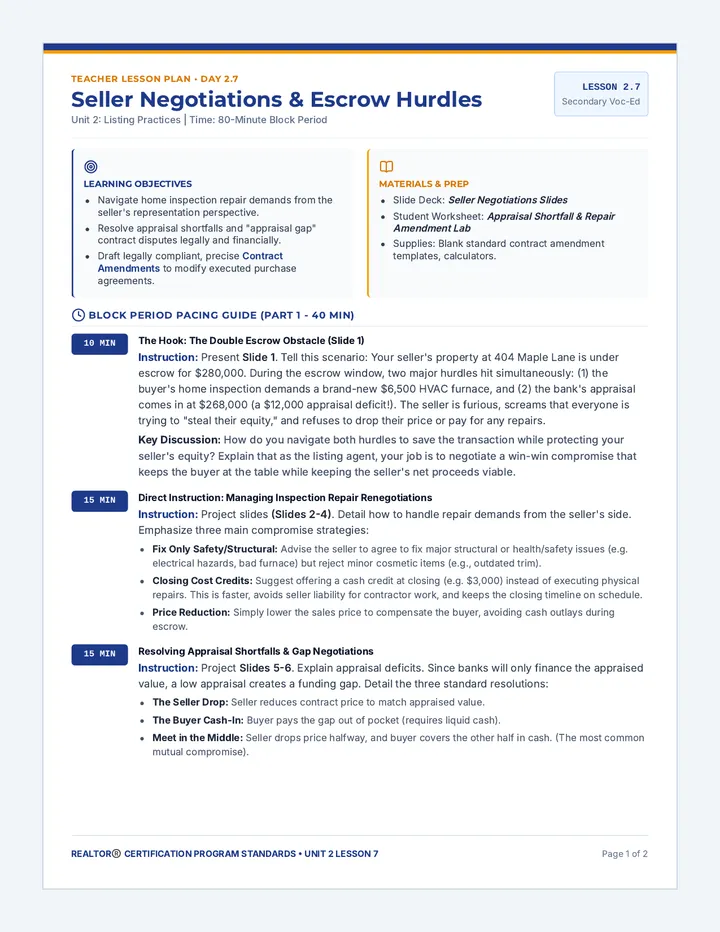
"Seller Thomas is under contract to sell 404 Maple Lane for $280,000. During escrow, two crises hit: (1) the home inspector demands a complete $6,500 furnace replacement, and (2) the bank's independent appraisal comes in at $268,000 (shortfall of $12,000). Thomas is furious and refuses to drop his price or execute any repairs."
Analysis Task: As Thomas's listing agent, propose a balanced middle-ground compromise. Draft the exact text of the contract amendment you would write to resolve both pricing and repair defects while protecting Thomas's marketable title.
Case Study 3: The Deceptive Seller's Concealment Demand
"Your seller client basement flooded 2 years ago, rotting structural drywall studs. He has painted over the rot to hide it and tells you: 'Do not write this down on our state property disclosure form, or I will fire you and find another agent.'"
Analysis Task: Explain your legal and fiduciary obligations in this case. Cite which of the OLD CAR duties are challenged. Write the exact professional, firm script you would use to counsel the seller and enforce complete written disclosure.
National Realtor Board Standards • Licensing Practice Exam
Page 2 of 2
Evaluator Notes & Qualitative Feedback:
National Realtor Board Standards • Practical Skills Assessment
Rubric Form 1.0 • Page 1 of 1
Dream Elements
Show students how real estate agents use the "Five Whys" questioning framework to find the true motivation behind client demands (e.g., they don't necessarily need 4 bedrooms; they need a quiet, dedicated home office space).
REALTOR® Certification Program Standards • Unit 1 Lesson 2
Page 1 of 2
TEACHER LESSON PLAN • DAY 2
Buyer Consultation & Needs Assessment
Unit 1: Buying Practices | Time: 80-Minute Block Period
LESSON 1.2
Secondary Voc-Ed
Block Period Pacing Guide (Part 2 - 40 Min)
15 MIN
Guided Practice: Modeling the Consultation (Slide 7)
Instruction: Choose a volunteer or act out a brief 5-minute consultation with a mock client. Model the transition from casual chat to structured professional data gathering. Emphasize:
Asking open-ended financial questions: "Have you met with a lender, or do you have a pre-approval letter ready?"
Realigning budget: "In your preferred neighborhood, homes list for an average of $350k. If our cap is $300k, would you prefer to look in adjacent areas or consider a smaller layout?"
Instruction: Pair students up. Distribute the Buyer Consultation Intake Worksheet.
One student acts as the Licensed REALTOR®, and the other acts as the First-Time Buyer (Persona: Marcus & Sarah, Budget $320k). The agent must interview the client and fill out the intake sheet completely, including needs analysis and calculating financing boundaries. Swap roles if time permits, or focus on a deep, single role-play.
10 MIN
Consolidation & Exit Ticket (Slide 8)
Instruction: Facilitate a quick debrief. Ask: "What was the most challenging part of getting the buyer to admit their financial limitations?"
Exit Ticket Prompt (Slide 8):
"Explain the primary legal and practical difference between Pre-Qualification and Pre-Approval. Why should an agent require a Pre-Approval letter before showing a client single-family homes?"
Teacher Professional Facilitation Tips
Vocational Standards: Clarify that showing homes to unapproved buyers wastes valuable listing agent/seller prep and poses safety risks. In commercial brokerage, pre-approval is 100% required. Common Student Pitfall: Students often skip asking about the pre-approval letter because they feel talking about money is "awkward". Guide them on professional language: "To protect your interests and make sure our offers are strong in this competitive market, we need a current pre-approval letter from your lender."
REALTOR® Certification Program Standards • Unit 1 Lesson 2
Page 2 of 2
CRITICAL: Never write offers without a formal Pre-Approval! Slide 4 of 9
Intake Mechanics
Understanding Buyer Criteria
1. Must-Haves
Non-negotiable dealbreakers
Primary school district
Minimum bedrooms/baths
Commute limit (e.g., < 30 min)
Wheelchair accessibility
2. Nice-to-Haves
Strong upgrades wanted
Granite kitchen counters
Hardwood floors
Fenced-in backyard
Two-car garage
3. Dream Items
Can add or remodel later
Custom inground pool
Detached guest house
Built-in home theater
Smart home automation
Rule of Thumb: A house matches if it has 100% of Must-Haves and > 50% of Nice-to-Haves. Slide 5 of 9
Questioning Artistry
The "Five Whys" Consultation Strategy
Clients often ask for features they don't actually need because they haven't clarified their true underlying motivation.
By asking open-ended questions and drilling down "Five Whys" deep, you uncover alternative (and cheaper!) housing solutions that save their budget.
Analysis in Action
Client Statement: "We absolutely must have a 4-bedroom house."
Why? "Because we have two kids and need a home office."
The Discovery: A 3-bedroom house with a finished basement or a built-in office nook would work perfectly, instantly widening inventory and cutting costs.
Listen 80% of the time, talk 20% of the time during a consultation. Slide 6 of 9
Conflict Management
Aligning Budget with Market
When the client's pre-approved budget is lower than their preferred target neighborhood cost, apply these strategic pivots:
Pivot 1: Location
Search adjacent zip codes or suburbs with lower price-per-square-foot ratios but comparable styles.
Pivot 2: Property Type
Consider solid townhomes or modern condominiums instead of detached single-family options to save cost.
Pivot 3: Renovation
Purchase a "fixer-upper" home requiring cosmetic repairs, allowing the client to build sweat equity.
Educate, don't validate, unrealistic financial criteria. Slide 7 of 9
Class Workshop
First-Time Buyer Consultation Lab
Get into your assigned pairs to begin:
Student A: The professional licensed REALTOR®
Student B: Marcus & Sarah (First-Time Buyers)
Goal: Complete the Buyer Consultation Intake Worksheet with absolute accuracy.
Intake Evaluation Steps
Ask clarifying questions to uncover their OLD CAR expectations.
Examine Marcus & Sarah's financial profiles.
Map out their non-negotiable Must-Haves vs. Nice-to-Haves.
Be ready to report your recommended housing pivots back to the class! Slide 8 of 9
Evaluation
Exit Ticket
On a clean sheet of paper, answer the following prompt individually and submit it before leaving:
"Explain the primary legal and practical difference between Pre-Qualification and Pre-Approval. Why should an agent require a Pre-Approval letter before showing a client single-family homes?"
REALTOR® Certification Program Standards • Unit 1 Lesson 2 Slide 9 of 9
Local Market Realities (Current MLS Data):
Target Area
Property Type
Average MLS Sales Price
Key Features & Conditions
Oak Hills
Single-Family Detached (4-Bed)
$420,000 - $480,000
Move-in ready, updated kitchens, pools.
Oak Hills
Modern Townhouse (3-Bed)
$290,000 - $330,000
No private pool (has HOA pool), zero yard work.
Maplewood (Adj)
Single-Family Detached (4-Bed)
$310,000 - $340,000
Needs significant cosmetic repairs (Fixer-Upper).
Cedar Ridge (Sub)
Single-Family Detached (4-Bed)
$295,000 - $325,000
Move-in ready, large private yard, 15-min commute.
Section V: Case Assessment & Advising
1. Financial Realities: Check Marcus & Sarah's financial status. Are they pre-qualified or pre-approved, and what is their maximum purchase price limit? What role-play notes can you state about Oak Valley Lending?
2. The Mismatch: Outline their housing "expectations mismatch." Map out their ideal "Must-Haves" vs "Nice-to-Haves" from Page 1 and identify how their $320,000 pre-approved budget conflicts with their Oak Hills single-family home goal.
3. Propose Pivots: Present two viable "Strategic Pivots" from the MLS data to Marcus & Sarah. Briefly explain the trade-offs of each (e.g., location vs condition vs property type) that align with their $320k financial limit.
4. Professional Scripting: Draft a brief dialogue script (3-4 sentences) showing exactly how you would present these pivots to them in the consultation. Use professional language that respects their dream but firmly guides them to financial compliance.
REALTOR® Certification Course Standards • Day 2 Workshop
Form 1.2 • Page 2 of 2
Discuss what happens when an agent shows a house first, but another agent writes the offer. Highlight that showing a house first does NOT automatically guarantee procuring cause!
REALTOR® Certification Program Standards • Unit 1 Lesson 3
Page 1 of 2
TEACHER LESSON PLAN • DAY 3
Exclusive Buyer Representation & Commissions
Unit 1: Buying Practices | Time: 80-Minute Block Period
Instruction: Project Slide 7 (Commission Confrontation). Read the dispute aloud: Agent A shows a house to Buyer. Buyer goes home, thinks about it, then visits an open house. There, Agent B offers to write the contract with a $1,000 rebate. The contract closes. Who gets the commission?
Teacher Guidance: Facilitate debate. Highlight that Agent A initiated the chain of events but did they write the contract? If Buyer had signed an Exclusive Buyer Agreement with Agent A first, Agent A has clear recourse. Without it, Agent B might win the procuring cause dispute through arbitration.
15 MIN
Independent Practice: Contract Clause Sifting Lab
Instruction: Distribute the Exclusive Buyer Brokerage Agreement Study sheet.
Students will examine a standardized exclusive contract excerpt. They must find, highlight, and critique the specific sections outlining: commission percentages, safety period definitions, non-exclusivity clauses, and dispute resolution details.
10 MIN
Consolidation & Exit Ticket (Slide 8)
Instruction: Conclude with a discussion on how commission transparency protects both parties. Have students write and submit their responses to the exit ticket on Slide 8:
Exit Ticket Prompt (Slide 8):
"In your own words, define Procuring Cause. Explain why having a signed Exclusive Buyer Brokerage Agreement prevents listing agents from bypassing a buyer's representative."
Teacher Professional Facilitation Tips
National Licensing Focus: Commission calculation and agency contract terms are heavily tested. Emphasize that brokerage fees are always negotiable by law—there is no fixed "standard" fee set by licensing boards or boards of REALTORS® (antitrust law / Sherman Act). Common Student Misconception: Students often think commission is paid directly to the salesperson. Clarify that all commissions must be paid directly to the supervising broker, who then distributes the agreed split to the salesperson.
REALTOR® Certification Program Standards • Unit 1 Lesson 3
Page 2 of 2
The Buyer Duty:
buyer client
TRANSPARENCY: Clarify payment structures during Day-1 consultation! Slide 4 of 9
Legal Terminology
What is Procuring Cause?
THE LEGAL TEST:
"An uninterrupted series of causal events that leads directly to the successful completion of a real estate transaction."
If an agent shows a home but the buyer writes the offer with another broker, who gets the commission? A legal dispute is initiated!
Common Misconceptions
False: "The first agent who shows a house automatically gets paid." (Showing alone is not procuring cause).
False: "The agent who writes the offer automatically gets paid." (If they hijacked the transaction, they may lose).
True: Having a signed Exclusive Buyer Brokerage Agreement protects you from losing commission.
The uninterrupted chain of causation is the golden standard. Slide 5 of 9
Guided Debate
Commission Confrontation
Agent A shows a property to Buyer. Buyer goes home to think about it.
The next day, Buyer visits an open house. Agent B offers a $1,000 rebate if the buyer writes the offer with them. Buyer signs with Agent B and closes.
Debate & Analyze
Who initiated the uninterrupted series of causal events?
Did Agent B engage in unethical solicitation or "client poaching"?
If Buyer had a signed Exclusive Agreement with Agent A, does Agent A get paid? (Yes!)
Ethics and contracts are the core shields for professional REALTORS®. Slide 6 of 9
Federal Regulations
Commissions & Sherman Antitrust Act
Antitrust laws exist to protect free-market competition. Real estate licensing exams strictly test these four prohibitions:
1. Price Fixing
Brokers cannot agree on "standard" rates. Fees are always 100% negotiable by law.
2. Group Boycotting
Conspiring with competitors to avoid doing business with discount or fee-alternative brokers.
3. Market Allocation
Agreeing to divide geographic sales areas, territories, or clients with competing firms.
Antitrust violations carry massive federal civil and criminal penalties! Slide 7 of 9
Independent Lab
Contract Clause Sifting Lab
Examine your contract worksheet study:
Locate the Retainer Fee and Broker Compensation parameters.
Find the exact duration of the Protection Period.
Critique how cooperative MLS splits are processed when there is a commission deficit.
Contract Highlights
Use yellow highlighter for compensation clauses.
Use blue highlighter for protection periods.
Answer the critical case-study questions on the back.
Reviewing fine print protects your commission rights and your brokerage. Slide 8 of 9
Evaluation
Exit Ticket
On a clean sheet of paper, answer the following prompt individually and submit it before leaving:
"In your own words, define Procuring Cause. Explain why having a signed Exclusive Buyer Brokerage Agreement prevents listing agents from bypassing a buyer's representative."
REALTOR® Certification Program Standards • Unit 1 Lesson 3 Slide 9 of 9
REALTOR® Certification Course Standards • Day 3 Lab Work
Form 1.3 • Page 1 of 2
UNIT 1: BUYING PRACTICES • CONTRACT DECONSTRUCTION
Contract Analysis & Commission Math Lab
FORM 1.3
NRA Secondary Accreditation
Part 1: Contract Parameter Identification
Based on the Page 1 contract excerpt, identify and record the exact parameters:
Exclusivity Term (Months): _________________
Retainer Fee Amount: ______________________
Brokerage Fee Percentage: _____________
Protection Period Duration: _________________
Part 2: Brokerage Fee Deficit Math
Apply the brokerage compensation clause from Section 2 to the following financial closing scenario. Show your work clearly.
Math Scenario: Client purchases a single-family home for $350,000. The listing broker is offering a cooperative buyer agent split of 2.5% in the MLS.
A) What is the total compensation owed to the broker (3.0% of purchase)?
B) What is the co-op commission paid by the listing broker (2.5% of purchase)?
C) Compensation Deficit: Does the buyer owe a deficit balance to the broker at closing? If so, calculate the exact dollar amount they must pay to satisfy Section 2.
Part 3: Procuring Cause Legal Dispute Analysis
Read this commission dispute case and write your analytical judgment below.
"Agent A tours five homes with Client. Client really likes 123 Oak Street but is hesitant. Two days later, Client visits an open house at 123 Oak Street. There, Agent B offers to write the purchase contract and give the Client a $1,500 rebate. Client signs with Agent B and closes. Agent A had a signed Exclusive Agreement on Day 1; Agent B did not check for active agreements."
A) Legal Evaluation: Apply Section 3 (Protection Period) and Procuring Cause. Who has the valid legal claim to the cooperative buyer agent commission, and why?
B) Professional Advice: What immediate legal and ethical action should Agent A's supervising broker take to recover the commission from Agent B's firm or the client?
REALTOR® Certification Course Standards • Day 3 Lab Work
Form 1.3 • Page 2 of 2
REALTOR® Certification Program Standards • Unit 1 Lesson 4
Page 1 of 2
TEACHER LESSON PLAN • DAY 4
Offers, Counteroffers & Negotiations
Unit 1: Buying Practices | Time: 80-Minute Block Period
LESSON 1.4
Secondary Voc-Ed
Block Period Pacing Guide (Part 2 - 40 Min)
15 MIN
Guided Practice: Modeling the Lowball Presentation (Slide 7)
Instruction: Model how a listing agent presents a "lowball" offer to a proud, offended seller. Roleplay the professional dialogue to keep the seller calm:
"Mr. and Mrs. Seller, the buyers wrote a lower starting offer, but remember, an offer is just an invitation to negotiate. Let's not get offended; instead, let's write an aggressive, data-backed counteroffer that keeps them at the table while protecting your equity."
Instruction: Pair students up. Distribute the Lowball Negotiation Scenario Lab worksheet.
One student acts as the Buyer's Representative (supporting a budget-focused buyer bidding $290k). The other student acts as the Seller's Representative (supporting a proud seller asking $350k). They must negotiate a written "meeting of the minds" compromise, calculating intermediate price points and contingency compromises.
10 MIN
Consolidation & Exit Ticket (Slide 8)
Instruction: Bring the class together. Ask: "How many pairs successfully reached a compromise? What was the hardest term to negotiate?" Project Slide 8 and collect the exit tickets.
Exit Ticket Prompt (Slide 8):
"Explain the legal status of an original offer once a counteroffer has been issued. What is legally required to achieve a binding 'meeting of the minds' in real estate contract law?"
Teacher Professional Facilitation Tips
Vocational Alignment: Remind students that negotiations can collapse over emotional issues (like a light fixture or minor cosmetic repair) rather than the purchase price. Teach them to focus on the big-picture numbers. Common Student Pitfall: Students often believe that once a seller issues a counteroffer, the buyer can accept either the original price or the counter. Emphasize that the original offer is permanently void once countered.
REALTOR® Certification Program Standards • Unit 1 Lesson 4
Page 2 of 2
The Pivot of Responsibility
Role Reversal: The counter-offering seller becomes the "Offeror".
The Power: The buyer becomes the "Offeree", holding sole power of acceptance or rejection.
Clean Slate: Each counteroffer clears the board of previous negotiation terms.
Every licensing exam tests this specific counteroffer outcome! Slide 5 of 9
Financial Calculations
Evaluating Offers: The Net Sheet
Sellers do not care about the purchase price alone; they care about their Bottom-Line Net proceeds.
A lower-priced offer with zero seller concessions or repair requests might actually net the seller more cash than a higher-priced offer with heavy demands!
Net Sheet Equation
Sales Price
- Mortgage Payoff Balance
- Brokerage Commissions
- Escrow Closing Costs & Taxes
= Seller's Bottom-Line Cash Net
Always run a Seller Net Sheet when presenting incoming offers. Slide 6 of 9
Strategic Practice
The Art of Negotiation
Professional agents apply these three rules to keep negotiations on track:
1. De-personalize
Keep emotion out of it. Remind the client that a low offer is simply a business proposal, not a personal insult.
2. Focus on Data
Support your counters with clear, recent comparative market analysis (comps) from the MLS database.
3. Build Bridges
Find win-win compromises. Trade price for terms (e.g., matching the seller's preferred settlement date).
"An offer on paper is always better than no offer at all." Slide 7 of 9
Classroom Activity
Oak Street Negotiation Lab
Find your negotiation partner:
Buyer Agent: Represents a client bidding $290,000 on Oak Street.
Listing Agent: Represents a proud seller listed at $350,000.
Your Objective: Negotiate a written compromise (Meeting of the Minds) including price and contingencies.
Required Deliverables
Determine final agreed price and terms.
Calculate the buyer's required earnest money deposit.
Write out the agreed compromise contingencies.
Remember: Keep your dialogue professional and focus on win-win terms! Slide 8 of 9
Evaluation
Exit Ticket
On a clean sheet of paper, answer the following prompt individually and submit it before leaving:
"Explain the legal status of an original offer once a counteroffer has been issued. What is legally required to achieve a binding 'meeting of the minds' in real estate contract law?"
REALTOR® Certification Program Standards • Unit 1 Lesson 4 Slide 9 of 9
Offer Data:
$340,000
$215,000
5.0%
$4,500
$3,000
A) Calculate the dollar amount of the total broker commission (5.0% of price):
B) Calculate the total seller deductions (Mortgage + Commission + Escrow + Concessions):
C) Bottom-Line Net Proceeds: Calculate the final cash amount the seller will receive at close. Did this offer satisfy the seller's minimum goal of $110,000 net proceeds?
1. The Chandelier & Concessions Pivot: How did you and your partner compromise on the sentimental dining room chandelier and the closing concessions? Explain the exact trade-off that satisfied both parties.
2. Counteroffer Void Rules: A seller receives your buyer's offer of $290,000. The seller counters at $330,000. Your buyer rejects this counter. Can the seller then say, "Fine, we will accept your original offer of $290,000"? Explain the legal status of the original offer.
3. Meeting of the Minds: In contract law, at what exact moment does an offer convert from an active proposal into a legally binding bilateral contract? What step must happen after signing?
REALTOR® Certification Course Standards • Day 4 Workshop
Form 1.4 • Page 2 of 2
Liquidated Damages: A contractually agreed-upon remedy in advance. If the buyer defaults, the seller accepts the earnest money deposit as the sole and complete financial compensation.
Specific Performance: A rare legal lawsuit where a court orders the breaching buyer or seller to complete the transaction exactly as promised under the contract.
REALTOR® Certification Program Standards • Unit 1 Lesson 5
Page 1 of 2
TEACHER LESSON PLAN • DAY 5
Drafting Sales Contracts & Purchase Offers
Unit 1: Buying Practices | Time: 80-Minute Block Period
Instruction: Project Slide 7 (Contract Blueprint). Demonstrate how to enter names legally, map a tax parcel lot and block number, and write down the financial math. Show how to clearly separate fixtures (included) from personal chattels (excluded) using the proper sections of the agreement.
15 MIN
Independent Practice: The Elm Street Purchase Agreement Lab
Instruction: Distribute the Purchase & Sale Drafting Worksheet.
Students will read the Chen scenario details provided on Page 2 and use them to fill out the standard contract template on Page 1. They must use blue or black ink and ensure 100% legal accuracy—no blank spaces left in key financial sections, and correct checkboxes checked.
10 MIN
Consolidation & Exit Ticket (Slide 8)
Instruction: Have students trade contracts for a quick "broker compliance audit" with their partners. Project Slide 8 and collect exit tickets.
Exit Ticket Prompt (Slide 8):
"What is the primary difference between a fixture and a chattel in a sales contract? Explain why the distinction matters legally to prevent home-buying disputes at the final walkthrough."
Teacher Professional Facilitation Tips
Vocational Standard: Emphasize that licensed salespersons are not attorneys. They are only authorized to fill in blanks on standardized forms pre-approved by legal counsel and state real estate boards. Writing custom legal clauses violates licensing law (unauthorized practice of law). Common Student Pitfall: Leaving lines blank. In a contract, any blank space can be filled in fraudulently later by another party. Instruct students to write "N/A" (Not Applicable) or "None" in any blank space that does not contain specific terms.
REALTOR® Certification Program Standards • Unit 1 Lesson 5
Page 2 of 2
Lot & Block:
County Records: Refers directly to recorded subdivision plat maps in the county tax assessor database.
Legal Standard: Indestructible, precise, and required to establish a valid transfer of real property.
RULE: Always pull the county tax card to write legal descriptions! Slide 4 of 9
Property Definitions
Fixtures vs. Chattels
THE LEGAL TEST (MARIA):
Method of attachment, Adaptation, Relationship of parties, Intention, and Agreement.
If an item is physically attached to the walls or ceiling (e.g., a chandelier or ceiling fan), it is legally a fixture and conveys to the buyer.
Contract Mapping Rules
Fixtures (Real Property): Convey automatically with the land. Central AC, ceiling lights, built-in shelves stay with the home.
Chattels (Personal Property): Moveable items. Freestanding refrigerators, washing machines, patio furniture do NOT stay unless explicitly listed.
The Clause: Write explicitly: "Inclusions: Refrigerator" to avoid final walkthrough disputes.
When in doubt, write it out explicitly in Section 4! Slide 5 of 9
Contract Escape Hatches
Essential Contingencies
Contingencies protect the buyer's escrow deposit by making the deal conditional on three key benchmarks:
1. Home Inspection
Gives the buyer X days (typically 7-10) to conduct structural audits and negotiate repairs or withdraw with full EMD refund.
2. Mortgage Finance
Conditions the deal on securing a lender loan commitment within X days (typically 30). Void if the buyer is rejected.
3. Appraisal Gap
The property must appraise at or above purchase price. If it appraises low, the buyer can renegotiate or cancel.
Missing a contingency deadline constitutes automatic waiver and contract breach! Slide 6 of 9
Breach of Contract
Liquidated Damages Explained
If a buyer breaches the contract without a legal contingency escape, the seller has a right to compensation.
Instead of filing a long and expensive court lawsuit, real estate contracts use the Earnest Money Deposit (EMD) as the pre-agreed financial remedy.
The Legal Remedy Path
Liquidated Damages: Pre-determined cap. The seller accepts and keeps the EMD cash as the sole financial settlement.
Specific Performance: Rare legal lawsuit where a court orders the buyer to buy, or the seller to sell, the property.
Standard Practice: Sellers demand 1-3% EMD to ensure the buyer has skin in the game.
EMD acts as liquidated damages, providing quick security for sellers. Slide 7 of 9
Independent Lab
Elm Street Purchase Contract Lab
Complete Page 1 of your contract worksheet:
Read the Chen Purchase Scenario details on Page 2.
Fill in every blank line on the standard Residential Purchase Agreement.
Ensure all dates, prices, names, and contingency periods are written with 100% legal accuracy.
Audit Rules
Use blue or black ink only. No pencils!
Write "N/A" on any blank sections that do not apply.
Identify the correct legal tax parcel description.
accuracy is the ultimate hallmark of a certified real estate professional. Slide 8 of 9
Evaluation
Exit Ticket
On a clean sheet of paper, answer the following prompt individually and submit it before leaving:
"What is the primary difference between a fixture and a chattel in a sales contract? Explain why the distinction matters legally to prevent home-buying disputes at the final walkthrough."
REALTOR® Certification Program Standards • Unit 1 Lesson 5 Slide 9 of 9
The following items are explicitly excluded and reserved by Seller: _____________________________________
REALTOR® Certification Course Standards • Day 5 Lab Work
Form 1.5-A • Page 1 of 2
UNIT 1: BUYING PRACTICES • SCENARIO LAB
Purchase Contract Scenario & Compliance
FORM 1.5-B
NRA Secondary Accreditation
Section I: The Chen Purchase Scenario Details
The Clients: Your buyer clients, Marcus & Elena Chen, want to submit a formal purchase contract on 1428 Elm Street, Oakville. The property is owned by seller Sarah Miller.
Property tax card details: Lot 12, Block D, Section 4, Oak Hills Subdivision, Oakville County.
Financial variables: Offer price is $340,000. They will provide a $7,000 earnest money deposit to be held in escrow by Apex Trust LLC. They have been pre-approved for a conventional mortgage loan of $306,000, meaning they will pay a cash down payment balance of $27,000 at close. They request $3,000 in seller concessions.
P&S Contingencies & Inclusions: They demand a 10-day inspection period, 30-day mortgage window. They want the freestanding kitchen refrigerator and washer included in the purchase. However, Sarah Miller has excluded the custom dining room crystal chandelier (sentimental family heirloom) and will remove it prior to closing.
Section II: Contract Audit & Computations
1. Financial Balance Check: Verify that the financial terms sum up correctly on Page 1. Show your mathematical verification: (Earnest Money + Mortgage Loan Amount + Cash Down Payment Balance) must equal the total Purchase Price. Verify here:
2. Inclusions/Exclusions Legal Mapping: Based on the scenario, how did you write Section 4 on Page 1 to ensure that the refrigerator and washer stay with the buyers, but the seller avoids a legal lawsuit by taking the sentimental crystal chandelier?
3. Liquidated Damages Case Study: Suppose the Chens sign this agreement, and Sarah Miller accepts it. Three weeks later, the Chens change their minds because they found a cheaper house. They refuse to close. What is the seller's legal recourse? Under the contract, how much money does the seller keep, and what is the legal term for this cap?
4. Specific Performance alternate Remedy: If Sarah Miller refuses to keep the earnest money and instead wants to sue the Chens in court to force them to purchase the property exactly as agreed, what is the legal term for this court-ordered remedy? Is it common in residential transactions?
REALTOR® Certification Course Standards • Day 5 Lab Work
Form 1.5-B • Page 2 of 2
Deconstruct Private Mortgage Insurance (PMI), explaining that it is a monthly premium charged by lenders to protect the LENDER (not the buyer!) from default loss whenever LTV exceeds 80%.
REALTOR® Certification Program Standards • Unit 1 Lesson 6
Page 1 of 2
TEACHER LESSON PLAN • DAY 6
Mortgage Financing Pathways
Unit 1: Buying Practices | Time: 80-Minute Block Period
LESSON 1.6
Secondary Voc-Ed
Block Period Pacing Guide (Part 2 - 40 Min)
15 MIN
Guided Practice: Modeling LTV & PMI Math (Slide 7)
Instruction: Write a scenario on the whiteboard: Purchase price $250,000, down payment $25,000 (10%). Model the calculations line by line:
1. Loan Amount = $250,000 - $25,000 = $225,000
2. LTV Ratio = ($225,000 / $250,000) * 100 = 90%
3. Audit Step: Does 90% exceed 80%? Yes, therefore monthly Private Mortgage Insurance (PMI) is required.
15 MIN
Independent Practice: Mortgage & Down Payment Math Lab
Instruction: Distribute the Mortgage & Down Payment Math Lab worksheet.
Students complete Part 1 (matching financial profiles to Conventional, FHA, or VA pathways) and Part 2 (computing down payments, loan amounts, LTV ratios, and PMI requirements for three diverse buyer scenarios). Circulate to support students with the fraction and percentage calculations.
10 MIN
Consolidation & Exit Ticket (Slide 8)
Instruction: Bring the class together. Go over the answers to the math cases. Project Slide 8 and collect exit tickets.
Exit Ticket Prompt (Slide 8):
"State the primary down payment requirement for FHA loans versus VA loans. Explain why lenders require Private Mortgage Insurance (PMI) when a buyer's Loan-to-Value (LTV) ratio exceeds 80%."
Teacher Professional Facilitation Tips
National Licensing Standards: Real estate exams heavily test the LTV calculation and PMI activation limits. Ensure students master the core formula. FHA Specific Rule: Clarify that FHA's Mortgage Insurance Premium (MIP) is paid *for the life of the loan* if the buyer puts down less than 10%, whereas Conventional PMI drops off automatically once LTV hits 78%. This is a vital comparison detail!
REALTOR® Certification Program Standards • Unit 1 Lesson 6
Page 2 of 2
Mortgage Insurance (MIP):
MIP on FHA loans never drops off automatically, regardless of LTV level! Slide 4 of 9
Military Benefits
VA Veteran-Guaranteed Pathway
The Department of Veterans Affairs (VA) guarantees home loans for active-duty military, honorable veterans, and eligible surviving spouses.
This is the single most powerful home-buying pathway in the nation, offering exceptional financial terms as a thank-you for military service.
Core Parameters
Down Payment Minimum:0% down (100% Loan-to-Value!).
Funding Fee: Requires a one-time upfront VA Funding Fee (e.g., 2.15%) which can be rolled directly into the loan.
VA appraisal standards are strictly regulated to protect veterans' safety. Slide 5 of 9
Lender Risk Math
Understanding Loan-to-Value (LTV)
LTV is the primary mathematical metric lenders use to measure risk. It compares the requested loan amount to the home's purchase price:
THE LTV FORMULA
LTV = ( Loan Amount / Purchase Price ) × 100
Example: $270,000 loan on a $300,000 purchase price results in an LTV ratio of 90%.
The higher the LTV, the higher the default risk for the lending bank! Slide 6 of 9
Financial Fees
What is Private Mortgage Insurance (PMI)?
Whenever a buyer's LTV ratio exceeds 80% (meaning their down payment is less than 20%), Conventional lenders require PMI.
PMI is an extra monthly fee added to their mortgage payment. It protects the lender from losing money if the buyer forecloses.
How PMI Drops Off
Amortization Path: Buyer pays down principal mortgage balance over time.
The 80% Threshold: Buyer can request PMI removal once LTV hits 80%.
Automatic drop: Federal law orders lenders to drop Conventional PMI automatically when LTV reaches 78%.
PMI is a major factor in calculating monthly affordability! Slide 7 of 9
Independent Lab
Mortgage & Down Payment Lab
Open your math worksheet lab:
Match the four buyer profiles to the correct loan pathways on Part 1.
Execute LTV, down payment, loan principal, and PMI calculations on Part 2.
Work individually or with your assigned desk partner.
Required Materials
Basic handheld calculator.
Pencil and eraser for calculation scrap lines.
Mortgage comparison reference sheet.
Show every single step of your ratio math to ensure full grading credit! Slide 8 of 9
Evaluation
Exit Ticket
On a clean sheet of paper, answer the following prompt individually and submit it before leaving:
"State the primary down payment requirement for FHA loans versus VA loans. Explain why lenders require Private Mortgage Insurance (PMI) when a buyer's Loan-to-Value (LTV) ratio exceeds 80%."
REALTOR® Certification Program Standards • Unit 1 Lesson 6 Slide 9 of 9
650
$300,000
$15,000
Recommended Pathway: ____________________________ Minimum Down Payment %: ______ %
REALTOR® Certification Course Standards • Day 6 Lab Work
Form 1.6-A • Page 1 of 2
UNIT 1: BUYING PRACTICES • MORTGAGE ANALYSIS
Financing & LTV Math Computations
FORM 1.6-B
NRA Secondary Accreditation
Section III: Down Payment & LTV Calculation Labs
Math Case 1: Conventional Loan Structuring
A buyer executes a Conventional purchase agreement on a home for $300,000 and provides a down payment of $30,000 (10%).
A) Loan Amount ($):
B) Loan-to-Value (LTV) %:
C) Is Monthly PMI Required?
Math Case 2: FHA Government Down Payment & Upfront MIP
A buyer executes an FHA purchase contract on a townhome for $240,000. They put down the absolute minimum requirement of 3.5% down.
A) Down Payment ($):
B) Initial Loan Amount ($):
C) Upfront MIP Fee (1.75% of loan):
Section IV: Fiduciary Advising & Analysis
1. Mortgage Insurance Comparison: Compare Conventional PMI to FHA's Mortgage Insurance Premium (MIP). Why is a Conventional loan with 5% down often superior long-term to an FHA loan with 5% down for a buyer with stellar credit?
2. Government Insurance Justification: Explain why the federal government insures FHA loans and guarantees VA loans. How does this government backing protect local lending institutions and stimulate the housing market?
3. VA Fiduciary Advice: Your client is a decorated veteran who has $20,000 in savings and is pre-approved for both a VA loan (0% down) and a Conventional loan. Formulate your professional advice regarding which loan they should select to protect their assets.
REALTOR® Certification Course Standards • Day 6 Lab Work
Form 1.6-B • Page 2 of 2
A. Accept As-Is
Accept the defects without any concessions.
B. Demand Repair
Require the seller to fix specified items.
C. Cash Credit
Reduce sales price or ask for closing credit.
D. Terminate
Cancel contract and receive full EMD back.
REALTOR® Certification Program Standards • Unit 1 Lesson 7
Page 1 of 2
TEACHER LESSON PLAN • DAY 7
Contract Contingencies & Addendums
Unit 1: Buying Practices | Time: 80-Minute Block Period
Instruction: Project Slide 7 (Addendum Crafting Blueprint). Model how to translate a technical inspection defect report into a precise, legally binding contract clause. Contrast a poor clause with a professional clause:
Poor: "Seller shall fix the active roof leaks and look at the HVAC furnace." (Vague, who does it? When? No standard of care defined).
Professional: "Seller shall, at Seller's sole expense, have a licensed roofing contractor repair the leaking flashing on the south chimney. Seller shall deliver paid receipts to Buyer at least 5 days prior to closing."
15 MIN
Independent Practice: Addendum Writing Practice Lab
Instruction: Distribute the Home Inspection Addendum Practice Lab worksheet.
Students read the technical home inspector report summary on Page 2 (detailing a cracked furnace heat exchanger [$6,500] and actively leaking copper main water pipes [$1,200]). They must fill out the blank formal Home Inspection Addendum on Page 1, drafting precise, legally compliant repair clauses using the active-verb templates modeled in class.
10 MIN
Consolidation & Exit Ticket (Slide 8)
Instruction: Facilitate a quick peer-review audit. Have partners check if their custom-written clauses include: (1) Licensed professionals specified, (2) timelines for receipts, and (3) clear active verbs. Project Slide 8 and collect exit tickets.
Exit Ticket Prompt (Slide 8):
"Explain why a buyer agent must explicitly specify that a 'licensed contractor' perform home inspection repairs rather than just writing 'Seller shall fix.' What is the liability risk to your buyer client?"
Teacher Professional Facilitation Tips
Vocational Alignment: Many home sales collapse during the inspection period. Teach students that a buyer agent's job is not to kill deals, but to professionally negotiate reasonable repairs to keep the transaction alive while fiercely protecting the buyer client. Common Student Pitfall: Writing vague clauses like "fix furnace." If the seller does a cheap, unsafe DIY repair themselves, they have technically fulfilled the vague clause. Emphasize requiring licensed and certified technicians.
REALTOR® Certification Program Standards • Unit 1 Lesson 7
Page 2 of 2
Lender mandates home appraises at/above contract price
Protects buyer from overpaying for assets
Allows renegotiation if value is short
Each core contingency represents a critical safety net for buyer clients. Slide 4 of 9
Asset Valuation
What is an Appraisal Gap?
Imagine contract price is $350,000, but the lender's independent appraiser values the property at only $335,000.
This creates a $15,000 appraisal gap. The bank will NOT lend on the overage!
Appraisal contingencies prevent buyers from being trapped in over-valued assets! Slide 5 of 9
Defect Management
Inspection Resolution Pathways
When the structural home inspector discovers a "material defect" (e.g., active sewer leaks or cracked heating exchangers):
The buyer agent must structure a formal, legally binding Home Inspection Repair Addendum to present demands.
The Four Addendum Demands
Option A: Seller repairs the defect using licensed professionals prior to close.
Option B: Seller reduces purchase price to compensate for repair costs.
Option C: Seller offers a cash closing credit, allowing buyer to hire their own contractor.
Option D: Terminate contract outright and receive EMD refund.
Every demand must be documented on an official bilateral contract addendum! Slide 6 of 9
Professional Standards
The Art of Addendum Drafting
Vague & Dangerous
"Seller shall fix the active plumbing leaks and look at the HVAC furnace."
Who does it? (DIY handyman or licensed plumber?)
What is the standard? ("look at" is not "replace")
When is it due? No invoices or receipts required.
Precise & Binding
"Seller shall, at Seller's sole expense, hire a licensed HVAC contractor to replace the cracked heating exchange furnace. Seller shall deliver paid contractor invoices to Buyer 5 days prior to closing."
Who: Licensed HVAC professional.
What: Fully replace, not just "look at."
Timeline: Receipts delivered 5 days before close.
CRITICAL: Vague clauses invite disputes, litigation, and broker lawsuits! Slide 7 of 9
Classroom Activity
Inspection Addendum Drafting Lab
Open your drafting worksheet lab:
Read the technical Home Inspector Report Summary on Page 2.
Translate the technical heating and plumbing defects into professional, legally binding repair clauses.
Complete the formal Bilateral Inspection Addendum on Page 1 completely.
Addendum Checkpoints
Use active verbs (e.g., "replace", "install", "repair").
Mandate "licensed and certified professionals."
Set clear receipt delivery deadlines (5 days prior to close).
Your written clauses must be 100% airtight and ready for broker signing! Slide 8 of 9
Evaluation
Exit Ticket
On a clean sheet of paper, answer the following prompt individually and submit it before leaving:
"Explain why a buyer agent must explicitly specify that a 'licensed contractor' perform home inspection repairs rather than just writing 'Seller shall fix.' What is the liability risk to your buyer client?"
REALTOR® Certification Program Standards • Unit 1 Lesson 7 Slide 9 of 9
Section II: Contingency Law & Fiduciary Analysis
1. Standard of Care & Liability: Why is writing "Seller shall hire a licensed and certified professional" so critical when drafting inspection repairs? What is the legal and safety liability risk to your buyer client if you omit this requirement?
2. Receipt & Verification Deadline: Why is requiring "paid contractor invoices and receipts delivered to Buyer 5 days prior to closing" a vital professional standard? Why is waiting until closing day or walkthrough too late legally?
3. Missing the Deadline: Suppose your 10-day inspection contingency window expires on June 10th. Your inspector finds these defects on June 8th, but you forget to write and deliver the Addendum until June 11th. What is the legal consequence? Can the buyer still cancel the deal and get their $7,000 back?
4. Escalation & Seller Refusal: If you deliver the Addendum on time, but the Seller replies, "I refuse to replace the furnace or fix the shower pan." What are the buyer's options under the inspection contingency clause?
REALTOR® Certification Course Standards • Day 7 Lab Work
Form 1.7-B • Page 2 of 2
Debit (Charges)
An expense or charge. Increases the cash the buyer must bring to closing. (e.g., Purchase Price, Appraisal Fee, Title Policy, Tax Prepaids).
Credit (Payments)
A payment or deposit already made. Reduces the cash the buyer must bring. (e.g., Earnest Money, New Mortgage Principal, Seller Concessions).
REALTOR® Certification Program Standards • Unit 1 Lesson 8
Page 1 of 2
TEACHER LESSON PLAN • DAY 8
Closing Processes & Cash to Close
Unit 1: Buying Practices | Time: 80-Minute Block Period
Instruction: Project Slide 7 (Proration Math). Walk through property tax proration. Explain that property taxes are typically paid in arrears (after the fact) or in advance. Introduce the 360-day banker's year (30 days per month) used on real estate licensing exams:
Scenario: Annual taxes of $3,600 are unpaid and due at the end of the year. The deal closes on September 30th (10 months complete).
• Seller has owned the home for 10 months (300 days) and owes taxes for that window.
• Calculation: ($3,600 / 12) * 10 months = $3,000.
• Ledger Entry: Debit Seller $3,000, Credit Buyer $3,000. At closing, the seller gives the buyer a $3,000 credit, and the buyer will pay the full bill when it comes due in December.
15 MIN
Independent Practice: The Closing Day Audit Lab
Instruction: Distribute the Closing Statement & Tax Proration Lab worksheet.
Students read the closing scenario for Marcus & Elena Chen on Page 2 (closing on October 31st). They must categorize settlement costs into debits and credits on Page 1, calculate property tax proration using the 360-day banker's calendar, and solve the final Cash to Close formula.
10 MIN
Consolidation & Exit Ticket (Slide 8)
Instruction: Go over the final Cash to Close figure as a class. Facilitate a brief wrap-up debate. Project Slide 8 and collect exit tickets.
Exit Ticket Prompt (Slide 8):
"Differentiate between a debit and a credit on a buyer's closing statement. Explain why property tax proration is necessary when a transaction closes in the middle of a tax year."
Teacher Professional Facilitation Tips
Vocational Alignment: Proration and Cash to Close calculations make up some of the hardest mathematical questions on real estate licensing exams. Ensure students write out every single step. Common Student Muddle: Mixing up double-entry ledger items. Emphasize that a prorated tax credit to the buyer is *always* matched by an identical debit to the seller.
REALTOR® Certification Program Standards • Unit 1 Lesson 8
Page 2 of 2
Detailed buyer transaction summary
Detailed seller transaction summary
Proration double-entries
Final mathematical Cash to Close
Pages 1-3 contain the primary financial calculations for licensing exams. Slide 4 of 9
Double-Entry Accounting
Understanding Debits & Credits
Debits (Charges)
An expense or charge. Increases the final cash the buyer must bring to the table:
Gross purchase price ($340,000)
Lender origination & underwriting fees
Escrow closing fees & title policies
Prorated tax charges (buyer's share)
Credits (Payments)
A credit or payment already made. Reduces the final cash the buyer must bring:
Earnest money escrow deposit ($7,000)
New principal mortgage loan ($306,000)
Seller-paid closing cost concessions
Prorated tax credits (seller's share)
Cash to Close = Total Buyer Debits - Total Buyer Credits. Slide 5 of 9
Accounting Adjustments
What is a Calendar Proration?
Expenses like property taxes, HOA fees, and water bills are billed on fixed annual or monthly schedules.
Since transactions close in the middle of a billing period, expenses must be prorated based on the exact days of ownership.
The Licensing Exam Math Standard
360-Day Banker's Year: Simplified calendar. Every month has exactly 30 days (regardless of actual length).
Seller Ownership: Seller is legally responsible for closing day itself (varies by state custom).
Double Entry: Every prorated item is entered as an identical debit to one party and credit to the other!
Prorations ensure fair expense sharing based on exact days of occupancy. Slide 6 of 9
Step-by-Step Math
Property Tax Proration in Action
Annual taxes of $3,600 are unpaid and due in arrears on Dec 31. Closing is September 30 (10 months complete).
Step 1: Daily/Monthly Rate
$300 / Month
($3,600 / 12 Months)
Step 2: Seller Share
$3,000 Owed
($300 * 10 Months Owned)
Step 3: Ledger Entry
Debit Seller $3,000
Credit Buyer $3,000
At closing, the seller pays the buyer $3,000 cash; the buyer pays the full tax bill in December. Slide 7 of 9
Classroom Activity
Closing Day Audit Lab
Open your Closing Disclosure math worksheet:
Review the closing parameters for Marcus & Elena Chen closing on October 31st.
Categorize buyer settlement expenses into Debits vs Credits.
Calculate property tax proration and solve for the final Cash to Close bank wire amount.
Closing Balance Check
Sum all buyer debits completely.
Sum all buyer credits completely.
Compute: Debits - Credits = Cash to Close.
Audit every single line. Typographical errors can delay funding or break escrows! Slide 8 of 9
Evaluation
Exit Ticket
On a clean sheet of paper, answer the following prompt individually and submit it before leaving:
"Differentiate between a debit and a credit on a buyer's closing statement. Explain why property tax proration is necessary when a transaction closes in the middle of a tax year."
REALTOR® Certification Program Standards • Unit 1 Lesson 8 Slide 9 of 9
Prorated Property Tax parameters: Annual property taxes are $3,600, billed in arrears, and unpaid. At closing, the seller must credit the buyer for the portion of the year the seller owned the home (Jan 1 to Oct 31 = exactly 10 months complete). Calculate this tax proration below.
Section III: Property Tax Proration Math
1. Property Tax Proration Calculation: Use the 360-day banker's calendar (30 days per month). Annual taxes are $3,600. The seller owned the home for exactly 10 months (300 days). Calculate: (a) Monthly tax rate, (b) Seller's total owed tax share, and (c) Write down how this is entered on Page 1 (Debit/Credit Seller or Buyer).
2. Buyer Credit Justification: Since property taxes are billed in arrears (unpaid until December), explain why the seller must give the buyer a cash credit at closing on October 31st. Why does this NOT mean the seller is paying the tax collector directly?
3. Escrow Prepaid Reserves: At closing, lenders typically require buyers to pre-fund an "escrow account" holding 3 months of property taxes and homeowners insurance in reserve. If monthly tax is $300, and insurance is $100, calculate the total dollar amount the lender will require for prepaid escrows.
4. TRID 3-Day Rule Compliance: Suppose the Chens receive their Closing Disclosure on Monday, October 28th. What is the earliest day their transaction can legally close? If the lender suddenly discovers a credit reporting error and changes their interest rate on Wednesday, October 30th, what is the legal consequence for their closing day?
REALTOR® Certification Course Standards • Day 8 Lab Work
Form 1.8-B • Page 2 of 2
Under Dual Agency, the duties of Loyalty and Disclosure are severely restricted. The agent can no longer advise the seller to reject a low offer, nor advise the buyer to bid more. The agent becomes a neutral "transaction facilitator" rather than a client advocate.
However, Confidentiality remains absolute—the agent cannot reveal the seller's minimum price or the buyer's maximum budget!
REALTOR® Certification Program Standards • Unit 2 Lesson 1
Page 1 of 2
TEACHER LESSON PLAN • DAY 9
Unit 2: Listing Agent Foundations
Unit 2: Listing Practices | Time: 80-Minute Block Period
Instruction: Project Slide 7 (The Divided Agent). Model this dialogue: The buyer asks you, "How low do you think the seller will go?" You know the seller is desperate and will accept $20,000 less than list.
Show students that answering that question violates the seller's Confidentiality and Loyalty. However, refusing to answer may frustrate the buyer. Model the only legal response: "Under our dual agency agreement, I cannot disclose either party's confidential pricing strategies. I can only assist you in writing your offer as you instruct."
15 MIN
Independent Practice: Ethics & Dual Agency Lab
Instruction: Distribute the Dual Agency & Fiduciary Ethics Lab worksheet.
Students analyze three complex real estate scenarios where agents cross ethical lines during seller representation and dual agency listings. They must cite which of the OLD CAR duties were broken and write out how a compliant agent should behave.
10 MIN
Consolidation & Exit Ticket (Slide 8)
Instruction: Have students share their case findings. Highlight that Dual Agency requires informed written consent prior to writing offers. Project Slide 8 and collect exit tickets.
Exit Ticket Prompt (Slide 8):
"Explain why Dual Agency is illegal in several states. Describe what happens to the fiduciary duty of Loyalty under a consensual Dual Agency relationship."
Teacher Professional Facilitation Tips
National Exam Warning: Agency relationships are some of the most heavily tested items on state licensing exams. Memorizing the differences between Single, Dual, and Designated Agency is essential. Fiduciary Reality: Explain to students that in the real world, many top-performing brokers completely ban Dual Agency within their offices to protect themselves from massive negligence lawsuits.
REALTOR® Certification Program Standards • Unit 2 Lesson 1
Page 2 of 2
Regulatory: Illegal in states like Florida, Colorado, and Kansas due to severe risk.
Conflicting: Fiduciary advocate role is permanently restricted.
Dual agency turns an advocate into a neutral transaction facilitator! Slide 4 of 9
Regulatory Solutions
What is Designated Agency?
To solve the dual agency deadlock, many states authorize Designated Agency.
The supervising broker appoints separate salespeople in their firm to represent each client exclusively.
How Designated Agency Works
Salesperson A: Designated to represent the Seller exclusively. Full fiduciary loyalty intact.
Salesperson B: Designated to represent the Buyer exclusively. Full fiduciary loyalty intact.
The Broker: Acts as the "Dual Agent" supervising both, while sales staff advocate for their side.
Designated agency preserves client advocacy within a single large brokerage firm. Slide 5 of 9
Fiduciary Boundaries
OLD CAR Under Dual Agency
When Dual Agency is activated, three fiduciary duties are legally frozen:
1. Loyalty is Lost
The agent cannot favor one party over another. Advise on fair deal terms is restricted; you cannot suggest bid values.
2. Disclosure is Frozen
You cannot disclose the other side's personal motivations, desperate timelines, or hidden pricing margins.
3. Confidentiality Stays
This duty remains absolute! You cannot reveal the seller's minimum price or the buyer's maximum budget under any circumstances.
WARNING: Dual agents walk a tightrope—one loose word can lead to massive liability! Slide 6 of 9
Ethical Modeling
The Divided Agent
You are acting as a dual agent. The buyer client whispers to you:
"I love this home. How low do you think the seller will go? Will they accept $20,000 less than list?"
Fact: You know the seller is desperate and will accept $30,000 less.
The Compliant Response
Revealing the seller's desperation breaches confidentiality. You must state:
"Under our dual agency agreement, I cannot disclose either party's confidential pricing strategies. I can only assist you in writing your offer as you instruct."
Dual agency means giving up your role as a strategic pricing advocate. Slide 7 of 9
Independent Lab
Dual Agency Ethics Lab
Open your fiduciary ethics worksheet:
Read the three complex agency dispute scenarios.
Identify which specific OLD CAR duties were violated.
Formulate the correct, compliant agent actions for each case.
Audit Checkpoints
Clearly separate "fair treatment" from "fiduciary representation."
Master the written consent requirements for dual agency.
Highlight why confidentiality is the only duty that stays intact.
Ethics is the ultimate foundation of a successful, professional REALTOR® career. Slide 8 of 9
Evaluation
Exit Ticket
On a clean sheet of paper, answer the following prompt individually and submit it before leaving:
"Explain why Dual Agency is illegal in several states. Describe what happens to the fiduciary duty of Loyalty under a consensual Dual Agency relationship."
REALTOR® Certification Program Standards • Unit 2 Lesson 1 Slide 9 of 9
Form 2.1-A • Page 1 of 2
UNIT 2: SELLER REPRESENTATION • ETHICS LAB
Fiduciary Ethics Case Scenarios
FORM 2.1-B
NRA Secondary Accreditation
Section III: Real Estate Ethics Lab Case Studies
Case Study 1: The Undisclosed Double Split
Agent represents Seller under an Exclusive Right to Sell contract. A buyer (customer) calls on the lawn sign and asks the agent to write a cash purchase offer. The agent immediately drafts the offer and presents it to Seller, urging acceptance because "it's a clean cash deal." The agent does not disclose in writing that they are representing both sides, planning to collect a double commission split.
A) Legal Violation: Identify the licensing law violation in this case. What should the agent have delivered to both parties before drafting the offer?
Case Study 2: The Water-Cooler Compromise
Salesperson A (designated agent for Seller) and Salesperson B (designated agent for Buyer) work for the same brokerage firm. During lunch, Salesperson A tells B, "My seller is desperate and will take $310k on their $330k listing." Salesperson B tells their buyer, who immediately submits a lowball offer of $310k. The seller accepts but is furious later when they discover how the buyer guessed their exact bottom line.
B) Ethical Violation: Did Salesperson A violate their fiduciary duties to the seller? Explain why designated agents cannot share client secrets within the office water-cooler environment.
Section IV: Logical Contradiction Analysis
Explain the fundamental logical contradiction of Dual Agency. Why is it impossible to offer complete client advocacy when representing both a seller and a buyer? Why do some states completely ban Dual Agency by regulatory statute?
REALTOR® Certification Course Standards • Day 9 Lab Work
Form 2.1-B • Page 2 of 2
Comp is Superior (S)
If the comparable has a feature the subject lacks (e.g., has a garage, subject doesn't): SUBTRACT value from Comp's sales price.
Comp is Inferior (I)
If the comparable lacks a feature the subject has (e.g., no fireplace, subject has one): ADD value to Comp's sales price.
REALTOR® Certification Program Standards • Unit 2 Lesson 2
Page 1 of 2
TEACHER LESSON PLAN • DAY 10
The Listing Consultation & Pricing
Unit 2: Listing Practices | Time: 80-Minute Block Period
Instruction: Project Slide 7 (CMA Math). Walk through a sample math adjustment on the whiteboard:
Subject home has a 2-car garage. Comparable sells for $300,000 but has a 3-car garage (valued at $10,000 difference).
• Assessment: Is the comparable superior or inferior to our subject? (Superior).
• Math Action: Since the Comp is superior, we subtract the value of the extra garage space from the Comp.
• Adjusted Comp Price = $300,000 - $10,000 = $290,000.
15 MIN
Independent Practice: Pine Street Comparative Valuation Lab
Instruction: Distribute the Comparative Market Analysis Lab worksheet.
Students analyze the "Pine Street Subject Property" parameters on Page 2. They perform mathematical adjustments on three recently closed comparable sales (matching garages, swimming pools, and bedrooms) on Page 1. They compute the adjusted prices and formulate a final recommended listing price range for the seller.
10 MIN
Consolidation & Exit Ticket (Slide 8)
Instruction: Have students share their recommended listing prices. Explain that pricing is a range, not a single exact number. Project Slide 8 and collect exit tickets.
Exit Ticket Prompt (Slide 8):
"State the primary rule of CMA price adjustments: do you adjust the comparable property or the subject property? Why is overpricing a home on Day 1 a severe strategic mistake?"
Teacher Professional Facilitation Tips
Vocational Standard: Emphasize that a CMA is *not* an official appraisal. Salespersons cannot charge separate fees for a CMA; it is provided as part of their brokerage services. Charging a separate fee violates state appraisal board laws. Strategic Pricing Concept: Introduce the "overpricing trap." Overpriced homes sit on the market, accumulate "Days on Market" (DOM), become stigmatized as "having something wrong with them," and eventually close for less than they would have if priced correctly on Day 1.
REALTOR® Certification Program Standards • Unit 2 Lesson 2
Page 2 of 2
Computed by county tax assessors
Typically lower than actual market value
Used strictly to compute annual property tax
CRITICAL: Real estate salespersons are legally barred from charging separate fees for CMAs! Slide 4 of 9
CMA Selection
Selecting Comparable Properties (Comps)
To build a valid CMA, you must select properties that closely mirror the subject home.
THE RULE OF THREE:
Use at least three closed comparable properties that sold within the last 6 months and sit within a 1-mile radius of the subject property.
The Competitive Categories
Recently Closed (3 minimum): Tells you what buyers in this market actually paid. The best gauge of true value.
Active Listings: Represents your current competition. Tells you what prices buyers are currently comparing yours to.
Pending Sales: Tells you which list prices were attractive enough to successfully secure offers.
Never select comps from adjacent school districts or across major natural borders (e.g., rivers). Slide 5 of 9
Adjustment Mathematics
The Golden Rule of Adjustments
THE CARDINAL RULE:
"Never, under any circumstances, adjust the valuation of the subject property. You only adjust the comps!"
The subject property value is the unknown 'X' we are trying to solve. Adjusting the subject makes the calculation mathematically invalid.
The Adjustments Logic
If Comparable is Superior (S): SUBTRACT
The comp has a fireplace (valued at $3,000) but our subject does not. Subtract $3,000 from Comp's sales price to make them comparable.
If Comparable is Inferior (I): ADD
The comp has no pool, but our subject has one (valued at $20,000). Add $20,000 to Comp's sales price to make them comparable.
Superior = Subtract (Comp - value). Inferior = Add (Comp + value). Slide 6 of 9
CMA Math
CMA Price Adjustments
Subject home has a 2-car garage. Comparable sells for $320,000 but has a 3-car garage (valued at $10,000 difference).
Step 1: Evaluation
Comp is Superior
(Comp has extra garage space)
Step 2: Formula
Subtract Value
(- $10,000 from Comp)
Step 3: Adjusted Value
$310,000
($320,000 - $10,000)
By making the comp match our subject, we determine our target value! Slide 7 of 9
Classroom Activity
Pine Street CMA Lab
Open your Pine Street CMA worksheet lab:
Review the subject parameters (3-bed, 2-bath, no pool, 2-car garage).
Analyze the three recently closed comparable sales on Pine Street.
Execute price adjustments on the comps based on features and garage spaces.
CMA Math Checkpoints
Never write or adjust figures under the subject column!
Verify whether each comp feature is superior or inferior.
Sum the adjusted prices to formulate a listing price range.
Prepare to present your recommended list price range back to the seller client! Slide 8 of 9
Evaluation
Exit Ticket
On a clean sheet of paper, answer the following prompt individually and submit it before leaving:
"State the primary rule of CMA price adjustments: do you adjust the comparable property or the subject property? Why is overpricing a home on Day 1 a severe strategic mistake?"
REALTOR® Certification Program Standards • Unit 2 Lesson 2 Slide 9 of 9
Comparable Sale 3: 202 Pine Street (Closed 2 Months Ago) Sales Price: $290,000. Features: 3 beds, 2 baths, a 1-car garage, and NO pool.
Assigned Dollar Values for Property Differences:
Extra Bedroom: $10,000
Extra Bathroom: $8,000
Garage Space: $5,000
Swimming Pool: $15,000
Section III: CMA Math Computations & Analysis
1. Comp 1 (145 Pine) Adjustments: Compare Comp 1 to our Subject. Is Comp 1 superior or inferior, and in what feature? Based on the Golden Rule, show your mathematical adjustment to Comp 1's price:
2. Comp 2 & 3 Adjustments: Execute the math adjustments for Comps 2 and 3. Show your work clearly for both calculations below. What are the final adjusted prices entered on Page 1?
3. Pricing Recommendation & Range: Calculate the mathematical average of the three adjusted comps. Based on this average, establish a strategic listing price range for the seller. What is your recommendation?
4. Overpricing Advisory Script: Suppose the seller rejects your CMA findings and demands, "I want to list my outdated 3-bed home at $350,000." Draft a brief professional dialogue script (3-4 sentences) gently advising them on the DOM risks of overpricing.
REALTOR® Certification Course Standards • Day 10 Lab Work
Form 2.2-B • Page 2 of 2
Broker Protection Period (Safety Clause)
"Protects the listing broker's commission if a buyer who toured the home during the active listing term purchases the home within X days after the contract has expired."
Explain that the safety period prevents sellers from waiting out the listing duration to close with a broker-introduced buyer behind their back.
REALTOR® Certification Program Standards • Unit 2 Lesson 3
Page 1 of 2
TEACHER LESSON PLAN • DAY 2.3
The Exclusive Right to Sell Listing Contract
Unit 2: Listing Practices | Time: 80-Minute Block Period
LESSON 2.3
Secondary Voc-Ed
Block Period Pacing Guide (Part 2 - 40 Min)
15 MIN
Guided Practice: Dispute Modeling (Slide 7)
Instruction: Project Slide 7 (Safety Clause Clash). Read the dispute aloud: Agent lists home. Listing expires October 1st. On October 15th, a buyer who toured the home with the agent in September submits an offer directly. Deal closes. If the contract had a 90-day safety clause, does the seller owe a commission?
Teacher Guidance: Show students that yes, because the sale closed within the 90-day safety period and the buyer was originally introduced by the agent, the broker is legally entitled to the full listing commission.
Instruction: Distribute the Exclusive Listing Agreement Study worksheet.
Students analyze a standardized Exclusive Right to Sell contract excerpt. They identify key elements: start/end dates, total broker commission % (e.g. 5.0%), coop splits offered to buyers' brokers (e.g. 2.5%), and the length of the broker safety period. They solve the case questions on the back.
10 MIN
Consolidation & Exit Ticket (Slide 8)
Instruction: Review case answers. Focus on why brokers must deliver a "written list of introduced buyers" to the seller within X days of contract expiration to activate their safety clause rights. Project Slide 8 and collect exit tickets.
Exit Ticket Prompt (Slide 8):
"State the primary legal difference between an 'Exclusive Right to Sell' and an 'Exclusive Agency' listing agreement. Explain how a safety clause protects a broker's commission after a contract has expired."
Teacher Professional Facilitation Tips
National Exam Focus: Understanding listing agreement types is a staple of licensing exams. Students must master the distinction of "who gets paid when." Safety Period Activation: Highlight to students that in actual practice, the protection period is void if the buyer registers with a new broker under a subsequent exclusive listing agreement. This is a vital consumer-protection detail.
REALTOR® Certification Program Standards • Unit 2 Lesson 3
Page 2 of 2
Listing agreements are bilateral contracts defining mutual obligations. Slide 4 of 9
Broker Protection
The Safety Clause
Some buyers try to negotiate "back-channel" deals with sellers, saying:
"Your listing expires next month. Let's wait until then to sign our contract; that way, we save paying the broker a commission!"
The Legal Shield
The Safety/Protection Period block defeats this scheme:
Duration: Typically extends 60 to 90 days post-expiration.
Requirement: Broker must deliver a written list of introduced buyers to seller within X days of contract expiration.
Termination: Clause is voided if seller signs a subsequent exclusive contract with another active firm.
The safety period preserves broker rights to commission for introduced clients. Slide 5 of 9
Guided Debate
Safety Clause Clash
Listing Contract has a 90-day safety period and expires October 1st.
On October 15th, a buyer who toured the home with the agent in September submits an offer directly. Deal closes. Does the seller owe a commission?
Analysis Checkpoints
Was the buyer introduced during the active listing window? (Yes, September).
Did the close occur within the 90-day safety period? (Yes, Oct 15 is 15 days later).
Verdict: The seller owes the broker the full negotiated commission! (Legal Victory).
Strict record-keeping of shown clients protects your commission rights! Slide 6 of 9
Unethical Agreements
Why Net Listings are Illegal
THE NET LISTING DEFINITION:
"Seller specifies a target net price. The broker keeps any sales amount over that target as their commission."
Example: Seller wants $300,000 net. Broker sells for $340,000 and pockets a massive $40,000 commission split (11.7%).
Why It's Banned
Breach of Loyalty: Incentivizes brokers to lie about real property value to secure a low target.
Conflict of Interest: Broker is favored over client's best interest.
Illegal: Strictly banned in most states; carries immediate license revocation!
Ensure listing commission splits are ALWAYS transparent percentages! Slide 7 of 9
Independent Lab
Listing Agreement Lab
Open your listing worksheet study:
Deconstruct the Apex Brokerage Listing Agreement excerpt.
Calculate listing commission distributions and splits on Part 2.
Evaluate the complex broker protection period case study on Part 3.
Lab Objectives
Locate listing start, end, and duration windows.
Audit safety period dates with calendar calculations.
Contrast the commission structures with net listings.
Reviewing fine print protects your commission rights and your brokerage. Slide 8 of 9
Evaluation
Exit Ticket
On a clean sheet of paper, answer the following prompt individually and submit it before leaving:
"State the primary legal difference between an 'Exclusive Right to Sell' and an 'Exclusive Agency' listing agreement. Explain how a safety clause protects a broker's commission after a contract has expired."
REALTOR® Certification Program Standards • Unit 2 Lesson 3 Slide 9 of 9
FORM 2.3-B
NRA Secondary Accreditation
Part 1: Contract Parameter Identification
Based on the Page 1 contract excerpt, identify and record the exact parameters:
Thomas Henderson (Seller) List Price: $_________________
Total Brokerage Commission %: ______________________
Safety Period Duration (Days): ______________________
Part 2: Commission Distribution Math
The property at 404 Maple Lane closes escrow for exactly the listing price of $280,000. Show your work clearly for each calculation:
A) Calculate total gross commission paid by Seller (6.0%):
B) Calculate split paid to cooperating Buyer Broker (2.5%):
C) Calculate net split retained by listing broker Apex (3.5%):
Part 3: Broker Safety Period Dispute Analysis
Read this contract dispute case and write your analytical judgment below.
"Apex Brokerage represents Thomas Henderson under the exclusive agreement. Expiration is December 1st, 2026. On November 15th, Agent shows the property to buyer Susan. On December 2nd, Susan approaches Thomas Henderson directly, proposing to buy the home for $275,000. Susan says: 'Since the listing expired yesterday, we don't owe the broker a fee!' They sign a contract on December 20th and close. Apex delivered Susan's name on a written list to Thomas on December 3rd."
A) Legal Evaluation: Apply Section 4 (Safety Clause). Does Thomas Henderson legally owe a commission to Apex Brokerage? Support your answer with specific contract and calendar dates.
Part 4: Net Listing Illegality Analysis
Suppose Thomas Henderson says, "I don't care what you list it for. Just give me $250,000 net, and you can keep anything over that as your fee."
A) Valuation Ethics: Why is this 'Net Listing' model highly unethical, and why does it violate the core fiduciary duty of Loyalty? Explain why listing agents are banned from writing these agreements in most states.
REALTOR® Certification Course Standards • Day 2.3 Lab Work
Form 2.3-B • Page 2 of 2
The Lead-Based Paint Hazard Reduction Act of 1992
1978
Provide buyers with the official EPA lead hazard pamphlet.
Disclose any known lead-paint test results or check a formal disclosure box.
Grant buyers a 10-day calendar period to conduct private lead-paint testing.
REALTOR® Certification Program Standards • Unit 2 Lesson 4
Page 1 of 2
TEACHER LESSON PLAN • DAY 2.4
Seller Disclosures & Material Facts
Unit 2: Listing Practices | Time: 80-Minute Block Period
Instruction: Project Slide 7 (Disclosure Counseling). Model how to counsel a seller who demands: "My basement flooded 2 years ago, but we pumped the water out. Don't write that down on our disclosure form; it will scare away buyers."
Show students that as a licensed salesperson, you cannot assist in active concealment. Model the mandatory professional script: "Under licensing law, I am legally obligated to disclose any known flooding history to all prospective buyers, even if you refuse to list it on your seller disclosure form. Disclosing this now protects you from massive fraud lawsuits after closing."
15 MIN
Independent Practice: Material Fact & Lead-Paint Coverup Lab
Instruction: Distribute the Material Fact & Lead-Paint Coverup Lab worksheet.
Students complete Part 1 (categorizing defects into patent, latent, or immaterial facts) and Part 2 (analyzing two complex legal case studies detailing pre-1978 lead-paint violations and hidden dry rot). They draft professional advisor scripts counseling their seller client on the legal and financial liabilities of hiding known physical defects.
10 MIN
Consolidation & Exit Ticket (Slide 8)
Instruction: review lab cases. Focus on how the listing agent holds independent liability—if an agent knows about a latent defect but the seller refuses to disclose it, the agent must disclose it to the buyer *personally* or withdraw from the listing entirely. Project Slide 8 and collect exit tickets.
Exit Ticket Prompt (Slide 8):
"Differentiate between a patent defect and a latent defect. Explain the legal obligation of a listing agent when a seller client explicitly commands them to hide a known structural wall crack."
Teacher Professional Facilitation Tips
National Licensing Focus: Misrepresentation is a leading cause of license suspension. Students must grasp that honesty to third parties (buyers) is a legal duty that supercedes loyalty to their seller client. Federal Penalty Standards: Emphasize that failing to deliver the Lead-Based Paint pamphlet carries massive federal penalties of up to $16,000 per violation and civil liability for triple the buyer's actual damages!
REALTOR® Certification Program Standards • Unit 2 Lesson 4
Page 2 of 2
Standard:
known latent defects
A seller must NEVER paint over or try to conceal known latent defects! Slide 4 of 9
Federal Regulations
Lead-Based Paint Hazard Act
Under the Lead-Based Paint Hazard Reduction Act of 1992, federal law imposes strict mandates on older residential listings.
THE 1978 THRESHOLD:
If a home was constructed prior to 1978, Lead-Based Paint disclosure is strictly required by federal law.
The Four Federal Mandates
Provide buyers with the official EPA lead hazard pamphlet.
Disclose any known lead-paint test results or check a formal disclosure box.
Grant buyers a 10-day calendar period to conduct private lead-paint testing.
Include the federal disclosure form signed by seller, buyer, and brokers.
Failing to comply carries massive federal civil and criminal penalties! Slide 5 of 9
Health Hazards
Hazardous Residential Materials
State and federal licensing boards prioritize these three residential hazards for written seller disclosures:
1. Asbestos Insulation
A fibrous mineral used prior to 1980 for pipe insulation. Poses extreme lung cancer risks (mesothelioma) if fibers become airborne.
2. Radon Gas
An odorless, radioactive gas that leaks from underground soil into basements. The second leading cause of lung cancer in the US.
3. Toxic Mold
Active spores growing behind wallpaper or plumbing fixtures due to dampness. Severely compromises air quality and respiratory health.
Every hazard requires clear, written seller disclosure on the state property condition form. Slide 6 of 9
Ethical Scenarios
Counseling the Hostile Seller
The seller client demands:
"My basement flooded 2 years ago, but we pumped the water out. Don't write that down on our disclosure form; it will scare away buyers."
Your Fiduciary Obligation
You cannot assist in concealment. You must counsel them immediately:
"Under licensing law, I am legally obligated to disclose any known flooding history to all prospective buyers, even if you refuse to list it on your seller disclosure form. Disclosing this now protects you from massive fraud lawsuits after closing."
If a seller refuses to disclose a known material defect, you must terminate the listing contract! Slide 7 of 9
Independent Lab
Material Fact & Lead-Paint Coverup Lab
Open your seller disclosure worksheet:
Complete the Property Defect Classification Grid on Part 1.
Analyze the two complex liability case studies on Part 2.
Draft the exact professional advisor scripts you would use to counsel a deceptive client.
Required Materials
Pencil and eraser for script writing.
EPA Lead-Based Paint reference sheet.
Bilateral state disclosure compliance checklists.
Ensure your drafted scripts are firm, polite, and fully legally compliant! Slide 8 of 9
Evaluation
Exit Ticket
On a clean sheet of paper, answer the following prompt individually and submit it before leaving:
"Differentiate between a patent defect and a latent defect. Explain the legal obligation of a listing agent when a seller client explicitly commands them to hide a known structural wall crack."
REALTOR® Certification Program Standards • Unit 2 Lesson 4 Slide 9 of 9
Seller Thomas is listing their property. He knows active plumbing leaks behind the kitchen drywall have caused a massive growth of toxic black mold. Thomas paints over the stained drywall with heavy-duty stain-blocking primer right before your walkthrough and commands you: "Don't mention the mold to anyone. The drywall is freshly painted, so the issue is resolved."
A) Legal Analysis: Identify the listing agent's legal liability if they stay silent. If the buyer discovers the mold after close, can they sue the agent's brokerage firm for active fraud and misrepresentation?
B) Compliant Action: Draft a brief dialogue script (3-4 sentences) showing exactly how you would counsel Thomas, enforcing written disclosure of the mold and the leak history:
Case Study 2: The Pre-1978 Lead Paint Coverup
Seller Sarah lists her charming 1968 craftsman home. Sarah knows the window frames have chipping, lead-based paint, but refuses to complete the Federal Lead-Based Paint Disclosure form, stating: "I've lived here 20 years and I'm fine. Disclosing this will kill my listing."
A) Federal Compliance: Identify the federal civil penalties and liabilities Sarah and her broker face if they fail to deliver the lead hazard pamphlet and signed disclosure form to the buyer.
B) Mandatory Fiduciary Response: If Sarah flatly refuses to sign the Lead-Paint disclosure or reveal the chipping paint history, what must the listing agent legally do regarding the listing contract?
REALTOR® Certification Course Standards • Day 2.4 Lab Work
Form 2.4-B • Page 2 of 2
Illegal Phrasing:
Legal Phrasing:
REALTOR® Certification Program Standards • Unit 2 Lesson 5
Page 1 of 2
TEACHER LESSON PLAN • DAY 2.5
Property Marketing & MLS Public Remarks
Unit 2: Listing Practices | Time: 80-Minute Block Period
LESSON 2.5
Secondary Voc-Ed
Block Period Pacing Guide (Part 2 - 40 Min)
15 MIN
Guided Practice: The Three-Part Public Remarks Formula (Slide 7)
Instruction: Project Slide 7 (Remarks Formula). Model how to structure public remarks using the 3-part layout:
The Hook: Lead with emotional style or location (e.g., "Step onto the sun-drenched front porch of this historic craftsman beauty...").
The Story: Walk through 2-3 key highlights using sensory adjectives (e.g., "gourmet chef's kitchen with quartz island", "soaring vaulted ceilings").
The Call to Action (CTA): End with urgency (e.g., "Join us at the Sunday open house or schedule your private walkthrough today!").
15 MIN
Independent Practice: MLS Public Remarks Drafting Lab
Instruction: Distribute the MLS Public Remarks Drafting Lab worksheet.
Students read the technical listing specs for 404 Maple Lane on Page 2 (craftsman style, quartz counters, fenced yard, nearby park). They must structure a complete 4-step property marketing campaign (flyers, walkthroughs, open houses) and draft a 150-word, fully Fair Housing compliant set of MLS Public Remarks using the modeled 3-part formula.
10 MIN
Consolidation & Exit Ticket (Slide 8)
Instruction: Have partners exchange remark drafts for a "Fair Housing & Style Audit." Have them circle any illegal phrasing or boring words. Project Slide 8 and collect exit tickets.
Exit Ticket Prompt (Slide 8):
"Identify why the phrase 'Ideal for active young families close to local Catholic schools' is a Fair Housing violation. Re-write this phrase to be fully compliant."
Teacher Professional Facilitation Tips
Vocational Alignment: Creative copywriting and Fair Housing compliance are crucial vocational competencies. Explain that HUD (Housing and Urban Development) actively monitors online listing portals using crawler bots and can levy massive fines for marketing violations. Common Student Pitfall: Overusing exclamation marks and ALL CAPS. Remind students that professional remarks rely on rich, descriptive adjectives (e.g. "oversized," "seamless," "gourmet") rather than shouting at the consumer.
REALTOR® Certification Program Standards • Unit 2 Lesson 5
Page 2 of 2
Marketing Strategies
The Multichannel Property Campaign
Professional Media
Wide-angle lens interiors, drone lot boundaries, and HD virtual walk-through videos.
Staging & Prep
De-cluttering, neutral paint, furniture placement, and curb-appeal landscaping.
Physical Open Houses
Weekend afternoon open houses, custom signboards, color flyers, and neighbor invitations.
Social Targeting
Targeted geographical social media ads targeting buyers within a 15-mile commute radius.
Diverse multichannel marketing is key to securing multiple competing offers! Slide 5 of 9
Federal Regulations
Fair Housing Advertising Guidelines
The federal Fair Housing Act strictly bans any listing descriptions that express preferences, limitations, or discrimination.
Always describe the physical property features, never describe the desired buyer profile!
Advertising Compliance
Forbidden Phrasing (Illegal):
"Perfect for active young families close to local Catholic schools." (Discriminates based on familial status and religion).
Compliant Phrasing (Legal):
"Spacious backyard with fencing, located within 1 mile of parks and neighborhood schools." (Focuses on property, fully compliant).
Fair Housing crawler bots actively audit public MLS remarks. Compliance is mandatory! Slide 6 of 9
MLS Copywriting Blueprint
The 3-Part Remarks Blueprint
Professional agents use this three-part formula to structure compelling property descriptions:
1. The Lead Hook
Lead with an emotional, descriptive lifestyle image. (e.g. "Charming, sun-drenched front porch welcomes you to this historic craftsman beauty...")
2. Sensory Highlights
Walk through 2-3 high-impact features using sensory adjectives (e.g. "gourmet chef's kitchen with quartz island," "private fenced oasis backyard").
3. Urgent Call to Action
Conclude with a clear sense of urgency (e.g., "Join us at the Sunday open house or schedule your private walkthrough today!").
Rich, lifestyle-focused remarks generate significantly higher digital click rates! Slide 7 of 9
Classroom Activity
MLS Copywriting Lab
Open your copywriting worksheet lab:
Read the technical listing specifications for 404 Maple Lane on Page 2.
Structure a 4-step property marketing plan (flyers, staging, walkthroughs, open houses).
Draft a 150-word, fully Fair Housing compliant set of MLS Public Remarks.
Copywriting Checkpoints
Lead with an emotional, descriptive lifestyle hook.
Highlight quartz counters and the private fenced yard.
Verify zero Fair Housing preference violations exist!
Exchange drafts with your desk partner for a Fair Housing audit before final grading! Slide 8 of 9
Evaluation
Exit Ticket
On a clean sheet of paper, answer the following prompt individually and submit it before leaving:
"Identify why the phrase 'Ideal for active young families close to local Catholic schools' is a Fair Housing violation. Re-write this phrase to be fully compliant."
REALTOR® Certification Program Standards • Unit 2 Lesson 5 Slide 9 of 9
1. The Lead Hook: Write a compelling, lifestyle-oriented lead sentence that catches a buyer's digital attention instantly:
2. Sensory Highlights: Draft 3-4 sentences walking the buyer through the chef's kitchen, quartz island, and backyard deck. Choose rich, sensory adjectives:
3. Urgent Call to Action: Conclude with a clear sense of urgency directing them to the open house or a walkthrough:
Section V: Marketing Reflection
Explain how writing lifestyle-focused remarks improves digital click-through rates on third-party syndication feeds (like Zillow) compared to simply listing the home's basic data statistics. Why is emotional resonance a commercial advantage?
REALTOR® Certification Course Standards • Day 2.5 Lab Work
Walk through each deduction category: Brokerage fees (e.g. 5.0%), seller-paid title policy insurance, escrow closing officer fees, prorated taxes, and the seller's current mortgage payoff balance.
REALTOR® Certification Program Standards • Unit 2 Lesson 6
Page 1 of 2
TEACHER LESSON PLAN • DAY 2.6
Receiving Offers & Net Sheet Analysis
Unit 2: Listing Practices | Time: 80-Minute Block Period
LESSON 2.6
Secondary Voc-Ed
Block Period Pacing Guide (Part 2 - 40 Min)
15 MIN
Guided Practice: Modeling Net Sheet Comparison (Slide 7)
Instruction: Project Slide 7 (Comparing Nets). Model a sample comparison calculation on the whiteboard:
Scenario: List price $300,000. Seller mortgage payoff is $150,000. Broker commission is 5.0% ($15,000). Escrow fees $2,000.
• Offer A: Price $300,000 with $8,000 in closing concessions. Net proceeds = $300k - $150k - $15k - $2k - $8k = $125,000.
• Offer B: Price $293,000 cash with zero concessions. Net proceeds = $293k - $150k - $14.65k - $2k = $126,350.
• Analysis: Offer B is $7,000 lower in gross price, but nets the seller $1,350 more cash while carrying 0% mortgage finance risk!
15 MIN
Independent Practice: Maple Lane Multi-Offer Lab
Instruction: Distribute the Multi-Offer Net Sheet Analysis Lab worksheet.
Students read the target closing parameters for Thomas Henderson's Maple Lane home on Page 2. They perform ledger calculations comparing two competitive purchase offers (one conventional with concessions, one all-cash with zero concessions) on Page 1. They compute total deductions, calculate the final net proceeds, and write a professional advising recommendation brief.
10 MIN
Consolidation & Exit Ticket (Slide 8)
Instruction: Review final net figures as a class. Emphasize that cash offers are superior not just on price, but because they carry 0% appraisal or mortgage finance default risks. Project Slide 8 and collect exit tickets.
Exit Ticket Prompt (Slide 8):
"Explain why the highest purchase price offer is not always the best financial offer for a seller client. Describe the fiduciary risk of advising a seller to accept an offer without running a Seller Net Sheet first."
Teacher Professional Facilitation Tips
National Licensing Standard: Net sheet calculations and comparing multiple offers are common practical questions on state licensing examinations. Masters of this math is essential. Operational Ethics: Reinforce that listing agents must remain objective transaction advisors—never let personal commission differences skew your recommendation of which offer the seller should choose.
REALTOR® Certification Program Standards • Unit 2 Lesson 6
Page 2 of 2
Financial Tools
Anatomy of a Seller Net Sheet
The Seller Net Sheet is an estimate prepared by the listing agent to show the final cash proceeds the seller pockets at closing.
Subtracting all transaction costs from the contract sales price ensures full equity transparency for the seller.
Deduction Ledger Variables
Payoff Balance: Paying off the seller's current outstanding home mortgage.
Brokerage Commissions: Full negotiated fee paid to listing and cooperating firms.
Closing Concessions: Cash credited to buyer's closing costs (if requested).
Settlement Expenses: Transfer taxes, title policies, and escrow fees.
Running net sheets prevents closing shocks and keeps transactions on track. Slide 5 of 9
Risk Evaluation
Comparing Financing Strength
When comparing competing offers, listing agents rate financing strength based on transaction risk:
1. All-Cash (Gold Standard)
Zero mortgage finance contingency. Zero appraisal risk. Quick settlement (typically 15 days).
2. Conventional (Strong)
Needs standard appraisal. Moderate risk of loan default, but typical 20% down indicates strong asset backing.
3. FHA / VA (Moderate Risk)
Lenient credit but carries strict government appraisal rules. Often requests heavy closing concessions.
An all-cash offer is often superior to a higher-priced offer with financing risk. Slide 6 of 9
Comparative Math
The Proceeds Comparison
Thomas Henderson's home is listed for $280,000. Mortgage payoff balance is $120,000.
Offer A: Conventional
$290,000 Price
($6,000 Seller Concessions)
Offer B: All-Cash
$282,000 Price
(Zero Concessions)
Net proceeds Comparison
Offer A Net: $144,600
Offer B Net: $145,130
(Offer B nets more + zero loan risk!)
By presenting the net sheet, you protect your seller client from pricing illusions! Slide 7 of 9
Classroom Activity
Multi-Offer Net Sheet Lab
Open your seller net sheet worksheet lab:
Review the seller closing parameters on Page 2.
Calculate brokerage commissions and settlement deductions for both Offer A and Offer B.
Complete the final net proceeds comparison ledger on Page 1.
Lab Checkpoints
Remember to calculate the 6.0% commission split on each gross price separately!
Factor in the $6,000 concessions under Offer A's column.
Formulate your professional advising recommendation for Thomas.
Show every single step of your mathematical calculations to secure full grading credit! Slide 8 of 9
Evaluation
Exit Ticket
On a clean sheet of paper, answer the following prompt individually and submit it before leaving:
"Explain why the highest purchase price offer is not always the best financial offer for a seller client. Describe the fiduciary risk of advising a seller to accept an offer without running a Seller Net Sheet first."
REALTOR® Certification Program Standards • Unit 2 Lesson 6 Slide 9 of 9
Section III: Multi-Offer Calculations & Advisory
1. Net Proceeds Math: Execute calculations for Offer A and Offer B on Page 1. Show your mathematical subtraction lines for both below. Which offer yields a higher bottom-line net cash proceed, and by what exact dollar difference?
2. Risk Advisory: Compare the risk profiles of FHA/Conventional financing (Offer A) versus All-Cash (Offer B). Why does Offer B carry significantly less transaction risk for Thomas? Define 'appraisal gap risk' in your answer.
3. Multi-Offer Presentation Ethics: Buyer Susan's agent calls and asks, "Has anyone else written an offer, and what is their price?" Can you legally or ethically disclose the price or terms of Competing Offer B to Susan's agent? Cite licensing regulations.
4. Professional Advisory Script: Draft a brief dialogue script (3-4 sentences) showing exactly how you would present these comparative net proceeds findings to Thomas, advising him to choose the cash offer despite the lower gross price.
REALTOR® Certification Course Standards • Day 2.6 Lab Work
Form 2.6-B • Page 2 of 2
Instruction: Project Slides 5-6. Explain appraisal deficits. Since banks will only finance the appraised value, a low appraisal creates a funding gap. Detail the three standard resolutions:
The Seller Drop: Seller reduces contract price to match appraised value.
The Buyer Cash-In: Buyer pays the gap out of pocket (requires liquid cash).
Meet in the Middle: Seller drops price halfway, and buyer covers the other half in cash. (The most common mutual compromise).
REALTOR® Certification Program Standards • Unit 2 Lesson 7
Page 1 of 2
TEACHER LESSON PLAN • DAY 2.7
Seller Negotiations & Escrow Hurdles
Unit 2: Listing Practices | Time: 80-Minute Block Period
Instruction: Project Slide 7 (Amendment Writing). Clarify a vital licensing concept: An Addendum is written with the initial offer; an Amendment is written to modify an already executed contract. Model how to draft a price reduction and closing credit amendment legally:
"The contract purchase price on 404 Maple Lane is hereby amended from $280,000 to $274,000. Additionally, Seller agrees to credit Buyer $2,000 at closing toward Buyer's non-recurring closing costs in lieu of performing any home inspection repairs."
15 MIN
Independent Practice: The Appraisal Deficit & Repair Lab
Instruction: Pair students up. Distribute the Appraisal Shortfall & Repair Amendment Lab worksheet.
One student acts as the Listing Agent representing Seller Thomas (listed at $280k, facing a $12k appraisal shortfall and $6,500 furnace demand). The other student acts as the Buyer's Agent. They must negotiate a balanced compromise (e.g., meeting in the middle on price, or trading a partial price drop for a closing credit), write down their final compromise terms, and draft the formal Contract Amendment on Page 1 completely.
10 MIN
Consolidation & Exit Ticket (Slide 8)
Instruction: Bring the class together. Go over the different compromise formulas reached by different student pairs. Project Slide 8 and collect exit tickets.
Exit Ticket Prompt (Slide 8):
"Explain the legal difference between an Addendum and an Amendment in real estate contract law. Why is offering a closing cash credit often superior for a seller than executing physical repairs themselves?"
Teacher Professional Facilitation Tips
National Licensing Standards: Licensing exams strictly test contract modifications. Remind students that once an amendment is signed by both sides, it becomes a legally binding part of the contract, superceding any original terms. Appraisal Challenge Tip: Clarify that listing agents can submit a "Reconsideration of Value" to lenders if they can mathematically prove the appraiser missed superior, recent comps in the MLS. This is a vital vocational defense strategy.
REALTOR® Certification Program Standards • Unit 2 Lesson 7
Page 2 of 2
Zero Liability: Buyer hires their preferred contractor post-close, removing seller liability.
Convenience: Seller avoids managing contractors or paying cash out-of-pocket during escrow.
PMI & Concession Limits: Check lender guidelines before offering closing credits! Slide 4 of 9
Appraisal shortfalls
Resolving Appraisal Deficits
When the appraiser values the property below contract price, the lender will only finance the appraised value.
This leaves a funding deficit gap. If the contract has an appraisal contingency, the buyer can terminate the deal unless a compromise is met.
The Three Resolution Paths
Price Reduction: Seller agrees to drop sales price to match appraised value.
Buyer Cash Injection: Buyer agrees to pay the difference in liquid cash at close.
Meet in the Middle: Seller drops price halfway, and buyer covers the other half in cash. (The most common mutual compromise).
The intermediate compromise preserves the sale while sharing the equity hit fairly. Slide 5 of 9
Contract Mechanics
Addendum vs. Amendment
Real estate professionals must strictly separate these two contract modifications:
1. Addendum (Initial Offer)
An additional form drafted alongside the initial purchase offer prior to contract execution. Adds brand-new clauses (e.g., Home Inspection Addendum).
2. Amendment (Contract Change)
A form drafted to modify an already executed, active contract under escrow. Changes prices, settlement dates, or credit concessions post-agreement.
Entering the wrong form on licensing exams constitutes automatic failure! Slide 6 of 9
Professional Copywriting
Drafting Precise Amendments
When price and closing credits are renegotiated post-inspection, draft the Bilateral Amendment with absolute clarity.
Always define: (1) exact price changes, (2) exact credit figures, and (3) a complete waiver of the initial contingency.
The Compliant Phrasing Model
"The purchase price on 404 Maple Lane is hereby amended from $280,000 to $274,000. Additionally, Seller agrees to credit Buyer $2,000 at closing toward Buyer's non-recurring closing costs in lieu of performing any home inspection repairs. Buyer hereby removes the home inspection contingency in full."
Precise drafting prevents final walkthrough disputes and legal litigation! Slide 7 of 9
Classroom Activity
Appraisal & Repair Amendment Lab
Get into your assigned negotiation pairs:
Student A: Listing Agent representing Seller Thomas (budget-focused).
Student B: Buyer's Agent representing the Buyer.
Scenario: $12k appraisal gap & $6.5k furnace replacement request on Maple Lane.
Objective: Negotiate a written compromise and draft the formal bilateral Amendment.
Required Deliverables
Calculate the revised gross purchase price.
Define any agreed seller closing concessions or credits.
Draft the exact compromise amendment text on Page 1 completely.
Your written amendment must be legally airtight and signed by both agents! Slide 8 of 9
Evaluation
Exit Ticket
On a clean sheet of paper, answer the following prompt individually and submit it before leaving:
"Explain the legal difference between an Addendum and an Amendment in real estate contract law. Why is offering a closing cash credit often superior for a seller than executing physical repairs themselves?"
REALTOR® Certification Program Standards • Unit 2 Lesson 7 Slide 9 of 9
2. Advisory Rationale: Did Thomas Henderson net more or less than his absolute floor price of $130,000? Strategically, why was dropping the price and offering a credit superior to letting the contract fail and putting the home back on the market? (Hint: Define 'Days on Market' [DOM] stigma).
3. Addendum vs. Amendment: Explain the strict difference between a contract Addendum and a contract Amendment. Why would writing Susan's repair list on an Addendum form post-escrow constitute a licensing compliance violation?
4. Liability Protection: Why does offering a $2,000 closing credit protect Thomas from legal liability compared to hiring a contractor to install a new furnace himself prior to closing? Defend the credit strategy legally.
REALTOR® Certification Course Standards • Day 2.7 Lab Work
Form 2.7-B • Page 2 of 2
Deconstruct the proration difference: Conveyance tax is almost *always* a direct debit (charge) to the seller on the closing statement!
REALTOR® Certification Program Standards • Unit 2 Lesson 8
Page 1 of 2
TEACHER LESSON PLAN • DAY 2.8
Seller Closing Process & Deed Conveyance
Unit 2: Listing Practices | Time: 80-Minute Block Period
Instruction: Project Slide 7 (Conveyance Tax Math). Model a sample tax calculation on the whiteboard:
Scenario: Gross purchase price of $250,000. Combined state and local transfer tax rate is $1.50 per $1,000 of purchase price.
• Assessment: How many increments of $1,000 are in $250,000? (250,000 / 1,000 = 250 units).
• Calculation: 250 units * $1.50 = $375.00.
• Ledger Entry: Debit Seller $375.00. It is entered as an expense to the seller's final settlement.
15 MIN
Independent Practice: Conveyance Tax & Seller Net Lab
Instruction: Distribute the Conveyance Tax & Final Seller Net Math Lab worksheet.
Students analyze the final negotiated closing variables for Thomas Henderson's Maple Lane property on Page 2 (closing on November 30th). They calculate the regional transfer taxes, compute mortgage payoff prorated interest offsets, complete the seller's final settlement ledger grid on Page 1, and solve for the final Seller Net proceeds cash-out.
10 MIN
Consolidation & Course Celebration (Slide 8)
Instruction: Review final net figures as a class. Congratulate students on completing all 16 block periods of the Realtor Certification course! Project Slide 8 and collect exit tickets.
Exit Ticket Prompt (Slide 8):
"State the primary legal purpose of a Deed in a real estate transaction. Calculate the total conveyance tax on a $320,000 sale if the combined state and county transfer tax rate is $1.65 per $1,000 of purchase price."
Teacher Professional Facilitation Tips
National Exam Warning: Deed execution elements (grantor signing, delivery, and acceptance) and conveyance tax mathematics are staple test items. Masters of these elements is mandatory. Licensing Completion: Guide students to the next immediate milestone: registering for their official state licensing board examinations. Provide them with a study plan template to review both Units.
REALTOR® Certification Program Standards • Unit 2 Lesson 8
Page 2 of 2
General warranty deeds offer buyers the absolute highest level of legal protection. Slide 4 of 9
Government Taxation
Conveyance (Transfer) Taxes
State and county authorities tax the transfer of real property deeds, calculated as a ratio of the gross purchase price.
Conveyance taxes are almost always debited (charged) directly to the seller client on closing day!
Testing Calculation Standard
State Tax Rate: $1.10 per $1,000
County Tax Rate: $0.55 per $1,000
Total Tax Rate: $1.65 per $1,000
Calculated on the full gross purchase sales price!
Mastering transfer tax calculations is a heavily tested real estate math item! Slide 5 of 9
Step-by-Step Math
Conveyance Tax Calculations
Compute the total combined state and county transfer tax for Thomas's Maple Lane home sold at $274,000.
Step 1: Unit Conversion
274 Units
($274,000 / $1,000)
Step 2: Total Rate
$1.65 / Unit
($1.10 State + $0.55 County)
Step 3: Total Debit
$452.10
(274 Units * $1.65)
Entered as a DEBIT (Charge) to the Seller on the final ledger! Slide 6 of 9
Interest Accrual
Mortgage Payoff Interest
Mortgage interest is billed in arrears (e.g. October's payment covers September's interest).
When a seller pays off their mortgage mid-month, they must pay interest accrued up to the exact closing date.
Payoff Math Example
Mortgage Payoff Principal: $120,000
Interest Rate: 6.0% annually ($7,200/yr)
Daily Interest Rate: $20.00 / Day ($7,200 / 360)
Closing on Nov 30 (30 days complete) = $600.00 payoff interest due!
Interest is calculated down to the day to ensure precise escrow payoff funding. Slide 7 of 9
Final Lab
Conveyance & Final Net proceeds Lab
Final Course Milestones:
Complete Thomas Henderson's final closing statement on Page 1.
Calculate combined state and county transfer taxes.
Compute final seller net proceeds and celebrate transaction funding!
Prepare for the cumulative Realtor Certification exam!
COURSE COMPLETED!
You have mastered both Unit 1: Buying Practices and Unit 2: Listing Practices. You are fully prepared to pass the licensing certification!
Incredible job! Best of luck on your licensing board exams! Slide 8 of 9
Evaluation
Exit Ticket
On a clean sheet of paper, answer the following prompt individually and submit it before leaving:
"State the primary legal purpose of a Deed in a real estate transaction. Calculate the total conveyance tax on a $320,000 sale if the combined state and county transfer tax rate is $1.65 per $1,000 of purchase price."
REALTOR® Certification Program Standards • Unit 2 Lesson 8 Slide 9 of 9
$1.65 per $1,000
Section III: Payoff Interest & Conveyance Tax Math Labs
1. Prorated Mortgage Payoff Interest (360-day banker's calendar): Calculate: (a) Annual interest cost, (b) Daily interest rate, and (c) Accrued interest payoff due for the 30 days complete in November. Show your work line-by-line:
2. Conveyance Tax calculation: Calculate the total combined state and county transfer tax owed on the $274,000 gross sale price. Use the combined rate of $1.65 per $1,000 of purchase price. Show your calculations clearly:
1. Deed Execution Law: A General Warranty Deed legally transfers real property title from grantor (seller) to grantee (buyer). Identify who must legally sign the Deed for a conveyance to be valid. Are buyer signatures required under escrow law?
2. Contract Modifications: Suppose a buyer wants to move the closing date 5 days early post-agreement. What is the legal difference between an Addendum and an Amendment? Which form must be executed to modify this active escrow date?
3. Fiduciary Loyalty Boundaries: Suppose a listing agent discovers a major structural roof leak, but the seller commands them: "Do not disclose this, or I will fire you." Explain the agent's legal and ethical duty to third-party buyers under state licensing law.
REALTOR® Certification Course Standards • Day 2.8 Lab Work