Somatic Regulation Treatment Plan
School-Based Counseling Services
Somatic Regulation & Sensory Treatment Plan
Focus Area: Emotional Regulation and Coping Strategies for Intense Emotions
Plan Duration
10-12 Weeks (24 Sessions)
30 Mins / Bi-Weekly
Student & Case Information
Student Name
Grade / Placement
Date of Birth
School Clinician
Implementation Date
Review Date
Clinical Formulation & Modality Rationale
Presenting Problem: The student experiences frequent autonomic nervous system dysregulation, manifesting as intense emotional surges (hyperarousal, anger, anxiety, or hypoarousal, shut-down/withdrawal) that disrupt academic engagement, peer relations, and classroom safety.
Therapeutic Modality: This plan integrates Somatic and Sensory Regulation strategies. By shifting focus from cognitive-heavy interventions to body-state awareness and polyvagal-informed mechanics, the student will learn to identify physiological pre-indicators of stress and employ sensory/movement-based anchors to co-regulate and self-regulate within the school setting.
Measurable Goals & Objectives
GOAL 1
Develop Interoceptive & Autonomic Self-Awareness
The student will identify internal physiological signals of dysregulation in real-time.
• Obj 1.1: Map 3 distinct body states (safe, active/fight, collapse) using physical templates by Week 3.
• Obj 1.2: Label current somatic state (heart rate, muscle tension) with 80% accuracy during check-ins by Week 5.
GOAL 2
Acquire and Implement Somatic Grounding Strategies
The student will utilize somatic or sensory reset exercises during periods of emotional charge.
• Obj 2.1: Demonstrate 3 sensory grounding tools (e.g., cold reset, deep pressure) in session by Week 6.
• Obj 2.2: Independently initiate a somatic strategy to reduce physical stress levels on 4/5 opportunities by Week 9.
GOAL 3
Generalize Regulation Skills to Classroom & Social Environments
The student will translate self-regulation strategies from counseling sessions to active school environments.
• Obj 3.1: Implement at least 2 discrete desk-based somatic adjustments (core pushes, visual anchors) by Week 8.
• Obj 3.2: Reduce overall classroom emotional outbursts / clinical crises by 50% from baseline by Week 12.
School Counseling Treatment Plan Template Confidential Clinical Record Page 1 of 4
School-Based Counseling Services
Clinical Roadmap: Weeks 1 – 6
Somatic & Sensory Focus (2 Sessions / Week • 30 Mins Each)
Phase 1 & 2 Foundation & Tooling
Phase 1: Physiological Interoception & Safety (Weeks 1-3) Sessions 1 - 6
Week 1: Safety & Mapping S1 & S2
S1: Establishing Somatic Co-Regulation
Introduce physical boundaries and safety signals. Establish baseline comfort levels in room.
S2: Body Clues Explorer
Introduce concept of internal sensations (heart rate, temperature, butterflies) without judgment.
Week 2: Interoception Mapping S3 & S4
S3: Safe Zones vs. Danger Zones
Map internal physical safety zones on a physical outline sheet. Find where "quiet" lives in body.
S4: High Energy vs. Low Energy
Contrast rapid body states (running) with slow body states (lying flat) to build discrimination.
Week 3: The Autonomic Ladder & Polyvagal Mapping Sessions 5 & 6
S5: Introducing the "Nervous System Ladder"
Map autonomic states in child-friendly colors: Green (social connection), Yellow (fight/flight, hyperarousal), Blue (shut-down, freeze/hypoarousal).
S6: Mapping My Individual Ladder Triggers
Connect classroom specific situations directly to jumps or falls on the nervous system ladder. Detail bodily indicators for each.
Phase 2: Sensory-Somatic Grounding & Skill Building (Weeks 4-6) Sessions 7 - 12
Week 4: Visual & Auditory S7 & S8
S7: Visual Anchors & Scanning
Orienting reflexes. Practice sweeping classroom environment for physical objects to calm the visual cortex.
S8: Soundscapes for Co-Regulation
Test different auditory pitches. Identify specific frequencies that prompt safe somatic tones.
Week 5: Proprioceptive Core S9 & S10
S9: Wall Pushes & Heavy Work
Release high adrenaline/fight-flight charges safely using strong muscular resistance and muscle discharge.
S10: Joint Compressions & Pressure
Introduce self-applied deep touch pressure as a centering mechanism to manage hyperarousal.
Week 6: Breath as an Autonomic Braking System Sessions 11 & 12
S11: The Physiological Sigh
Practice double-inhalation with extended exhalation. Explain physiological mechanics of dropping heart rate quickly.
S12: Box Breathing & Tactile Prompts
Utilize physical shapes (tracing a square on paper or a hand) to guide consistent, balanced inhalation/exhalation pacing.
School Counseling Treatment Plan Template Confidential Clinical Record Page 2 of 4
School-Based Counseling Services
Clinical Roadmap: Weeks 7 – 12
Somatic & Sensory Focus (2 Sessions / Week • 30 Mins Each)
Phase 3 & 4 Integration & Exit
Phase 3: Integration & State-Shifting Strategies (Weeks 7-9) Sessions 13 - 18
Week 7: Tactile & Olfactory S13 & S14
S13: Temperature Shock Reset
Use of ice packs, cold water on wrists, or holding cold stones to instantly engage parasympathetic activity.
S14: Texture Tracing & Scents
Curate tactile patches or calming scents to ground processing within somatic sensory systems.
Week 8: State-Shifting S15 & S16
S15: Progressive Muscle Release
Learn to trigger systemic muscular release by tensing muscle groups explicitly before fully releasing tension.
S16: Shakeout & Tremor Reset
Somatic discharging of built-up nervous system energy via intentional limb shaking and stretching exercises.
Week 9: Relational Co-Regulation & Internal Resourcing Sessions 17 & 18
S17: Somatic Boundaries
Define physiological comfort boundaries in social spacing. Identify physical cues of interpersonal encroachment.
S18: Cultivating Internal Safe State
Build memory-based somatic "haven." Tie this haven state to a physical hand posture for easy retrieval.
Phase 4: Environmental Generalization & Graduation (Weeks 10-12) Sessions 19 - 24
Week 10: Desk Strategies S19 & S20
S19: Spotting My Sparks in Class
Analyze real classroom stress triggers in-session. Practice discreetly tracking state transitions.
S20: Co-Regulation with Teachers
Agree on somatic pass card cues with teachers. Draft non-verbal cues for teacher co-regulation.
Week 11: Crisis Inoculation S21 & S22
S21: 3-Step Emergency Reset Plan
Establish a personalized visual card system for critical distress moments. Solidify muscle memory.
S22: In-Session Stress Inoculation
Gently activate mild stress response in-session, and practice active recovery exercises.
Week 12: Consolidation, Graduation, & Maintenance Sessions 23 & 24
S23: Finalizing My Somatic Tool Portfolio
Create a personalized physical "sensory survival" ring of cards for classroom desks or backpack pull keys.
S24: Graduation & Self-Compassion Anchors
Celebrate bodily control progress. Connect self-affirmations with deep breathing practices for long-term maintenance.
School Counseling Treatment Plan Template Confidential Clinical Record Page 3 of 4
School-Based Counseling Services
Somatic Interventions & Support Protocols
Somatic & Sensory Resources for Clinician Reference and School Implementation
Clinical Tools Resource Suite
Core Somatic Intervention Cheat Sheet
1. Temperature Reset (Vagus Stimulation)
Application: High emotional spikes, panic, or intense anger.
Prompt: Place ice pack or cold water on back of neck/wrists. Focus entirely on the sharp physical contrast of cold to drop sympathetic drive.
2. Wall Pushes & Muscle Release
Application: Extreme hyperarousal or motor agitation.
Prompt: Stand flat against a solid wall. Place palms flat, press hard for 10 counts using body weight, release completely with a sigh. Repeat twice.
3. The Physiological Sigh
Application: Quick calming of immediate chest-tightness.
Prompt: Take two sharp, fast inhales through nose (one deep, then one short extra puff), followed by an extended, slow sigh out of open mouth.
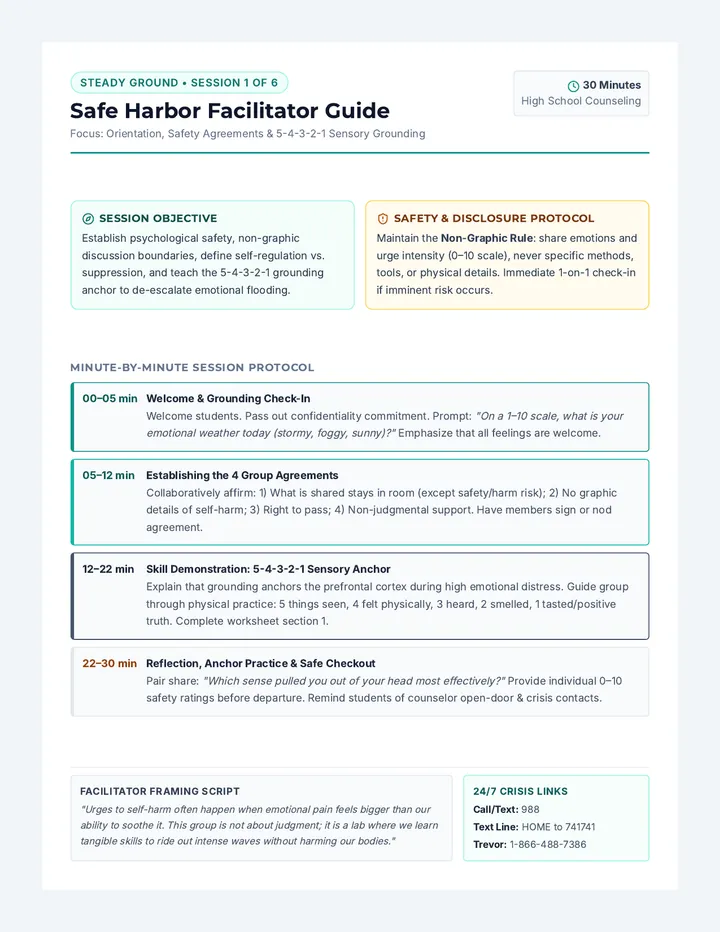
4. 5-4-3-2-1 Sensory Orienting
Application: Safe grounding when experiencing dissociative or freeze states.
Prompt: Actively find 5 colors, 4 textures on body, 3 distinct sounds, 2 objects to touch, and take 1 deep belly expansion.
School-Based Somatic Accommodations & Co-Regulation Support
Classroom Sensory Accommodations
The classroom environment should allow for discrete proprioceptive adjustments. Accommodations include: (a) Permitting the student to stand or perform desk pushes during long instruction, (b) Availability of handheld sensory items (textures, resistance bands), (c) Designated seating away from high-stimulation areas (e.g., HVAC vents, active hallways).
Non-Verbal Co-Regulation Prompts
When signs of physiological activation (restlessness, flushing, shallow breathing) are spotted by staff: (a) Staff will utilize a neutral, grounding vocal tone and keep open, non-threatening physical posture, (b) Staff will offer a discreet, pre-arranged visual card prompt for a 1-minute somatic pause (sigh breathing or hand stretch).
Somatic Safe Pass Protocol
In events of high autonomic escalation where classroom strategies are insufficient: (a) The student is authorized to use a non-verbal "Somatic Pass" card to step out, (b) Transition to the counseling room or sensory quiet area is self-initiated without academic penalty, (c) Clinician/support staff will immediately apply co-regulation (temperature reset or joint pressure).
Clinician Sign-off:
Signature / Title Date
Guardian / Authorized Approver:
Signature / Relationship Date
School Counseling Treatment Plan Template Confidential Clinical Record Page 4 of 4