Gig Economy Study Guide
Financial Literacy & Careers
Understanding the Gig Economy
Video & Article Study Guide • Completed with Simple Words
Name: Answer Key / Sample
Date: October 2026
1
Trends in Independent Work
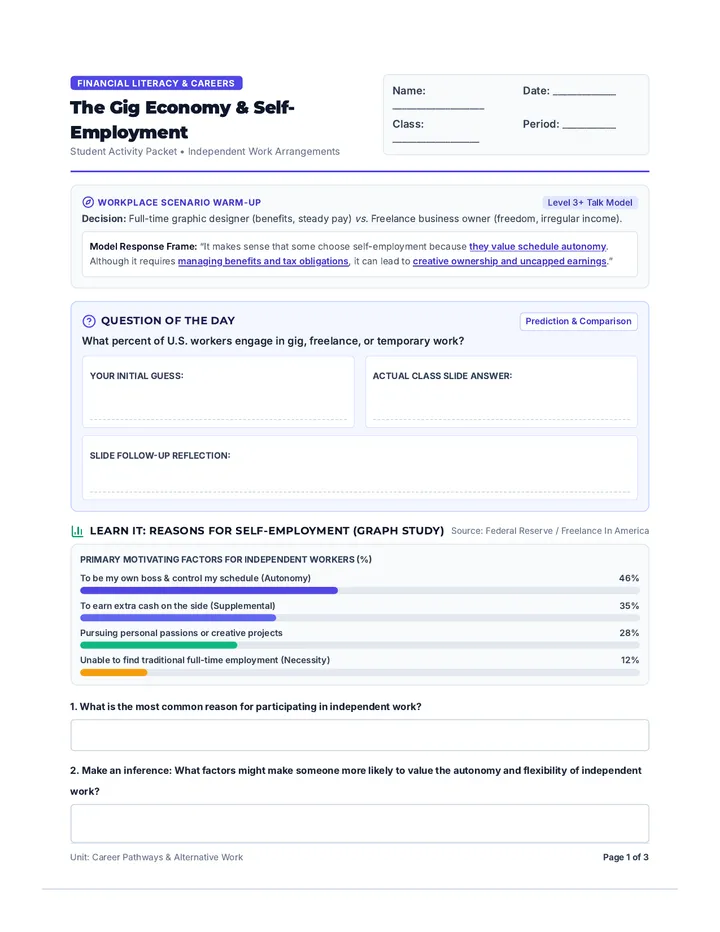
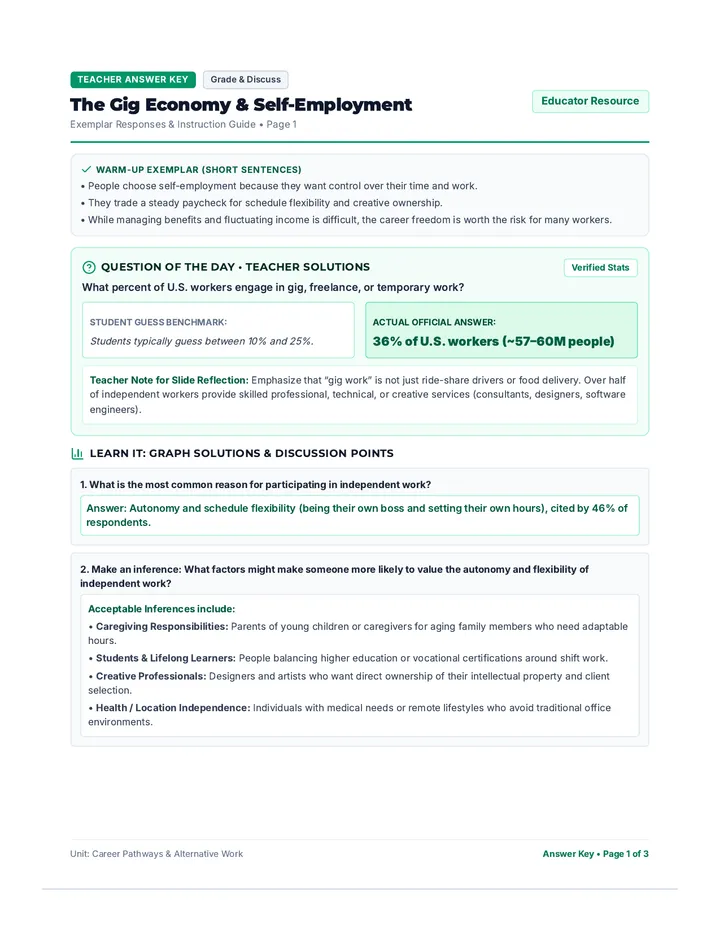
What is the most common reason for participating in independent work? Stat: 25.7%
Answer: The primary reason is schedule flexibility and autonomy. Exactly 25.7% of independent workers report that being able to choose when, where, and how much they work is their number one motivation.
Make an inference: What factors might make someone more likely to value the autonomy and flexibility of independent work?
Completed Response: People who have unpredictable schedules or major personal responsibilities—such as parents caring for young children, college students with rotating classes, or caregivers looking after sick relatives. Independent work lets them earn money without being trapped in a strict 9-to-5 schedule.
2
Video Analysis: What It Takes to Be a Freelancer
Three essential things needed to succeed as an independent worker (freelancer):
You’ll need…
Details (What does this step include in simple words?)
A skill that’s in demand
You must have a talent or service that people are willing to pay money for today (e.g., website design, writing, coding, translation, photography, or home repairs). If nobody needs your skill, you cannot make a living.
To transform yourself into an entrepreneur
You are running a real small business. There is no boss to give you work. You must find your own clients, market your services, agree on prices, send bills (invoices), follow up on late payments, and manage your time.
To budget for benefits
Independent workers get zero job perks from an employer. You do not get paid sick leave, paid vacation, or company health insurance. You must save extra money on your own to pay for doctor visits, days off, and retirement.
Unit: Exploring Careers & Personal Finance Page 1 of 3
Gig Economy: Costs & Evaluation
Part 3: Hidden Expenses & Personal Career Reflection
Part 2 of Worksheet
3
What are two of the “hidden costs” of app-based gig work described in the video?
1 Vehicle & Equipment Costs
If you drive for rideshare or food delivery apps, the company does not buy your car or pay for gas.
Simple Example: You must pay out-of-pocket for gas, oil changes, new tires, car insurance, phone data plans, and rapid wear-and-tear on your vehicle.
2 Self-Employment Tax & Unpaid Time
You only earn money while active on a job. Time spent waiting for an order or driving back is unpaid.
Simple Example: Independent workers pay higher taxes (15.3% self-employment tax for Social Security and Medicare) because no employer pays half of it.
4
Based on the description from the video, do you think gig work is a good fit for you? Why or why not?
Below are two sample responses written in simple words depending on personal preference:
Perspective A: "Yes, It's a Good Fit"
"Yes, gig work is a good fit for me as a part-time option. I like the idea of being my own boss and setting my own hours so I can balance school and hobbies. Even though there are extra costs and no paid benefits, the freedom to choose when I work is worth it for me."
Perspective B: "No, It's Not a Good Fit"
"No, I don't think gig work is a good fit for me. I prefer having a steady, predictable paycheck every two weeks and receiving job benefits like health insurance and paid vacation days. Managing my own business taxes and paying for car repairs would create too much financial stress."
Quick Vocabulary Key (Palabras Clave)
Gig Economy: A labor market based on short-term contracts or freelance work instead of permanent jobs.
Autonomy: The independence and freedom to control your own work, decisions, and daily schedule.
Depreciation: The loss of value and wear-and-tear on your car or tools over time as you use them.
Unit: Exploring Careers & Personal Finance Page 2 of 3
Independent Worker Responsibilities & Taxes
Part 4: Article Reading Analysis • Completed with Simple Words
Part 3 of Worksheet
5
The Four Responsibilities of Independent Workers
The article outlines four major responsibilities: buying health insurance, setting aside taxes, saving for retirement, and budgeting on a variable income. Which of these would be the most challenging for you? Why?
1. Health Insurance Paying for doctor visits and monthly insurance all by yourself.
2. Setting Taxes Aside Saving 25%–30% of each paycheck to pay the government every 3 months.
3. Saving for Retirement Putting money away for old age without a company retirement plan.
4. Variable Income Handling money when your pay is different each week or month.
Sample Answer in Simple Words:
The Most Challenging: Budgeting on a variable (changing) income.
Why: "My bills (like rent, phone, food, and car insurance) stay the same every single month. But as an independent worker, one month I might make $3,000, and the next month I might only make $1,200. It requires a lot of discipline to save extra money during good months so I can survive the slow months without going into debt."
6
Why do you think the article recommends using an accountant for your first year of paying self-employment taxes?
Hiring a professional accountant (un contador) during year one is recommended for three simple, practical reasons:
A Complex Tax Rules
Freelance taxes are much more complicated than a regular job. An accountant knows the exact deadlines for quarterly taxes so you avoid penalties and fees.
B Finding Deductions
An accountant teaches you what business expenses you can legally write off (like gas, phone bills, or laptop use), saving you hundreds or thousands of dollars.
C Creates a System
They set up an organized tracking system for you during your first year. Once you see how it works, you can easily manage your taxes on your own in future years.
Summary in Simple Words: "An accountant prevents costly mistakes with the government (IRS), finds all the legal discounts you qualify for, and teaches you how to keep clean records from day one."
Key Rule The 25%–30% Tax Rule for Freelancers:
Keep Business & Personal Money Separate
Every time you get paid by a client or an app, immediately transfer 25% to 30% into a separate savings account just for taxes. If you don't touch it, you will never be surprised by a huge tax bill at the end of the year!
Unit: Exploring Careers & Personal Finance Page 3 of 3