Court Vision Student Workbook
Court Vision Playbook
Social-Emotional Skills • Session Workbook
Player: ___________________
Date: _____________
Module 01
The Scouting Report: Triggers & Calling Plays
Reading social court dynamics, spotting tension early, and choosing when to engage.
Game Concept: Press vs. Drop Back. In basketball, pressing every single possession wears you out and gets you into foul trouble. Social life is the same. Recognizing what triggers frustration lets you choose whether a situation requires an assertive response or if it is smarter to drop back and let it go.
1. My Social Triggers (Check all that apply & add your own)
Friends whispering or group chat exclusion
Unfair blame during a game or group project
Eye-rolls or passive-aggressive remarks
People talking about me behind my back
My personal #1 trigger:
2. The Play Call: Respond Assertively vs. Let It Roll
Decide your move and write your quick rationale
Play A: Someone makes a sarcastic, snide comment to you in the crowded hallway between classes.
[ ] Address It [ ] Let It Roll
Play B: A close friend shares private screenshots of your text messages with others in your friend circle.
[ ] Address It [ ] Let It Roll
Play C: An opponent during gym class repeatedly fouls you and talks trash to provoke a reaction.
[ ] Address It [ ] Let It Roll
Rule: If it won't matter in 7 days, don't waste 7 minutes of energy. PAGE 01
Module 02
The Shot Clock Reset: Emotional Self-Regulation
Using CBT tools to pause before reacting, rewrite hot thoughts, and utilize physical outlets.
1. Body Warning Lights: Catching Heat Before the Technical Foul
Head & Jaw
Teeth clenching, hot cheeks, temples pulsing
[ ] I feel this
Chest & Breathing
Rapid heartbeat, shallow breathing, chest tightness
[ ] I feel this
Hands & Core
Clenched fists, shaking hands, stomach dropping
[ ] I feel this
2. The 3-Point Play: Rewriting The Game
Notice the automatic thought → reframe to change the outcome
Trigger Scenario:
Your friends made plans over the weekend and didn't invite you, then talk about it at your locker.
Automatic Foul Play
Hot Thought: "They hate me. They're fake. I'm calling them out right now."
Feeling: Furious, betrayed, embarrassed (10/10)
Impulsive Reaction: Slamming locker, throwing shade on social media, yelling.
Result: Drama blows up, friends become defensive.
Playmaker Reframe (Your Turn)
Cooler Thought:
Regulated Feeling:
Strategic Next Move:
3. My Bench Outlets: Releasing Frustration Productively
Physical Release
Free throws, sprints, boxing out, weight room
Creative / Journal
Unfiltered notebook venting, music playlist
Trusted Coach
Counselor, coach, parent, or trusted adult
Space & Pause
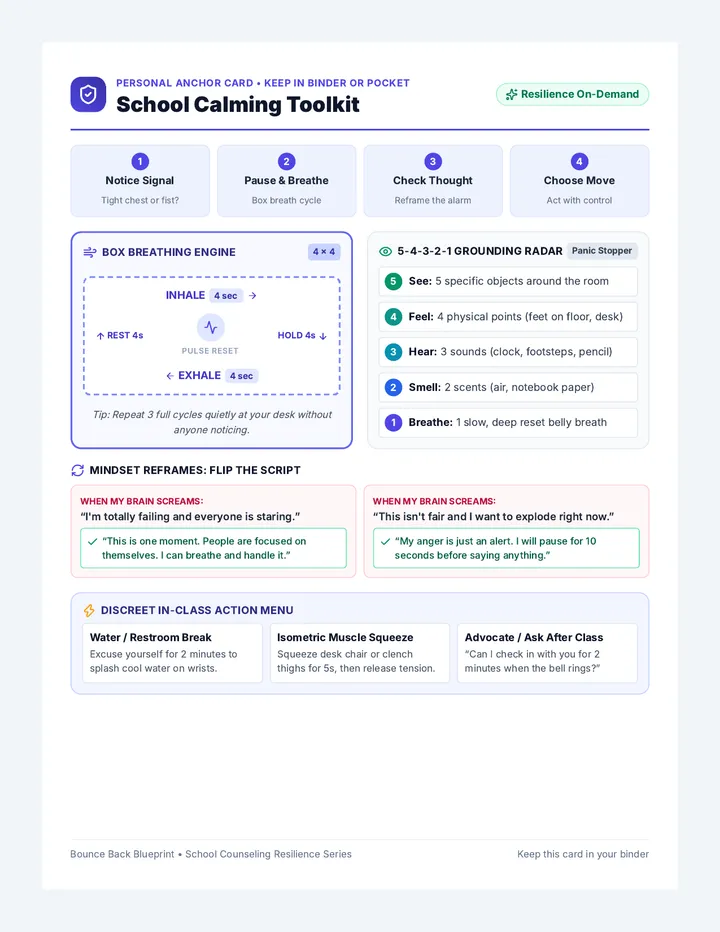
4-count box breathing, 5-minute walk
The 24-Second Rule: Never send a message or make a confrontation when your heart rate is above 100. PAGE 02
Module 03
Playmaker Communication: From Venting to Action
Moving past reliving drama, practicing assertive 'I' play calls, and active perspective-taking.
Venting Only (Replaying The Tape)
- Tells the story repeatedly without looking for solutions
- Keeps emotional frustration burning high
- Focuses 100% on what others did wrong
- Leaves you feeling exhausted and helpless
Problem Solving (Executing The Play)
- Acknowledges the anger, then asks: "What's my move?"
- Focuses on what YOU can control right now
- Sets clear, respectful boundaries directly
- Restores confidence and closes the chapter
The Play Call Formula (Clear, Direct, Respectful)
1. "I feel..." [Name the emotion: disrespected, frustrated, left out]
2. "When..." [State the factual event without name-calling or blaming]
3. "Because..." [Explain the impact on you or the friendship]
4. "Next time, I need..." [State your boundary or clear request]
Practice Scenario 1: Peer Disrespect A friend makes a joke at your expense in front of a group to get laughs.
Write your assertive play call:
Practice Scenario 2: Teammate Accountability During a game or group assignment, a peer yells at you for a mistake while ignoring their own.
Write your assertive play call:
Perspective Radar: Seeing Their Side of the Court
Understanding why someone reacted poorly doesn't mean excusing it—it helps you stay composed.
Point Guard Rule: Great communicators speak clearly, listen to defense, and don't take cheap fouls. PAGE 03
Module 04
Next Level: High School Game Plan & Teammate Standards
Setting high standards for your circle, sportsmanship, and navigating high school social pressure.
1. My Friendship Roster Audit: Teammates vs. Technical Fouls
High School MVP Teammate Qualities
✓ Hypes you up when you succeed
✓ Addresses issues privately with you, not a mob
✓ Respects your goals, sports schedule, and boundaries
✓ Doesn't switch up when around new or older crowds
Technical Fouls (Walk Away Signals)
× Pressures you to participate in drama or skip out
× Acts hot and cold depending on who is watching
× Brings middle school gossip into high school spaces
× Invalidates your feelings or calls you "too sensitive"
My High School Circle Standard:
What are the 2 non-negotiable qualities someone needs to be in your inner circle next year?
2. High School Pressure Playbook
High School Dilemma A:
Older students or teammates urge you to join in mocking a peer online or during practice.
My Prepared Play:
High School Dilemma B:
A friendship you had in middle school starts growing apart as people find different interests.
My Prepared Play:
Personal High School Athlete & Leadership Pledge
"As I step onto the high school court and into high school halls, I choose to lead with emotional discipline, communicate directly rather than venting endlessly, protect my energy, and surround myself with genuine teammates who elevate my game."
Student Signature: ______________________
Counselor Witness: ______________________
Ready for the next level: Skills, Composure, Character. PAGE 04