Budgeting Breakdown Answer Key
Money Moves: Budgeting Breakdown
Teacher Answer Key & Facilitation Guide
High School Financial Literacy
Unit: Cash Flow & Budgeting
Prompt
$1,000 Contest Allocation Response
"Pretend you won $1,000 in a contest. Explain how much of this money you would allocate toward spending, saving, and other purposes and what led you to those decisions."
Model Exemplary Response:
Saving ($500 / 50%) $500 Emergency Cushion
Needs / Debt ($300 / 30%) $300 Car/School Needs
Wants ($200 / 20%) $200 Guilt-Free Spending
Rationale Criteria: Student answers will vary. Look for clear justification of trade-offs: prioritizing savings to build a cushion against future emergencies, addressing pressing immediate financial obligations (needs), and allowing a modest, disciplined amount for personal enjoyment to prevent budget fatigue.
Learn It
Fixed vs. Variable Expenses
Q: In your own words, explain the difference between a fixed expense and a variable expense.
Answer: A fixed expense remains identical or predictable each billing period (e.g., set rent, standard recurring subscription) and does not change based on day-to-day choices. A variable expense fluctuates in frequency and dollar amount depending on consumption, lifestyle choices, or unforeseen circumstances (e.g., dining out, utility spikes, medical emergencies).
Expense Categorization Key 5 Items Evaluated
| Expense Item | Classification | Instructional Rationale |
|---|
| Your cell phone bill | Fixed | Standard unlimited carrier plans charge a predictable contracted monthly flat rate. |
| A restaurant | Variable | Discretionary dining out varies directly with consumer choice, frequency, and order cost. |
| Your Netflix subscription | Fixed | Recurring digital subscription fees remain identical month-to-month until an account plan changes. |
| An emergency room bill | Variable | Unplanned, non-recurring medical costs with unpredictable pricing based on treatments received. |
| School supplies | Variable | Seasonal expenditure that fluctuates based on grade level, course requirements, and replacement needs. |
Common Misconception Alert: Students often conflate needs with fixed expenses and wants with variable expenses. Remind them that groceries and emergency medical care are essential needs, yet they are strictly variable. Conversely, a streaming subscription is a want, yet it is a fixed monthly cost.
Money Moves: Personal Budgeting Breakdown Page 1 of 3
Money Moves • Educator Answer Key Part 2: Budgeting Strategies
Article Review
Four Popular Budgeting Frameworks
1 Pay Yourself First (Reverse Budgeting)
Briefly summarize the Pay Yourself First strategy.
Summary: Automatically transferring a designated percentage or amount into savings or investment accounts immediately upon receiving income, prior to paying any discretionary or variable expenses.
2 The 50/30/20 Budgeting Rule
The 50/30/20 budget recommends 50% on needs. What factors would impact your ability to stick to this rule?
Factors: High-cost-of-living housing markets where rent alone exceeds 40–50% of take-home pay; entry-level or minimum-wage income levels where basic necessities consume most income; or high fixed obligations like student loans or required healthcare costs.
3 Zero-Based Budgeting (Income - Expenses = $0)
Zero-based budgeting accounts for every available dollar. How is this beneficial?
Benefit: Eliminates "phantom spending" and unmonitored cash leaks. Giving every single dollar an intentional assignment (bills, savings, or guilt-free spending) provides total clarity and accountability over where money goes.
4 Envelope Budgeting (Cash Stuffing)
How does envelope budgeting work?
Explanation: Cash is physically or digitally apportioned into categorized envelopes (e.g., Food, Entertainment). You only spend what is inside each envelope; once empty, spending in that category is finished until the next budget cycle.
Video Analysis
Zero-Based Budgeting Where Every Dollar Counts
Q1: Desean sets up his zero-based budget and has $175 left after assigning all expenses. What would be a good category for him to put that money in?
Recommended Categories: Emergency Fund, High-Interest Debt Paydown, or a Sinking Fund for irregular car/medical expenses. In zero-based budgeting, this surplus must be allocated to an explicit goal so unassigned income equals exactly $0.
Q2: Think about the process of zero-based budgeting. What might one drawback of this method be?
Drawbacks: High time requirement to track every transaction, rigidity that can create stress when expenses fluctuate unexpectedly, and administrative friction for individuals with irregular or hourly income.
Unit: High School Personal Finance Page 2 of 3
Money Moves • Educator Answer Key Part 3: Envelope Budgeting, Case Study & Exit Ticket
Video Analysis
Envelope Budgeting & Cash Stuffing
Q1: What is one benefit of envelope budgeting?
Answer: Creates an immediate physical and psychological limit on spending, provides visual proof of remaining funds, and prevents credit card debt by keeping spending within cash on hand.
Q2: True or False: Envelope budgeting means that you have to deal with only cash and physical envelopes. Explain your answer.
FALSE Explanation: Digital envelope budgeting allows consumers to use banking sub-accounts, specialized debit cards, or budgeting applications (e.g., Goodbudget, Qube) that enforce category caps electronically without physical cash.
Q3: Do you think this is a method that you would use? How might using this method benefit you?
Evaluation Criteria: Accept either position if supported: Yes: Helps overcome impulse swiping and provides tactile discipline. No: Security risk of cash, lack of credit score building, or hassle with online retail.
Do It Activity
Case Study: How Do I Budget? (Rubric)
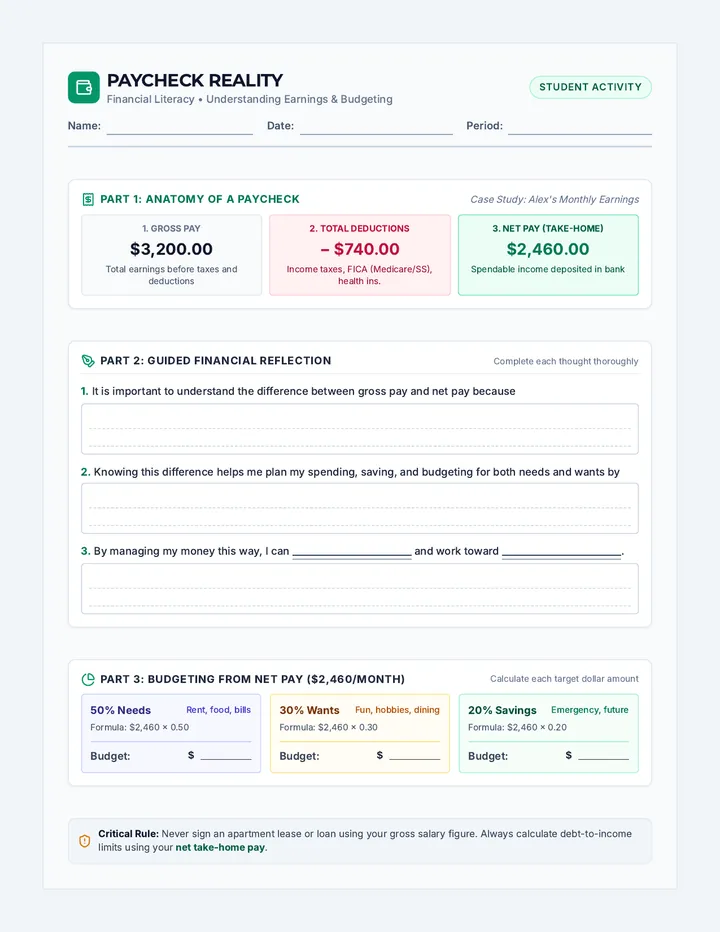
1. Calculate Net Income Base budgets on take-home pay after taxes and withholdings.
2. Deduct Fixed Costs Lock in non-negotiable rent, debt minimums, and insurance first.
3. Estimate Variable Needs Set realistic caps on groceries, fuel, and utilities.
4. Select Framework Match strategy (50/30/20, Zero-based, Envelopes) to habits.
Exit Ticket
Synthesis Check & Proficiency Benchmark
Prompt: "Which budgeting strategy learned today is most sustainable for your lifestyle, and why?"
Benchmark: A proficient response identifies one strategy, references at least one core mechanism (e.g., 50% needs limit, assigning every dollar to $0, or tactile cash dividers), and connects it to personal spending patterns.
Teacher Note: Video resources can be sourced via NGPF FinCap Friday library Page 3 of 3