Digital Footprint Lesson Plan Your Digital Footprint
Lesson Plan & Facilitation Guide
Audience: 11th-12th Grade
Duration: 60 Minutes
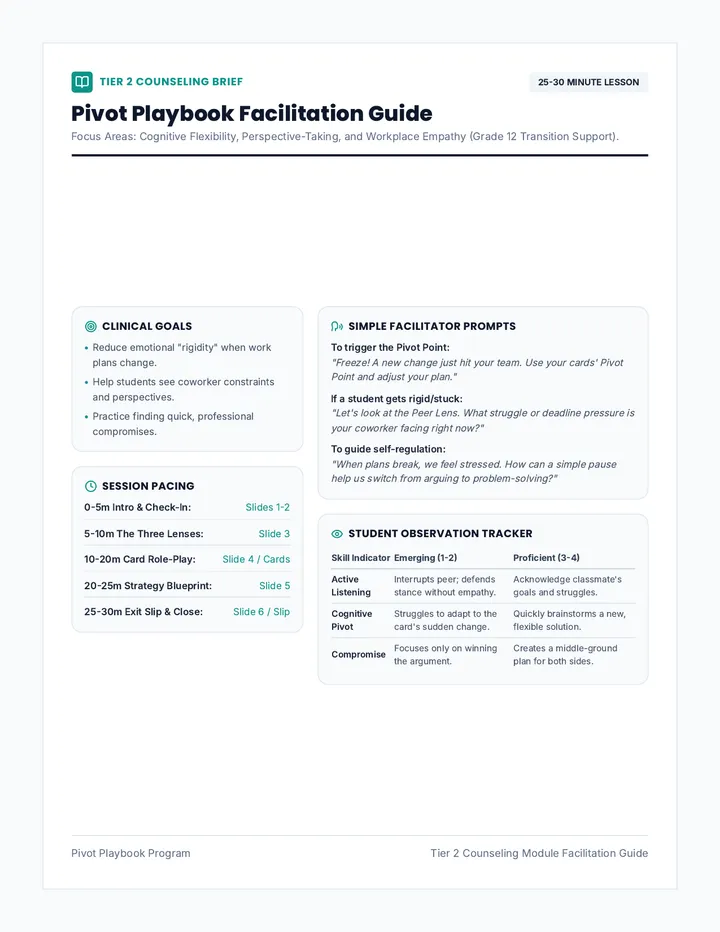
Objective
Students will define 'digital footprint,' identify how online actions contribute to it, and apply strategies to manage their online presence for future opportunities.
Approach
Interactive discussion, practical analysis, real-world case studies, and reflective scenario-based decision making.
Prep Time
20 Minutes: Review materials, test slide deck, print worksheets/reading, and verify device access for scavenger hunt.
The Rationale
"In today's interconnected world, nearly everything we do online leaves a trace. This digital footprint can significantly influence future opportunities, from college admissions to job prospects. Understanding and managing it responsibly is a critical life skill for students transitioning to adulthood."
Materials Checklist
Smartboard or Projector
Digital Footprint Slide Deck
Digital Footprint Script
Digital Footprint Reading
Scavenger Hunt Activity Guide
Reflection Worksheets
Scenario Showdown Cards/Guide
Project Guide & Rubric
Warm-Up & Cool-Down Tickets
Assessment Pack (Quiz/Test/Key)
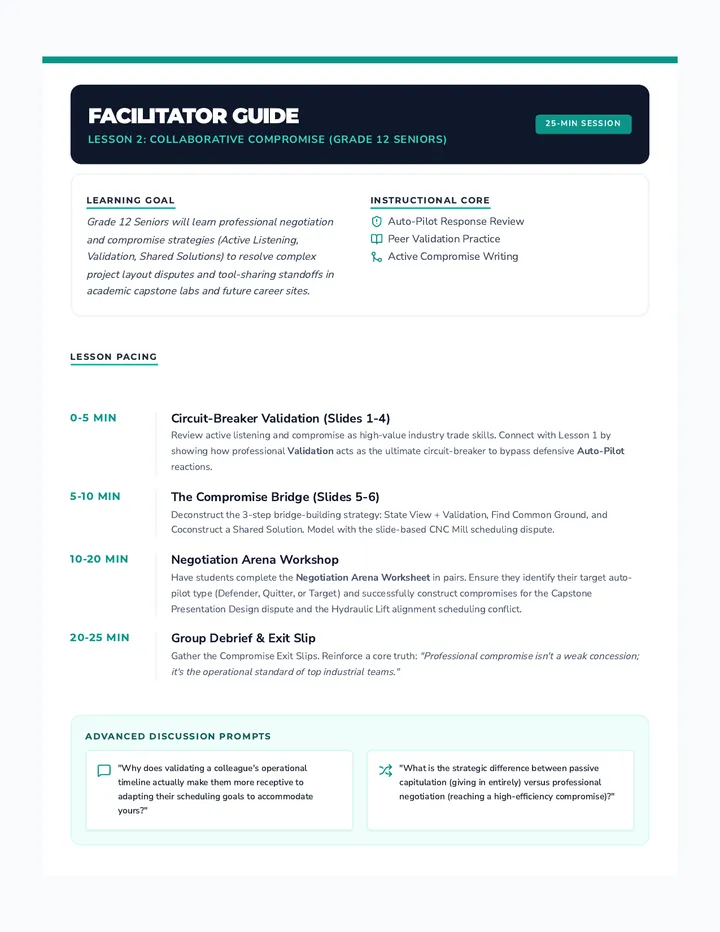
Lesson Flow
Time Phase Facilitation Notes 5 min Warm-Up Distribute the Warm-Up Ticket . Ask students to define "digital footprint" in their own words. Facilitate a brief share-out to gauge baseline perceptions. 10 min Instruction Present the Slide Deck using the provided Script . Focus on differentiating between active and passive footprints. 15 min Explore Distribute Reading: The Echoes We Leave . Use Discussion Questions to analyze Sarah, Mark, and Emily's case studies. Focus on real-world impacts. 15 min Activity Run the Online Scavenger Hunt . If devices aren't available, use the fictional profile analysis option. Students complete the Reflection Worksheet . 10 min Game Lead the Scenario Showdown . Present dilemmas and have groups vote on/discuss the best course of action for long-term footprint management. 5 min Wrap-Up Administer the Cool-Down as an exit ticket. Introduce the Project Guide for homework. Mention Quiz/Test for future evaluation.
Teacher Tips
Emphasize that a digital footprint isn't just "bad"—it can be a powerful asset (Emily's story).
Encourage students to check privacy settings during the scavenger hunt to make it immediately actionable.
Differentiation
Scaffolding: Provide sentence starters for the reflection worksheet.
Extension: Have advanced students research the "Right to be Forgotten" laws in the EU vs. US.
Digital Footprint Warm Up Warm-Up Reflection
Digital Footprint Awareness
Name
Date
Take a moment to think about your online presence. Respond to the following questions in a few sentences each.
1 What comes to mind when you hear the phrase "digital footprint"?
2 How do you currently manage your online presence? (e.g., privacy settings, being selective about posts, etc.) Digital Footprint Slide Deck Your Digital Footprint
What does "digital footprint" mean to you?
Trace Your Path
Warm-Up Review
Let's share our initial thoughts.
What were some of your definitions? How do you currently navigate the online world?
What is a Digital Footprint?
Active Footprint
• Social media posts & comments
• Photos & videos you upload
• Emails you send
• Online forms & purchases
Passive Footprint
• Website cookies
• IP addresses & browser info
• Location data
• Search history
Why Does It Matter?
College Admissions
Job Prospects
Personal Reputation
Future Opportunities
"What you share today could be seen by a college admissions officer next year or a potential employer five years from now."
Real-World Impacts
Let's explore some examples of how digital footprints have shaped lives.
Read the stories of Sarah, Mark, and Emily .
Online Scavenger Hunt
Option 1: You
Discreetly review your own public presence. What impression does it create?
Option 2: Fictional
Analyze anonymous profiles provided by your teacher. What do you see?
Interactive Challenge
Scenario Showdown
1
Analyze
2
Discuss
3
Decide
Key Takeaways
Be mindful of what you share.
Think before you post.
Cultivate a positive presence.
Privacy settings are your friend!
Homework/Project
Digital Footprint Project Guide
Reflection & Wrap-Up
What is the most important thing you learned today?
Complete your Cool-Down Ticket
Digital Footprint Script Instructional Script
Facilitation Guide for Slide Deck
9 Slides
Slide 1
Welcome & Hook
Teacher Script: "Good morning/afternoon, everyone! Today, we're diving into a topic that's incredibly relevant to your lives: your digital footprint. Before we get too deep, I want you to think for a moment: What comes to mind when you hear the phrase 'digital footprint'?"
Slide 2
Warm-Up Review
Teacher Script: "Alright, let's hear some of your thoughts. Who would like to share what they wrote or what they think a digital footprint is?"
(Wait for student responses)
"Excellent ideas! You're all on the right track. Essentially, your digital footprint is the trail of data you leave behind from your online activities. Every post, every like, every search – it all contributes to this digital identity."
Slide 3
The Definitions
Teacher Script: "Now, let's break this down a bit more formally. Your digital footprint isn't just one thing; it's a combination of two types: active and passive."
"Active footprint refers to the data you intentionally share. Think about your social media posts, comments, or photos. You're actively creating that content."
"On the other hand, a passive footprint is data collected about you without your direct input . This could be website cookies tracking your habits, your IP address, or location data. You might not even realize it's happening, but it's still part of your trail."
Slide 4
The High Stakes
Teacher Script: "So, why should we care? It has real-world consequences, especially for high school students. Your digital footprint can significantly impact college admissions, job prospects, and your reputation. What you share today could be seen by a college officer next year or a potential employer five years from now."
Slide 5
Case Studies
Teacher Script: "To really understand the weight of this, let's explore some real-world examples. I'm going to hand out a short reading titled 'The Echoes We Leave Online.' As you read, think about how the digital footprints in these stories impacted the individuals involved. We'll discuss them in a moment."
Slide 6
Scavenger Hunt
Teacher Script: "Now let's do a little 'Online Scavenger Hunt.' The goal isn't to judge, but to become aware. If you have a device, search your name in an incognito window. If not, use the anonymous profile examples I've prepared. Ask yourself: 'What kind of impression does this content create?'"
Slide 7
Scenario Showdown
Digital Footprint Reading Digital Citizenship Series
The Echoes We Leave Online
Understanding the Impact of Real-World Digital Footprints
Our online actions, no matter how small or fleeting they seem, create a permanent record—a digital footprint. This footprint can follow us, shaping perceptions and opening or closing doors to future opportunities. Here are a few anonymized stories that illustrate the power and potential pitfalls of our digital trails.
Case Study 1: The Rescinded Acceptance
Sarah, a bright high school senior, had worked tirelessly for years. Her grades were impeccable, her extracurriculars impressive, and she had just received an acceptance letter to her dream university. She celebrated with friends, and over the next few weeks, she posted several excited updates on social media, including some photos from a party that, while not explicitly illegal, showed questionable judgment.
Unbeknownst to Sarah, universities often review the social media presence of admitted students. Her posts, deemed inconsistent with the university's values, led to her acceptance being rescinded. Her digital footprint, intended for a small circle of friends, cost her a life-changing opportunity.
Case Study 2: The Lost Opportunity
Mark was thrilled when he landed an interview for an entry-level position at a respected company. During the interview, however, the hiring manager brought up a series of old, sarcastic tweets Mark had posted years ago. While Mark considered them harmless jokes at the time, the tweets could be interpreted as unprofessional and critical of past employers.
The hiring manager explained that they were looking for someone who demonstrated consistent professionalism. Mark didn't get the job. His past digital expressions, though from years before, painted a picture that contradicted the professional image he wanted to project.
Case Study 3: The Scholarship Surprise
Unlike Sarah and Mark, Emily used her digital footprint to her advantage. She was passionate about environmental conservation and consistently shared articles, participated in online discussions, and ran a small blog documenting local clean-up efforts.
When she applied for an environmental science scholarship, the committee performed a quick online search. They were impressed to find a consistent, positive online presence that perfectly aligned with the scholarship's mission. Her digital footprint was a curated reflection of her interests, which ultimately helped her secure the funding.
Reflection Questions
Question 1
What are the key differences in how Sarah, Mark, and Emily managed their digital footprints?
Question 2
How might Sarah and Mark have acted differently to achieve a more positive outcome?
Question 3
Digital Footprint Discussion Questions Echoes & Footprints
Class Discussion Guide
Name
Date
1. What was your initial reaction to Sarah's story? Do you think the university was justified in rescinding her acceptance? Why or why not?
2. Mark's old tweets cost him a job. How long do you think information should remain accessible online? Should there be a "right to be forgotten"?
3. Emily intentionally built a positive digital footprint. What are some specific actions you can take to proactively shape your online presence in a way that aligns with your goals?
4. What are some common mistakes or oversights people make that contribute to a negative digital footprint?
5. How can you help friends or family members understand the importance of their digital footprint without being preachy or judgmental?
Digital Footprint Activity Mission Protocol
Online Scavenger Hunt
Digital Trace Analysis
Objective
To become aware of the public information available online and critically evaluate the impression it creates on potential employers or university admissions officers.
Path Alpha
Personal Audit
Search your name (and city/school) in an incognito or private browsing window.
Review public social media profiles. What are the first 3 things a stranger would see?
Security Check: Are your "private" posts truly invisible to non-friends?
Path Beta
Profile Analysis
Analyze the fictional profiles or content snippets provided by your teacher.
Evaluate: What kind of character does this online behavior project?
Action: What 2 pieces of advice would you give this person?
Evidence Log
Overall Impression Logged
Surprising or Notable Findings
Future Adjustments Required
ENCRYPTED DATA // FOR EDUCATIONAL USE ONLY // 11.12.HS
Digital Footprint Reflection Worksheet Reflection Worksheet
Digital Footprint & Reputation
Unit: Digital Citizenship
HS-DL-04
Student Name
_________________________________
Date
_________________________________
01 Definition & Importance
Define "digital footprint" in your own words. Why is it important for someone your age to understand this concept?
02 Active vs. Passive
Provide one example of each from your own online life (or a hypothetical one).
Active Example
Passive Example
03 Notable Discoveries
After the "Online Scavenger Hunt," what was one notable thing you discovered about online information?
04 Resonance
Consider the stories: Sarah, Mark, and Emily. Which story resonated most with you and why?
05 Action Plan
List three concrete actions you can take starting today to maintain a positive footprint.
06 Future Impact & Advice
What is one piece of advice you would give to a younger student about managing their online presence?
Digital Footprint Game Scenarios Classroom Game
Scenario Showdown
Critical Decisions in a Digital World
1
Read the Case
2
Analyze Impact
3
Choose Path
High Risk
01: The Rant
Liam is frustrated with his part-time job. He posts an angry rant on his public profile, naming his boss and the company with strong language. He expects only friends to see it.
Analysis Questions
Who might see this besides friends? What are the long-term career risks?
Peer Ethics
02: The "Funny" Photo
Chloe snaps an embarrassing photo of a friend and posts it with a mocking caption. Her friend asks her to take it down, but Chloe insists "it's just a joke."
Analysis Questions
How does this reflect on Chloe's character? What about her friend's reputation?
Permanence
03: Old Post Resurfaces
David is applying for an internship. An employer finds an inappropriate, immature post David made at age 14. David had completely forgotten it existed.
Analysis Questions
Is "it was years ago" a valid defense? How can David mitigate the damage?
The Pro
04: Javier's Curation
Javier regularly shares his coding projects on LinkedIn and forums. He offers help to others and follows industry leaders in his field.
Analysis Questions
How is this building a 'personal brand'? What are the concrete benefits for Javier?
Decision Log
Scenario Chosen: ___________________
Recommended Action: ___________________
Digital Footprint Quiz Quiz: Digital Footprints
Formative Assessment
Score
/ 10
Name: _________________________________
Date: _________________________________
1. Which of the following best defines a "digital footprint"?
The amount of time you spend on digital devices.
The impact of technology on the environment.
The trail of data you leave behind from your online activities.
The physical size of your computer's hard drive.
2. Posting a photo on Instagram is an example of what type of digital footprint?
Passive Footprint
Active Footprint
Hidden Footprint
Temporary Footprint
3. Which of these is an example of a passive digital footprint?
Sending an email to a teacher.
Filling out an online survey for a class.
Website cookies tracking your browsing history.
Commenting on a YouTube video.
4. Explain two ways your digital footprint can impact your future opportunities.
5. Once something is posted online, how easily can it be completely removed?
Very easily, it disappears as soon as you hit delete.
With some effort, but it's often difficult to erase completely.
Only if you ask the website owner politely.
It can always be deleted without leaving a trace.
Digital Footprint Test Summative Assessment
Digital Identity & Reputation Management
Total Points
/ 50
Student Name
Date
Part I: Multiple Choice
1. Which of the following is NOT typically considered part of your active digital footprint?
Posting a comment on a blog or article.
Filling out an online application for a job.
Your smartphone's GPS collecting location data in the background.
Uploading a video to YouTube.
2. Why is it important for high school students to manage their digital footprint responsibly?
It only affects what their immediate friends think of them.
It can impact college admissions, job opportunities, and personal reputation.
It determines their credit score for future financial loans.
It is only relevant if they plan to work specifically in the tech industry.
Part II: Short & Long Response
3. Describe the main difference between an active and a passive digital footprint, providing an example for each.
4. Imagine you see a friend post something that could negatively impact their digital footprint. What steps could you take to respectfully advise them?
5. Discuss the concept of 'personal brand' in relation to your digital footprint. How can your online presence help build or detract from your goals?
Digital Footprint Answer Key Answer Key & Teacher Guide
Facilitator Resource
Digital Footprint Quiz
1. Definition: The trail of data you leave behind from your online activities.
2. Type: Active Footprint
3. Passive Example: Website cookies tracking browsing history.
4. Impact (Open): Affects college admissions (rescinded offers) and job prospects (hiring managers screening social media).
5. Removal: With some effort, but it's often difficult to erase completely.
Digital Footprint Test
1. Not Active Footprint:
Your smartphone's GPS collecting location data in the background.
2. Importance:
It can impact college admissions, job opportunities, and personal reputation.
3. Active vs. Passive:
Active is intentional (posting, emailing). Passive is unintentional/automated data collection (cookies, IP address, location tracking).
4. Advising a Friend:
Private message or talk in person. Frame it as helpful/protective ("I want you to get that scholarship"). Suggest editing or deleting.
5. Personal Brand:
Personal brand is your professional identity. A positive footprint builds credibility and shows passion/skill (like Emily). A negative footprint contradicts a professional image (like Mark).
Scenario Showdown: Facilitation Points
01: The Rant
Key Point: Screenshots are forever. Even if deleted, the employer likely already has it or it's cached. Liam should have vented privately.
02: The Photo
Key Point: Consent is vital. Chloe's "joke" harms another's footprint and shows Chloe's lack of professional/social empathy to future observers.
03: Old Posts
Key Point: The internet is an archive. David should perform regular "name audits" and use the "Right to be Forgotten" requests where applicable or prepare an explanation of growth.
04: Javier
Key Point: Proactive footprints are powerful. Javier isn't just avoiding bad things; he's actively creating "positive proof" of his competence.
Discussion Questions: Ideal Responses
Q1 (Sarah): Students should debate the ethics of monitoring social media. Most universities find it justified as it protects the student community and brand values.
Q2 (Mark): Focus on professionalism. Students should realize that "jokes" to friends don't translate well to professional contexts without context.
Q3 (Emily): Encourage students to think of their hobbies (art, music, coding, sports) as content that can be showcased professionally.
Digital Footprint Project Guide Performance Task
Crafting Your Online Identity
A strategic audit and action plan for your professional digital future.
The Mission
Your digital footprint is more than just a collection of posts; it's a reflection of your personal brand. In this project, you will take concrete steps to review, refine, and plan your online identity to ensure it helps, rather than hinders, your future goals.
01
Phase One: Digital Audit
Conduct a thorough audit of your online presence:
Search Analysis: Search your name (and variations) on at least two search engines.
Social Review: Review your public profiles on all major platforms (IG, TikTok, X, etc.).
Trace Check: Look for old comments, blog posts, or photos tagged by others.
Deliverable: 250-300 word written reflection on findings.
02
Phase Two: Action Plan
Create a strategic roadmap for your identity management:
Privacy Overhaul
List specific settings to adjust and why.
Content Strategy
Plan 3 types of positive content to share.
Content Review
Describe types of content to remove or edit.
Goal Alignment
Connect actions to your 5-year goals.
Submission Checklist
Written Reflection Report
250-300 words analyzing your current audit findings.
Strategic Action Plan
Detailed roadmap for privacy, content, and goal alignment.
Class Summary Presentation (Optional)
5-minute presentation focusing on your strategy.
Submission Window
Project Due Date: ____________________
Digital Footprint Project Rubric Project Rubric
Assessment Criteria: Crafting Your Online Identity
Student: __________________________
Final Score: ______ / 40
Criteria 4 - Mastery 3 - Proficient 2 - Developing 1 - Limited Audit & Reflection Comprehensive, insightful audit. All questions thoroughly addressed with deep critical thinking and surprising findings. Thorough audit. Most questions addressed with thoughtful responses. Identifies key strengths and weaknesses. Basic audit. Some reflection questions addressed but lacks depth or personal connection. Minimal audit. Reflection questions missing or irrelevant. No clear findings. Action Plan Strategic and highly practical. Detailed steps for privacy, content, and monitoring. Clear link to 5-year goals. Detailed and practical plan. Clear steps for management. Good link to long-term goals. Plan is vague or lacks details. Limited connection between actions and goals. Plan is missing or extremely superficial. No demonstrated strategy. Personal Branding Exemplary understanding of branding. Content strategy is creative and professionally aligned. Solid understanding of branding. Content strategy is appropriate for age and goals. Basic understanding of branding. Strategy is generic or inconsistent. No evidence of branding understanding. Strategy is missing. Effort & Professionalism Exceptional effort. Deliverables are professionally formatted and demonstrate mature citizenship. Good effort. Deliverables are organized and clear. Shows solid digital citizenship. Moderate effort. Some organizational issues. Basic citizenship demonstrated. Little effort shown. Disorganized, incomplete, or inappropriate.
40 - 36
Exceeds (A)
35 - 30
Meets (B)
29 - 24
Partial (C)
Below 24
Limited (D/F)
Instructor Feedback
Write feedback here...
Digital Footprint Cool Down Exit Ticket
Digital Footprint Reflection
Student Name
_________________________________
Key Takeaway
What is one new understanding you gained today?
Next Action
What is one action you will commit to taking today?
Reputation Management HS-V1