Voice Power Slides 5th Grade Mini-Lesson
25 Minutes
Voice Power
How to Speak Up, Ask for Help, and Handle Challenges
Your voice is a tool. Today we practice using it clearly and respectfully.
Ask for Help Speak Up Respectfully Handle a Challenge
WARM-UP 4 Minutes
What Is Self-Advocacy?
Self-advocacy means speaking up for what you need, what you think, or what is fair—in a calm, respectful way.
Self-Advocacy IS...
• Sharing what you need clearly
• Staying calm and respectful
• Trying another way if stuck
Self-Advocacy Is NOT...
• Yelling or demanding
• Staying silent when you need help
• Giving up after one try
SKILL 1 Ask for Help
Make Your Ask Specific
People can help you faster when they know exactly where you are stuck.
Vague Ask
"I don't get any of this. It's too hard."
Hard for the helper to know where to start.
Specific Ask
"I understand step 1, but I'm stuck on step 2. Can you show me an example?"
Clear, polite, and easy to answer!
SKILL 1 PRACTICE The 3-Part Help Ask
Try This Formula
1. What I Tried
"I already read the directions..."
2. Where I'm Stuck
"...but I'm confused about the graph."
3. What I Need
"Could you explain what the bottom row means?"
Your Turn (Worksheet Part 1): Rewrite a vague ask into a 3-part specific ask!
SKILL 2 Speak Up Respectfully
Share Opinions & Concerns with Confidence
You can disagree or share a worry without attacking the other person.
1
Use a calm voice & eye contact: Shows you are serious and respectful.
2
Start with "I": "I feel left out when..." or "I have a different idea because..."
3
Give one clear reason or request: "Next time, can we take turns?"
SKILL 2 PRACTICE Respectful vs. Unhelpful
How Would You Say It?
Scenario: Your group partner is doing the whole poster by themselves and won't let you help.
Blaming ("You" Statement)
"You're being bossy and hogging everything!"
Respectful ("I" Statement)
"I want to help with our poster too. Can I do the title and drawings?"
Your Turn (Worksheet Part 2): Write a respectful "I" statement!
SKILL 3 Handle a Challenge
What If They Don't Understand or Respond?
Sometimes the first try doesn't work. Choose a smart next step!
1. Rephrase It
Say it in simpler words or give a quick example.
2. Pick a Better Time
If they are busy, ask: "When is a good time to talk?"
3. Show or Write It
Point to the problem or write a short note.
4. Ask Another Helper
Check with a partner, teacher, or trusted adult.
ROLE-PLAY Partner Practice
Choose Your Next Step
Challenge A: You raise your hand to ask a question, and the teacher nods but moves on because they are helping someone else.
Challenge B: You tell a friend a joke hurt your feelings, and they say, "Calm down, I was just kidding!"
Act It Out (Worksheet Part 3): Pick one challenge, choose a next step, and practice!
WRAP-UP 3 Minutes
Your Voice Power Toolkit
Ask Clearly
Say what you tried, where you're stuck, and what you need.
Speak Respectfully
Use a calm voice and "I" statements.
Keep Going
Rephrase, wait for a good time, show it, or ask another helper.
Complete Part 4 on your worksheet: What is ONE situation this week where you will use your Voice Power?
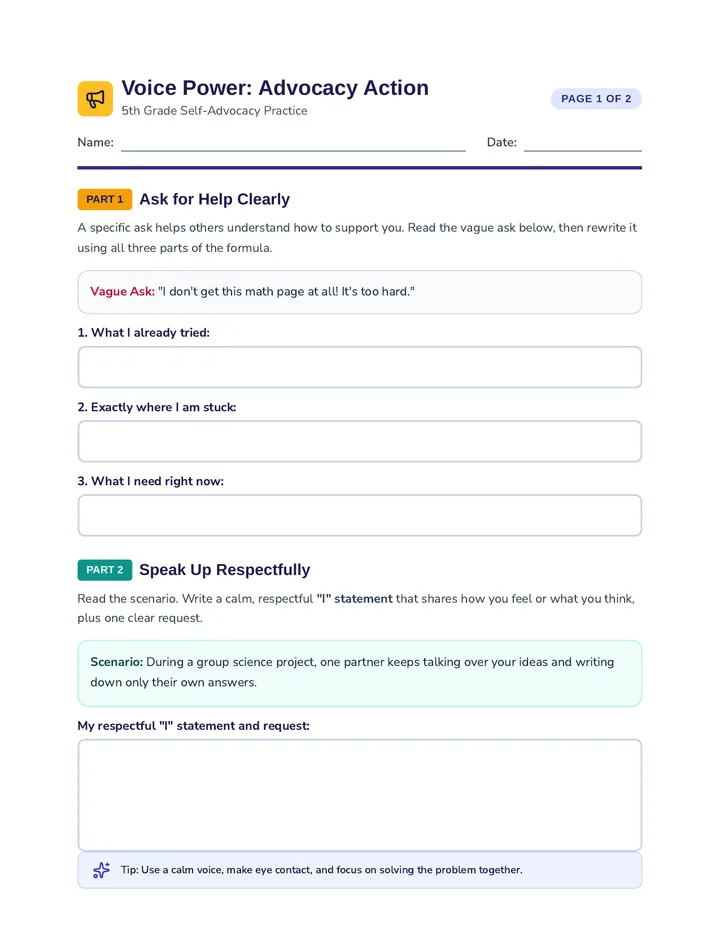
Advocacy Action Worksheet Voice Power: Advocacy Action
5th Grade Self-Advocacy Practice
Page 1 of 2
Name:
Date:
PART 1
Ask for Help Clearly
A specific ask helps others understand how to support you. Read the vague ask below, then rewrite it using all three parts of the formula.
Vague Ask: "I don't get this math page at all! It's too hard."
1. What I already tried:
2. Exactly where I am stuck:
3. What I need right now:
PART 2
Speak Up Respectfully
Read the scenario. Write a calm, respectful "I" statement that shares how you feel or what you think, plus one clear request.
Scenario: During a group science project, one partner keeps talking over your ideas and writing down only their own answers.
My respectful "I" statement and request:
Tip: Use a calm voice, make eye contact, and focus on solving the problem together.
Voice Power: Advocacy Action
Page 2 of 2
PART 3
Handle a Challenge
Sometimes the other person is busy, confused, or brushes you off. Choose a smart next step!
Challenge A: You raise your hand to ask a question, and the teacher nods but keeps helping another table because the room is noisy.
Check ONE next step you would try:
Rephrase my question
Pick a better time to ask
Write a note or point to it
Ask a nearby partner first
What will you say or do for Challenge A?
Challenge B: You tell a friend that a nickname they used bothers you, and they say, "Calm down, I was just joking!"
Write your next step and what you will say calmly:
PART 4
My Voice Power Pledge
One situation this week where I will use my Voice Power:
Here is what I plan to say:
How ready do you feel to advocate for yourself?
Still practicing
Getting there
Ready!
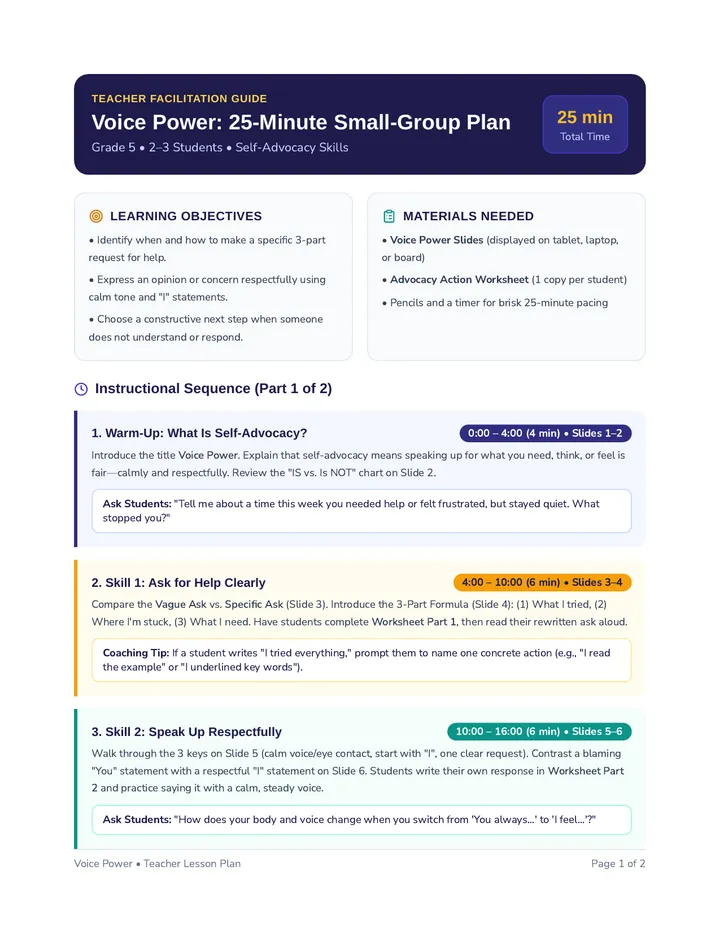
Voice Power Lesson Plan Teacher Facilitation Guide
Voice Power: 25-Minute Small-Group Plan
Grade 5 • 2–3 Students • Self-Advocacy Skills
25 min
Total Time
Learning Objectives
• Identify when and how to make a specific 3-part request for help.
• Express an opinion or concern respectfully using calm tone and "I" statements.
• Choose a constructive next step when someone does not understand or respond.
Materials Needed
• Voice Power Slides (displayed on tablet, laptop, or board)
• Advocacy Action Worksheet (1 copy per student)
• Pencils and a timer for brisk 25-minute pacing
Instructional Sequence (Part 1 of 2)
1. Warm-Up: What Is Self-Advocacy? 0:00 – 4:00 (4 min) • Slides 1–2
Introduce the title Voice Power. Explain that self-advocacy means speaking up for what you need, think, or feel is fair—calmly and respectfully. Review the "IS vs. Is NOT" chart on Slide 2.
Ask Students: "Tell me about a time this week you needed help or felt frustrated, but stayed quiet. What stopped you?"
2. Skill 1: Ask for Help Clearly 4:00 – 10:00 (6 min) • Slides 3–4
Compare the Vague Ask vs. Specific Ask (Slide 3). Introduce the 3-Part Formula (Slide 4): (1) What I tried, (2) Where I'm stuck, (3) What I need. Have students complete Worksheet Part 1, then read their rewritten ask aloud.
Coaching Tip: If a student writes "I tried everything," prompt them to name one concrete action (e.g., "I read the example" or "I underlined key words").
3. Skill 2: Speak Up Respectfully 10:00 – 16:00 (6 min) • Slides 5–6
Walk through the 3 keys on Slide 5 (calm voice/eye contact, start with "I", one clear request). Contrast a blaming "You" statement with a respectful "I" statement on Slide 6. Students write their own response in Worksheet Part 2 and practice saying it with a calm, steady voice.
Ask Students: "How does your body and voice change when you switch from 'You always...' to 'I feel...'?"
Voice Power • Teacher Lesson Plan Page 1 of 2
Instructional Sequence (Part 2 of 2)
Minutes 16–25
4. Skill 3: Handle a Challenge & Role-Play 16:00 – 22:00 (6 min) • Slides 7–8
Normalize that advocacy does not always work on the first try. Review the 4 next steps (Slide 7): Rephrase, Pick a better time, Show or write it, Ask another helper. Have students complete Worksheet Part 3, then pair up (or role-play with you) for 60 seconds per scenario on Slide 8.
Role-Play Prompt: Play the distracted teacher or defensive friend briefly so students practice staying calm and trying their Plan B.
5. Wrap-Up & Personal Pledge 22:00 – 25:00 (3 min) • Slide 9
Recap the 3-tool kit on Slide 9. Give students 2 minutes to complete Worksheet Part 4 and circle their readiness check-in. Close with each student sharing their one-sentence pledge aloud.
Small-Group Coaching & Differentiation
For Quiet or Hesitant Students:
Let them whisper-rehearse their line to you once before role-playing, or allow them to start with a written note as their first step.
For Blunt or Frustrated Students:
Practice lowering volume and slowing pace. Remind them that calm delivery helps the listener hear the message instead of getting defensive.
Sample Student Responses (Worksheet Guide)
Part 1 (3-Part Help Ask): "I already tried #1 and #2. I'm stuck on #3 because I don't know which operation to use first. Can you help me set up the first step?"
Part 2 ("I" Statement): "I feel frustrated when my ideas aren't heard. I want to be part of this project—can we take turns writing down our ideas?"
Part 3A (Teacher Busy): Write the question number on a sticky note and hold it up, or ask a table partner while waiting for a better moment.
Part 3B (Friend Says "Just Kidding"): Stay calm and rephrase clearly: "I know you meant it as a joke, but it still bothers me. Please call me by my real name."
Voice Power • Teacher Lesson Plan Page 2 of 2