Heart Felt Teacher Guide Heart Felt
Understanding Emotions • Grades 3-5
20 Minutes Total Duration
Empathy Focus Primary Objective
Interactive Learning Style
Why This Matters
Teaching emotions helps students manage feelings, improve communication, and build empathy. By naming their feelings, students gain better control over their reactions and social interactions.
Prepare Materials
• Review Emotions for Kids Video (provide link to students)
• Print Emotion Worksheet for each student
• Prepare Emotion Cards
• Set up video equipment
Instructional Path
1
Warm-Up: Facial Mimicry
3 MIN
Discuss known emotions. Show Emotion Cards and have students mimic facial expressions to "embody" the feeling.
2
Watch & Learn
5 MIN
Play the selected video. Ask students to pay close attention to the visual cues (body language, tone) used for different emotions.
3
Heart-to-Heart Discussion
5 MIN
Discuss video content. Share personal stories of feeling these emotions and talk about healthy vs. unhealthy expressions.
4
Reflection Worksheet
5 MIN
Students draw/write about a specific emotion they've felt, focusing on appropriate ways to express that feeling to others.
5
Quiet Hearts Cool Down
2 MIN
Deep breathing and calming reflection. Remind students that all emotions are valid when expressed respectfully.
Emotion Mimicry Warm-Up Activity Warm-Up Activity
Emotion Mimicry
"Mirror the feeling, share the story!"
Objective
Engage students and introduce the topic of emotions through a fun, interactive mimicry game that builds physical awareness of feelings.
Materials Needed
Emotion Cards (Happy, Sad, Angry, Surprised, Scared, Excited)
How to Play
1
The Setup (1 min)
Explain that students will play "Emotion Mimicry." When they see an Emotion Card, they must mimic that facial expression. Encourage them to be "over-the-top" and use their whole face!
2
Mirror Time (2 min)
Show cards one at a time. After everyone mimics the expression, pause and ask: "What is a situation that might make you feel this way?" Take 1-2 quick answers per card.
3
Wrap-Up (1 min)
Ask students: "How did it feel to express different emotions?" Remind them that emotions are natural and recognizing them is the first step to understanding them.
Keep it light-hearted! This activity is meant to break the ice and create a safe space for expression.
Calming Reflection Cool Down Activity Cool Down
Calming Reflection
"Breathing in peace, breathing out kindness."
Objective
Help students relax and reflect on the emotions lesson, reinforcing the importance of processing feelings in healthy, calm ways.
Breathing Space
1 MIN
Guide students through deep breathing: Inhale slowly through the nose (count to 3)... Hold (count to 1)... Exhale gently through the mouth (count to 4). Repeat 3 times.
Mindful Reflection
1 MIN
Ask students to close their eyes. Ask: "Think of one emotion from today. How can you express it in a healthy way next time you feel it?" Remind them all feelings are valid.
Closing Connection
OPTIONAL
Play soft, calm music. Conclude by saying: "Knowing our feelings helps us grow and be kind to others. You did a great job today."
Pro Tip: Dimming the lights slightly during this activity can significantly help students settle into a calm state.
Emotion Reflection Worksheet Emotion Reflection
Think about a time you felt a strong feeling.
Name:
Date:
Instructions: Think about a time when you felt a strong emotion. Use the prompts below to reflect on your experience. You can draw or write your responses.
1 What emotion did you feel?
Examples: Happy, sad, angry, surprised, scared, excited...
2 What happened to make you feel this way?
3 How did you express this emotion?
Did you smile, cry, shout, or do something else?
4 How could you express this in a healthy way next time?
5 Draw a picture of yourself feeling this emotion.
Remember: All emotions are important and it's okay to feel them!
Understanding Emotions Reading Passage Heart to Heart
Understanding Your Inner World
What Are Emotions?
Emotions are feelings that we all experience. They can be happy, sad, angry, scared, excited, and many more. Emotions are a natural part of being human and help us understand how we feel about different situations.
Why Are Emotions Important?
Emotions tell us how we feel about things happening around us. They help us make decisions, communicate with others, and understand what we need. For example, feeling happy might tell us that we enjoy something, while feeling scared might tell us to be careful.
How Can We Express Emotions?
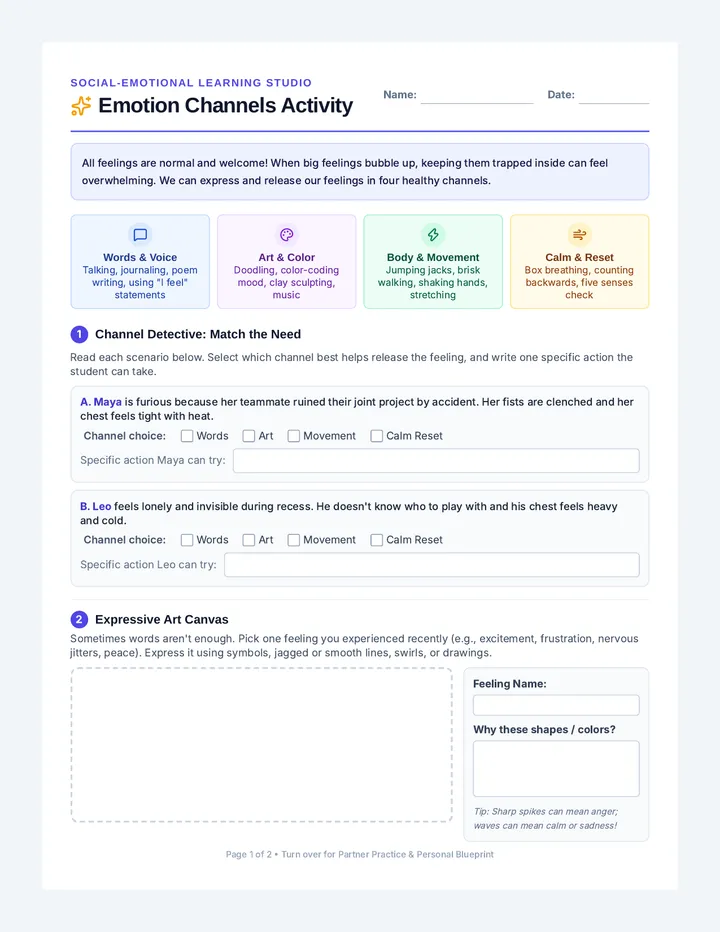
Expressing emotions means showing how we feel. We can express emotions through our facial expressions, words, and actions. It's important to express emotions in ways that are healthy and respectful to ourselves and others.
Facial Expressions
Smiles, frowns, wide eyes
Words
"I feel..." statements
Actions
Hugs, drawing, deep breaths
Understanding Others' Emotions
Just like we have emotions, other people do too. Understanding how others feel is called empathy . Empathy helps us be kind and supportive friends. We can show empathy by listening to others, noticing their feelings, and offering help if they need it.
4 Tips for Expressing Emotions
1 Talk About It: Use words to explain how you feel to a trusted adult or friend.
2 Draw or Write: Expressing yourself through art or a journal can help.
3 Take Deep Breaths: If a feeling is too strong, breathing helps you stay calm.
4 Find an Activity: Reading or playing can help you process your feelings.
"By understanding our emotions, we can build stronger relationships and feel more confident in ourselves."
Emotions Sharing Circle Guide Discussion Activity
Sharing Circle
"Listen with your heart, speak with your truth."
Objective
Provide students with a safe opportunity to share personal emotional experiences, practicing empathy and active listening in a supportive group setting.
Talking Stick
Or any small object to indicate the speaker.
Discussion Flow
1
Set the Norms (1 min)
Gather in a circle. Explain that only the person holding the stick speaks. Everyone else listens with their "whole bodies" (quiet mouths, eyes on speaker, hearts open).
2
The Lead-In (Teacher Lead)
Start by sharing a time you felt a strong emotion.
3
Student Sharing (3 min)
Pass the stick. Invite students to share a time they felt a specific emotion, how they expressed it, and how it made them feel afterward. Students may "pass" if they aren't ready to share.
4
Empathy Connection (1 min)
After a share, invite peers to give a "heart signal" (hands over heart) or a brief empathetic comment like: "I've felt that way too," or "Thank you for sharing."
Safety First
Ensure students know that everything shared in the circle stays in the circle, unless it's something that needs an adult's help for safety.
Emotion Charades Game Guide Interactive Game
Emotion Charades
"Act it out, guess the feeling!"
Objective
Reinforce students' understanding of emotions through a fun, collaborative game that focuses on non-verbal cues and body language.
Emotion Cards
Happy, Sad, Angry, Surprised, Scared, Excited, etc.
How to Play
1
Get Ready (1 min)
Explain the rules: "We are going to act out emotions without using words!" Divide the class into small groups or pairs and give each group a set of Emotion Cards.
2
Action! (5 min)
One student picks a card and acts out the emotion using only facial expressions and body language. The group tries to guess the feeling. Rotate turns so everyone gets a chance to perform.
3
Curtain Call (1 min)
Gather back and ask: "Which emotions were easy to guess? Which were hard? Why?" Discuss how observing body language helps us understand how others feel.
Actor's Strategy
Encourage students to focus on three things while acting:Eyes (wide, squinted, looking down)Mouth (frown, smile, open)Posture (slouched, jumping, hiding)
Emotions Quiz Emotions Quiz
How much do you know about feelings?
Name:
Date:
1
Which of the following is an example of a positive emotion?
Happy
Sad
Angry
Scared
2
What is the term for understanding how someone else is feeling?
Sympathy
Empathy
Apathy
Antipathy
3
Which emotion might you feel if you lost your favorite toy?
Excited
Joyful
Sad
Proud
4
Describe a time when you felt surprised. What happened and how did you express it?
5
Why is it important to express emotions in a healthy way?
Understanding emotions helps us grow together!