Ownership Anchor Chart The Ownership Shift
Staying in control when you make a mistake.
1
Listen & Breathe
Look at the person talking to you. Stay calm and wait until they are finished before you speak.
2
Say "Okay"
Acknowledge what was said with a calm "Okay" or "I understand." This shows you are listening.
3
No "Buts"
Don't argue, give excuses, or blame others. Accepting the consequence now is faster than fighting it.
4
Adjust & Move On
Do what is asked or follow the consequence. Once it's done, you can move back to your day with a clean slate!
Power Move:
Ownership is not about being perfect—it's about how you handle it when you're not.
Ownership Discussion Cards Reflection
Why is it sometimes really hard to say "Okay" when a teacher tells you that you have a consequence?
Ownership Shift
Strategy
What is one thing you can do with your body or breath to stay calm when you feel like arguing?
Ownership Shift
Impact
How does escalating a situation (arguing/yelling) affect the rest of the class?
Ownership Shift
Perspective
If you were the teacher, why would you appreciate a student who takes ownership right away?
Ownership Shift
The "But" Factor
What happens to a consequence when you say "But it wasn't my fault!" or "But they did it too!"?
Ownership Shift
Recovery
What does "starting with a clean slate" mean to you? How does it feel?
Ownership Shift
Action
Name three calm phrases you can use instead of arguing back.
Ownership Shift
Future Self
How will practicing "The Ownership Shift" now help you when you have a job in the future?
Ownership Shift
Ownership Scenario Challenge Worksheet Scenario Challenge
The Ownership Shift
Name:
Date:
The 4-Step Reminder
1
Listen & Breathe
2
Say "Okay"
3
No "Buts"
4
Adjust & Move On
SCENARIO 1
The Rules Routine
"The teacher is giving instructions for independent work. You start whispering to a neighbor. The teacher stops and says, 'I need you to stop talking and focus on your paper. That's a warning.'"
What you might feel like doing:
Blaming your neighbor for starting it, rolling your eyes, or continuing to whisper.
Your Ownership Shift Response:
SCENARIO 2
The Wandering feet
"You get up to walk across the room to see what a friend is doing. The teacher says, 'Please return to your seat right now. You didn't ask for permission to move.'"
What you might feel like doing:
Walking back slowly, sighing loudly, or arguing that you just needed a pencil.
Your Ownership Shift Response:
SCENARIO 3
The Object Distraction
"You are clicking your pen and spinning it on your desk instead of doing your math. The teacher says, 'Put the pen down and get to work, or I will have to hold onto it for the rest of the period.'"
What you might feel like doing:
Getting angry that they noticed, hiding the pen, or saying 'I was just thinking!'
Your Ownership Shift Response:
Ownership Lesson Guide Lesson Guide
The Ownership Shift
Social-Emotional Skills
Objective
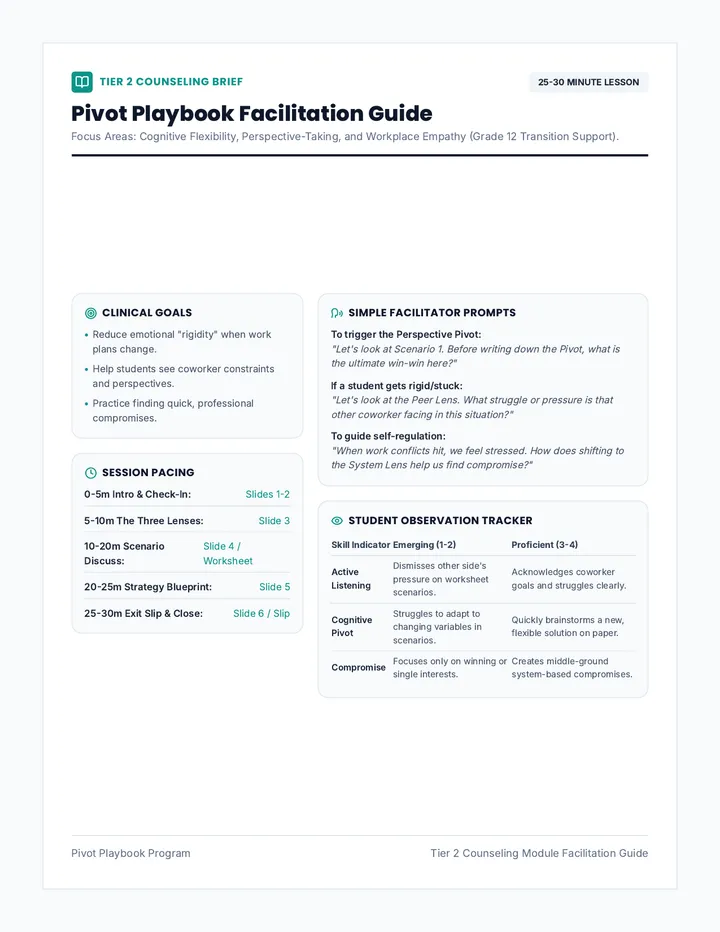
Students will identify the steps to accept consequences calmly and practice non-escalating responses to correction.
Time
45 - 60 Minutes
Materials
Anchor Chart
Discussion Cards
Scenario Worksheet
1. The Hook (5-10 mins)
Ask: "Have you ever seen someone get a small correction (like 'Please sit down') and turn it into a giant argument? What happens next?"
Teacher Tip: Focus on the "Snowball Effect"—how a 10-second correction can become a 30-minute problem if we don't handle it well.
2. Direct Instruction (10 mins)
Display The Ownership Shift Anchor Chart . Explain the four steps:
Listen & Breathe: Staying quiet is your superpower.
Say "Okay": This "verbal handshake" ends the conflict immediately.
No "Buts": "Buts" are the gas that fuels the fire. Even if you're right, save the talk for later.
Adjust & Move On: Do the thing, then get back to your day.
3. Discussion Groups (15 mins)
Distribute Ownership Discussion Cards to small groups. Have students take turns drawing a card and discussing their perspectives.
Circulate and listen for students who recognize the link between their response and the classroom vibe.
4. Role-Play & Scenarios (15-20 mins)
Hand out the Scenario Challenge Worksheet . For each scenario, use this structure:
The Role-Play Strategy
The "Mistake" Version: You (the teacher) and a student volunteer act out the scenario with an escalated response (arguing, walking away). Discuss how it feels.
The "Shift" Version: Act out the same scenario using the 4 steps. Note how quickly it ends.
Independent Work: Students write their ideal responses on the Scenario Challenge Worksheet.
5. Closing (5 mins)
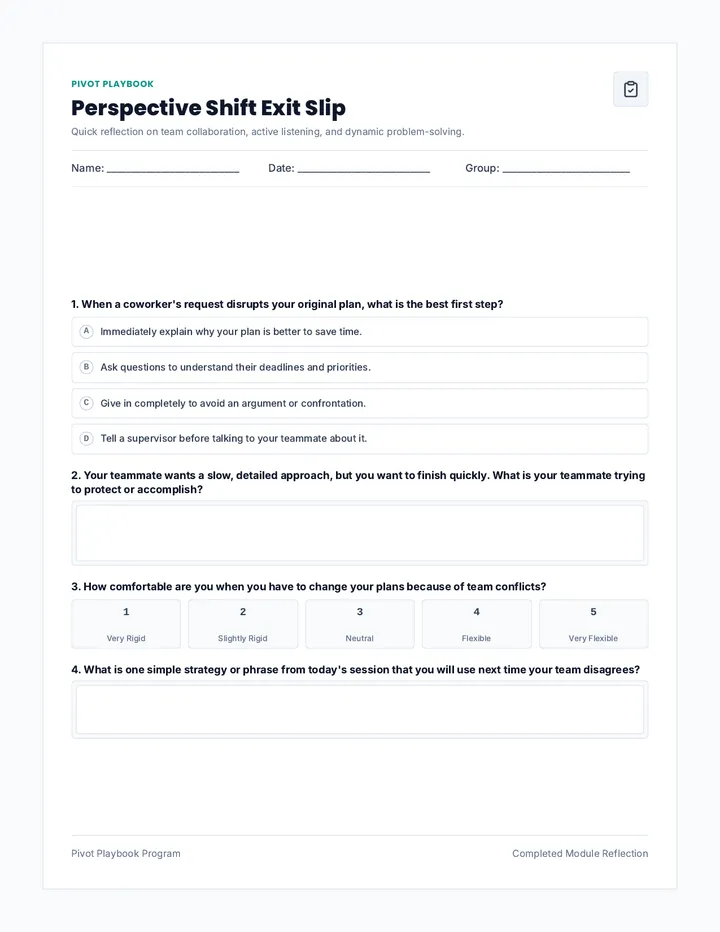
Exit Ticket Question: "Why is taking ownership of a small mistake easier than winning an argument with a teacher?"
Differentiation & Support
For students who struggle with verbal processing, provide a "Communication Card" they can point to that says "Okay/I understand" when they are too frustrated to speak.