Responsibility Accountability Lesson Plan Responsibility & Accountability
Building Awareness & Restoring Connection
Lesson Plan
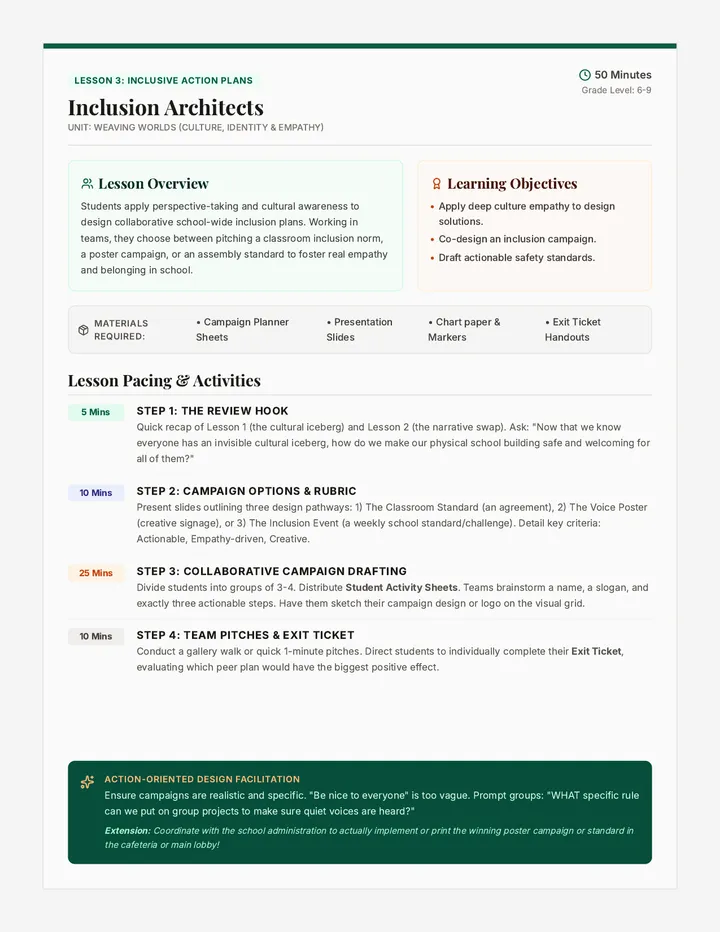
40 Minutes
The "Why"
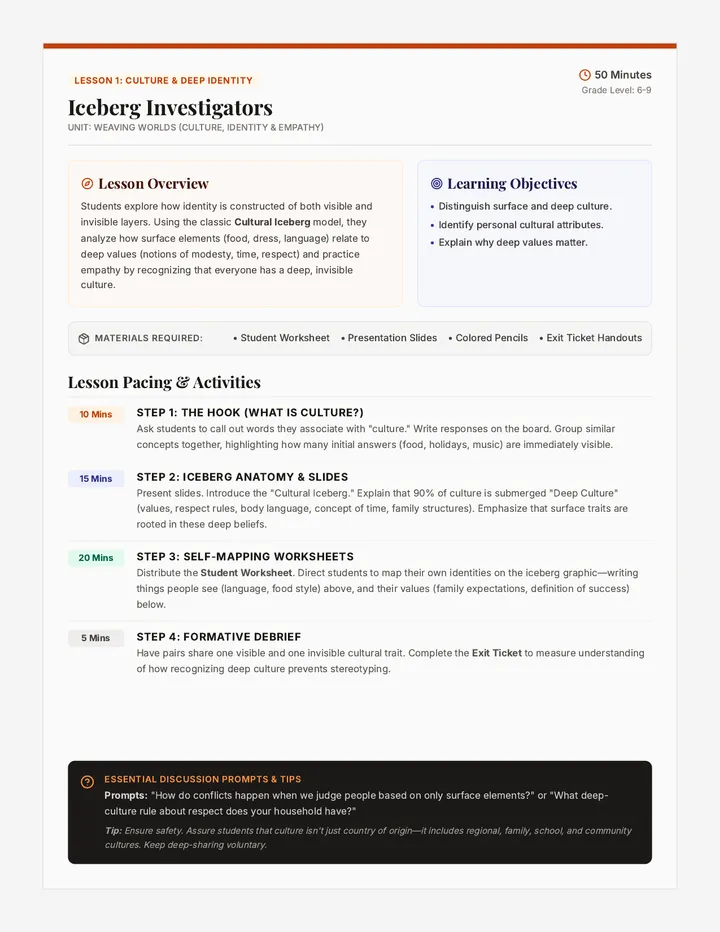
This lesson helps high school students in therapeutic classrooms understand the importance of taking responsibility and accountability for their actions. By exploring how their actions and words contribute to situations, students develop deeper self-awareness and empathy—essential for personal growth and healthy relationships.
Approach & Objectives
Focus: Trauma-Informed Teaching, Restorative Practices, Collaborative Learning
Objective: Students will distinguish between blame and accountability and identify personal strategies for taking responsibility.
Materials Checklist
Slide Deck: Responsibility & Accountability
Video Guide: Brené Brown on Blame
Worksheet: Reflecting on Responsibility
Scenario Cards: Blame vs. Accountability
Instructional Sequence
1
5 Mins
Introduction & Warm-Up
Begin with a brief discussion on what responsibility and accountability mean. Ask students to share examples of when they have taken responsibility for their actions. Focus on the feeling of taking responsibility vs. making excuses.
2
5 Mins
Video Viewing
Show the video Brené Brown on Blame . Distribute the "Video Follow-Along" worksheet for students to complete as they watch. Remind students that blame is often a way to discharge pain or anger.
3
10 Mins
Group Discussion
Facilitate a discussion on the video. Ask: "How does blame differ from accountability?" and "How does it affect relationships?" Encourage students to share personal insights or experiences where blame got in the way of solving a problem.
4
10 Mins
Blame vs. Accountability Activity
Divide the class into small groups and provide each group with a set of Scenario Cards . Groups discuss two possible responses: one involving blame and one involving accountability. Have groups act out both responses for the class if time allows.
5
7 Mins
Individual Reflection
Distribute the Reflecting on Responsibility worksheet. Have students complete it individually, reflecting on a recent situation where they had to take responsibility.
6
3 Mins
Closure
Invite a few students to share reflections. Summarize key takeaways: Accountability is about connection and learning; blame is about control and shame.
Responsibility Accountability Slides Responsibility
& Accountability
Building Self-Awareness & Stronger Relationships
The Warm-Up
"What does it mean to take responsibility for your actions?"
Think About:
A time you admitted a mistake.
How it felt before you spoke up.
How it felt after you took ownership.
The Great Divide
Blame
"The discharging of pain and discomfort."
Looking for someone to point at.
Accountability
"Owning our role in a situation."
Looking for a way to grow and heal.
Watch: Brené Brown on Blame
RSA Short / ~3 Mins
Embedded media
Follow along on your "Video Guide" worksheet!
Reflect & Discuss
1
Why does Brené Brown say blame is "incompatible with accountability"?
2
How did the speaker respond when she dropped the coffee? Was that accountability?
3
Think of a time you were blamed. How did it affect your relationship with that person?
The Anatomy of Accountability
1. Awareness
Noticing when we want to blame someone else to avoid feeling bad.
2. Ownership
Saying "I am responsible for my part in this," without excuses.
3. Action
Making it right. How can I fix this or do better next time?
Role Play Challenge
In your groups, take a Scenario Card. You must act out two responses:
Version A: BLAME
Version B: ACCOUNTABILITY
"Accountability is an act of courage."
When we take responsibility, we stop being victims of our circumstances and start being the authors of our lives.
Complete your Reflection Worksheet
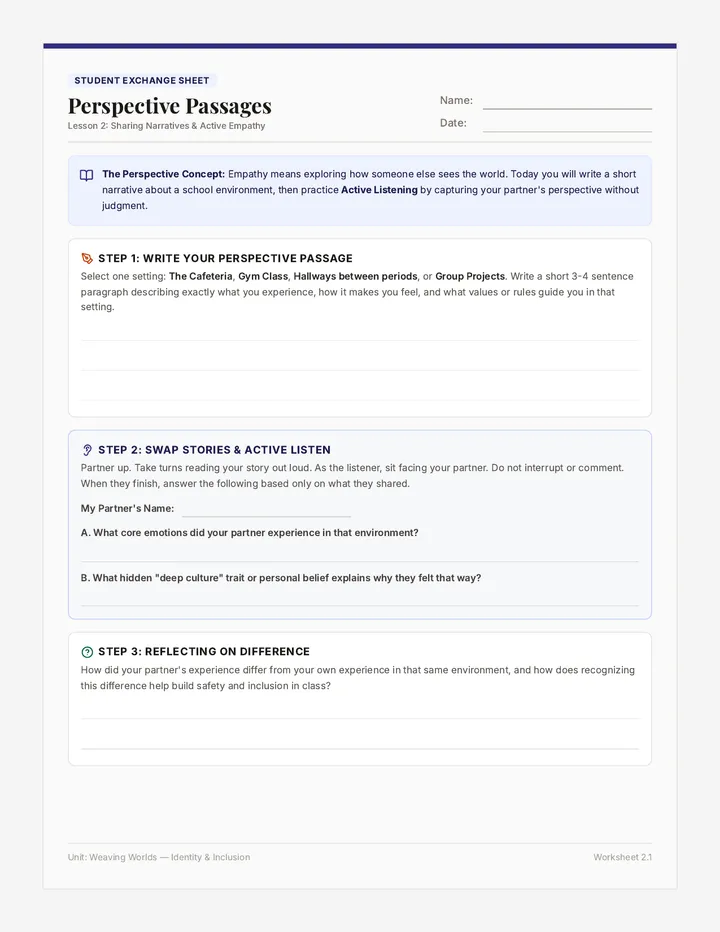
Reflecting on Responsibility Worksheet Reflecting on Responsibility
Personal Growth Studio
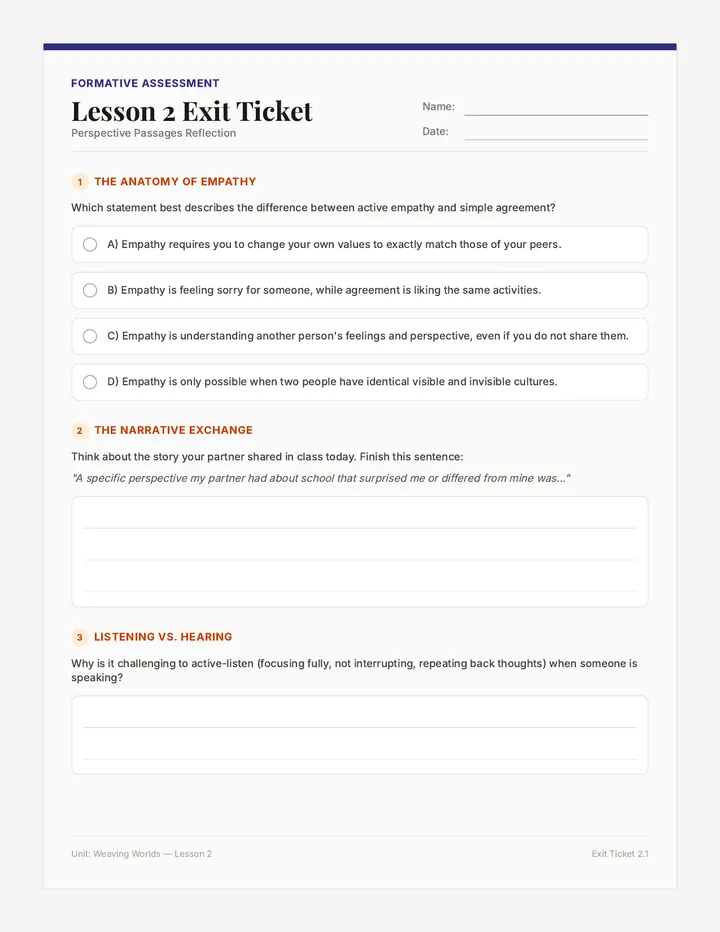
Name:
Date:
Taking responsibility isn't about blaming ourselves—it's about owning our power to make things right. Use this space to reflect honestly on a recent experience.
1
Describe a recent situation where you had to take responsibility for your actions. What happened?
2
How did taking responsibility affect the outcome of the situation? (Was it better, worse, or just different?)
3
What did you learn about yourself or your relationships from this experience?
4
How can you apply this learning to future situations? What will you do differently next time? Blame Accountability Scenario Cards Scenario Challenge Cards
Blame vs. Accountability
Cut out these cards. For each scenario, discuss: (A) What does Blame look like? and (B) What does Accountability look like?
1
The Homework Hiccough
You forgot to do your homework and tell your teacher that your friend distracted you.
Role Play Required
2
The Meeting Delay
You were late to a group meeting and blame traffic, or you apologize and offer to make up for lost time.
Role Play Required
3
The Broken Project
You accidentally broke a classmate's project and say it was already unstable, or you admit your mistake and help fix it.
Role Play Required
4
The Test Trouble
You didn't study for a test and blame the teacher for not covering the material, or you acknowledge your lack of preparation.
Role Play Required
5
The Missed Deadline
You missed a deadline and blame your team for not reminding you, or you take responsibility and work on your timing.
Role Play Required
Create Your Own
Think of a situation from your own week!
Restorative Practices Curriculum • Module 4: Personal Ownership
Brené Brown Video Guide Video Guide: Blame
Brené Brown on Accountability
Name:
Date:
Watch & Listen
As you watch the video, pay attention to how Brené defines blame. Look for the difference between finding a "culprit" and taking "accountability."
01 What is the main message Brené Brown conveys about blame?
02 List two examples Brené Brown uses to illustrate blame.
A.
B.
03 How does blame affect relationships, according to the video?
04 Reflect on a time when you blamed someone else. How could you have taken accountability instead?
Blame
Discharging pain
Accountability
Owning ownership