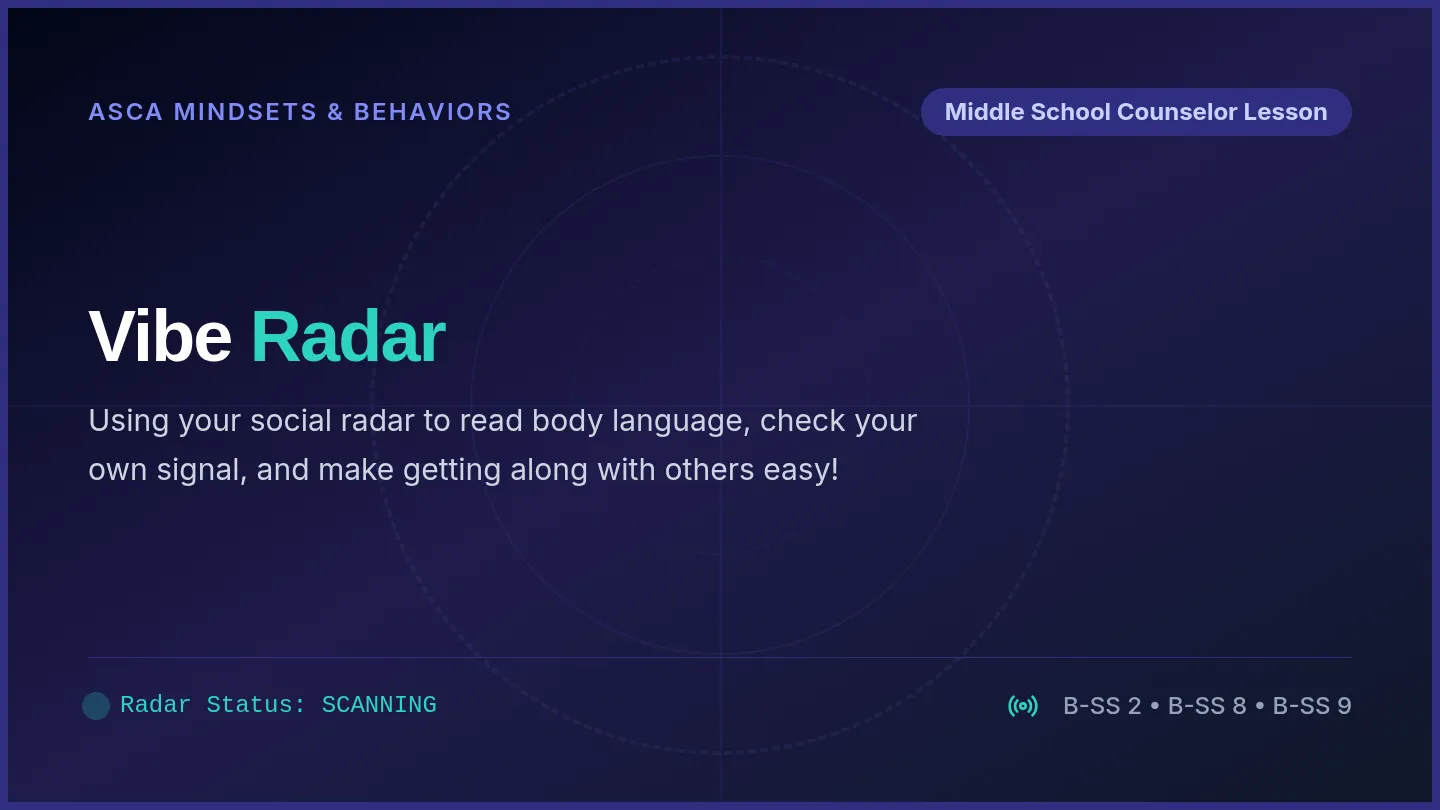
Respect Radar Slides
System Online
RESPECT RADAR
How we speak, listen, and react sends out waves. Learn to scan your surroundings, read the room, and project positive respect.
Mode Active Reflection
Subject Character Education
Slide 1 of 8
Concept Matrix
Unit 01
The Sonar Principle:
What Goes Out Bounces Back
Submarines send sound waves into the dark water. If they hit something, they echo back, drawing a map of the ocean.
Respect works the exact same way. The attitude, words, and body language you send out into the classroom bounce back and shape your entire environment.
The Respect Loop
Project respect → Create trust
Prompt: Think of a time your attitude set the mood of a room.
Slide 2 of 8
Signal Detection
System Calibration
Reading the Radar
How do we separate clear respectful signals from disruptive interference?
Green Signals
Strengthens the connection
- Active Radar Listening: Eyes and posture focused, nodding to show comprehension.
- Boundary Support: Stepping back when someone requests physical or emotional space.
- Voice Calibration: Speaking in a neutral, calm, and collaborative tone.
Radar Interference
Breaks the connection
- Signal Jamming: Talking over others, interrupting, or raising your voice to drown them out.
- Deflection Tactics: Eye-rolling, heavy sighs, or mocking expressions that dismiss people silently.
- Invisible Mode: Ignoring people, turning away, or scrolling on devices when they are speaking.
Prompt: Which "interference" is the easiest to accidentally commit?
Slide 3 of 8
Scenario 01 Collaboration Glitch
Alert Level: High
Group Work
The Teamwork Blind Spot
Your science team is deciding who builds the model rocket. Leo eagerly shares an idea he spent all weekend planning.
Before he finishes, Marcus interrupts: "That's way too hard. Let's just do a plain bottle rocket instead. Who agrees?" The group immediately turns away from Leo to vote.
Radar Sweep Questions
1
How did the group jam Leo's signal? Identify both the verbal and non-verbal actions.
2
If you were in this group, what is a specific phrase you could use to reboot the conversation with respect?
Goal: Notice the quiet voices and bring them back onto the radar.
Slide 4 of 8
Scenario 02 Performance Pressure
Alert Level: High
Physical Space
The Sideline Echo
During a soccer scrimmage in PE class, Maya misses an open shot on goal, causing her team to lose the lead.
Two teammates, Sarah and Chloe, walk back to the starting line together. They make eye contact with Maya, laugh quietly, whisper behind their hands, and shake their heads.
Radar Sweep Questions
1
Why are silent cues (whispering, eye contact, laughing) sometimes more damaging than words?
2
How could Maya respond in a way that establishes her boundaries firmly without escalating conflict?
Goal: Protect teammates when mistakes inevitably happen.
Slide 5 of 8
Scenario 03 Digital Footprint
Alert Level: High
Online Space
Digital Interference
Your class has a group chat for history homework. Late at night, a student sends a photo of a classmate with funny drawing overlays, making fun of how they spoke during an oral report.
A few people send "laughing" emojis, but the classmate pictured is also in the chat and stops responding entirely.
Radar Sweep Questions
1
Why is respect harder to maintain on digital platforms? How does distance distort our radar?
2
What is a small action an observer could take in this chat to clear the digital interference?
Goal: Maintain the same code of honor online as you do in person.
Slide 6 of 8
Calibration Protocol
Proactive Respect
Calibrating Your Radar Daily
Implement these three core protocols to keep your social radar clear and accurate.
01
Scan the Edges
Look for those who aren't being included. Who is sitting on the edge of the circle? Pull them in by actively asking their input or inviting them over.
02
Filter out Static
Refuse to repeat gossip, laugh at disrespectful jokes, or echo negativity. When you stop returning the static, the room cools down.
03
Align Tone
Check your volume, face, and body posture before responding to tension. Direct eye contact with relaxed shoulders is highly grounding.
Practice: Choose one protocol to focus on during today's transitions.
Slide 7 of 8
Radar Diagnostic
Shutdown Protocol
Self-Scan Complete
Respect is not passive. It takes intentional effort to turn on your radar, scan for needs, and transmit positive connections.
Be the signal booster in your environment. Respect is contagious.
Your Next Flight Steps:
A
Fill out your Radar Flight Log
Write down your personal radar metrics on the student reflection guide.
B
Identify One Partner
Share one green signal you will commit to boosting today in school.
C
Scan for Obstacles
Commit to spotting and defusing interference before it grows.
Thank you for calibrating your Respect Radar!
Slide 8 of 8
Respect Radar Guide
Facilitator Companion
CLASSROOM TOOLKIT
RESPECT RADAR
Core Metaphor and Classroom Implementation Guide • Grade levels 5-8
Duration 45 - 60 Mins
Target Value Respect & Boundaries
Format Slide & Discussion
Complexity Medium - High
Lesson Strategy
The Respect Radar framework uses a sonar-scanning metaphor to teach emotional intelligence. Instead of lecturing, this lesson positions respect as a signal-feedback system. What students project is what they receive. What they ignore or mock disrupts the entire classroom ecosystem (radar interference).
Setup & Materials
- Digital Display: Project the companion slides (Respect Radar Slides).
- Student Worksheets: One copy of the Respect Radar Reflection sheet per student.
- Concept Warm-Up: Optional use of standard lasers/mirrors to show physical reflection.
Facilitation Timeline
1. Signal Launch: The Hook (5-10 Mins)
Introduce sonar. Ask: "How do animals like bats navigate in pitch black?" Connect this to how we navigate social situations where thoughts aren't fully visible.
2. Interactive Scan: Calibration (15 Mins)
Review Slide 3 (Green Signals vs. Interference). Emphasize body language, active listening, and silent cues. Have students name key "interference" indicators.
3. Live Testing: Scenario Work (20-25 Mins)
Present Scenarios 1-3. Use Page 2 discussion notes to run small group dialogues. Instruct students to take reflective notes on their student worksheets.
Respect Radar Facilitator Guide Page 1 of 2
Facilitator Companion
CLASSROOM TOOLKIT
SCENARIO DEBRIEF PROTOCOL
Use these deep-dive questions and target student insights during class discussions.
Scenario 01
The Teamwork Blind Spot (Slide 4)
Key Issue: Groupthink & micro-exclusion. Ignoring helpful ideas for speed or popularity.
Probing Questions
- Why is it easier to go with the crowd than speak up?
- What is the long-term impact on group safety?
Target Responses
"We must slow down to hear everyone." or "Say: 'Let's actually look at Leo's design before choosing.'"
Scenario 02
The Sideline Echo (Slide 5)
Key Issue: Silent alienation. Shaming a teammate using subtle non-verbal signals.
Respect Radar Reflection
Crew Member Name
Date
Mission / Class
RESPECT RADAR: FLIGHT LOG
Track your signals, detect interference, and transmit high-level respect.
RADAR ACTIVE
1 The Sonar Principle
In your own words, explain how our personal attitude acts like sonar waves inside a classroom or group. What does it mean when we say "what you send out is what bounces back to you"?
2 Reading the Room
Review the social situations you witness daily. Write down one specific action for each category below:
Green Light Signal (Respect)
An action or cue that builds trust:
Red Flag Signal (Interference)
An action or cue that shuts down trust:
3 Scenario 1: Teamwork Pivot (Leo & Marcus)
In Slide 4, Marcus interrupts Leo's model rocket idea. If you were a teammate sitting at that table, write a specific, respectful response to bring Leo back onto the radar.
Respect Radar Reflection Page 1 of 2
Flight Instrument
MISSION CONTROLLER
SCENARIO LOG & ALIGNMENT
Formulating active responses for playground and digital situations.
4 Scenario 2: The Sideline Response (Maya)
In Slide 5, Maya missed a soccer shot, and teammates Sarah and Chloe laughed and whispered. How could Maya express her boundaries clearly and calmly to stop this interference?
5 Scenario 3: The Digital Pivot (Homework Chat)
In Slide 6, an embarrassing photo of a teammate was sent. Describe one small thing you would text in that group chat to completely stop the negativity and align back to safety.
6 Daily Personal Calibration
Select at least two protocols you will commit to deploying on your radar starting today:
Protocol A: Scan the Edges
I will look for students who are left out and invite them into my discussion or play group.
Protocol B: Filter out Static
I will refuse to laugh at jokes that target others, spread rumors, or echo critical messages in chats.
Protocol C: Align Tone
I will actively manage my breathing and physical posture when having hard conversations.
Respect Radar Reflection Page 2 of 2