Rage Bait Reset Slides
System Alert // Provocation Protocol 8th Grade Social Design
RAGE BAIT RESET
Unpacking the mechanics of peer provocation, emotional zone-hijacking, and how to stay in complete control of your reactions.
Do not take the bait. Own your energy.
Slide 1 of 8
What is "Rage Baiting"?
Core Concept
Online vs. Real Life
On social media, "rage bait" is content specifically designed to make viewers angry or outraged so they comment, share, and boost the algorithm.
In middle school, peer-to-peer rage baiting happens when someone says things on purpose to get an emotional reaction out of someone they don't like.
The Setup
Comments about clothing, skill levels, friend groups, or past mistakes designed to sting.
The Hidden Goal
They don't want a civil conversation; they want you to lose your temper so you look like the out-of-control one.
Key Term: Provocation Slide 2 of 8
Why Do They Bait?
Understanding the "Why"
When people attempt to provoke others, it is rarely about the target. It's almost always a sign of the provoker's own internal zone state.
BLUE
The Tired, Bored, or Sad State
A student in the Blue Zone might feel completely disconnected or low energy. They bait others to spark instant, artificial drama to feel "entertained" or relieve their own boredom.
YEL
The Insecure or Anxious State
A student in the Yellow Zone might feel frustrated or insecure. Baiting someone else acts as an emotional shield—making others look weak distracts from their own anxiety or lack of control.
Class Discussion: Have you ever noticed this connection? Slide 3 of 8
Tracking the Zone Shift
Zones of Regulation
Baiting aims to pull a student directly out of a productive state of mind. Watch how fast a target’s zone shifts when the bait is accepted:
START
Green Zone
Calm, focused, ready to learn, enjoying friends.
"They pass you in the hall and make a snide comment."
WARNING
Yellow Zone
Frustrated, physiological response starts, breathing speeds up.
"You stop, clench your fists, and feel your face get hot."
HIJACKED
Red Zone
Yelling, aggressive, physical reaction, out of control.
"You yell back an insult, getting the teacher's attention."
Result: The provoker gets exactly what they wanted, and you get the penalty.
Takeaway: Refuse to give them the remote control to your emotions. Slide 4 of 8
8th Grade Scenario Analysis
Scenario Study
THE BAIT
The "Overrated" Whisper
Marcus is practicing basketball before school. Jaxon—who doesn't like Marcus—stands on the sidelines and mutters loudly, "Man, look at those bricks. Who told him he was varsity material? Completely overrated."
What Jaxon Wants:
For Marcus to throw the ball at him, get mad, and lose focus on practice.
Disarming the Scenario
How can Marcus respond in a way that keeps him in the Green Zone while leaving Jaxon holding the empty line?
- Option A (Planned Ignore): Make eye contact, shrug slightly, and sink another shot.
- Option B (Agreement Disarm): "Good thing I'm practicing then." and keep going.
Discussion: Why is reacting with anger giving them power? Slide 5 of 8
The "No-Click" Strategies
Regulation Tools
Planned Ignore
Completely cut off the feedback loop. No facial reaction, no body language shift, no verbal reply. To them, it must look like their bait fell into a void.
Zone Preservation
Neutral Agreement
Agree with the basic premise of their comment to drain the power out of it. "Yeah, I probably could have done better there." and walk away.
Emotional Redirection
Self-Talk Anchor
Repeat a quiet internal statement: "This is about their zone, not mine." or "I'm keeping my energy." This maintains focus on the Green Zone.
Internal Regulation
Pro Tip: You are in absolute control of where you spend your attention. Slide 6 of 8
Activity: Four-Zone Sort
Interactive Lab
Sorting Social Behaviors
We will be working in pairs with our Rage Bait Reset Sorting Cards. Your task is to categorize behaviors into their correct regulating Zone:
Blue: Disconnected, flat responses, or low-motivation baiting.
Green: Productive ignoring, calm self-talk, healthy exit.
Yellow: Anxious defense, smirking back, sarcastic comebacks.
Red: Outbursts, personal insults, high drama escalation.
Sorting Checklist:
1
Identify the action (e.g., "Planned Ignore").
2
Determine if it *helps* or *hurts* regulation.
3
Place it in the correct colored zone on your chart.
Get Ready: Teacher will pass out materials now. Slide 7 of 8
Reset Code Complete Final Thoughts
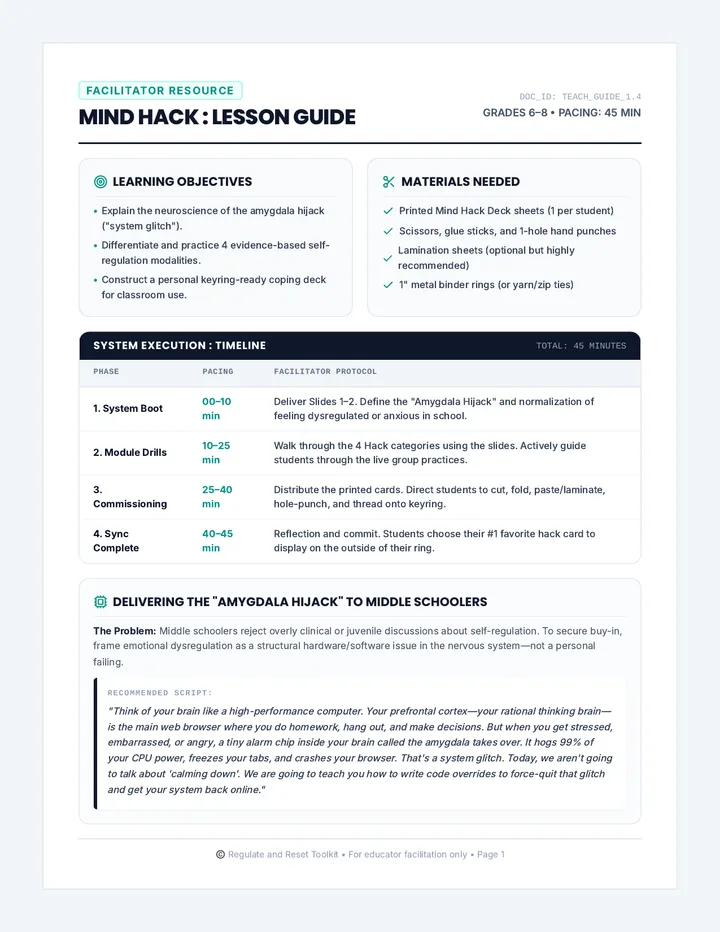
Your Brain is Your Territory
If you let another person determine whether you are happy, angry, calm, or stressed, you've handed them full administrator access to your brain.
"The ultimate power move is remaining completely untouched."
Next Step: Complete Reflection Worksheet Slide 8 of 8
Rage Bait Reset Teacher Guide
Facilitator Resource // Social Skill Design
RAGE BAIT RESET
Grade Range: 8th Grade
Focus: Peer Provocation
Framework: Zones of Regulation
Total Duration 45-50 Minutes
Materials Needed Slides, Cards, Worksheet
Group Setup Pairs / Small Groups
Learning Objectives
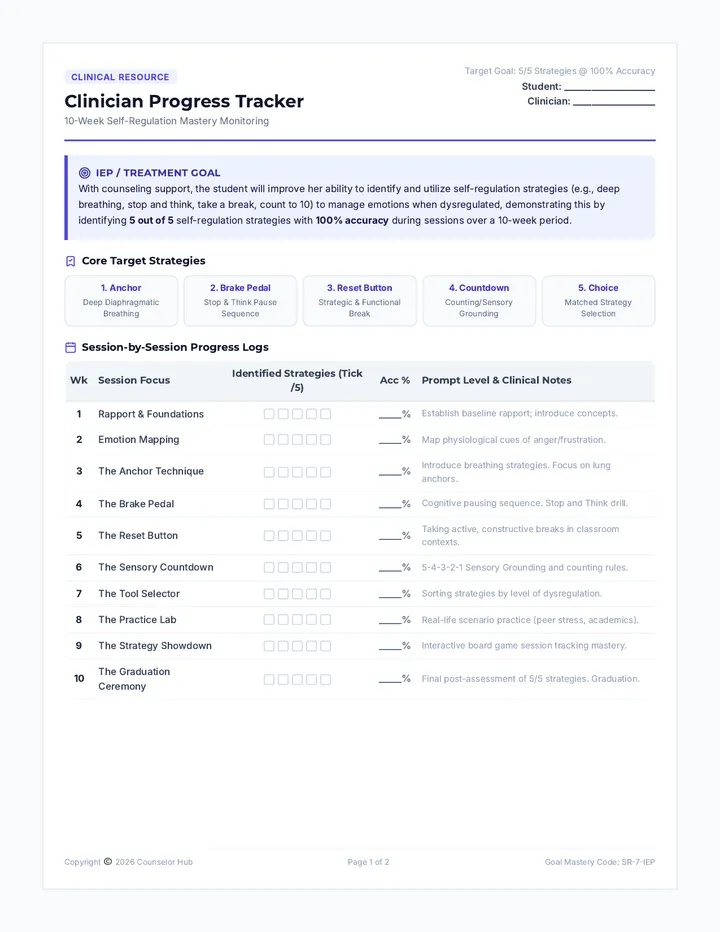
- Identify Baiting Motives: Students will analyze and explain how a provoker's zone (e.g., Blue or Yellow) drives them to bait others.
- Track Zone Transitions: Students will map the emotional movement of a target from the Green Zone to the Yellow/Red Zone during provocation.
- Apply Coping Strategies: Students will select and explain 1-2 functional coping tools to stay in the Green Zone when provoked.
Pacing & Facilitation Script
1. Hook: Digital to Real Life (5-10 Mins) SLIDES 1-2
Action: Define "rage bait" in social media (fake arguments, dramatic thumbnails). Pivot to real-world social context. Explain that online rage bait wants clicks; peer-to-peer baiting wants an emotional reaction to make you look bad.
Script: "We see rage baiting online all the time to get clicks. But some people bring this exact strategy into the school hallways. If someone doesn't like you, they might toss out a comment specifically hoping you'll react, lose your cool, and get in trouble. Today we're going to learn how to keep the control panel of your brain locked down."
2. The Provoker's Psychology (10 Mins) SLIDE 3
Action: Help students understand that baiting is a behavior stemming from the baiter's zone. If they are in the Blue Zone (bored, empty, isolated) they want to stir up excitement. If they are in the Yellow Zone (insecure, anxious, embarrassed) they want to drag others down to make themselves look dominant.
Script: "When Jaxon mocks Marcus, Jaxon isn't actually strong. Jaxon is likely in a low-energy Blue Zone looking for instant, toxic entertainment, or a chaotic Yellow Zone wanting to distract from his own insecurities. Realizing this changes how we see the bait. It's not a fact; it's just their dysregulation leaking out."
Rage Bait Reset Guide Page 1 of 2
3. Zone Transitions & "No-Click" Tools (10 Mins) SLIDES 4-6
Action: Walk through the three stages of a Zone Shift (Green -> Yellow -> Red) and contrast it with "No-Click" strategies (Planned Ignore, Neutral Agreement, Self-Talk Anchor). Practice saying neutral agreement responses as a class using dry, calm voices.
Script: "Notice how fast we move to Red when we take the bait. The provoker gets what they wanted—and you get the detention. Neutral Agreement is like judo; instead of blocking the blow, you let it slide off. Let's practice saying 'Yeah, probably' or 'Could be' with a blank face. It completely drains the drama out of their fuel tank."
Rage Bait Reset Sorting Cards
Print & Cut Activity // Set A
CONCEPT & SCENARIO CARDS
8th Grade Social Design
Teacher Instructions: Print this sheet on cardstock if possible. Have students cut along the dashed lines to create individual cards. Use these cards for vocabulary review and scenario sorting in pairs.
Concept Card
Rage Baiting
An intentional social move where a student says something provoking or insulting directly to a peer they dislike, trying to trigger a heated emotional response.
Rage Bait Reset Card 01
Concept Card
Planned Ignore
Choosing to give zero feedback to a provoker. No head turn, no eye contact, no facial expressions, and no verbal reply. The interaction falls completely flat.
Rage Bait Reset Card 02
Scenario A
The Science Fair Jab
Context: Sarah is presenting her project. Chloe walks by and whispers loudly, "Looks like a 3rd grader glued that together. Embarrassing." Chloe looks around to see if others heard.
Rage Bait Reset Card 03
Scenario B
The Gym Class Fumble
Context: Liam drops a pass in soccer. David immediately claps mockingly, shouting, "Classic Liam! Always helping the other team win! Best player on their side!"
Rage Bait Reset Card 04
Concept Card
Neutral Agreement
Agreeing with the factual core of an insult in a flat, unbothered voice. This leaves the baiter with nothing to argue against, stopping the drama immediately.
Rage Bait Reset Card 05
Concept Card
Self-Talk Anchor
A private phrase you repeat silently in your head to stabilize your emotions. (e.g., "They want me angry, but I'm in control of my own zone.")
Rage Bait Reset Card 06
Rage Bait Reset Sorting Cards Page 1 of 2
Print & Cut Activity // Set B
BEHAVIOR SORT CARDS
8th Grade Social Design
Sorting Task: Review the behaviors below. Determine which Zone of Regulation matches each behavior or reaction. Categorize them into Blue, Green, Yellow, or Red.
Sarcastic Retort
Smirking and replying, "Oh look, the genius has an opinion. Let's write that down." You feel your heart speeding up.
Which Zone? Card 07
Silent Deep Breath
Taking a slow, four-second breath through your nose and exhaling before responding or walking away.
Rage Bait Reset Worksheet
Student Worksheet // Individual Reflection
RAGE BAIT RESET
Interactive Session
Name:
Date:
Mission Protocol
Rage baiting only works if you click and engage. If you react with anger, you've handed the control panel of your emotional state to someone else. Complete this sheet to build your personal reset plan.
1 Part 1: Deconstructing the Provocation
Recall the science fair scenario (Chloe mocking Sarah) or the gym soccer scenario (David yelling at Liam). Choose one to analyze below:
Why is the provoker baiting? What Zone are they likely in, and what do they gain?
How does the bait push the target out of the Green Zone? Describe the physiological shift.
2 Part 2: Map the Shift
Fill in each box to describe the thoughts and behaviors as the target transitions through these emotional zones:
Green (Target's Start)
Yellow (The Warning)
Red (The Explosion)
3 Part 3: The "No-Click" Personal Strategy
Select one strategy (Planned Ignore, Neutral Agreement, or Self-Talk Anchor) and explain how you would execute it.
Why does this strategy keep you in control? How does it disarm the provoker?
Rage Bait Reset Worksheet Page 1 of 1