Pause Think Respond Slides 6th Grade Counseling
Pause. Think. Respond.
How to take control of the 3-second gap between what happens to you and what you do next.
1. Pause
2. Think
3. Respond
Why It Matters
Reacting vs. Responding
Instant React
• Happens in less than 1 second
• Driven by anger, stress, or embarrassment
• Often makes peer drama bigger
Chosen Response
• Uses a 3-second mental reset
• Driven by your goals and values
• Protects your friendships and reputation
Discussion: When is it hardest to pause in 6th grade?
Step 1
PAUSE: Hit the Brake
Notice Body Signals
• Heart beating faster
• Tight jaw, fists, or shoulders
• Face feeling hot
• Urge to snap back right away
Your 3-Second Reset
1. Drop your shoulders.
Tip: Silence for 3 seconds gives your thinking brain time to catch up.
Step 2
THINK: Run a Quick Check
01
What am I feeling?
Name it: frustrated, left out, embarrassed, or overwhelmed?
02
What are my choices?
List at least two options before you speak or type.
03
What happens next?
Will this choice solve the problem or start a bigger fire?
Remember: You do not have to act on every thought that pops up.
Step 3
RESPOND: Choose Your Move
Use an "I" Statement
"I feel ___ when ___. Next time, please ___."
Set a Clear Boundary
"I'm not okay with that joke. Let's talk about something else."
Take Space
"I need a minute before we talk about this."
Ask for Backup
Talk to a trusted teacher, counselor, or family member.
Strong responses are calm, clear, and respectful—to others and yourself.
Practice Together
6th-Grade Scenario Lab
Scenario A: Group Chat
Someone posts an embarrassing photo of you in the friend group chat and people start adding laughing emojis.
Scenario B: Hallway Bump
A classmate knocks your binder out of your hands in the hallway and walks away laughing without helping.
Turn & Talk: What would PAUSE, THINK, and RESPOND look like?
Your Next Move
Own the 3-Second Gap Today
The next time your body signals stress or frustration, remember: Pause to breathe, Think through your options, and Respond like the person you want to be.
Exit Question: What is one pause strategy you will try this week?
Signal Check Counselor Guide 6th Grade Counseling • Teacher & Counselor Guide
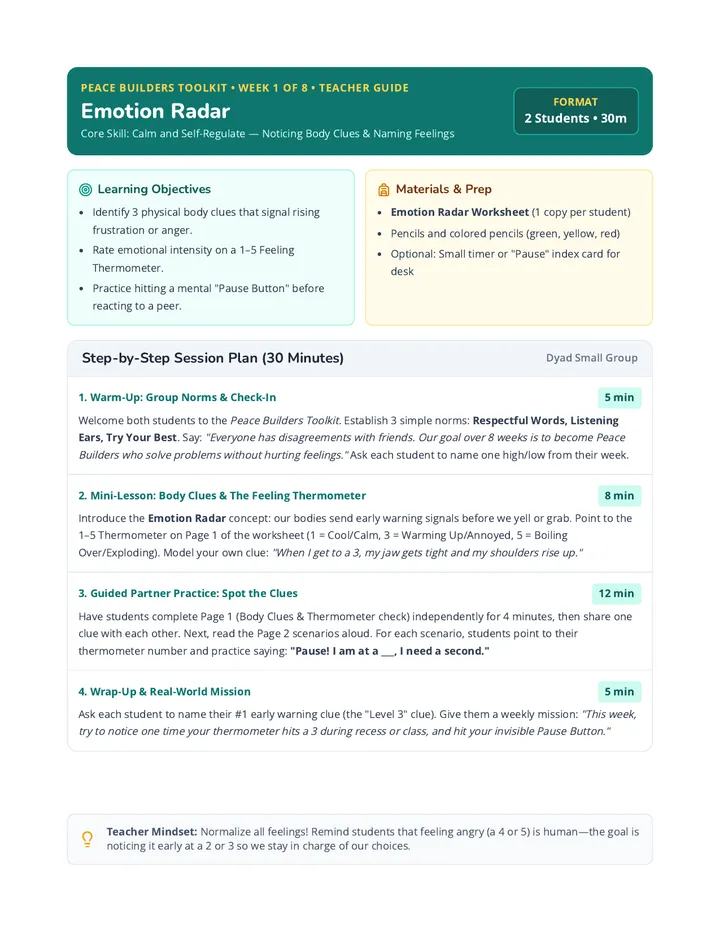
Pause. Think. Respond.
Time: 35–45 Minutes
Focus: Self-Regulation & Peer Conflict
Learning Objectives
• Identify physical body signals that warn of an emotional reaction.
• Apply the 3-step Pause, Think, Respond framework to 6th-grade peer conflicts.
• Formulate calm, respectful boundary or "I" statement responses.
Materials Needed
• Pause Think Respond Slides (projected)
• Pause Think Respond Worksheet (1 per student)
• Pencils or pens; optional timer for Turn & Talk
Lesson Pacing & Facilitation Flow
Phase
Slides
Counselor Actions & Key Talking Points
Hook
5 min
Slides 1–2
Ask students to raise a hand if they have ever said or texted something in 1 second that they wished they could take back. Contrast Instant React vs. Chosen Response using the "3-second gap" concept.
Step 1: Pause
7 min
Slide 3
Normalize that everyone feels heat, a fast heartbeat, or tight muscles when stressed. Practice the 3-second physical reset together once as a class (drop shoulders, unclench hands, one slow breath).
Step 2: Think
8 min
Slide 4
Walk through the 3 quick check questions: What am I feeling? What are my choices? What happens next? Emphasize that having an angry thought does not mean we have to act on it.
Step 3: Respond
8 min
Slide 5
Model a calm "I" statement and a clear boundary. Point out that walking away or asking an adult for backup is a strong, mature response—not weakness.
Practice
12 min
Slides 6–7
Have pairs discuss Scenario A or B on Slide 6, then complete the Pause Think Respond Worksheet independently. Close with Slide 7's exit question.
Tip for 6th Grade: Keep the tone matter-of-fact and respectful—middle schoolers respond best when treated like young adults.
Facilitation Notes & Answer Guide
Page 2 of 2
High-Impact Prompts
• "Where in your body do you notice frustration first?"
• "Why does a group chat make it harder to pause than talking in person?"
• "What is the difference between being passive and choosing a calm response?"
Common Misconceptions
• "Pausing means letting people walk over me." Clarify that pausing helps you set a stronger, clearer boundary.
• "I shouldn't feel angry." Emphasize that all feelings are valid; only harmful actions are off-limits.
Differentiation & Supports
Visual & ELL Support
Keep Slide 5 ("I" statement frame) visible during worksheet time so students can copy the sentence starter.
Executive Function
Allow students to circle body signals and draw or bullet-point their response instead of writing full paragraphs.
Extension
Have early finishers write a realistic 6th-grade cafeteria or locker scenario on the back and trade with a partner.
Worksheet Sample Responses (Answer Key)
Part 1: Body Signal Check
Answers vary. Look for realistic physical cues (e.g., tight jaw, fast heartbeat, hot face, clenched fists, restless legs).
Part 2, Scenario 1 (Blamed in Group Project)
Pause: Take one slow breath and put down my pencil. Think: I feel frustrated and unfairly blamed; I could yell back (makes it worse) or state what I actually finished. Respond: "I feel frustrated when my work isn't noticed. Here is the part I completed—let's check the rubric together."
Part 2, Scenario 2 (Excluded at Lunch / Group Chat)
Pause: Lock my phone / count to 3 before replying. Think: I feel left out; firing back a mean comment will escalate drama. Respond: Mute the chat, sit with another friend, or tell a trusted adult if it crosses into bullying.
Part 3: My 3-Second Plan
Look for one concrete trigger, one realistic pause move, and one calm response phrase the student can actually use this week.
Follow-Up: Check in during morning advisory 3–5 days later to ask who used their 3-second gap.
Pause Think Respond Worksheet Name: ____________________________________
Date: ___________________
6th Grade Counseling
Pause. Think. Respond.
1. Pause 2. Think 3. Respond
Part 1: My Body Signal Check
Check the signals your body gives you right before you react in anger, stress, or embarrassment:
Heart beats faster
Tight jaw or shoulders
Face feels hot
Hands clench into fists
Stomach feels tight
Urge to snap back fast
Another signal I notice in myself:
Part 2: Scenario Practice
Scenario 1: Group Project Blame
During class, a teammate tells the teacher you did not do your share of the slides, even though you worked hard on your section last night.
1. PAUSE — What will I do in the first 3 seconds?
2. THINK — What am I feeling, and what are two choices I have?
3. RESPOND — Write a calm, respectful response or "I" statement:
Pause. Think. Respond. — Practice & Plan
Page 2
Scenario 2: Group Chat Drama
Someone takes a screenshot of a private message you sent and posts it in the 6th-grade group chat with laughing emojis.
1. PAUSE — What will I do before I type or reply?
2. THINK — What happens if I clap back vs. step back?
3. RESPOND — What is my smartest next move?
Part 3: My 3-Second Plan
One situation in 6th grade where it is hardest for me to pause:
My go-to 3-second reset move (breathe, drop shoulders, count to 3, etc.):
One calm "I" statement or boundary I can use this week: