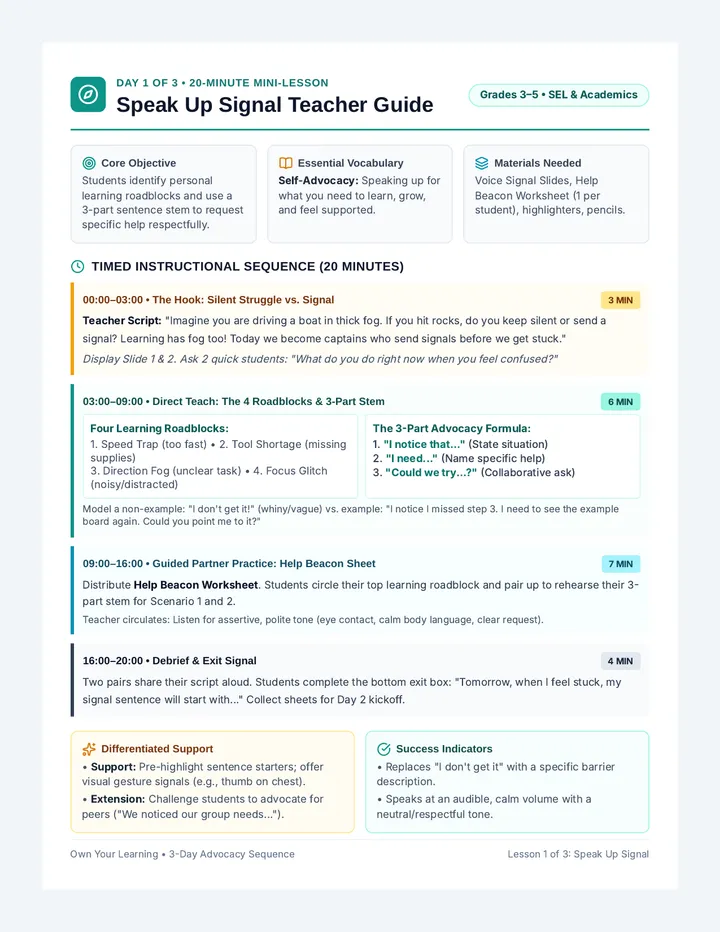
Mindful Moments Lesson Plan
Mindful Moments
Exploring Emotions Lesson Plan
Target Audience
3rd Grade Students
Duration
45 Minutes
Learning Objective
Students will be able to identify and express their current emotions through mindfulness techniques, including guided meditation and reflective journaling.
Why This Matters
Equipping students with skills to understand and manage their emotions fosters a positive classroom environment and enhances social-emotional learning (SEL). Mindfulness helps students develop self-awareness and emotional intelligence.
Materials Needed
- Guided Meditation Script
- Journaling Worksheet
- Discussion Questions Guide
- Pencils & Quiet Space
Instructional Steps
5m
Introduction: The World of Feelings
- Begin with a brief discussion on emotions and why it's important to understand them.
- Explain the purpose of the lesson: to explore and express emotions through mindfulness.
- Teacher Tip: Ask students to name three different "big" emotions they've felt this week.
10m
Guided Meditation
- Lead the students through a guided meditation using the provided script.
- Encourage students to focus on their breathing and notice any emotions that arise without judgment.
- Ensure the room is quiet and lighting is dimmed if possible.
15m
Reflective Journaling
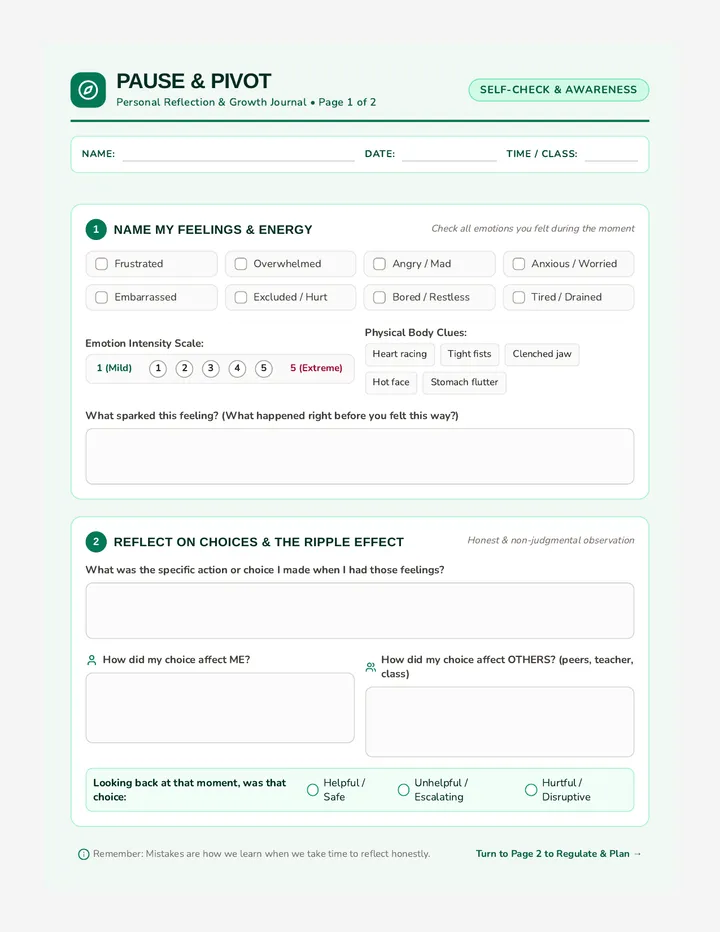
- Distribute the journaling worksheet to each student.
- Ask students to write about the emotions they felt during the meditation and any thoughts they have.
- Provide prompts: "What emotion did you feel most strongly?" or "How did your body feel?"
10m
Classroom Discussion
- Use the discussion questions to facilitate a conversation about the journaling experience.
- Encourage students to share their thoughts and listen respectfully to others' experiences.
5m
Closure
- Summarize the key points: emotions are natural, and being aware of them helps us manage them.
- Reinforce the importance of expressing emotions in healthy ways.
- Encourage students to practice mindfulness at home or when they feel overwhelmed.
Mindful Meditation Script
Inner Calm
Guided Meditation Script
Teacher Instructions
Read this script slowly and calmly. Pause for 3-5 seconds wherever you see ... and allow students time to process. Ensure the classroom is quiet and comfortable.
"Let’s begin by finding a comfortable position in your chair. You can rest your hands on your lap or on your desk. When you feel ready, gently close your eyes. ..."
"Take a deep breath in through your nose, feeling your chest and belly fill with air. Now, slowly let it out through your mouth, like you’re blowing out a candle. ..."
"As you breathe, notice how your body feels right now. Is it relaxed and heavy? Or does it feel a little tight or tense? Don’t try to change it, just notice it. ..."
"Now, turn your attention to your heart. Think about how you are feeling right this second. What emotions are visiting you? Maybe you feel calm, or maybe you feel excited, worried, or even just a little sleepy. ..."
"Imagine these emotions are like clouds floating across the sky. You are just watching them pass by. Allow yourself to feel them without judging them. It is okay to feel exactly how you feel right now. ..."
"Continue to breathe deeply. Focus on the feeling of the air moving in and out, and the quiet space inside of you. ..."
"In a moment, we will finish our meditation. Take one last deep breath in ... and a long, slow breath out. ..."
"When you’re ready, you can wiggle your fingers and toes, and slowly open your eyes."
Encourage students to keep this quiet feeling with them as they transition to their journaling.
Mindful Journaling Worksheet
My Mindful Moment
Reflecting on my thoughts and feelings
Name:
Date:
What emotion did you feel most strongly during the meditation?
Think about the feelings that came up as you focused on your breath.
How did your body feel during the meditation?
Consider if you felt relaxed, tense, wiggly, or something else.
What thoughts came to your mind?
Write down any specific thoughts or images that appeared like clouds in your sky.
Mindful Discussion Questions Guide
Mindful Talk
Discussion Guide for Emotional Awareness
Facilitator Tips
- • Create a "brave space" where all emotions are valid and welcome.
- • Allow students to "pass" if they aren't ready to share.
- • Model vulnerability by sharing a small, relatable emotion you felt.
- • Use "I feel" statements and encourage students to do the same.
1
What emotions did you notice during the meditation?
Follow-up Prompts:
- "Where in your body did you feel that emotion?"
- "Did the emotion stay the same, or did it change while you watched it?"
- "If your emotion had a color or a shape, what would it look like?"
2
How can being aware of your emotions help you in daily life?
Key Takeaways to Guide Toward:
- Better decision-making (not acting purely on impulse).
- Improved relationships (understanding how our feelings affect others).
- Self-regulation (knowing when we need to take a break or ask for help).
3
What are some ways you can practice mindfulness outside of school?
Creative Ideas to Suggest:
- Mindful Walking (noticing the feeling of feet on the ground).
- Five Senses Check-in (5 things I see, 4 I feel, 3 I hear, etc.).
- Deep Breathing before a test or a sports game.
- Quiet listening to music or nature sounds.
Lesson Wrap-Up
Remind students that mindfulness is a "muscle" that gets stronger with practice. Just like we exercise our bodies to stay healthy, we practice mindfulness to keep our minds and hearts healthy. Thank everyone for their honesty and bravery in sharing.