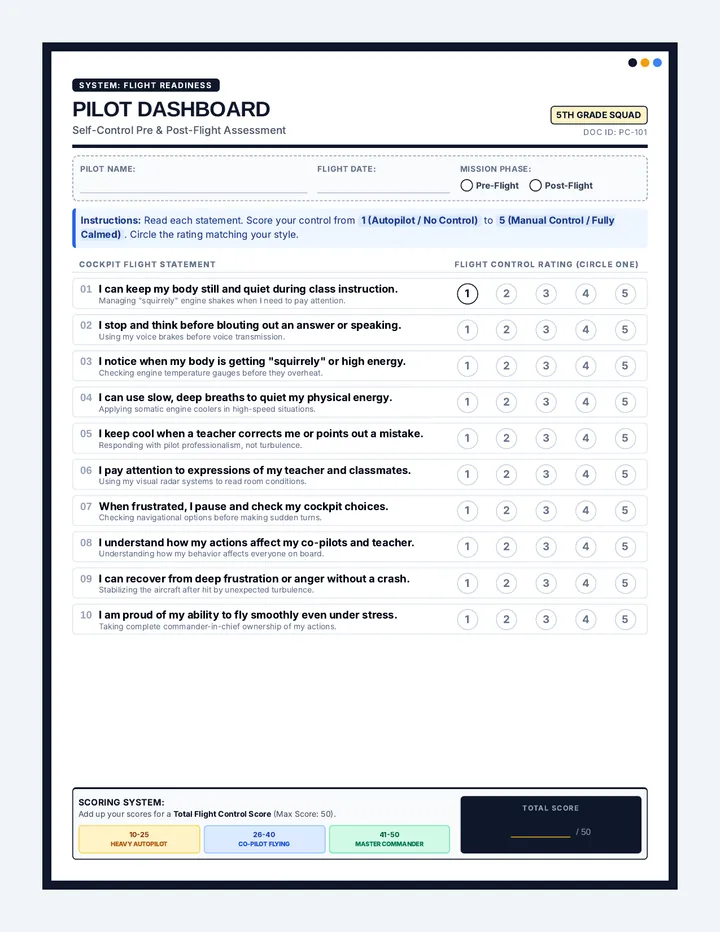
A neurodiversity-affirming lesson for Upper Elementary students to explore their internal signals, complete a low-demand baseline across five opportunities, and identify helpful coping strategies in a supportive environment.
Administering the five low-demand baseline probes (10-20 min)
RUN IDENTIFIER:
PROBE-RUN-01
Step-by-Step Probe Instructions & Scripting
For each probe, deliver the instruction, observe the natural response, and record the data on your Session Data Tracker. Do not teach or over-prompt. This establishes a clean baseline.
Probe 1: Direction Command DEMAND: MILD
Ask the student to follow a simple multi-step or single-step direction without helping hand gestures.
Script: "Please take your pencil, write today's date in the Station ID box on Page 1, and look at me when you are ready."
Track: Task-Start Latency Baseline Target
Probe 2: Material Shift DEMAND: TRANSITION
Deliver a transition cue to switch focus from workbook checking to an auxiliary workbook sheet or the table space.
Script: "In ten seconds, we are going to close our markers and move to the calibration puzzle on Page 2. Go ahead and finish up."
Track: Task Shift & Time Transit Target
Probe 3: Frustration Frequency DEMAND: COGNITIVE
Present a mock difficult task/story scenario to see if the student can label the cognitive trigger.
Script: "Imagine a puzzle is missing the final three pieces. What level of static (1 to 5) would that make you feel? Circle it on page 2."
Track: Self-Label Accuracy Coping Target
Probe 4: Coping Choice DEMAND: CHOICE
Direct the student to actively select a calming or helpful sensory tool from Page 3 of the workbook.
Script: "Look at Page 3. When school feels super loud, which tool from our Booster list would help your signal? Point to or circle your favorite."
Start your physical timer. Present "The Calibration Maze" on Page 2. Instruct the student to attempt it. Watch for: avoidance, latency, and request for support.
Script: "Here is a 2-minute quick maze challenge. Let's see if we can guide the signal to the receiver. It's totally okay if you don't finish. Just try your best for two minutes. Go!"
MIND STATION COGNITIVE LABS PAGE 2 OF 3
Session Closing
INTEGRATION & CLOSING
Teaching the Slow Static Exhale and practicing generalizability
FINAL LAP
GUIDE-M3
Teaching "The Slow Static Exhale" (20-22 min)
Purpose: Now that baseline items are recorded, model a simple physiological calming technique. Keep the practice sensory-friendly—no forced physical postures.
VERBATIM SCRIPT
"We finished all our tests! High five. Now, let's learn our first major upgrade. It's called the Slow Static Exhale. Let's sit comfortably. We will breathe in deep for 3 seconds, filling our internal antenna with fresh signal power... and then make a quiet 'hissing' radio sound as we exhale for 5 seconds. Ready? Let's do it once together."
Completing the Signal Starters (22-24 min)
Assist the student in writing their answers on Page 3 of the workbook. If handwriting is an area of struggle, offer a scribe or co-writing support.
VERBATIM SCRIPT
"Now let's complete our Signal Starters. Page 3 has two sentence blanks. For the first one, 'When school feels hard, I can...'. What should we fill in? Maybe 'take a deep breath' or 'ask for help' or 'put on my headphones'? Let's write down what feels most real to you!"
Closing & Rehearsal (24-25 min)
Rehearse the coping skill or verbal starter exactly once before ending. Confirm the student understands when they will use this during the week.
VERBATIM SCRIPT
"You did an awesome job tuning your signal today. Where is one place at school you can use your Slow Static Exhale this week? Yes, in the math classroom! Let's pretend math is starting, take one quick deep breath, blow out the static... and we are ready. See you next week!"
Facilitation Golden Rules
• Give 10 seconds of processing time before prompting.
• Accept all forms of communication (verbal, pointing, AAC).