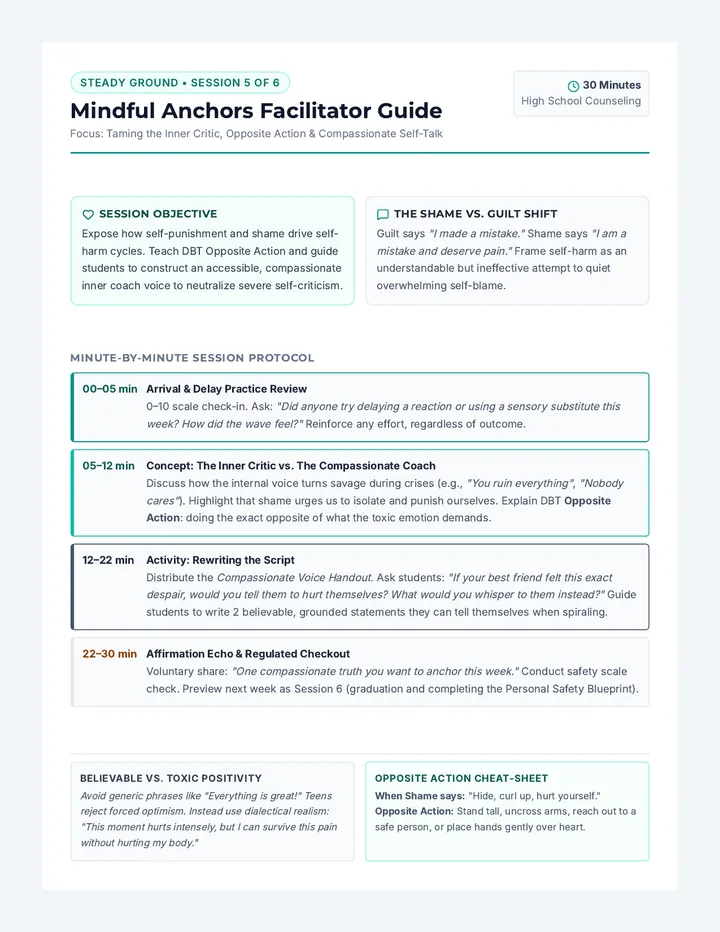
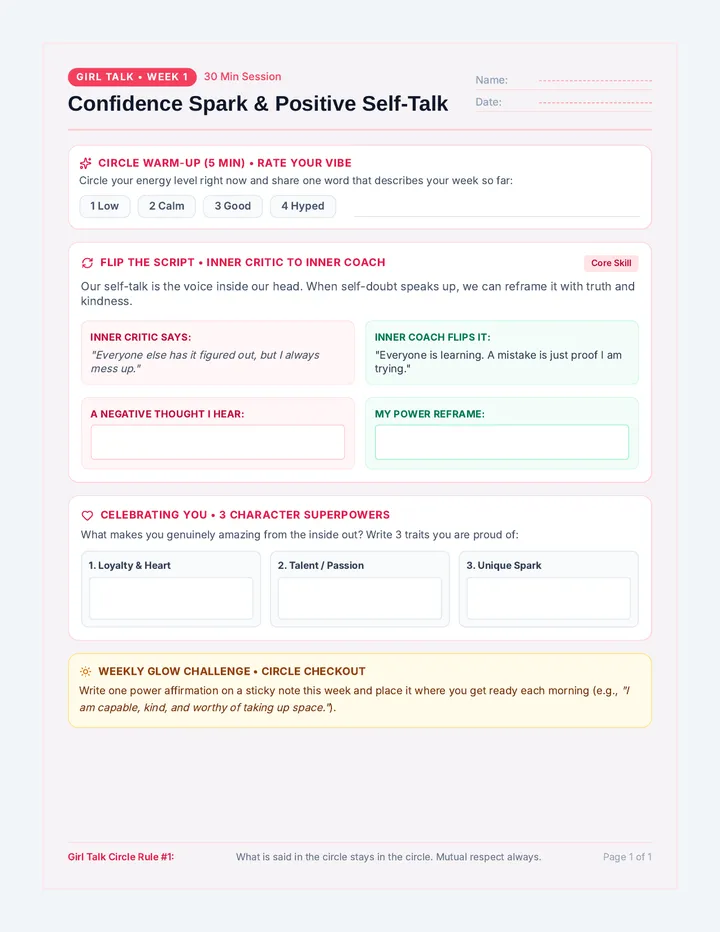
Inner Voice Lesson Plan Inner Voice:
Friend or Foe?
Lesson Plan
TIER 1 CLASSROOM
Duration: 30 Minutes
Audience: High School Leaders
Objective
Students will be able to distinguish between negative and balanced self-talk and practice reframing negative thoughts into more balanced, constructive perspectives.
The "Why"
Understanding and managing self-talk is crucial for mental well-being, resilience, and leadership. This lesson provides practical tools for students to develop a healthier inner dialogue.
Teacher Preparation
• Review the Slide Deck and familiarize yourself with the content.
• Read through the Guide Script to prepare talking points.
• Print copies of the Snapshot Fact Sheet for each student.
• Ensure projector/screen and computer are set up.
Time Required
15 Minutes Prep | 30 Minutes Class
Required Materials:
Slide Deck Fact Sheet Guide Script Warm-Up Page Cool-Down Exit Ticket
Instructional Sequence
5m
Warm-Up: Self-Talk Check-In
Instruct students to briefly write down one thought they've had today that impacted their mood. Discuss a few anonymous examples to introduce the concept of internal dialogue.
5m
Introduction to Self-Talk
Use the Slide Deck and Script to define self-talk. Explain the spectrum: positive, negative, and balanced. Ask students how their thoughts impact their leadership and actions.
10m
Negative vs. Balanced Self-Talk
Present examples of negative self-talk ("I can't do this"). Introduce balanced self-talk as a realistic alternative. Distribute the Fact Sheet and review key reframing techniques.
7m
Reframing Activity & Discussion
Lead a guided reframing exercise using the Slide Deck. Students work in pairs to brainstorm balanced reframes for common student stressors. Share out as a class.
3m
Cool-Down: Reframing Reflection
Students reflect on one personal negative thought and reframe it. Collect these "Exit Tickets" to gauge student understanding and provide future support.
Inner Voice Slides Your Inner Voice:
Friend or Foe?
Understanding and Mastering Self-Talk
Student Leadership Series
What is Self-Talk?
The ongoing internal dialogue we have with ourselves throughout the day.
"Your thoughts create your reality. How you speak to yourself determines how you interact with the world."
Negative
Critical & Doubting
Balanced
Realistic & Supportive
The "Foe"
Negative Self-Talk
"I'm going to fail this presentation."
"Everyone else is better than me."
"I'll just mess it up, so why try?"
How does this make you FEEL?
Stressed Insecure Defeated
The "Friend"
Balanced Self-Talk
"This is a challenge, but I have prepared."
"I have unique strengths to offer."
"It's okay to make mistakes; I can learn."
How does this make you FEEL?
Resilient Capable Calm
Reframing Challenge!
Turn the Foe into a Friend
The Foe Says:
"I messed up on that assignment; I'm just not good at this subject."
What would a balanced friend say?
Reframing Challenge!
Part 2
The Foe Says:
"No one will listen to my ideas; they probably think I'm silly."
What is a more realistic thought?
Key Takeaways
Your inner voice can be your greatest ally!
Practice makes progress.
Inner Voice Teacher Script Inner Voice Teacher Script
Lesson Delivery & Facilitation Guide
30 Minute Session
5 MINS
Warm-Up: Self-Talk Check-In
"Good morning, everyone! Let's start today with a quick self-talk check-in. I want you to silently or briefly write down one thought you've had today that impacted your mood. It could be positive, negative, or neutral. Just one thought, and how it made you feel."
Teacher Note: Take about a minute for students to write. Do not force sharing, but invite general descriptions of mood changes.
"Now, without sharing specifics, can anyone describe generally how their thought impacted their mood? Did it make you feel more confident, stressed, motivated, or something else?"
5 MINS
Introduction (Slides 1-2)
"(Advance to Slide 1) That exercise was a perfect lead-in to our topic today: self-talk. Has anyone heard that term before? What do you think it means?"
Wait for responses. Guide them to the idea of internal conversation.
"(Advance to Slide 2) Self-talk is essentially the ongoing internal conversation we have with ourselves. It's that voice in your head—the one that comments on things, evaluates situations, and judges yourself and others. It can be negative, positive, or—what we'll focus on today—balanced."
10 MINS
Foe vs. Friend (Slides 3-4)
"(Advance to Slide 3) Let's look at negative self-talk. This is the 'foe' within. It's critical, uses words like 'always' or 'never,' and often targets your worth. Take a look at these examples... How do these kinds of thoughts make you feel? What do they do to your motivation?"
Teacher Tip: Encourage students to identify if they've had similar thoughts. This builds empathy and awareness.
"(Advance to Slide 4) Now meet the 'friend'—balanced self-talk. This isn't about being 'fake happy.' It's about being realistic and supportive. It's like having a coach in your head. Look at the reframed examples... How do these change your perspective?"
Action: Distribute the Snapshot Fact Sheet now. Briefly explain that it's a reference tool for them to keep.
7 MINS
Reframing Challenge (Slides 5-6)
"(Advance to Slide 5) Let's practice. I'll give you a negative thought, and I want you to brainstorm a balanced reframe. Work with a partner for a minute on this one: 'I messed up on that assignment; I'm just not good at this subject.'"
Activity Guide: Ask for volunteers to share reframes. Emphasize growth mindset (e.g., "I'm not good at this yet ," or "I need a different study strategy"). Repeat this process for Slide 6.
Self Talk Warmup Self-Talk Check-In
Warm-Up Activity
Student Name
Date
1. Pause and Listen
Take a moment to check in with your inner voice. In the space below, briefly write down one thought you've had today that impacted your mood (positively or negatively).
2. Reflect
Think about that thought you just wrote down. Answer the following questions:
How did that thought make you feel (e.g., confident, stressed, calm)?
Did it help you move forward, or did it hold you back ?
"Your thoughts are like a radio station. You can't always control the signal, but you can learn to tune the dial."
Self Talk Fact Sheet Self-Talk Snapshot
Mastering Your Internal Dialogue: Friend or Foe?
Your inner voice, or self-talk, is the constant stream of thoughts and opinions you have about yourself and the world. It significantly impacts your mood, confidence, and actions.
Spotting the "Foe": Negative Self-Talk
Catastrophizing
Expecting the worst-case scenario. "I failed this, my life is over."
Overgeneralizing
Taking one negative event and applying it to everything.
Personalization
Blaming yourself for things outside your control.
"Should" Statements
Focusing on rigid rules, leading to guilt and shame.
Note: Negative self-talk is often exaggerated and uses extreme words like always or never .
Finding the "Friend": Balanced Self-Talk
1
Notice It
Catch the thought as it happens.
2
Challenge It
Is this 100% true? Would I say this to a friend?
3
Reframe It
Replace it with a realistic, helpful thought.
Negative "Foe" Balanced "Friend" "I can't do this; it's too hard." "This is a challenge, but I can break it down." "I'm going to fail." "I'll prepare and do my best. I can learn from whatever happens." "I made a mistake; I'm so stupid." "Everyone makes mistakes. I can learn from this and improve." "No one will listen to me." "My ideas have value. I'll focus on communicating clearly."
"Your inner voice is your constant companion. Make sure it's someone you actually want to spend time with."
Reframing Reflection Exit Ticket Reframing Reflection
Exit Ticket: Personal Action Plan
Mindset Leadership Series
Student Name
Date
"Watch your thoughts, they become your words; watch your words, they become your actions." Use this space to practice the skill we learned today with a real thought of your own.
Step 1
Identify a Negative Thought
Write down one negative thought you sometimes have about yourself, school, or a challenge you're currently facing.
Step 2
Reframe to a Balanced Thought
Now, reframe that thought into a more balanced, realistic, and supportive statement. Think about what a helpful coach or a best friend would say to you.
Why is it important to reframe negative self-talk?
My Commitment
I will notice when my "Inner Foe" is speaking and choose to practice a "Balanced Friend" response.
Signature (Optional)