Grit and Gold Facilitator Guide Grit and Gold
Facilitator Guide: Resilience Small Group
Grades: 6-12
Duration: 45-60 Minutes
Standards Alignment
ASCA Mindsets & Behaviors
M 2: Self-confidence in ability to succeed
B-SMS 10: Demonstrate ability to manage transitions and adapt to changing situations and responsibilities
CASEL & State Standards
Self-Awareness: Identifying personal, cultural, and linguistic assets
CO Health 3.3: Analyze how to manage stressors and build resilience
Learning Objectives
Define
Explain resilience using the Kintsugi metaphor.
Identify
Pinpoint personal strengths and 3+ support systems.
Reframe
Transform a negative thought into a resilient one.
Facilitation Outline
1
Check-In & The Metaphor (10 min)
Script: "Welcome back. Today we're talking about Resilience. In Japan, there is an art called Kintsugi . When a piece of pottery breaks, they don't throw it away. They repair the cracks with gold. The piece is actually considered more beautiful and stronger because it was broken and repaired."
Discussion: How can a person be like a Kintsugi bowl? (Allow students to share personal reflections on 'breaks' and 'gold'.)
2
The Three Pillars (15 min)
Discuss the protective factors using the slide deck. Focus on the idea that these are built , not just something you're born with:
Connections: Who are the people who help you feel 'held together'?
Purpose: What is your 'North Star' or goal that motivates you?
Self-Efficacy: This is your 'I can' muscle. How do we build it? (Small wins).
3
Activity: Workbook Practice (20 min)
Strengths Inventory: Encourage students to check at least 5. If they struggle, ask peers to suggest strengths they see in each other.
Support Circle: This visual represents their safety net. Ensure they include at least one adult (counselor, teacher, coach) and one peer.
4
Reframing & Check-Out (10 min)
Explain that reframing is like putting gold in a crack. It doesn't change the fact that it broke, but it changes how we see it. Wrap up with a round of "I am strong because..."
Materials Needed
Grit and Gold Slide Deck
Grit and Gold Workbooks
Writing Utensils
Gold highlighters (optional)
Grit and Gold Slides Grit & Gold
Building Resilience through the Art of Repair
What is Resilience?
It's NOT...
Being "tough" all the time, never feeling sad, or pretending nothing happened.
It IS...
Learning how to "bounce back" and grow stronger because of the challenges you face.
"The capacity to recover quickly from difficulties; toughness."
Kintsugi (金継ぎ)
In Japanese culture, Kintsugi is the art of repairing broken pottery with lacquer mixed with powdered gold.
The break is not hidden. It is highlighted .
The object becomes more valuable because it was repaired.
Your "cracks" (adversity) can be filled with "gold" (strength and support).
History makes you unique.
The Protective Pillars
Connections
Positive relationships with friends, family, or mentors who truly "get" you.
Purpose
Having goals or a "why." Something that makes you want to keep showing up.
Self-Efficacy
The belief that you have the skills and power to handle whatever comes next.
The Power of Reframing
NEGATIVE STORY:
"I failed that test. I'm just not smart enough for this class."
RESILIENT REFRAME:
"I failed that test. It shows me I need a better study strategy next time."
Pro Tip
Reframing isn't lying to yourself. It's looking for the evidence of what you can learn or do differently next time.
Group Reflection
1
What is one "break" you’ve experienced that made you a stronger person today?
2
Who is a person in your life who represents "Gold" (a strong support)?
Grit and Gold Workbook Grit & Gold
My Resilience Workbook
Name: ________________________________
Date: ________________________________
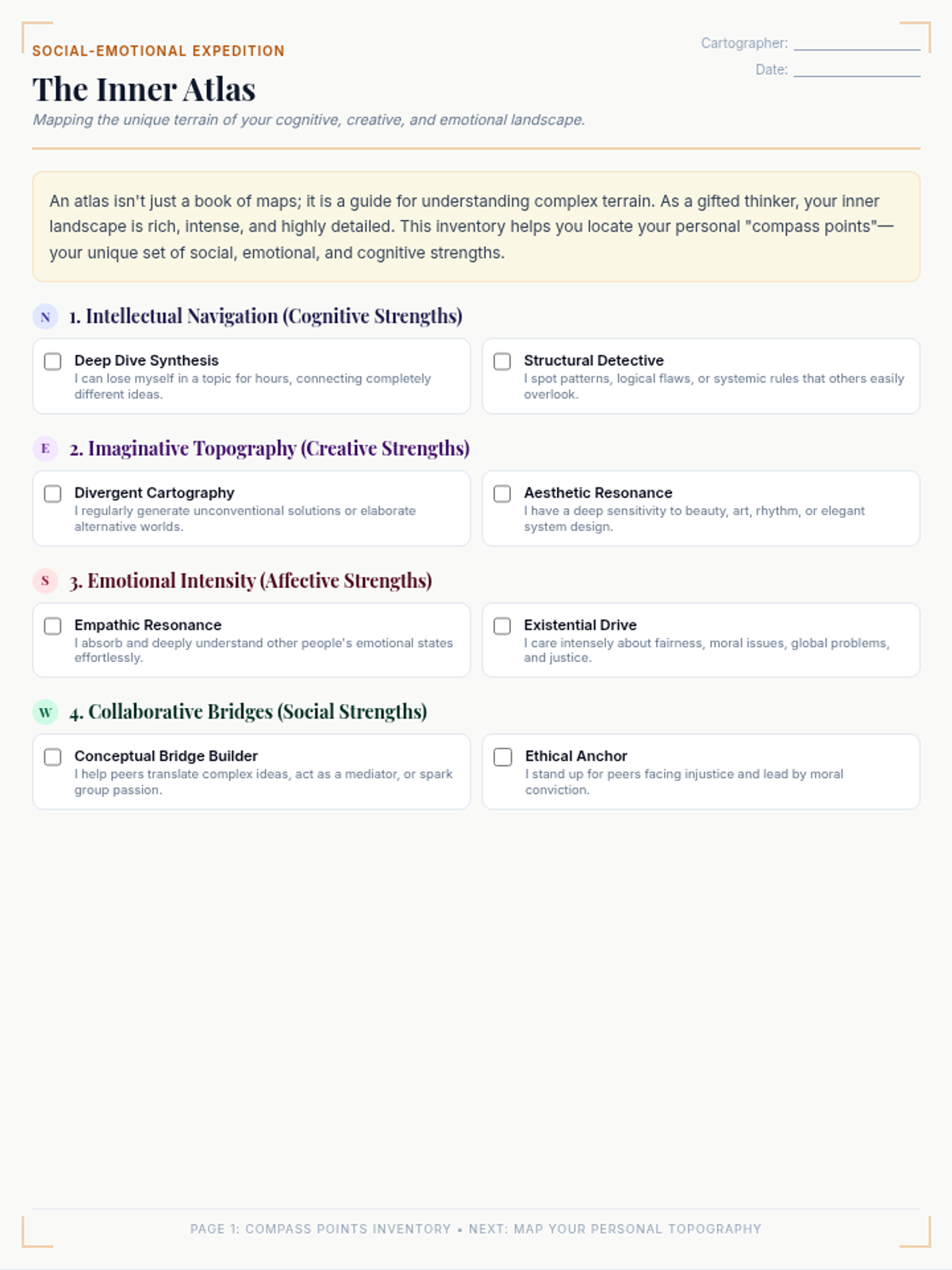
The Strengths Inventory
Resilience is built on what you already have. Check off the strengths that you see in yourself. Own your "Gold"!
Mindset Strengths
I am a problem-solver
I can stay calm under pressure
I am willing to ask for help
I see challenges as lessons
I am patient with myself
Social Strengths
I am a good listener
I use humor to cope
I am a loyal friend
I can empathize with others
I am honest and reliable
Action Strengths
I am persistent (I don't quit)
I plan ahead and stay organized
I am creative or artistic
I am physically active
I help my family or community
Other Personal Assets
Pick one strength you checked. Describe a time this strength helped you overcome a challenge.
The Support Network
In Kintsugi, the gold is the bond. Who or what makes up your support system? Fill the circles with the names of people, groups, or activities that keep you strong.
ME
Friends & Peers
Trusted Adults & Mentors
Peer name...
Trusted adult...
A hobby or club...
My counselor...
Flipping the Script
Cognitive reframing helps us see the "gold" in a crack. Practice changing these thoughts:
"I messed up that presentation. Everyone thinks I'm an idiot."
"I didn't make the team. I'll never be good at this sport."
(Write a negative thought you have had...)
Grit and Gold Reframing Guide Grit and Gold
Facilitator Resource: Reframing Guide
What is Cognitive Reframing?
Cognitive reframing is the practice of identifying and then disputing irrational or maladaptive thoughts. In resilience work, we call this "Putting Gold in the Crack." It doesn't ignore the problem; it shifts the focus to growth, learning, and personal power.
Reframing Examples for Students
Original Negative Thought
Resilient Reframe
"I'm so stupid for failing that math quiz. I'll never get this."
"This quiz was really hard, but it shows me exactly what I need to ask my teacher for help with before the final."
"My friends are hanging out without me. They must all hate me."
"I'm bummed I wasn't there, but it's okay for them to have other friends. I can reach out to one of them tomorrow to hang out."
"I can't do this presentation. I'm going to mess up and look like a fool."
"I feel nervous because I want to do well. Even if I stumble on a few words, I have my notes and I know the material."
"Everything always goes wrong for me. I just have bad luck."
"I'm having a really tough week, but I've handled hard things before and I will figure this out one step at a time."
The "Gold Check" Questions
When a student is stuck in a negative thought, ask:
"What is the evidence?" (Is it 100% true that you're 'stupid'?)
"What would you say to a friend in this situation?" (We are often kinder to others than ourselves.)
"What is one thing you can control right now?" (Shifts from helplessness to efficacy.)