A comprehensive social-emotional learning lesson guiding students to decode emotional cues in facial expressions, body language, and voice tone, while building empathy and practical conflict-resolution skills.
“Watch my posture and listen to my voice: [Cross arms, look down, sigh loudly] 'I am totally excited to be here today.' What did your radar notice? Why did your brain instantly doubt my words?”
Transition to I-Statements:
“When we are annoyed, our natural urge is to point a finger: 'You always cut in line!' What happens inside the other person's body when we say 'You always'? They get defensive. An I-Statement shifts the focus back to our experience so they can actually hear us.”
3-Minute Pair Role-Plays (Rotate Partners)
Scenario A: The Group Work Clash
Situation: Partner A is rushing and making all decisions on the poster. Partner B stops contributing and stares out the window.
Goal: Partner A notices withdrawal and asks: "Hey, did I take over? What idea do you want to add?"
Scenario B: Borrowed Supplies
Situation: Partner B used Partner A's colored pencils without asking and broke the tip off the favorite color.
Goal: Partner A uses Peace Path Step 3: "I felt frustrated because that pencil is new. Next time please ask first."
Differentiation Strategies
ELL / Language Learners
Provide sentence frames on index cards; use illustrated emotion emoji wheels; allow drawing of body signals before writing.
Neurodivergent Learners
Acknowledge that neurodivergent eye contact or stimming differs from distress; focus on clear verbal check-ins rather than assuming cues.
Extension / Advanced
Challenge students to write a two-sided dialogue where both characters use de-escalation skills to solve a complex playground dispute.
Formative Assessment Rubric
Skill Dimension
Approaching (1 pt)
Proficient (2 pts)
Exemplary (3 pts)
Emotion Cue Recognition
Names primary feeling (e.g., mad) without noting specific physical cues.
Identifies 2 specific cues across face, body, or voice to justify emotion inference.
Identifies multi-channel cues and recognizes underlying feelings (e.g., hurt masked as anger).
Empathy & Perspective
Focuses primarily on who was right or wrong in the scenario.
Articulates the other person's perspective with respectful language.
Validates the peer's experience while brainstorming respectful boundary solutions.
Conflict De-escalation
Relies on blaming statements ("You made me...").
Forms a functional "I feel... when... because..." statement.
Independently drafts an I-Statement paired with a constructive, negotiable request.
Automatic Judgment: “She isn't talking to me at recess. She must hate me now.”
Write an Empathetic Reframe (What else could she be experiencing?):
4 Part 4: The “I-Statement” Construction Zone
Use the 4-part formula to turn conflict into clear communication without pointing fingers:
“I feel [Emotion] when [Action/Event] because [Reason]. Next time, could we please [Request]?”
Scenario: You spent 20 minutes building a tower of blocks. A classmate walked by quickly, tripped on a chair, and crashed into your tower. They laugh nervously and say, “Oops!”
1. I feel (specific emotion):
2. When (state the action without insults):
3. Because (explain your impact):
4. Next time, could we (fair solution):
5 Part 5: Personal Radar Reflection
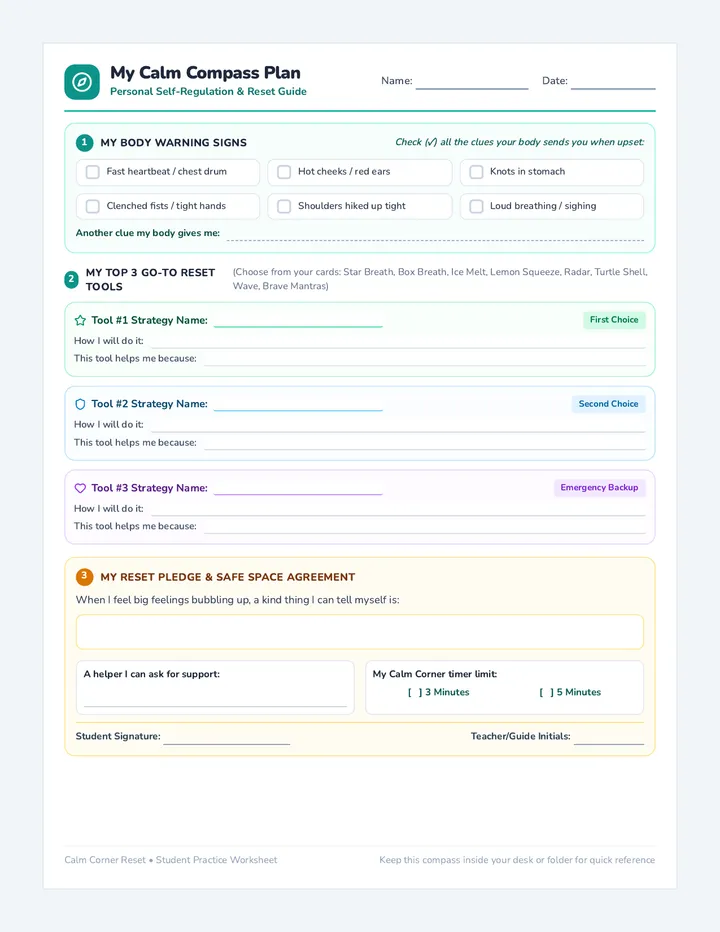
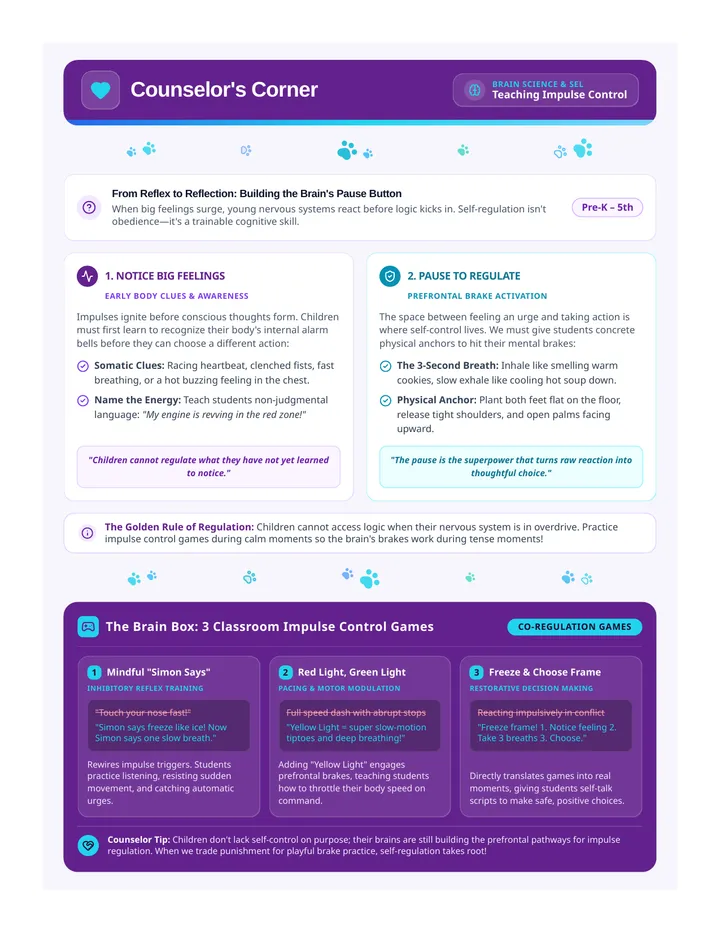
When you notice your own body getting tense (clenched fists, tight chest, or heated face), what is one specific action you can take to pause before speaking?