Emotion Thermometer Slides Self-Regulation & SEL Series
Level: Grades 3–8
Track Your Internal Climate
The Feelings Thermometer
Learn how to gauge your emotional temperature, detect warning signs early, and select the right tool before you reach the boiling point.
Recognize Signals
•
Targeted Strategies
•
Clear Self-Advocacy
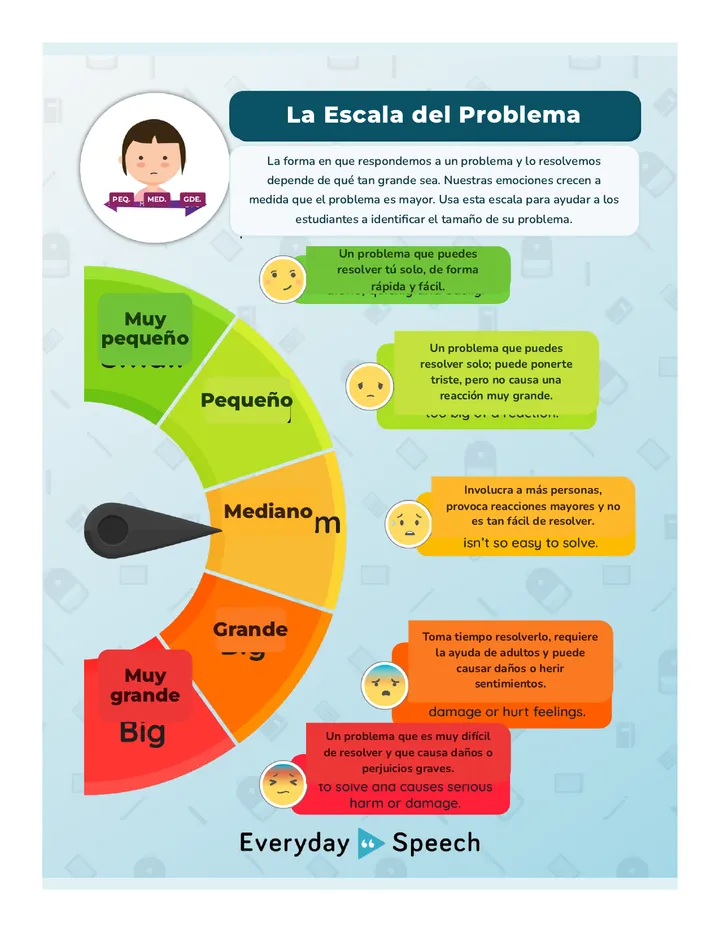
The Scale
5 Distinct Zones
5 Levels of Emotional Temperature
1 🧊
Chilly
Low Energy
Tired, detached, bored, sad, or sluggish.
Goal: Gentle activation
2 🌱
Steady
Optimal
Calm, focused, content, ready to learn.
Goal: Maintain flow
3 ☀️
Simmer
Warming Up
Restless, annoyed, confused, worried.
Goal: Quick reset break
4 🔥
Boiling
High Alarm
Frustrated, anxious, heart pounding fast.
Goal: De-escalate & pause
5 🌋
Eruption
Overload
Explosive anger, panic, flight, shutdown.
Goal: Safe space & support
Key Principle: No level is bad or wrong. The goal is noticing when temperature rises so you can respond early!
Detection System
Triggers Spark. Body Signals Warn.
External Triggers
Events or situations that dial up your internal heat:
• Unfair game rules or teasing peers
• Surprise schedule changes or sudden tests
• Too much noise, crowding, or sensory input
• Feeling confused and falling behind
Physical Body Clues
Your body rings the fire alarm before your brain catches up:
• Head & Face: Hot cheeks, clenched jaw, racing thoughts
• Chest: Fast heartbeat, shallow tight breaths
• Stomach: Butterflies, knot, or churning nausea
• Hands: Balling fists, fidgeting, sweaty palms
Pro Tip: When you feel your body warning clues at Level 3 , act right away before Level 4 hits!
Regulation Toolkit
Match the Tool to the Temperature
Levels 1 & 2
Energy Boosters & Flow
When low energy or cruising calmly:
✓ Cool sip of water
✓ Gentle shoulder rolls & stretch
✓ Positive self-talk affirmation
✓ Tidy desk for fresh focus
Level 3 (Simmer)
Brake Taps & Resets
Cool down before boiling over:
✓ 4-count Box Breathing
✓ 5-4-3-2-1 Sensory Grounding
✓ Squeeze stress ball 5 times
✓ Step to pencil sharpener
Levels 4 & 5
Emergency De-escalation
Safety, quiet, and adult support:
✓ Signal teacher for cool-down corner
✓ Put head down on desk in dark
✓ Wall pushes / chair pushups
✓ Hand signal for adult help
Different moments need different tools. Never force high-energy work when you need an emergency cool-down!
Communication Scripts
The 3-Part Self-Advocacy Formula
1 State Your Level
"I am at a Level..."
Name your current zone clearly so others understand your urgency.
2 Identify the Trigger
"...because..."
Briefly state what raised your heat without shouting or blaming.
3 Ask for a Tool
"Can I please have...?"
Request a specific coping strategy, break, or partner support.
Ready-To-Use Example
"Mr. Davis, I'm feeling at a Level 3 right now because the loud group noise is making it hard to think. Can I please work in the quiet corner with headphones for 5 minutes?"
Speaking up at Level 3 prevents having to fix mistakes made at Level 5. Practice with a partner today!
Classroom Challenge
Heat Check: What Level & What Tool?
Case 1 Math Practice
Your pencil lead snaps, your stomach feels like a tight knot, and you don't understand question #4.
Likely Heat Level: Level 3 (Simmering)
Best Strategy: 3 Deep Breaths + Ask for Clue
Case 2 Recess Kickball
A peer calls you "out" when your foot clearly touched the base. Your face is burning hot and fists are balled.
Likely Heat Level: Level 4 (Boiling)
Best Strategy: Step Away 10 Paces + Breathe
Now let's open your Personal Thermometer Practice Guide to map your own triggers, signals, and coping menu!
Emotion Thermometer Activity Social-Emotional Learning • Self-Regulation Lab
My Feelings Thermometer
Name:
Date:
Directions: Emotions shift throughout the day like weather. Use this guide to identify your intensity levels, catch physical warning cues early, and build your custom cool-down plan.
1 Map Your 5 Intensity Zones
Write 2 emotion words and what it feels like for each level:
5 • Eruption 🌋 High Alarm
Feelings (e.g. Furious, Terrified):
What I look & sound like:
4 • Boiling 🔥 Intense
Feelings (e.g. Angry, Panicked):
What I look & sound like:
3 • Simmer ☀️ Warming Up
Feelings (e.g. Frustrated, Worried):
What I look & sound like:
2 • Steady 🌱 Optimal
Feelings (e.g. Calm, Focused):
What I look & sound like:
1 • Chilly 🧊 Low Energy
Feelings (e.g. Tired, Sad, Bored):
What I look & sound like:
Body Clues Radar (Check your signs)
Check the physical cues that alert you when your temperature rises to Level 3 or 4:
Clenched jaw Racing heartbeat Hot red cheeks Stomach knot Tight shoulders Balld up fists Short breaths Fidgety legs
My #1 earliest warning clue is:
My Top 2 Spark Triggers
Identify 2 situations that reliably heat up your feelings thermometer:
Trigger A (e.g. being interrupted, test anxiety):
Usual Level Sparked: [ ] 2 [ ] 3 [ ] 4 [ ] 5
Trigger B (e.g. unfair rules, loud noise):
Usual Level Sparked: [ ] 2 [ ] 3 [ ] 4 [ ] 5
Feelings Heat Check Activity • Page 1 of 2 Turn over to build your Coping Menu & Communication Scripts →
2
Coping Toolkit & Self-Advocacy Practice
Page 2
Custom Strategy Menu: Match the Tool to the Zone
Pick strategies you are confident using in class
Levels 1 & 2 • Refocus 🌱
Boost energy or stay in your calm productive flow.
My Go-To Strategy 1:
My Go-To Strategy 2:
Ideas: Sip water, 5 shoulder rolls, desk stretch, positive self-talk.
Level 3 • Quick Reset ☀️
Tap the brakes before simmering turns to boiling!
My Go-To Strategy 1:
My Go-To Strategy 2:
Ideas: 4x4 box breathing, 5-4-3-2-1 senses, stress ball, quick pencil walk.
Levels 4 & 5 • Cool Down 🌋
Emergency de-escalation, quiet space & support.
My Safe Reset Plan:
Adult I can signal:
Ideas: Cool-down zone, head on desk, wall pushups, calming card to teacher.
Self-Advocacy Scripts: Practice Speaking Up
Formula: 1. "I feel at a Level [ ]..." → 2. "...because [Trigger/Reason]..." → 3. "Can I please [Strategy/Request]?"
Scenario 1 • Independent Work Time Simmering at Level 3
You've been stuck on problem #5 for ten minutes. The room feels warm and your jaw is clenching tightly.
Write your script to the teacher:
"Excuse me, I'm feeling at a Level because
Can I please ?"
Scenario 2 • Group Project Disagreement Boiling at Level 4
A classmate talks over your idea twice and marks through your work. Your chest feels tight and face is flushed.
Write what you will say to your classmate or teacher:
"Hey, my temperature is at Level right now because
I need to before we continue."
I agree to check my internal temperature and use my Level 3 tools early.
Student Signature:
Feelings Heat Check Activity • Page 2 of 2 Keep in your binder or desk as your daily self-regulation guide!
Emotion Thermometer Teacher Guide Teacher Facilitation & Instructional Framework
Feelings Heat Check: Teacher Guide
Grades 3–8
Duration: 45–60 min
SEL Competencies
Self-Awareness (body cues), Self-Management (coping choices), and Relationship Skills (advocacy).
Core Objective
Students identify emotional intensity (1–5), detect warning signs early (Level 3), and request tools proactively.
Key Materials
Emotion Thermometer Slides, Student Worksheet (2 pages), desk temperature cards (optional).
The Neurobiology of the Emotional Thermometer
• The "Window of Tolerance" (Levels 1–2): The prefrontal cortex is fully online. Rational problem-solving, cognitive flexibility, and academic retention happen here.
• The Alarm Bell / Amygdala (Levels 3–5): When heat reaches Level 4–5, the brain perceives threat. Fight, flight, or freeze takes over. Reasoning won't work until the body cools down.
Instructional Pacing & Lesson Arc (50 Minutes)
10 Min
Phase 1: Hook & Internal Weather Check
Display Slide 1. Ask: "If your feelings had an internal temperature right now, what's your reading?" Introduce the 5 zones without moral judgment (no level is "bad" or "punishable").
15 Min
Phase 2: Direct Instruction (Slides 2–5)
Walk through the 5 zones, physical body clues (heart rate, muscle tension), and external triggers. Emphasize Level 3 as the "Pivot Point" : tapping the brakes at Level 3 prevents boiling over at Level 5.
15 Min
Phase 3: Student Lab & Strategy Menu (Worksheet)
Distribute the 2-page activity. Guide students through mapping their vocabulary, checking body signs, and selecting 2 realistic coping strategies for each temperature bracket.
10 Min
Phase 4: Script Simulator & Partner Practice
Students practice the 3-part formula: "I'm at a Level [X] because [Y], can I please [Z]?" Have student pairs roleplay asking for water, headphones, or a quick desk break.
Key Vocabulary for Students
• Emotional Intensity: How strong or heated a feeling is (1 to 5).• Spark Trigger: The specific outside event that starts the heat.• Body Radar: Physical clues (heart, jaw, tummy) warning of rising heat.• Pivot Point: Level 3, where a quick reset keeps you in control.
Pre-Flight Teacher Checklist
✓ Print double-sided copies of the 2-page Student Activity.
✓ Cue up Emotion Thermometer Slides on your presentation display.
✓ Designate a quiet "Reset Station" or corner in the classroom.
✓ Review non-verbal hand signals for student break requests.
Emotion Thermometer Teacher Guide • Page 1 of 2 Turn over for Facilitation Scripts, Tiered Differentiation & Answer Keys →
2
Classroom Protocols, Tiered Supports & Guidance
Page 2
Teacher Responses: What to Say at Each Intensity Level
Student Zone Teacher Co-Regulation Move Sample Facilitation Script
Level 1 (Chilly / Sluggish) Gentle activation, stretch, water "I notice low energy. Let's do a 30-second standing shake-out and sip water."
Level 2 (Steady / Focused) Positive reinforcement & flow "You are in your steady zone right now. Notice how your body feels calm and ready."
Level 3 (Simmer / Anxious) Validate cue + offer choice "I see your jaw clenching. Would you like to do box breathing or step for a pencil?"
Levels 4–5 (Boiling / Overload) Minimal words, silence, safe space "You are safe. No talking right now. Take your time in the calm corner."
Tiered MTSS & Differentiation Supports
Tier 1 • Universal
• Daily morning meeting temperature check (finger scale 1–5).
• Visual 5-zone poster displayed near the board.
• Scheduled brain breaks after 25 min of focus.
Tier 2 • Targeted
• Personal laminated desk thermometer with movable clip.
• Coping strategy keyring at the student's desk.
• Pre-planned non-verbal break pass (no verbal negotiation needed).
Tier 3 • Intensive
• Designated sensory cool-down corner with weighted lap pad.
• Individualized de-escalation sequence planned with school counselor.
• Post-crisis restorative debrief protocol once back at Level 2.
Common Pitfalls & Best Practices
1. "Are coping breaks just getting out of work?" Teach that strategies have a clear time boundary (3–5 minutes) followed by a supported return to task. Self-regulation is an academic enabler, not an escape.
2. Demanding an apology at Level 5: When a child is in fight-or-flight, demanding explanations or apologies causes further escalation. Always allow physiological regulation before processing consequences.
Student Activity Exemplar Responses (Scenarios)
Scenario 1 (Math Frustration):
"Excuse me Mr. Lee, I'm feeling at a Level 3 because question #5 is confusing me. Can I please take 3 deep breaths and look at the example chart?"
Scenario 2 (Group Conflict):
"Hey Jordan, my temperature is at Level 4 right now because I felt talked over. I need to take a 2-minute water break before we talk through this together."
Emotion Thermometer Teacher Guide • Page 2 of 2 Designed for ongoing schoolwide SEL implementation & MTSS alignment.