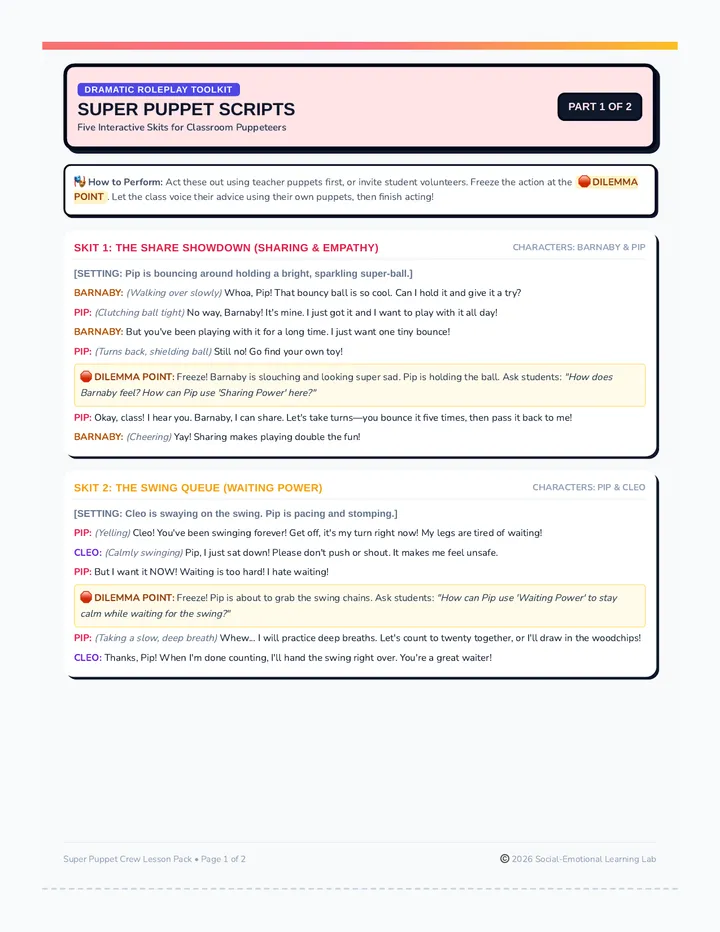
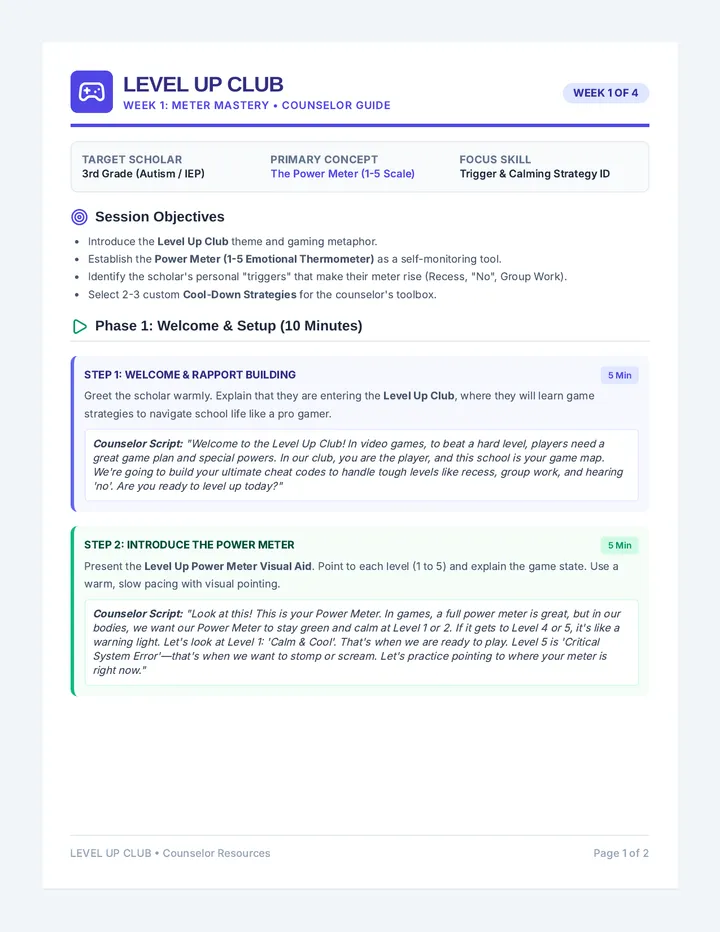
Feelings Faces Facilitation Guide
Feelings Faces
Facilitation Guide • Tier 3 Intervention
Duration 15 min
Why This Matters
Understanding and identifying emotions is a foundational life skill that helps children articulate their feelings, understand others, and navigate social situations. This lesson fosters emotional literacy, crucial for healthy development.
Audience & Approach
Audience: 1st Grade, Individual Student (Tier 3)
Approach: Visual recognition and guided discussion.
Prep & Materials
Prepare Materials (5 min):
- Review the Feelings Faces Slides.
- Print and cut the Emotion Matching Cards. (Laminate for reuse).
- Ensure a quiet, comfortable space.
Items Needed:
- Feelings Faces Slide Deck
- Emotion Matching Cards
Learning Objective
Students will be able to identify and name basic emotions (happy, sad, angry, surprised) using visual cues and personal examples.
Step-by-Step Instructions
1
Warm-Up & Introduction
2 min
• Greet the student and make them feel comfortable.
• Briefly introduce the topic: "Today we're going to talk about feelings! We all have them, and learning to recognize them can help us understand ourselves and others better."
• Ask: "What's a feeling you've had today?"
2
Explore Feelings Faces
5 min
• Present the Feelings Faces Slide Deck.
• Go through each emotion (happy, sad, angry, surprised) one by one.
• For each emotion:
- Ask: "What emotion do you see here? How can you tell?"
- Discuss facial expressions, body language, and situations.
- Ask the student to make the face of that emotion.
3
Emotion Matching Activity
5 min
• Introduce the Emotion Matching Cards.
• Explain: "We're going to match these feeling words to the faces!"
• Lay out the emotion picture cards and emotion word cards.
• Guide the student to match each emotion picture with its name. Encourage them to explain why they made each match.
• Prompts: "What clue on this face tells you it's angry?"
4
Wrap-Up & Reflection
3 min
• Review: "Great job! We talked about happy, sad, angry, and surprised today. Can you tell me one feeling you learned about?"
• Ask: "When might you feel (name an emotion)?"
• Close: "Knowing our feelings helps us know what we need and how to talk about it. Thank you for working with me today!"
Feelings Faces Slides
Understanding Our Feelings
How are you feeling today?
Teacher Notes
Welcome the student and explain that today's lesson is about understanding different emotions. Emphasize that all feelings are okay to have.
Happy
A wide smile, bright eyes, and a cheerful laugh!
Happy feels good!
Teacher Notes
Show the slide and ask the student to identify the emotion. Discuss what makes the face look happy (smile, bright eyes). Ask: "When do you feel happy?"
Sad
A frown, sometimes tears, and a quiet voice.
Sad feelings are okay, too.
Teacher Notes
Show the slide and ask the student to identify the emotion. Discuss what makes the face look sad (down-turned mouth, tears). Ask: "When do you feel sad?"
Angry
A furrowed brow, a tight mouth, and a loud voice.
It's okay to feel angry, but stay safe!
Teacher Notes
Show the slide and ask the student to identify the emotion. Discuss what makes the face look angry (furrowed brows, tight lips). Ask: "When do you feel angry?"
Surprised
Wide eyes, an open mouth, and a quick gasp!
A big feeling when things change fast!
Teacher Notes
Show the slide and ask the student to identify the emotion. Discuss what makes the face look surprised (wide eyes, open mouth). Ask: "When do you feel surprised?"
Let's Review!
Happy
Sad
Angry
Surprised
Now, let's play a game to match them up!
Teacher Notes
Review the emotions and transition to the matching activity.