Emotional Regulation Lesson Plan Emotional Regulation Exploration
Lesson Plan • Tier 1 Classroom Support
Time 30 min
Learning Objective
Students will learn to identify their emotions in various situations and practice specific, healthy strategies for regulating those emotions effectively.
The "Why"
Developing emotional intelligence is crucial for social interactions and personal well-being. This lesson uses experiential learning to help students move from simply feeling emotions to actively managing them in a healthy way.
Instructional Approaches
Experiential Learning Restorative Practices Trauma-Informed Active Learning
Materials List
Emotional Regulation Presentation (Slides)
Video: "How to Manage Your Emotions"
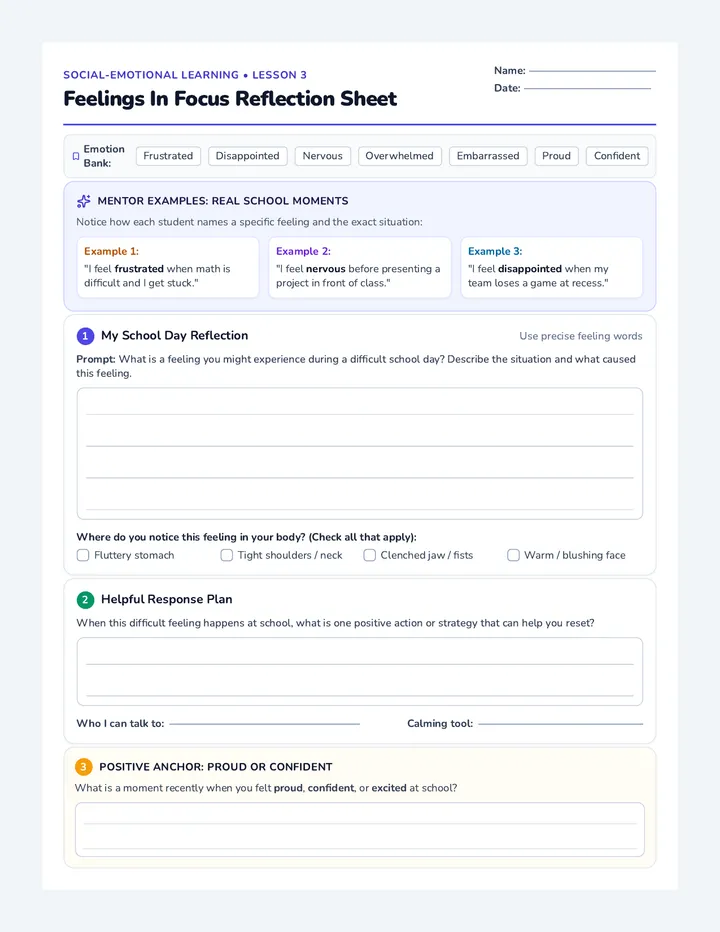
Emotion ID & Regulation Worksheet
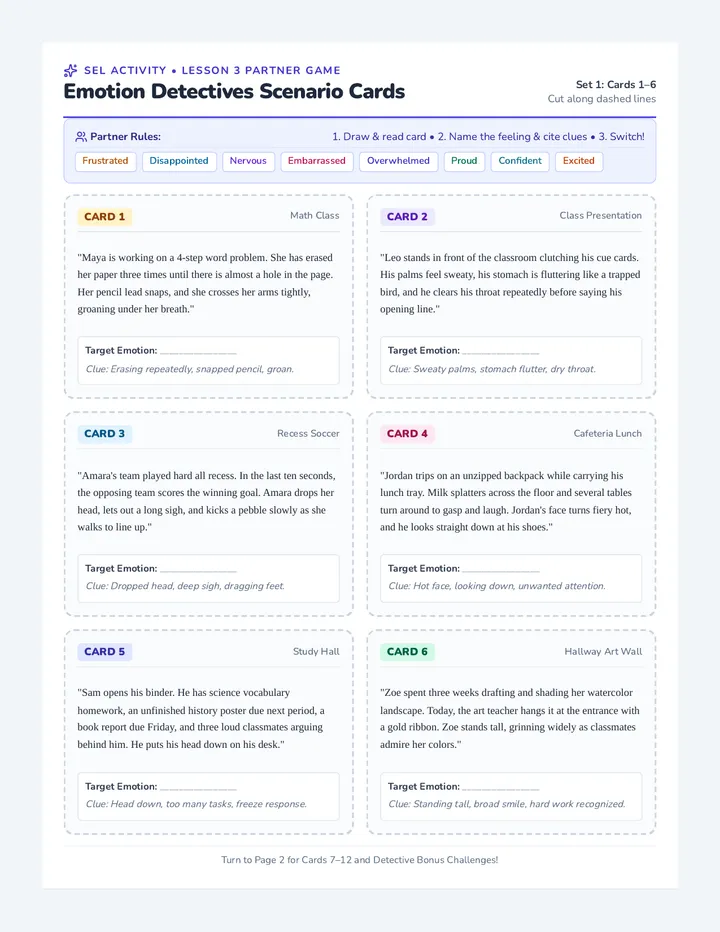
Scenario Cards for Role-Play
Quiz & Exit Ticket
Instructional Sequence
Intro 5 min
Introduction & Video
Briefly introduce the concept of emotions as information.
Explain the objective: learning to "pilot" our emotional responses.
Watch the video "How to Manage Your Emotions" on the presentation slide.
Discuss 5 min
Understanding Emotions Discussion
Facilitate a group discussion using the provided prompts in the slides.
Focus on common daily emotions and the impact of regulation on relationships.
Action 10 min
Emotion Regulation Role-Play
Divide students into small groups.
Assign each group a Scenario Card.
Students must identify the emotion and role-play a healthy regulation strategy.
Work 5 min
Independent Worksheet Completion
Students complete the "Emotion Identification and Regulation" worksheet.
Monitor for students who might need help identifying internal states.
Assess 5 min
Quiz & Exit Ticket
Administer the 2-question concept quiz.
Have students complete the Reflection Exit Ticket.
Emotional Regulation Presentation Slides Emotional Regulation Exploration
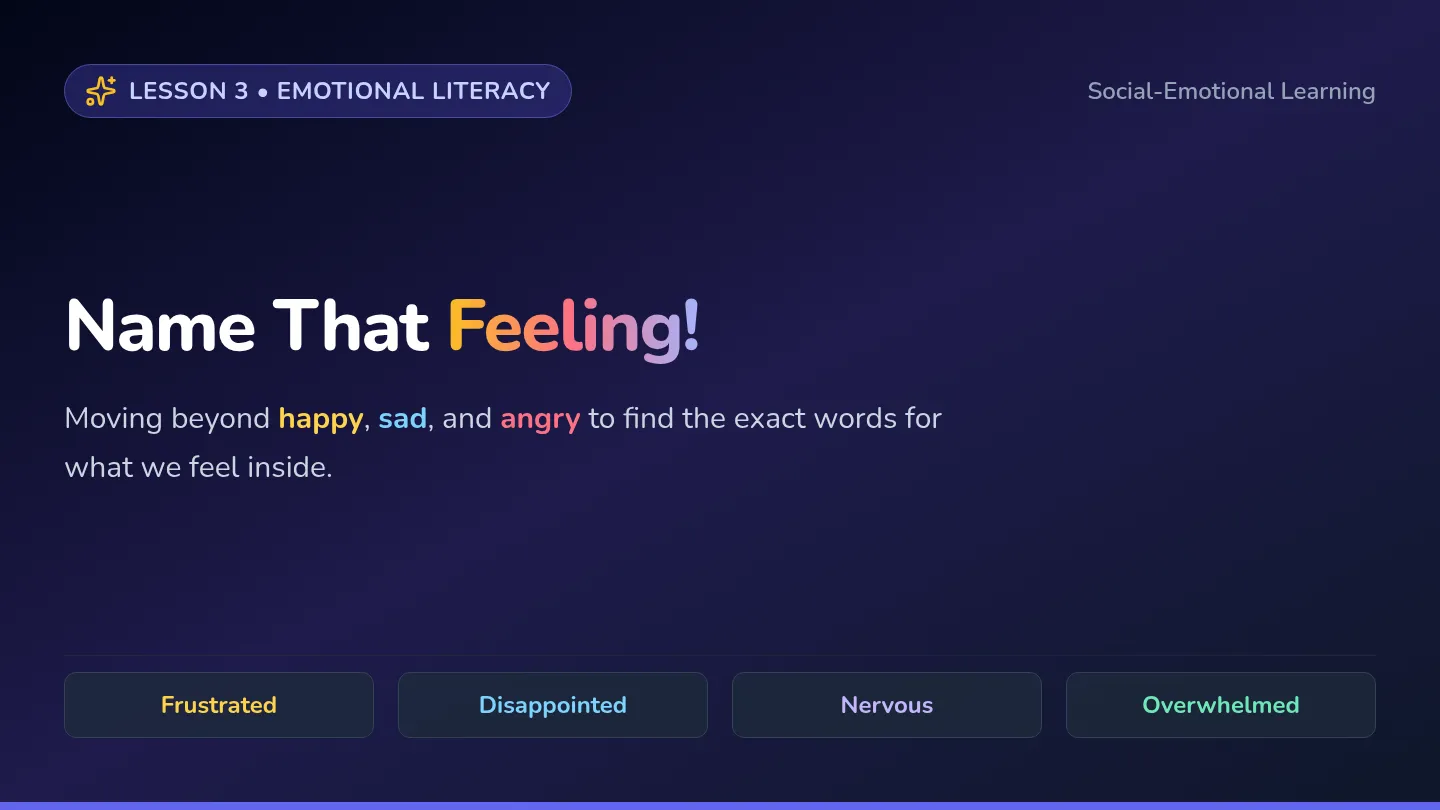
Understanding our feelings and taking charge of our reactions.
What are Emotions?
Emotions are like signals or messages from your body and brain.
They tell you about what is happening around you and how it affects you.
Happy
Angry
Sad
Calm
Scared
Excited
Video: How to Manage Your Emotions
Click to watch instructional video
https://haverhill-ps.lennylearning.org/view/how-to-manage-your-emotions
Let's Talk
What are some common emotions you experience daily?
Think about different situations: school, home, playing sports, or being with friends.
The Big Question
Why is it important to regulate our emotions?
Better decision making
Stronger friendships
Feeling more in control
Sharing Stories
Can you share a time when you successfully managed your emotions?
What strategy did you use? (Deep breathing, counting to 10, walking away?)
Role-Play Challenge!
1 Get into your small groups.
2 Read the scenario card given to you.
3 Act out the "not-so-good" reaction vs. the regulated reaction.
Emotion Identification Worksheet Emotion ID & Regulation
Social Emotional Learning
Name
Date
Part 1: Identifying My Emotions
List three emotions you felt today and describe the situations that caused them. Think about different times of the day—morning, lunch, or during a specific class.
Emotion
Situation (What happened?)
Emotion
Situation (What happened?)
Emotion
Situation (What happened?)
Part 2: Regulation Strategy
Choose one emotion from above and describe a strategy you used (or could use) to regulate it. Consider techniques like deep breathing, taking a break, or talking to someone you trust.
Chosen Emotion
Regulation Strategy (How will you manage this feeling?)
Remember: All emotions are information, not enemies.
Emotional Regulation Concepts Quiz Regulation Check
Emotional Regulation Concepts Quiz
Name: __________________________
Date: ___________________________
Select the best answer for each question below. Remember what we discussed about managing our "emotional signals."
1
Which of the following is a healthy way to regulate emotions?
Ignoring them and pretending they aren't there
Deep breathing and taking a pause
Yelling to make sure everyone knows how you feel
Bottling them up until you explode
2
True or False: All emotions are bad and should be avoided.
True
False
Regulation is a skill—keep practicing!
Reflection Exit Ticket Daily Reflection
EXIT TICKET
NAME: __________________________
What is the most important thing you learned today about emotional regulation?
How do you plan to use one of the strategies we discussed next time you feel a "big" emotion?
Emotional Regulation Exploration Turn this in before you leave!
Daily Reflection
EXIT TICKET
NAME: __________________________
What is the most important thing you learned today about emotional regulation?
How do you plan to use one of the strategies we discussed next time you feel a "big" emotion?
Emotional Regulation Exploration Turn this in before you leave!
Answer Key Worksheet and Quiz Teacher Answer Key
Emotional Regulation Exploration
Instructional Resource
Emotion Identification Worksheet
1. List three emotions you felt today and describe the situations...
Varies by student response.
Grading Criteria: Look for specific emotion words (e.g., frustrated, proud, anxious) rather than just "good" or "bad." Ensure the student has linked the emotion to a concrete event (e.g., "I felt anxious when I realized I forgot my lunch").
2. Choose one emotion and describe a strategy to regulate it...
Varies by student response.
Grading Criteria: The strategy should be a healthy, constructive action. Examples include deep breathing, "taking space," counting to ten, positive self-talk, or seeking help from a trusted adult.
Emotional Regulation Concepts Quiz
Q1: Which of the following is a healthy way to regulate emotions?
CORRECT
Deep breathing and taking a pause
Rationale: Unlike bottling emotions or reacting aggressively, deep breathing activates the parasympathetic nervous system, helping the brain move out of "fight or flight" mode.
Q2: True or False: All emotions are bad and should be avoided.
CORRECT
False
Rationale: Emotions are natural human experiences that provide valuable feedback about our environment and our needs. The goal is regulation , not elimination .
Facilitation Tip
When reviewing these answers with the class, emphasize that "mastering" emotions is a lifelong process. If students struggle to name emotions, consider providing an "Emotion Wheel" or "Feelings Poster" as a visual scaffold for future activities.