Detective Emotions Plan Case File: SEL-001
Detective Emotions Plan
Topic: Social Awareness & Empathy
Total Time
40 MIN
Mission Objective
"Students will become 'emotion detectives' by observing facial expressions and body language to accurately identify and label basic feelings, building empathy and social awareness in real-world scenarios."
Audience & Approach
Audience: 1st Grade ClassApproach: Interactive challenges with images, cards, and movement-based games.
Preparation & Evidence
Required Materials
Clue-Finding Slides
Emotion Picture Cards (Printed/Cut)
Guess the Feeling Game Props
Emotion Journal Sketches
Quick Tasks (10 min)
• Review slides for facial/body cues prompts.
• Organize any cue cards or "badges" for the game.
• Ensure student journals or pads are ready.
Investigation Timeline
5m
Mission Briefing (Introduction)
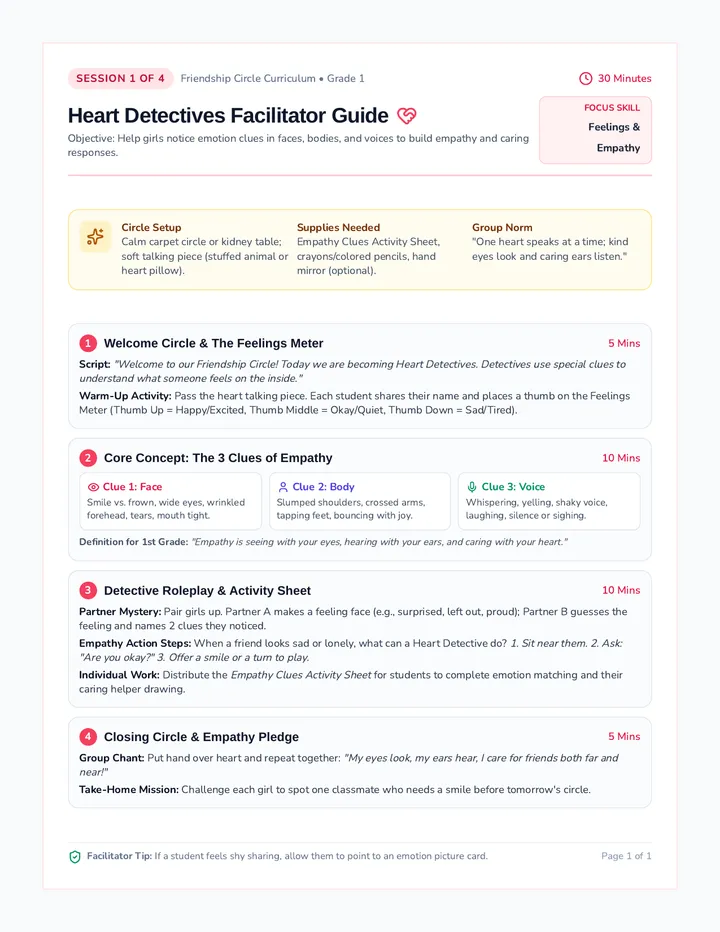
Gather students in a circle and introduce the detective theme. Explain that detectives use clues to figure out how someone feels without words. Show the first slide and ask, "What emotion do you see?"
10m
Evidence Training (Mini Lesson)
• Use Clue-Finding Slides to model identifying facial cues: eyebrows, mouth, and eyes.
• Discuss body language signals: posture, gestures, and stance.
• Label each emotion and build a word bank of synonyms.
10m
Field Work (Detective Activity)
Pair students with Emotion Picture Cards . One acts as the detective while the other reveals a card. Detective describes clues and names the feeling; partner confirms. Rotate roles.
10m
Grand Reveal (Guess the Feeling Game)
Volunteers act out emotions silently. The class acts as detectives, guessing the emotion and citing the specific clues they observed (e.g., "I saw narrowed eyes!").
5m
Debrief (Cool-Down)
Students draw or write in their Emotion Journal Sketch . Share journal entries and discuss what clues helped them solve the case.
Clue Finding Slides Case Briefing
Emotion
Detective Mission
01
Check the Face: Eyes, Brows, Mouth.
02
Notice the Body: Arms, Shoulders, Stance.
03
Name the Feeling using all clues!
Teacher: Introduce the mission. Detectives look for clues in faces and bodies to solve the case of "How do they feel?"
Evidence File #1
Happy Clues
Mouth: Corners turned way up!Eyes: Bright with "smile lines."Body: Relaxed shoulders, open arms.
😊
Teacher: Encourage children to mimic these cues. Ask: "What else does a happy body do? (Dancing, jumping?)"
Evidence File #2
Sad Clues
Mouth: Corners turned down.Eyes: Droopy or watery eyes.Body: Slumped shoulders, head down.
😢
Teacher: Ask: "How can you tell someone is sad if they aren't crying?" (Looking for body posture clues).
Evidence File #3
Angry Clues
Brows: Pulled down and together.Eyes: Narrowed or staring hard.Body: Clenched fists, stiff posture.
😡
Teacher: Have students tighten their muscles like an angry person, then shake it out to relax.
Evidence File #4
Surprised
Mouth: Open in an "O" shape.Eyes: Wide open!Brows: Raised way up high.
😲
Teacher: Invite students to freeze in their best "Surprised" pose. Discuss how it feels in their body.
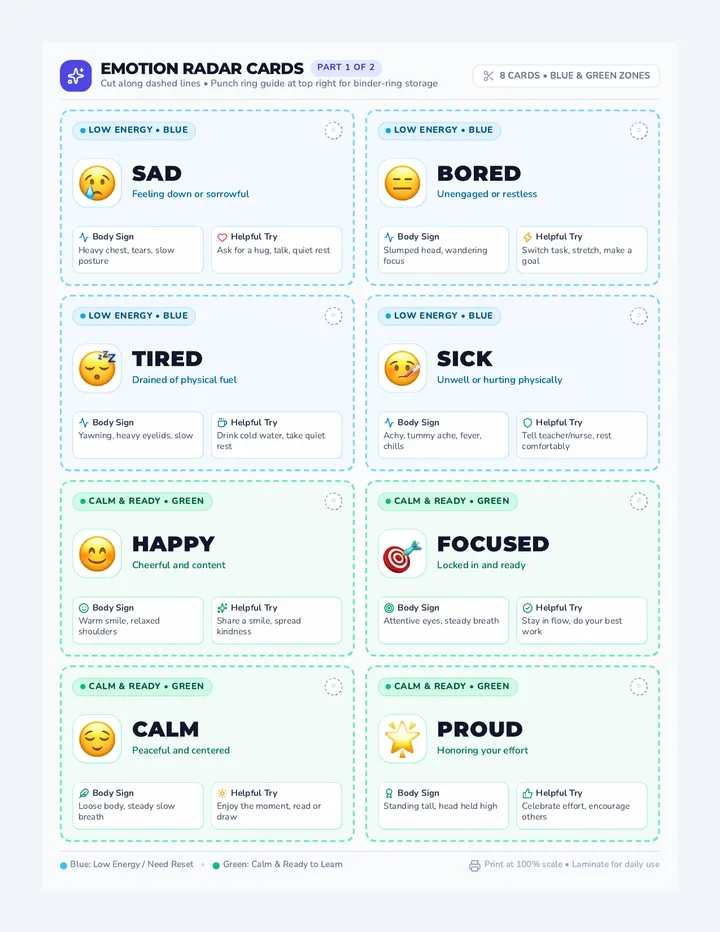
Emotion Picture Cards Emotion Case Files
Print and Cut ✂️
Evidence #1
Happy
Visual Clues:
🔎 Wide smile showing teeth
🔎 Eyes crinkled at the corners
🔎 Open, relaxed arms
Evidence #2
Sad
Visual Clues:
🔎 Downturned mouth / frown
🔎 Droopy eyes or tears
🔎 Shoulders slumped down
Evidence #3
Angry
Visual Clues:
🔎 Eyebrows pulled down
🔎 Tight lips / clenched teeth
🔎 Clenched fists or stiff body
Evidence #4
Surprised
Visual Clues:
🔎 Mouth open in an "O" shape
🔎 Eyes wide open
🔎 Raised eyebrows way up
Emotion Case Files (Cont.)
Print and Cut ✂️
Evidence #5
Scared
Visual Clues:
🔎 Wide eyes / mouth gasp
🔎 Tense shoulders / pulled back
🔎 Hands near mouth or chest
Evidence #6
Excited
Visual Clues:
🔎 Big grin / bright eyes
🔎 Bouncing or jumping posture
🔎 Raised arms or high energy
Evidence #7
Bored
Visual Clues:
🔎 Head resting on hand
🔎 Half-lidded / sleepy eyes
🔎 Slouched posture / still body
Evidence #8
Confused
Visual Clues:
🔎 Tilted head / furrowed brow
🔎 One hand up / shrugging
🔎 Squinted eyes looking up
Guess the Feeling Game Field Manual: Guess the Feeling
Active Learning • Movement • Social Cues
Operation Goal
Reinforce students’ ability to read nonverbal clues by guessing classmates’ emotions based on facial expressions and body language.
Preparation
• Use the Emotion Picture Cards or assign emotions quietly.
• Prepare "Detective Badges" or stickers for correct guesses.
• Clear a "Stage Area" at the front of the room.
Pro Tip
"Encourage volunteers to stay 'frozen' in their pose so detectives have time to scan for clues from head to toe!"
The Rules
1 Invite 3–4 volunteers to the front. Assign each one a secret emotion card.
2 Volunteers act out their emotion silently —no words, only face and body clues.
3 Detectives raise their hands. When called, they must name the emotion AND one clue they see.
4 Reveal the card! Reward correct guesses with a sticker or badge. Rotate volunteers.
Investigation Questions
"What part of their face gave you the biggest hint?"
"How would their body change if they were feeling [other emotion]?"
"Can someone feel two things at once? What would that look like?"
"What can we do to help someone who shows these clues?"
Emotion Journal Sketch Emotion Journal
Case Report #_________
Detective:
Date:
Evidence Sketch
Draw a picture of an emotion you saw today. Show the facial expression and body clues!
Detective Notes
Complete the sentence to explain your evidence.
I saw
and I knew
they felt
.
Official SEL Case File
Emotion Detective Unit