Lenny.com
Explore
Create
ActivitiesNewMathEnglish Language ArtsScience & EngineeringSocial StudiesGlobal LanguagesHealth & Physical EducationSpecial EducationCounseling & Life SkillsArts & CreativityESL
Lenny.com
Lenny.com
Explore
Create
ActivitiesNewMathEnglish Language ArtsScience & EngineeringSocial StudiesGlobal LanguagesHealth & Physical EducationSpecial EducationCounseling & Life SkillsArts & CreativityESL
Lenny.com
Lenny.com

Solutions

Lenny for EducatorsLenny for SchoolsLenny for Districts

Product

ExploreSign inCreateSupportAbout

Resources

Getting startedMTSS Acceleration Program

Newsletters

School Funding Newsletter

© 2026 Lenny Learning Inc.

TermsPrivacyAccessibility
LinkedInInstagramX
Lenny
Counseling & Life SkillsSelf-AwarenessBasic Emotion RecognitionComplex Emotion IdentificationEmotional Nuance & Mixed FeelingsBuilding Positive Self-ImageRecognizing Strengths & Growth AreasAccurate Self-AssessmentPersonal Values IdentificationCultural & Individual Identity ExplorationValues-Based Decision MakingSelf-ManagementStop-and-Think StrategiesDelaying GratificationIndependent Impulse ManagementIdentifying Stress TriggersShort-Term Goal SettingSMART Goals DevelopmentGoal Monitoring & AdjustmentBuilding Perseverance & ResilienceInternal Motivation DevelopmentComprehensive Stress Reduction PlanningSocial AwarenessRecognizing Others' FeelingsDemonstrating EmpathyRespecting Individual DifferencesUnderstanding Cultural DiversityComplex Empathetic ResponsesMultiple Viewpoint ConsiderationMulti-Perspective AnalysisChallenging Stereotypes & BiasRelationship SkillsActive ListeningClear Verbal & Nonverbal CommunicationBuilding Positive FriendshipsWorking Cooperatively in GroupsCommunicating Personal BoundariesRespecting Others' BoundariesAssertive ExpressionPeaceful Problem-SolvingContributing to Team GoalsComplex Conflict NavigationMediation & NegotiationHealthy Romantic RelationshipsResponsible Decision-MakingDaily Problem IdentificationBrainstorming Multiple SolutionsEvaluating Pros & ConsRecognizing Risks & ConsequencesApplying Ethical FrameworksInformed Risk-Benefit DecisionsRoot Cause AnalysisMindfulnessMindful BreathingBody Scan MeditationDaily Mindfulness ApplicationDaily Self-Care RoutinesBalancing Life DemandsAdvocating for Wellness NeedsMental Health SupportUnderstanding Anxiety SymptomsWorry Management StrategiesProgressive Muscle RelaxationRecognizing Depression SignsBuilding Mood-Supporting RoutinesBehavioral Activation for MoodUnderstanding Grief StagesHealthy Grief CopingCreative Expression of LossBehavioral SupportDaily Check-In ProceduresDaily Goal Setting & ReviewRecognizing Escalation Warning SignsRequesting Breaks & SupportSelf-Calming During DistressUnderstanding Positive ReinforcementToken Economy ImplementationBehavior Chart TrackingAnalyzing Behavior PatternsIdentifying Antecedents & ConsequencesDetermining Behavior FunctionFunction-Based InterventionsIndividualized Behavior ContractsData-Driven Behavior AdjustmentTherapeutic ApproachesThoughts-Feelings-Behaviors ConnectionRecognizing Thinking PatternsChallenging Negative ThoughtsPositive Self-Talk PracticeThought Record TrackingAdvanced Cognitive RestructuringComprehensive CBT PlansBehavioral Activation TechniquesBuilding Positive ExperiencesExposure Hierarchies for AnxietyPresent-Moment AwarenessNon-Judgmental ObservationSelf-Soothing & DistractionComplex Emotion LabelingReducing Emotional Vulnerability (PLEASE)DEAR MAN CommunicationGIVE Skills for RelationshipsFAST Skills for Self-RespectRadical Acceptance PracticeCrisis Survival Skills (TIPP)Understanding Trauma EffectsTrauma Responses & TriggersIdentifying Trauma FeelingsGrounding TechniquesRegulation During Trauma DistressSafe Place VisualizationProcessing Through NarrativeDeveloping Trauma StoryPersonalized Safety PlanningGroup SupportTurn-Taking & SharingGroup Conversation SkillsSharing in Supportive EnvironmentLearning from Similar ChallengesBuilding Community & BelongingNavigating Peer RelationshipsGroup Skill PracticeGroup Mental Health EducationStress & Anxiety UnderstandingCrisis Support & SafetyKnowing When to Seek HelpIdentifying Mental Health CrisesGrounding During CrisisUsing Crisis HotlinesBuilding Support NetworksAccessing Mental Health ResourcesWarning Signs & Coping StrategiesDeveloping Personal Safety PlansUnderstanding Suicide Warning SignsGatekeeper Skills for PeersDigital LiteracySocial MediaTechnology BasicsProductivity ToolsInternet and Online ResearchWeb Design and PublishingDigital CitizenshipOnline Safety and PrivacyEmerging TechnologiesFinancial LiteracyMaking Financial DecisionsBanking and AccountsConsumer SkillsSaving and InvestingCredit and DebtEmployment and IncomeTaxesInsuranceMajor PurchasesEconomic ConceptsFinancial PlanningCollege & Post-Secondary PlanningCareer ExplorationUnderstanding Post-Secondary OptionsCollege Research & SelectionAdmission RequirementsCollege Application ProcessPersonal Statement WritingFAFSA CompletionScholarship Search & ApplicationsUnderstanding Student LoansContinuing Education PlanningInterview PreparationResearching EmployersCommon Interview QuestionsSTAR Method ResponsesProfessional Interview PresenceVirtual Interview SkillsInterview Follow-UpJob Search SkillsUnderstanding Job PostingsEffective Job Search StrategiesNetworking for OpportunitiesResume Writing BasicsAction Verbs & AchievementsTailoring Resumes to JobsCover Letter WritingProfessional ReferencesProfessional CommunicationBusiness Email EtiquettePhone & Voicemail ProfessionalismMeeting ParticipationPresentation SkillsProfessional Work EthicTime Management & ProductivityTeamwork & CollaborationAdaptability & FlexibilityProblem-Solving at WorkConstructive FeedbackWorkplace RightsUnderstanding Employment LawsPay & Benefits UnderstandingWorkplace SafetyAnti-Discrimination & Harassment

Speak Up Script

An interactive DBT-based lesson introducing high school students to the DEAR MAN framework. Students learn to assertively advocate for themselves with adults and peers through guided scripting and realistic role-play scenarios.

CClara

Speak Up Script

An interactive DBT-based lesson introducing high school students to the DEAR MAN framework. Students learn to assertively advocate for themselves with adults and peers through guided scripting and realistic role-play scenarios.

CClara

N Negotiate: Alternate Plan B

Pivot when met with resistance.

If the other person says an absolute "No" to your primary assert ask, what is a realistic, acceptable compromise (Plan B) you can suggest?

Draft your compromise option here... (E.g., "If Friday is too late, can I submit my work by Thursday evening for a 5-point deduction?")

Step 3: Peer Script Review & Verification

PEER-REVIEW RUNTIME

Partner with a classmate. Read your compiled D-E-A-R script aloud. Have your partner evaluate your flow, assertiveness, and tone.

D - Facts Clear? Y / N

E - Avoid Blame? Y / N

A - Clear Request? Y / N

R - Mutual Gain? Y / N

PEER SIGNATURE: _____________________________ READY FOR DEPLOYMENT

DRAFTBOARD V1.0

DBT SKILLS TRAINING COHORT

PAGE 2 OF 2

INSTRUCTIONS:

#05

Mission: Friendship

THE STUDY STEALER

Context: Your close friend, Leo, keeps asking to "borrow" your completed history homework. You worked for hours on it, and you're worried about getting caught for academic cheating.

Role Guidelines:

Student: Say "No" clearly (Assert). Offer to explain concepts (Negotiate). Peer (Friend): Complain about being tired, say "you don't trust me," and beg.

#06

Mission: Boundaries

SOCIAL PRESSURE

Context: Your friend group wants to sneak out of an evening school event to go to an unmonitored party. You want to stay, but they are calling you a "buzzkill" and teasing you.

Role Guidelines:

Student: Stay Mindful (use Broken Record: "I'm staying here"). Peer (Group): Mock the rules, laugh, say "everyone is going," try to peer pressure.

#07

Mission: Collaboration

PROJECT SLACKER

Context: You are paired with a classmate, Marcus, for a chemistry project. Marcus has not contributed to the shared slides and is playing games on his laptop during work periods.

Role Guidelines:

Student: Describe the lack of slides. Assert clear, assigned deadlines. Peer (Marcus): Make excuses (stress, busy), try to put off working until "tonight."

#08

Mission: Personal

RUMOR PATROL

Context: Your friend, Chloe, heard a rumor about you and repeated it to several people in your lunch group. It's causing awkwardness, and you need to address it directly.

Role Guidelines:

Student: State the facts of what Chloe said. Express your hurt/disappoint. Peer (Chloe): Get defensive, say "it was just a joke," claim others said it first.

DEAR MAN ROLE-PLAY DECK

COMPLETED SCENARIOS VERIFIED

PAGE 2 OF 2


CURRICULUM MODULE: INTERPERSONAL EFFECTIVENESS

CONTINUE TO PAGE 2 FOR EXEMPLARY ANSWER KEYS

PAGE 1 OF 2

EXEMPLAR LIBRARY (ANSWER KEY)

Use these scripted benchmarks to guide student feedback, grading, and direct modeling.

SET: EX-01-A

Exemplar 01

Scenario #1: Mr. Harrison's Lab Delay (Academic)

Focus: High-risk negotiation with a strict, busy adult. Balancing objective facts with respect.

D - Describe:

"Mr. Harrison, the final draft of our biology lab report is due today at 3:00 PM."

E - Express:

"I'm feeling really stressed because I had an unexpected double work shift last night and couldn't run my final spell check."

A - Assert:

"I would like to ask if I can submit my report tomorrow morning before class begins."

R - Reinforce:

"If you grant this, I can submit a cleaner, fully edited paper which will make grading easier and faster for you."

M - Mindful:

(If Mr. Harrison says "No late work"): "I understand you have a strict policy, but I still want to turn in high-quality work. Can we look at an alternative?"

N - Negotiate:

"If tomorrow is impossible, could I email it to you by 6:00 PM tonight for a 10% penalty instead of a zero?"

Exemplar 02

Scenario #5: Leo's Homework Copy Request (Peer)

Focus: Saying "no" to a close friend. Preserving the relationship while firmly refusing a risk.

D - Describe:

"Leo, you asked to borrow my history homework packet so you can copy the answers before third period."

E - Express:

"I feel highly anxious about that because Mrs. Gable checks for plagiarism, and we could both get suspended and lose credit."

A - Assert:

"I cannot let you copy my packet."

R - Reinforce:

"This way, both of our grades remain safe, and we don't risk getting in trouble with the office."

M - Mindful:

(If Leo calls you selfish): "I care about our friendship, but I am still not going to share my answers." (Broken Record)

N - Negotiate:

"I'm happy to sit with you right now for 10 minutes and explain the answers to questions 3 and 4 so you can write your own."

Pacing & Reflection Debrief Questions

Conclude the class with these 3 check-for-understanding questions:

  1. "Which of the 7 steps was the most difficult to write? Why?"
  2. "How did your body feel during the 'Appear Confident' step? Did your tone match your script?"
  3. "What's the difference between negotiation and giving in?"

TEACHER METHODOLOGY CORE

CURRICULUM VERIFICATION COMPLETE

PAGE 2 OF 2

N Negotiate

[ OBJECTIVE: SYSTEMATIC CLARITY ]

[ INSTRUCTIONAL SLIDE 3 OF 7 ]


MODULE 03 // THE SCRIPT

SYS_REF: WRITING_PHASE

STAGE ONE

DEAR: Crafting Content

FOUR-STEP FLOW

D

Describe the Situation

Stick to objective facts. Avoid judgment or exaggeration. "We agreed to study, but you arrived 30 minutes late."

E

Express Your Feelings

Use "I" statements. Don't blame or say "You made me feel...". "I felt anxious because our study session was cut short."

A

Assert Your Request

State clearly and directly what you want or need. No hinting. "Next time, I need you to text me if you're running late."

R

Reinforce the Outcome

Explain the positive results of meeting your request. "That way, we can make the most of our shared study time."

[ ACTION: SCRIPT SPECIFICATION DRAFTED ]

[ INSTRUCTIONAL SLIDE 4 OF 7 ]


MODULE 04 // THE DELIVERY

SYS_REF: REGULATION_STATE

STAGE TWO

MAN: Managing the Delivery

THREE BEHAVIOR CONTROLS

M

Mindful

Keep your focus on your goal. Ignore baiting, side-topics, or defensive comments. Stay on track.

TECHNIQUE: BROKEN RECORD

A

Appear Confident

Maintain steady eye contact. Keep a calm, clear voice volume. Sit or stand comfortably tall.

TECHNIQUE: GROUNDED POSTURE

N

Negotiate

Be willing to compromise. Offer alternative suggestions that still respect your foundational boundaries.

TECHNIQUE: COOPERATIVE FLEX

[ REGULATION: EMOTIONAL TEMPERATURE STABLE ]

[ INSTRUCTIONAL SLIDE 5 OF 7 ]


MODULE 05 // COMPARISON

SYS_REF: SIMULATION_RUN

THE SYSTEM IN ACTION

Real-Life Simulation Case

SCENARIO: Requesting a project extension from an educator

UNOPTIMIZED STATEMENT

"You never grade things on time anyway, so why can't you just let me turn this in late? It's not fair."

Result: Triggers defensiveness, clouds the actual issue, and damages trust.

DEAR MAN PROTOCOL APPROVED

[D] "The project is due tomorrow, and I missed two classes due to fever."

[E] "I feel worried about getting a low grade on this major topic."

[A] "I'm asking if I can submit it on Friday with no penalty."

[R] "This will let me submit quality work that meets all specifications."

Result: Focuses strictly on facts, keeps tone respectful, and optimizes outcomes.

[ CASE: ACADEMIC SELF-ADVOCACY SCENARIO ]

[ INSTRUCTIONAL SLIDE 6 OF 7 ]


MODULE 06 // APPLICATION

SYS_REF: DRAFT_EXECUTE

LAB ACTIVITY

Drafting Your Custom Blueprint

Open your Speak Up Script Worksheet. We are going to construct your custom self-advocacy blueprint.

01

Select Your Target Scenario

Choose a peer conflict, boundary setting, or a request you need to make to an adult.

02

Draft the DEAR Script

Fill in the grid-lined blueprint boxes on page 1 and page 2 of your draftboard worksheet.

03

Execute and Test with a Peer

Use your Scenario Cards to role-play. Keep the MAN delivery controls locked in.

CRITICAL FOCUS

Focus on isolating Facts from Interpretations. If it cannot be recorded by a camera, it is an opinion, not a fact!

STATUS: ACTIVE_DRAFTING

[ PROTOCOL: LIVE PRACTICE MODULES ACTIVE ]

[ INSTRUCTIONAL SLIDE 7 OF 7 ]
You might also like

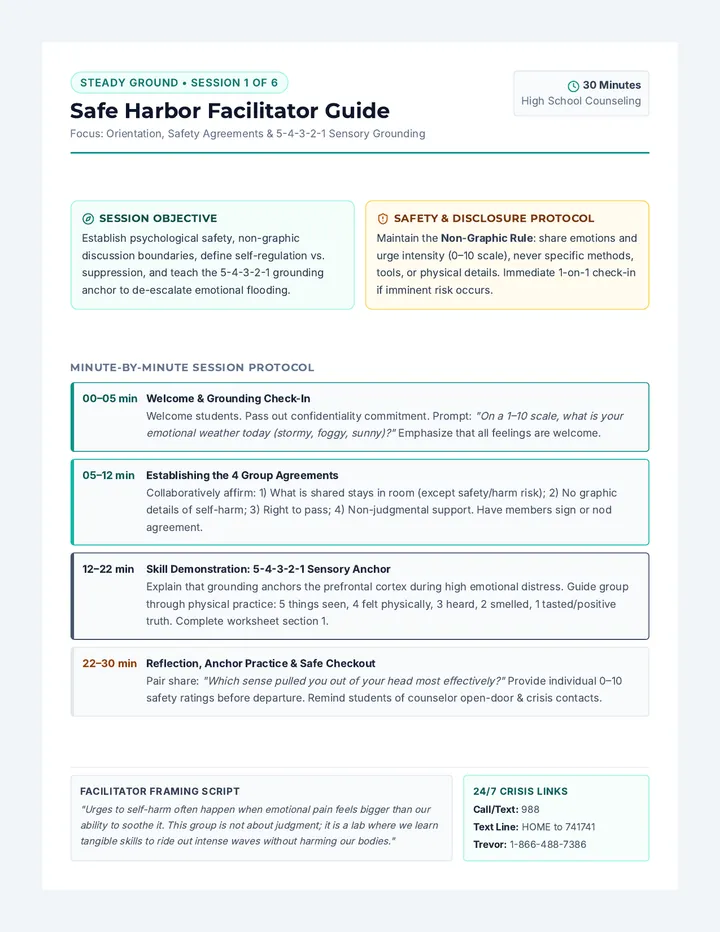
Safe Harbor Facilitator Guide

Steady Ground

A 6-session dialectical emotion-regulation and distress-tolerance group counseling curriculum designed for high school counselors supporting students struggling with self-harm urges. Each 30-minute session delivers targeted grounding practices, physiological resets, urge-surfing tools, and safety planning.

SL

Sofia Lopez

12
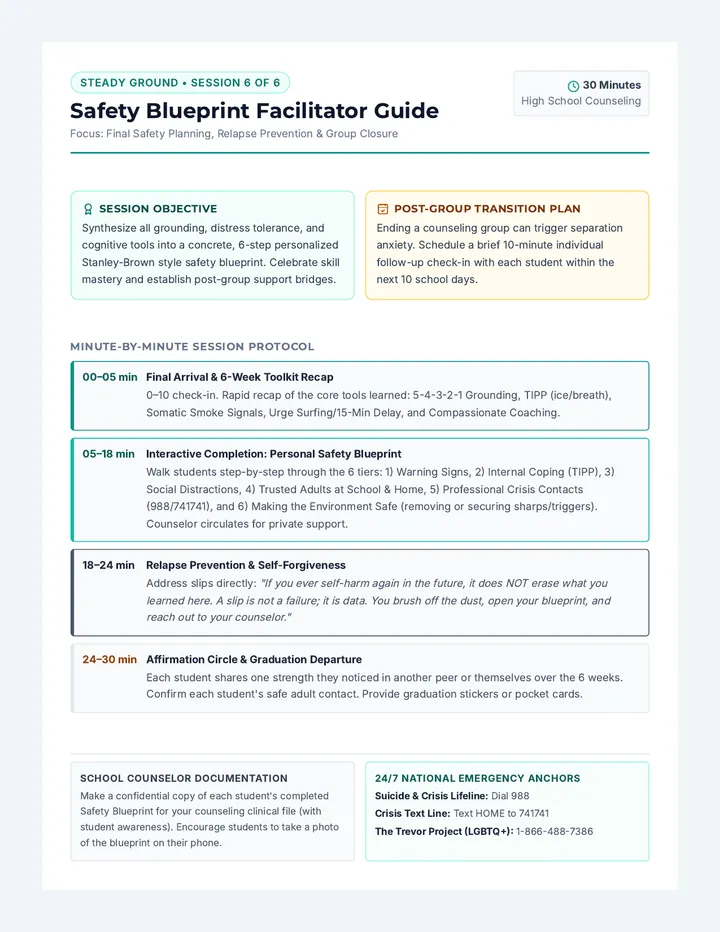
Safety Blueprint Facilitator Guide

Safety Blueprint

Synthesizes all skills into a personalized pocket crisis and regulation blueprint. Students identify safe adults, rehearse escalation protocols, and celebrate progress as the group concludes.

SL

Sofia Lopez

2
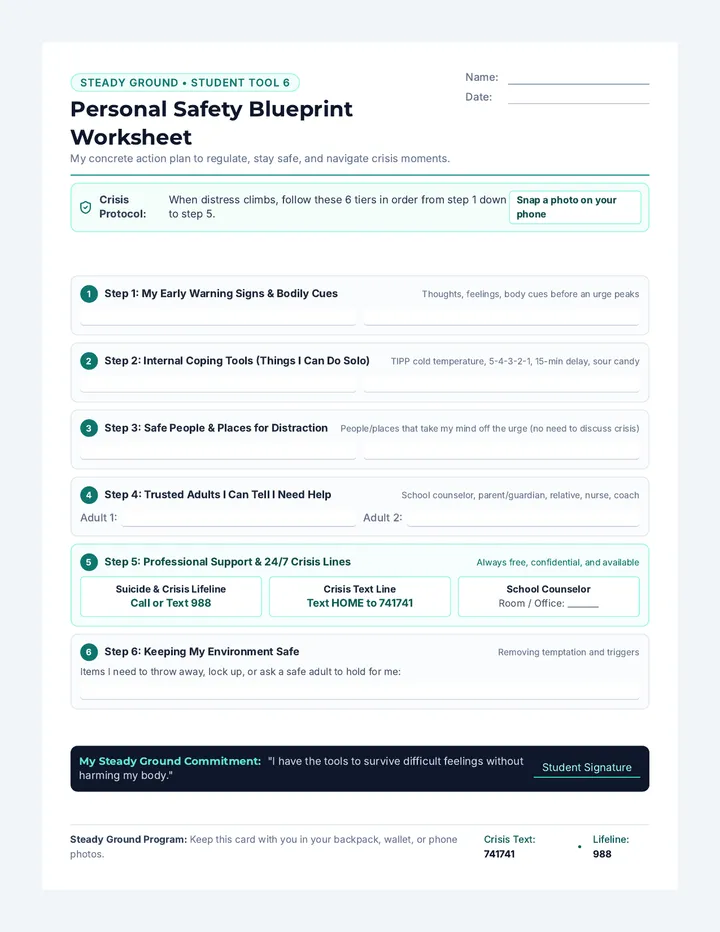
Personal Safety Blueprint Worksheet

Personal Safety Blueprint Worksheet

A personalized 6-step crisis regulation and safety blueprint documenting early warning signs, coping skills, safe contacts, and environmental safety.

SL

Sofia Lopez

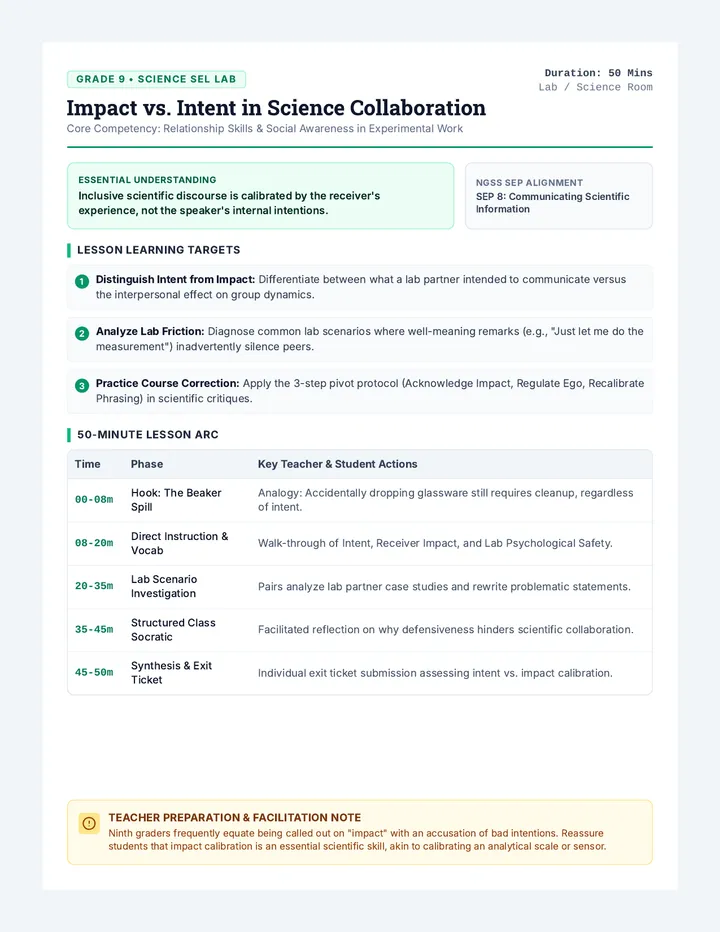
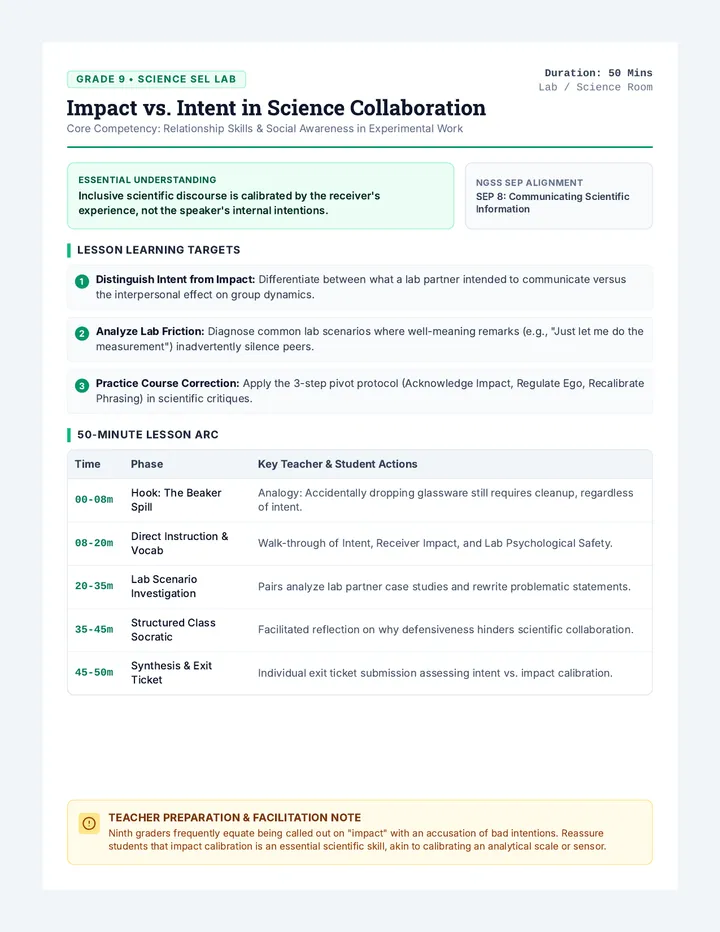
Impact Intent Teacher Guide

Science Lab Dialogue

A high school science SEL sequence that fosters inclusive collaboration, empathetic communication, and barrier-free scientific discourse across grades 9 through 11.

YB

Yna Bersales

27
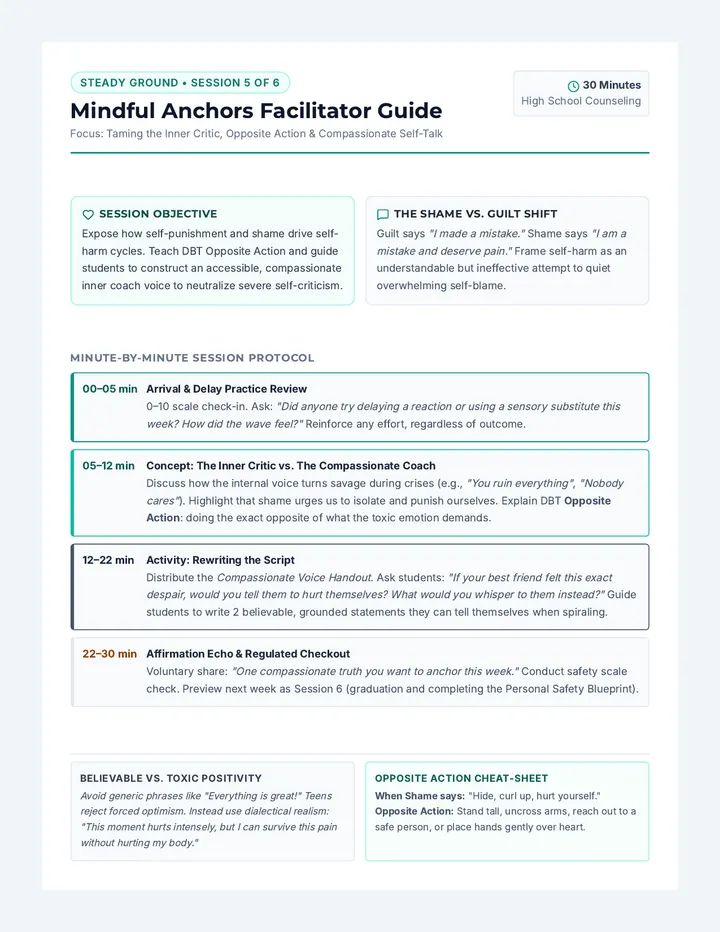
Mindful Anchors Facilitator Guide

Mindful Anchors

Explores the relationship between harsh self-criticism, overwhelming emotion, and self-harming behavior. Students practice dialectical opposite action and develop compassionate self-coaching scripts.

SL

Sofia Lopez

2
Safety Blueprint Facilitator Guide

Safety Blueprint Facilitator Guide

A 30-minute counselor facilitation protocol for Session 6, guiding closure, relapse prevention, individual check-in scheduling, and personalized crisis safety blueprint completion.

SL

Sofia Lopez

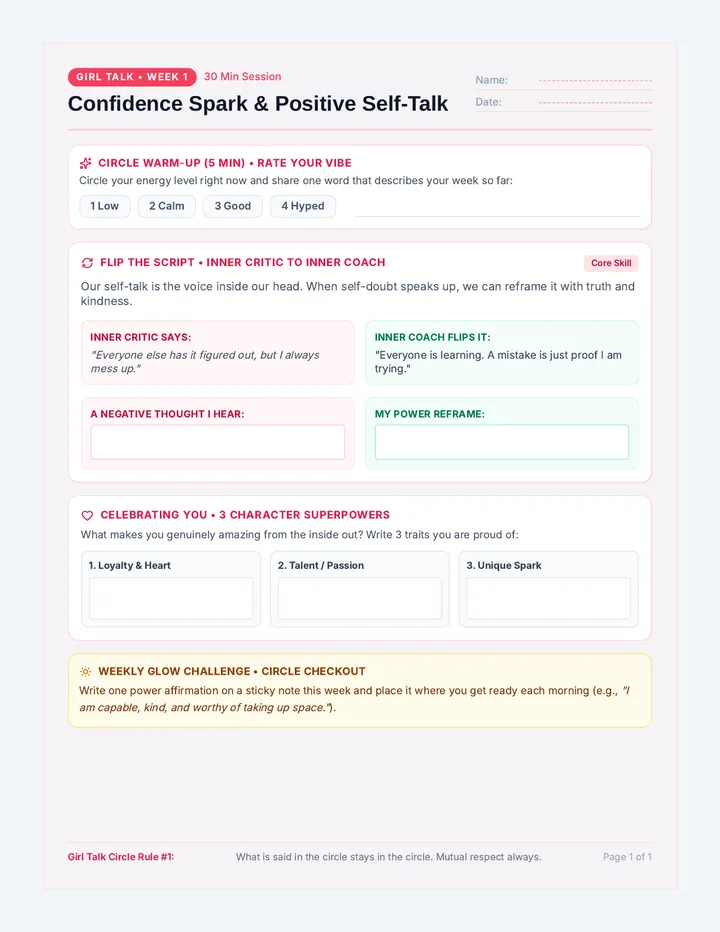
Confidence Spark Journal

Girl Talk Circle

A six-week small group curriculum for adolescent girls designed to build self-esteem, interpersonal loyalty, healthy boundaries, stress regulation, everyday etiquette, and future aspirations through engaging 30-minute weekly circles.

A

aiesha.olamiju

6
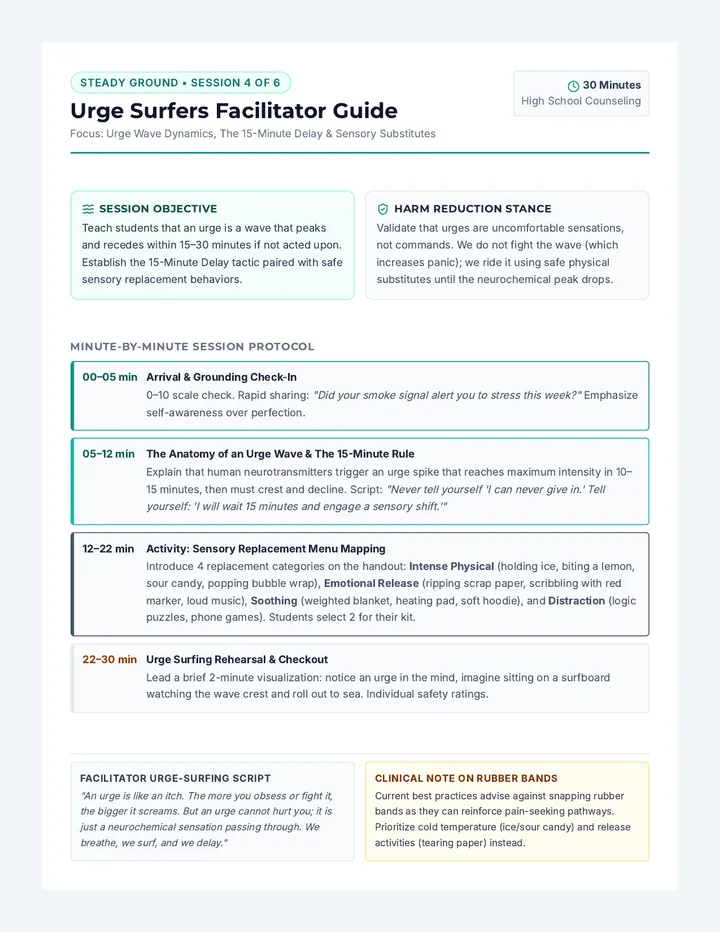
Urge Surfers Facilitator Guide

Urge Surfers

Focuses on riding out self-harm impulses through the 15-minute delay principle and sensory replacement behaviors. Students create a personalized tactile and sensory alternative kit.

SL

Sofia Lopez

2
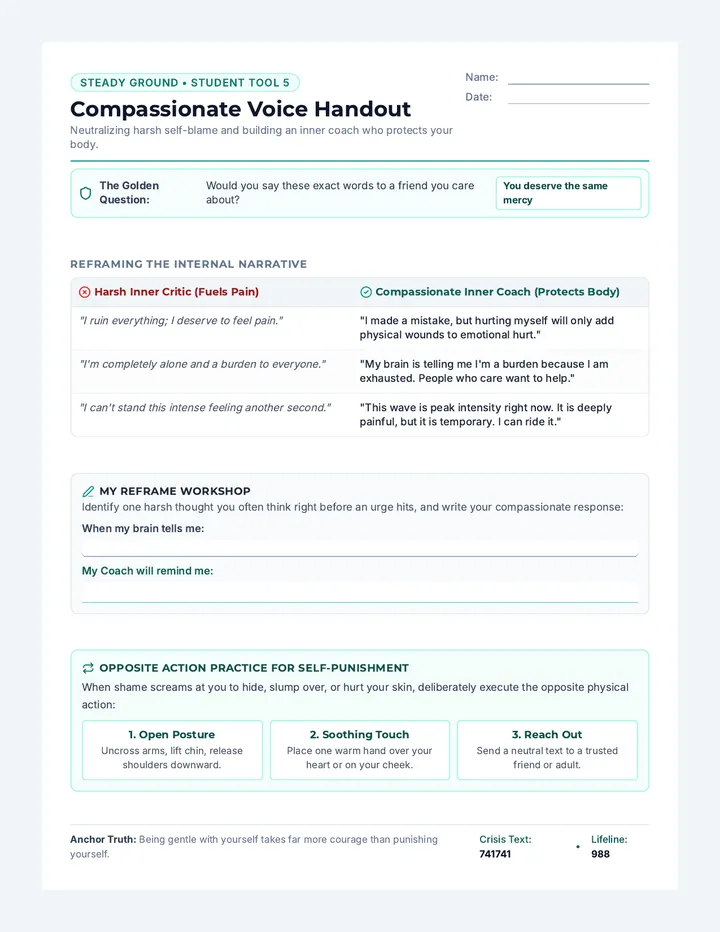
Compassionate Voice Handout

Compassionate Voice Handout

A student cognitive-reappraisal handout featuring DBT opposite action formulas, inner critic reframing exercises, and self-compassion grounding scripts.

SL

Sofia Lopez

Impact Intent Teacher Guide

Science Class Dialogue

A high school science SEL sequence that builds positive teamwork, clear communication, and barrier-free collaboration between project partners in science class across grades 9 through 11.

J

jtoomey

27
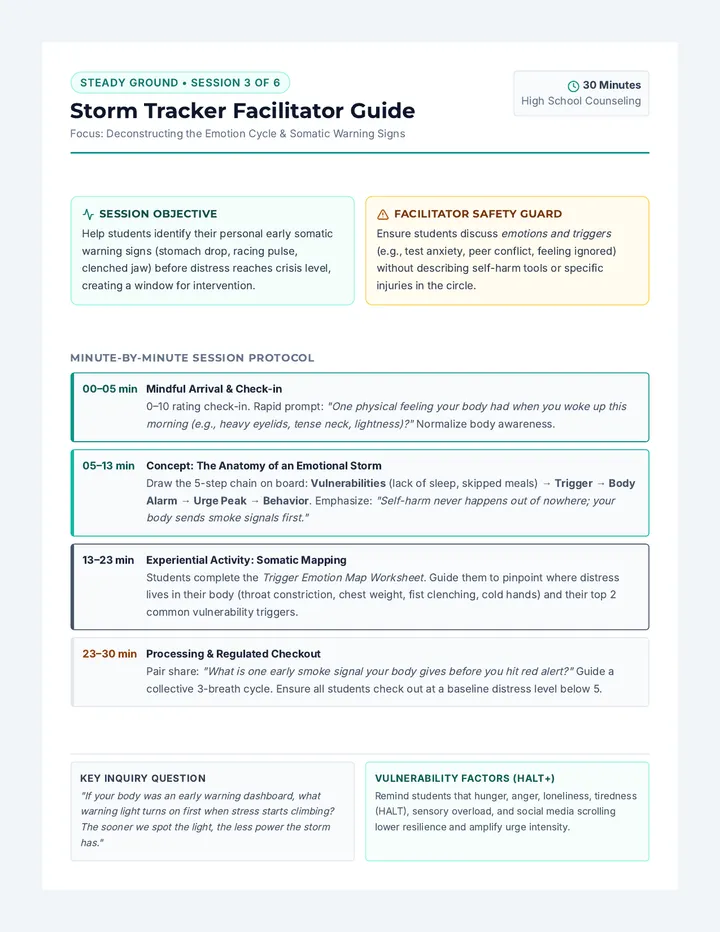
Storm Tracker Facilitator Guide

Storm Tracker

Guides students through identifying early somatic warning signs and situational triggers before distress peaks. Students map their personal emotional wave and explore the anatomy of an urge.

SL

Sofia Lopez

2
Mindful Anchors Facilitator Guide

Mindful Anchors Facilitator Guide

A 30-minute counselor facilitation protocol for Session 5, guiding students to challenge harsh self-critical narratives through DBT opposite action and compassionate self-coaching.

SL

Sofia Lopez