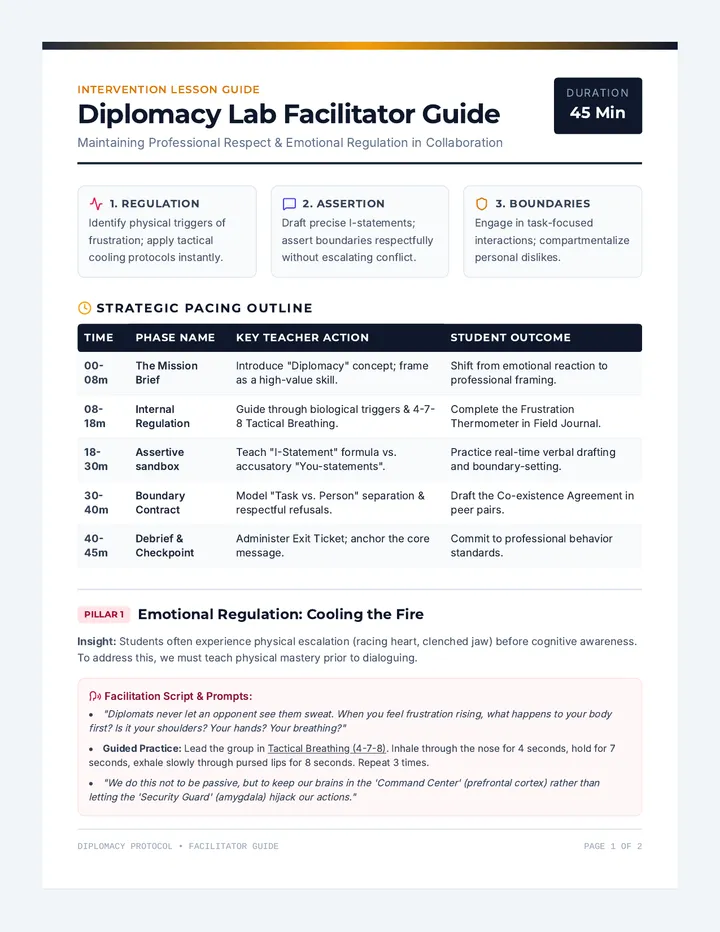
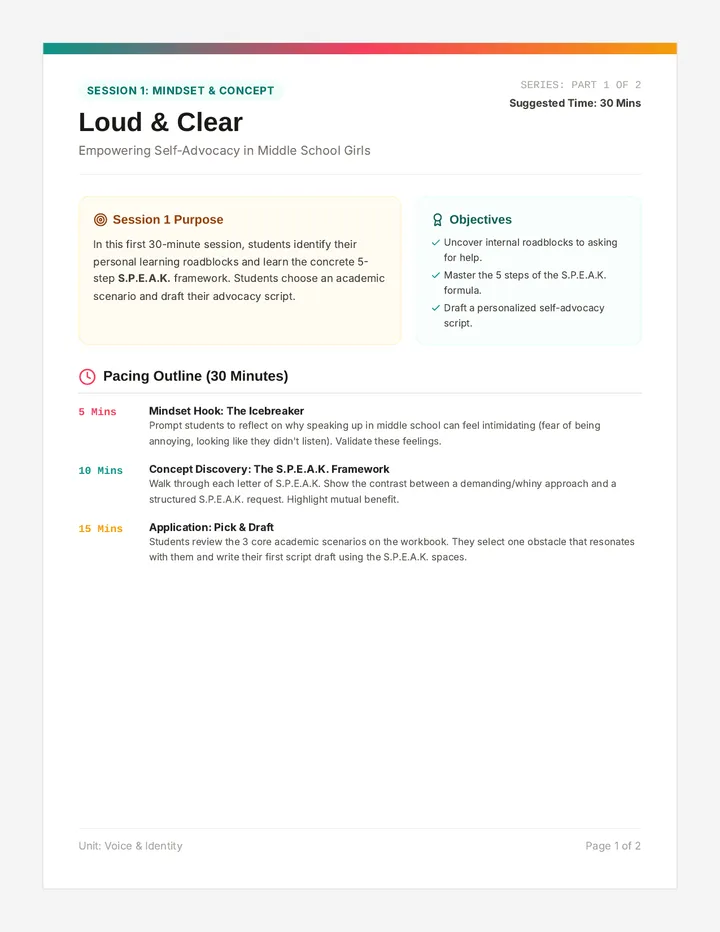
Creating Harmony Lesson PlanCreating Harmony Teamwork & Conflict Resolution Guide Duration 60 MIN WHY THIS MATTERS This lesson helps students develop essential life skills that enhance their ability to work collaboratively, resolve disagreements, and navigate conflicts in academic and personal settings. Mastering these interpersonal skills early leads to higher emotional intelligence and professional success. LEARNING OBJECTIVES Identify key components of effective teamwork and collaborative problem-solving. Apply "I" statements and active listening strategies to de-escalate conflict. Practice negotiation and compromise through real-world role-play scenarios. PREP CHECKLIST Review slides & scenarios. Set up projector/computer. Prepare activity materials (paper, tape, or straws for challenge). Print student handouts. Lesson Roadmap 10 MIN Phase 1: Spark & Connect Introduction, objective setting, and sharing teamwork examples. 20 MIN Phase 2: The Collaboration Challenge Small group problem-solving activity (e.g., Tower Build or Puzzle Hunt). 15 MIN Phase 3: Conflict Role-Play Practicing negotiation and de-escalation in realistic scenarios. 15 MIN Phase 4: Reflect & Anchor Debrief, strategy summary, and key takeaways for future use. Step-by-Step Facilitation Middle School Level (Grade 6-8) 1 Introduction (10 min) Goal: Define the personal and academic value of teamwork. Hooks: Ask, "Think of a time you were on a team where one person did all the work. How did it feel? Now think of a time where everyone worked together perfectly. What was the difference?" Discuss: Briefly define Conflict Resolution as "finding a peaceful solution to a disagreement where both sides feel heard." 2 Group Challenge (20 min) The Challenge: "The Silent Blueprint." Groups of 4 must build a structure (using paper/tape) but 10 minutes of the build must be silent. Organize students into small, diverse groups. Facilitator Note: Observe how groups communicate non-verbally. Do they get frustrated? Do they find new ways to share ideas? After the silent phase, give them 5 minutes to talk and refine their build. 3 Role-Play (15 min) Goal: Practice using the "Conflict Resolution Toolbox" handout. Assign pairs a scenario (e.g., "The Group Project Slacker" or "The Disagreement Over Social Plans"). Have students play it out twice: once focusing on the "Wrong Way" (blame, shouting) and once on the "Harmony Way" (active listening, compromise). 4 Debrief (15 min) Guiding Questions: "What was the hardest part about working silently? How did you adapt?" "In the role-plays, which strategy felt most natural? Which felt hardest to use?" "How can we use these 'Harmony' skills in our cafeteria or classrooms tomorrow?"
Creating Harmony SlidesCreating Harmony Teamwork & Conflict Resolution Lesson Objectives 💡 Learn practical teamwork strategies for group success. 🤝 Develop conflict resolution skills to handle disagreements. 💬 Enhance communication and negotiation abilities. Group Challenge "The Silent Blueprint" 20 MINUTES 1 Divide into your assigned small groups. 2 Work together to solve the design challenge. 3 Strict Rule: No talking for the first 10 minutes! Focus On: Non-verbal collaboration Collective decision-making Creative problem solving Role-Play Scenarios ACT Role-play the assigned conflict scenarios with your partner. PRACTICE Focus on negotiation, "I" statements, and de-escalation. ROTATE Switch roles to ensure everyone gets a chance to lead the solution. Goal: Find the "Harmony Way" 🕊️ The Debrief Reflect on the Challenge: "What teamwork strategies did you find most effective when you couldn't talk?" Reflect on the Conflict: "How did using 'I' statements change the outcome of your role-play?" Final Thought: What is one key takeaway you will use at home or in school this week?
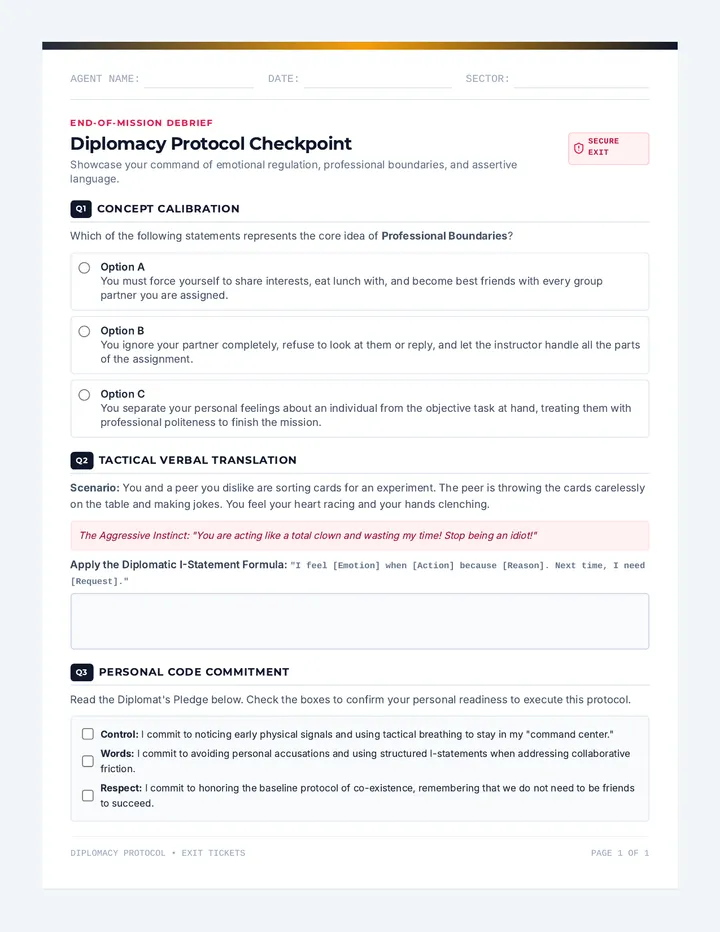
Harmony In Action WorksheetHarmony In Action Role-Play & Strategy Worksheet Name: Date: The Silent Blueprint Reflection Think about your team's performance during the "no talking" phase of the challenge. 1. How did your team communicate without using words? List at least 3 methods (e.g., gestures, drawing). 2. What was the biggest frustration your team faced? How did you solve it once you were allowed to speak? Conflict Role-Play Scenarios Scenario A The Group Project The Situation: You and your partner are working on a poster. You want to use bright markers and draw icons, but your partner wants to keep it "professional" with only black pens and printed text. Neither of you wants to budge. The Wrong Way Blaming, refusing to listen, and saying "my way or no way." The Harmony Way Use "I" statements and find a compromise (e.g., bright icons + black text). Scenario B The Cafeteria Seat The Situation: You always sit at the same table with your friends. Today, a new student sat there. One of your friends wants to tell them to leave, but you feel like that’s mean. Your friend is getting annoyed at you for not "having their back." The Wrong Way Arguing with your friend or ignoring the new student. The Harmony Way Active listening to your friend’s concerns, then suggesting an inclusive solution. My Takeaway Which "Harmony Way" strategy felt most effective during your role-play? Why?
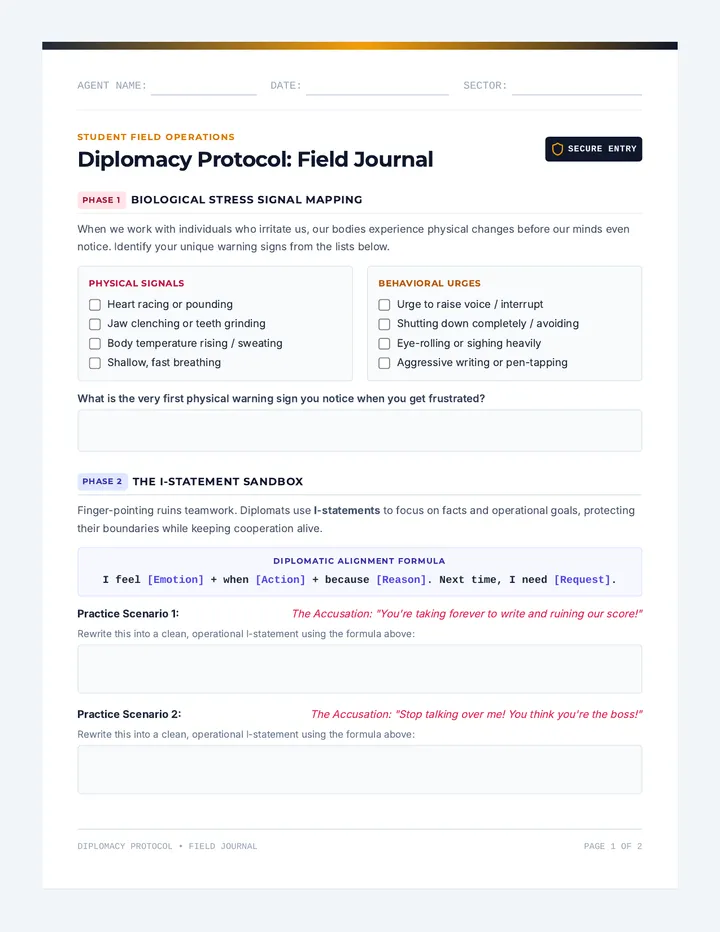
Harmony Toolbox Reference SheetThe Harmony Toolbox Skills for Teamwork & Conflict Resolution Tool #1 Active Listening Listening to understand, not just to respond. This shows the other person you value their perspective. Body Language Eye contact, nodding, and facing the person speaking. Key Phrases "What I hear you saying is..." "Can you tell me more about that?" Tool #2 The "I" Statement Expressing your feelings without attacking the other person. This stops people from getting "defensive." Formula: "I feel [emotion] when [behavior] because [reason]." Example: "I feel frustrated when you talk over me because I don't get to share my ideas." Tool #3 Negotiation & Compromise Finding a "Middle Ground" where everyone gets a little bit of what they want. Cool Off Step 1 Take a breath before you speak. Communicate Step 2 Share needs using "I" statements. Collaborate Step 3 Brainstorm solutions together. Remember: Harmony isn't about being identical—it's about fitting together!