Chill Skills Lesson Plan Chill Skills Unlocked
Instructional Lesson Plan • Tier 3 Intervention
Duration 40m
Objective
Student will identify and verbalize at least three situations that cause distress and develop at least three practical coping strategies to manage emotional distress in 80% of observed opportunities.
Rationale
"Learning to understand and manage emotions helps you feel more in control, communicate better with others, and respond to challenges in ways that benefit you."
Preparation
• Review slide deck and script.
• Print Tracker and Plan worksheets.
• Cut out Coping Strategy Cards.
• Secure a private counseling space.
Required Materials
Slide Deck Teacher Script Worksheets Strategy Cards Whiteboard Discussion Guide
Lesson Flow
5m
Warm-Up: What Fires You Up?
Activate prior knowledge by asking the student to reflect on a recent moment of frustration. Use the "What Fires You Up?" warm-up sheet.
5m
Introduction: The Boss of Feelings
Use slides 1-2. Explain that emotions are normal but chill skills help us stay in control. Establish the session as a "skill unlocking" mission.
10m
Activity: Trigger Tracking
Use slides 3-4 and the Trigger Tracker Worksheet. Guide the student to identify 3 specific situations that "light their fuse."
10m
Exploring Strategy Toolkit
Use slides 5-6. Introduce breathing, reframing, and mindfulness. Facilitate the Strategy Cards activity to find their "favorites."
8m
The Chill Plan
Complete the My Chill Plan Worksheet. Practice one breathing or reframing technique together to build confidence.
2m
Cool Down: Mission Complete
End with the exit ticket. Ask for the "one skill" they feel ready to try today. Celebrate their engagement.
Chill Skills Presentation Slides Tier 3 Emotional Regulation
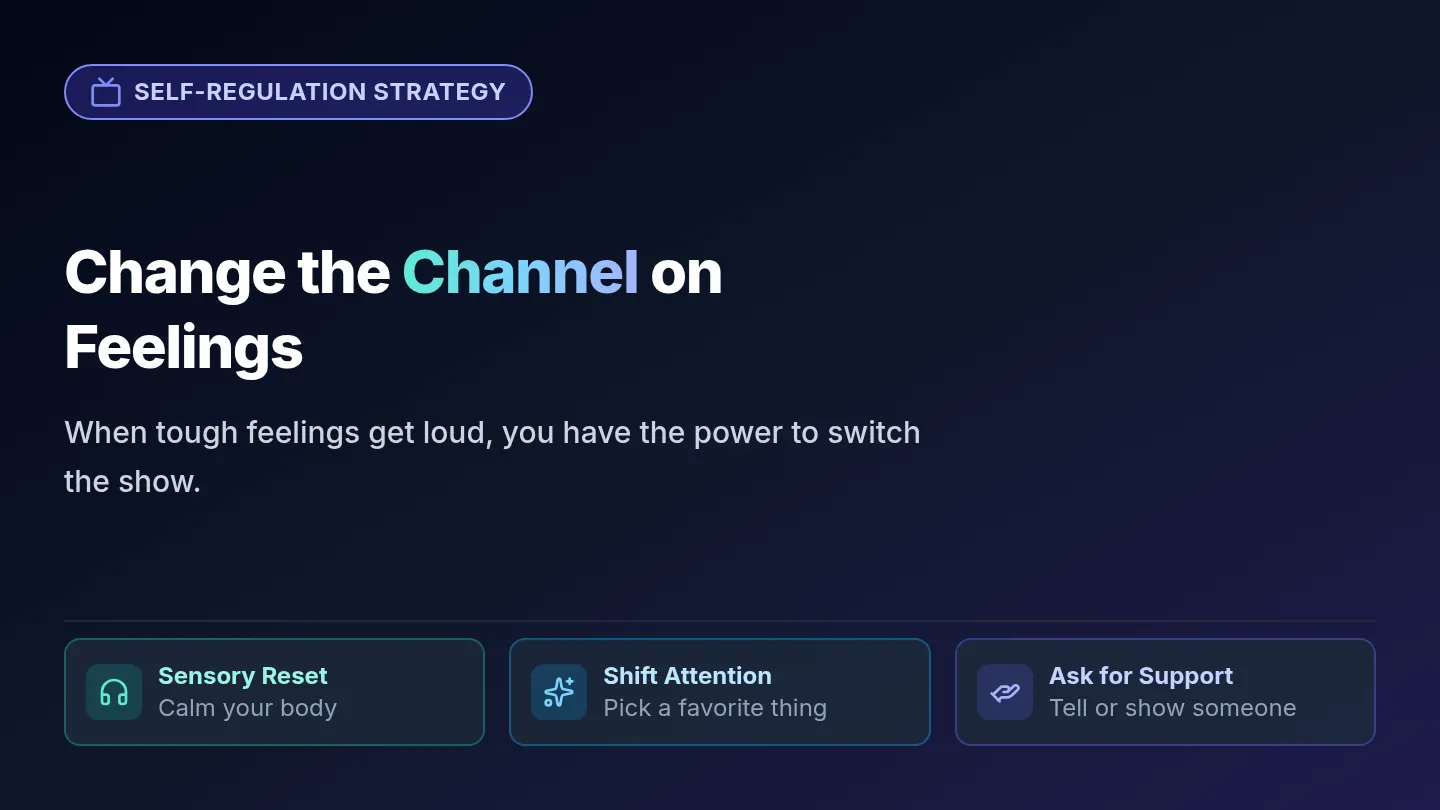
Chill Skills
Unlocked
Taking Charge of Your Emotions
Why Chill Skills?
Frustration, anger, and stress are normal feelings everyone has.
Chill skills help us respond in helpful ways instead of reacting.
They help you feel calm, confident, and in control .
Be the Boss of Your Feelings!
What Lights Your Fuse?
What are "Triggers"?
Triggers are situations or events that make you feel frustrated, angry, or upset .
Why identify them?
Knowing your triggers is like a superpower . It helps you prepare and stay cool before you boil over!
Identifying them is the first step to unlocking chill skills
Common Triggers
Schoolwork problems
Disagreements with friends
Feeling misunderstood
Changes in routine
Feeling pressured
Which ones sound familiar?
Think about what happened the last time you felt frustrated.
Chill Skills Toolkit!
Deep Breathing
Slow, calming breaths to tell your body it's safe and okay to relax.
Mindfulness
Focusing on the present moment—what you see and hear right now.
Reframing
Changing how you think about a situation to make it less overwhelming.
Journaling
Writing down your thoughts to clear your head and see things clearly.
Finding Your Favorites
Different skills work for different people. Which ones sound interesting to you ?
Explore
Choose
Practice
What Fires You Up Warm-Up Worksheet Chill Skills Unlocked
Warm-Up
Session Start
What Fires You Up?
Think about a time recently when you felt frustrated or upset. What happened right before you started feeling that way?
Write or draw your thoughts here...
Name: __________________________ Date: __________________________
Tier 3 Emotional Regulation
Chill Skills Teacher Script Teacher Script
Chill Skills Unlocked • Facilitation Guide
Tier 3 Intervention
01
Warm-Up: What Fires You Up? (5 min)
Teacher says: "Hey [Student's Name], thanks for coming today. We're going to talk about something super important: managing our emotions, especially when things get tough. To start, I want you to think about a time recently when you felt really frustrated or upset. What happened right before you started feeling that way? Take your time to think about it."
Listen attentively, allow space for the student to share. Validate their feelings (e.g., "I can see why that would be frustrating").
Teacher says: "Thanks for sharing that. It sounds like a really challenging situation. It's totally normal to feel frustrated, angry, or upset sometimes. Everyone does. Today, we're going to learn some 'chill skills' – ways to help you feel more in control when those big emotions pop up."
02
Introduction: Skills Unlocked (5 min)
Teacher says (Slide 1): "So, our lesson today is called 'Chill Skills Unlocked: Taking Charge of Emotions.' Have you ever felt like your emotions just take over, and you can't control what you say or do?"
Teacher says (Slide 2): "The goal isn't to stop feeling these emotions, because they're a part of life. The goal is to learn healthy ways to respond when you feel them. Think of it like being the boss of your feelings, instead of your feelings being the boss of you."
03
Identifying Triggers (10 min)
Teacher says (Slides 3-4): "First, let's talk about what 'lights your fuse.' What situations or things make you feel frustrated, angry, or upset? We call these 'triggers.' Knowing your triggers is like having a superpower – it helps you understand *why* you're feeling a certain way."
Action: Distribute the Trigger Tracker Worksheet . Guide the student to list 3 specific situations. Offer support as needed.
04
Strategies Activity (10 min)
Teacher says (Slide 5): "Great job identifying those triggers. Now for the fun part – building our toolkit! We're going to explore a few strategies: deep breathing, cognitive reframing, journaling, and mindfulness."
Action: Use the Strategy Cards . Have student pick 3-5 favorites. Discuss how/when to use each.
05
Practice and Plan (8 min)
Teacher says: "Now, let's make a plan. On the 'My Chill Plan' worksheet, list the strategies you've chosen. We'll write exactly when and how you'll use them. Let's try a quick deep breathing exercise right now together..."
Guide the student through 3 cycles of box breathing or 4-7-8 breathing. Ask how they feel afterward.
Trigger Tracker Worksheet Trigger Tracker
Chill Skills Unlocked Module
Name:
Date:
What Lights Your Fuse?
Think about times when you feel frustrated, angry, or upset. What specific situations or events tend to trigger these feelings for you? Knowing your triggers is the first step to managing your emotions.
1
Trigger:
What exactly happened?
How did you feel (e.g., mad, sad, overwhelmed)?
What did you do or want to do?
2
Trigger:
What exactly happened?
How did you feel?
What did you do or want to do?
3
Trigger:
What exactly happened?
How did you feel?
What did you do or want to do?
Knowing your triggers helps you prepare your chill skills before things heat up!
Coping Strategy Cards Activity Strategy Cards
Coping Toolkit Activity
Choose 3-5 Favorites
Instructions
Cut out the cards below along the dashed lines.
Read through each strategy carefully.
Choose 3 to 5 cards that might work for you.
Discuss your choices with your teacher.
Ready to
Deep Breathing
Take 3-5 slow, deep breaths. Breathe in for 4, hold for 4, out for 6.
Body Skill
Count to 10
Slowly count to ten (or even higher!) to give your brain time to cool down.
Brain Skill
Take a Walk
Step away and move your body for a few minutes to reset your energy.
Action Skill
Journal / Write
Write down what is bothering you. Getting it on paper clears your mind.
Brain Skill
Talk to Someone
Find a trusted adult or friend to share how you are feeling.
People Skill
Listen to Music
Put on some calm music or something that makes you happy to shift your mood.
Senses Skill
Drink Water
Take a slow sip of cold water. It helps ground you and cool your body down.
Body Skill
Mindfulness
Notice: 5 things you see, 4 you hear, 3 you feel, 2 you smell, 1 you taste.
Senses Skill
Reframing
Change your negative thoughts to neutral ones (e.g., "This is hard" vs "I can't do this").
Brain Skill
My Chill Plan Worksheet My Chill Plan
Coping Strategy Action Guide
Name:
Date:
Now that you know your triggers and have explored different 'chill skills,' let's make a personal plan! Choose at least three coping strategies that you want to try.
1
Strategy Name:
When I will use it
(e.g., when I feel frustrated in math class...)
How I will use it (steps)
(e.g., I will take 3 slow breaths...)
2
Strategy Name:
When I will use it
How I will use it (steps)
3
Strategy Name:
When I will use it
How I will use it (steps)
"Practicing these skills takes time and effort, but it will help you feel more in control and respond to challenges in a way that works best for you!"
Calm Down Cool Down Exit Ticket Mission Complete
Cool Down
Session Exit
Skill Reflection
What is one "chill skill" you learned today that you feel ready to try the next time you feel frustrated or upset?
I will try:
Why is this skill a good fit for you?
You've got this!
Name: __________________________ Date: __________________________
Skills Unlocked
Chill Skills Discussion Prompts Discussion Prompts
Chill Skills Unlocked • Facilitator Resource
Deepen the Conversation
Before Starting
"What does it mean to be 'in control' of your feelings?"
"Can you think of a time when someone else handled their frustration really well? What did they do?"
Trigger Identification
"When you feel [frustrated/angry/upset], what does it feel like in your body? (e.g., tight chest, hot face, shaky hands)"
"How do your triggers usually start? Is it a sudden thing, or does it build up?"
"What usually happens after you feel triggered? (e.g., you yell, you withdraw, you say something you regret)"
Strategy Exploration
"Out of the strategies we discussed, which one seems the most difficult for you to try? Why?"
"Which strategy do you think would be the easiest to remember when you're feeling upset?"
"How might using a chill skill change the outcome of a challenging situation?"
After Planning
"What challenges do you foresee when trying to use your new chill skills? How can we prepare for those?"
"How will you know if a chill skill is working for you? What will be different?"
"Who are some people in your life who could help remind you or support you in using these skills?"
Pro Tip: Use these prompts to encourage the student to think critically about their own emotional patterns. Validate their responses to build trust and ensure a safe space for Tier 3 intervention.