ANT Catcher Lesson Plan ANT Catcher Lesson Plan
Teacher Training: Cognitive Behavioral Strategies
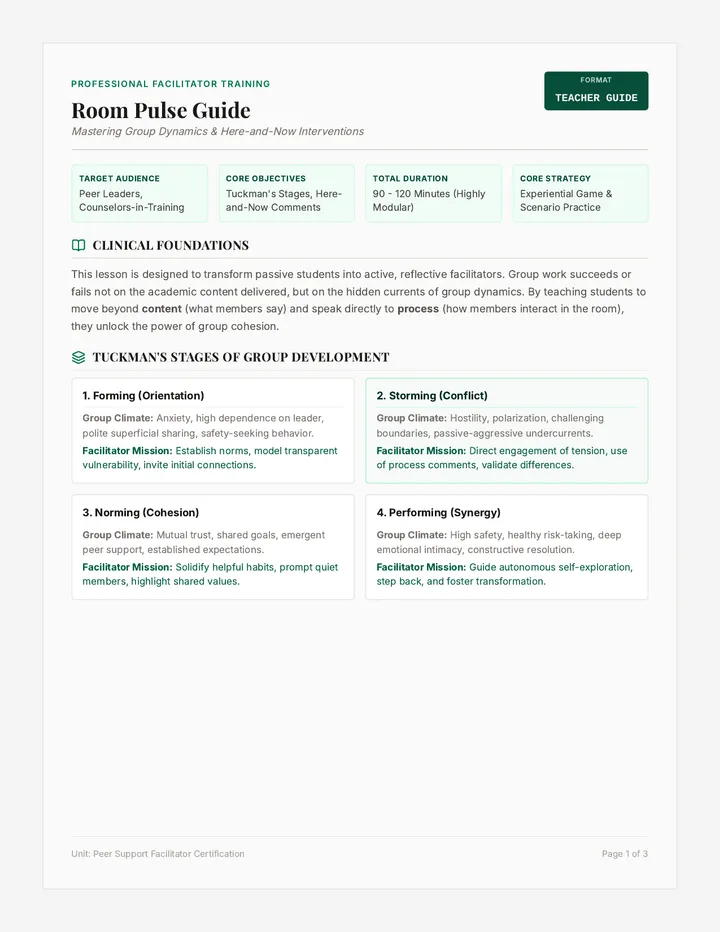
Duration 120 min
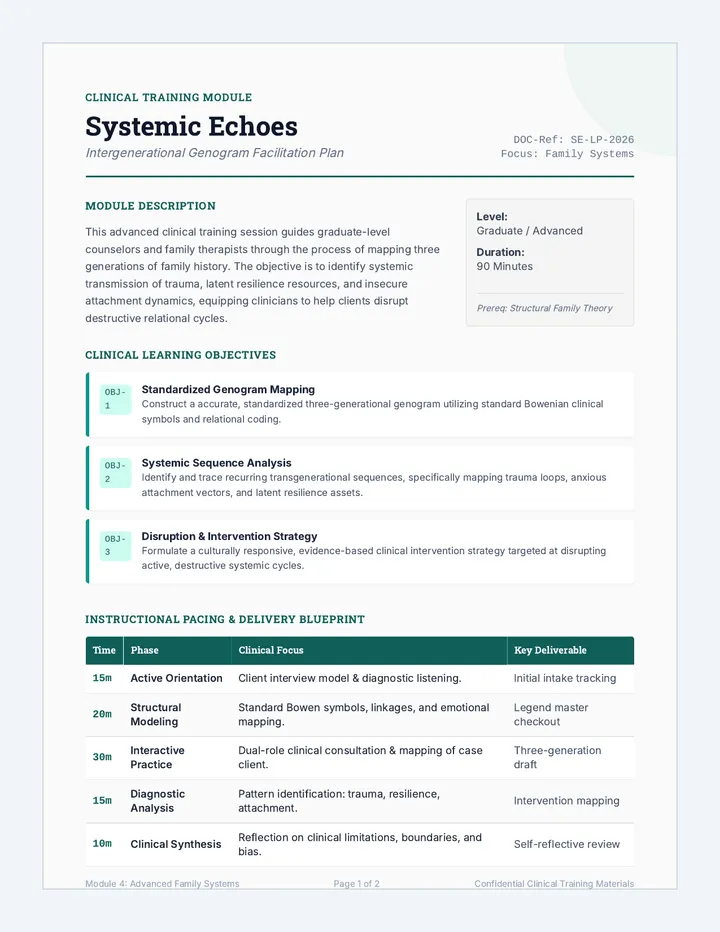
Objective
Teachers will be able to identify common cognitive distortions in student language and guide students through a simple thought-challenging exercise using the "Catch It, Check It, Change It" method.
The "Why"
By addressing ANTs, teachers help students develop resilience and emotional regulation, creating a more positive learning environment.
Preparation Steps (30 min)
Review all generated materials: Slide Deck, Match-Up Game, Worksheet, and Poster Kit.
Ensure projector/whiteboard is set up for digital presentation.
Print copies of the Thought Reframing Worksheet (one per teacher).
Cut out and prepare Scenario and Distortion cards for the Match-Up Game .
Gather art supplies for Poster Design Kit (markers, paper, glue, magazines).
Materials Required
Whiteboard/Projector Markers Slide Deck Match-Up Game Cards Worksheets Poster Design Kit
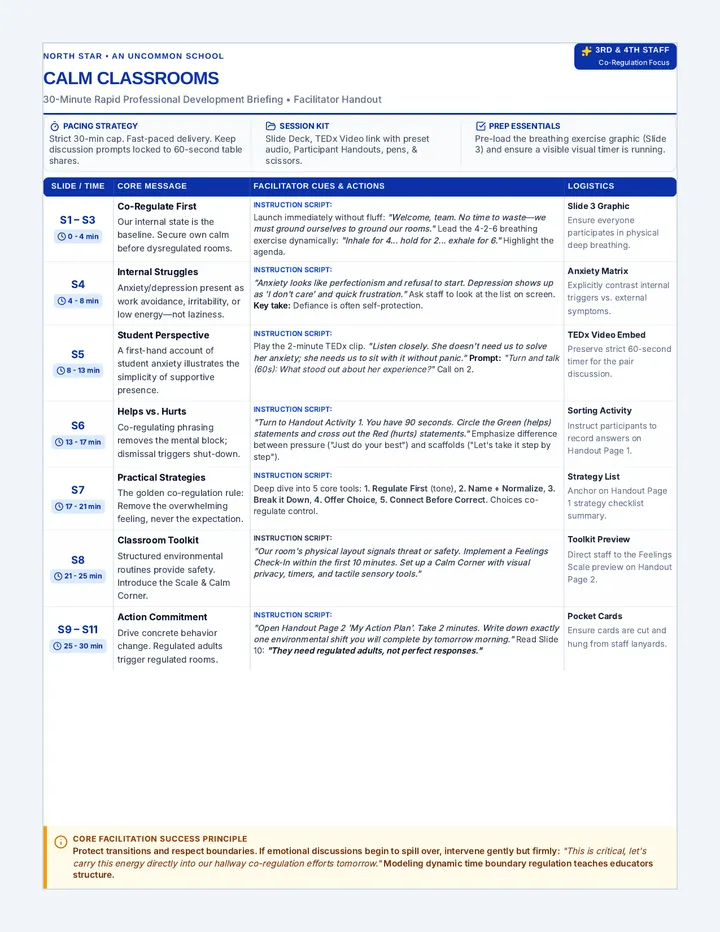
Implementation Guide
Step & Time Activity & Scripting Notes Warm-Up
15 Minutes
|
Reviewing the CBT Model
"Welcome back! Last time we discussed the connection between thoughts, feelings, and behaviors. Today, we're zooming in on those automatic thoughts that can sabotage our students before they even start. We're going to learn how to help them 'catch' these thoughts."
|
|
Instruction
25 Minutes
|
Introducing Cognitive Distortions
"Cognitive distortions are like 'glitches' in our thinking. They're often called ANTs—Automatic Negative Thoughts. They aren't facts, but they feel like facts. Let's look at the 5 most common ones we see in the classroom..."
Use Slides 4-9
|
|
Strategy
30 Minutes
|
The "Catch It, Check It, Change It" Method
"So how do we fix a glitch? We use a three-step method. Catch the thought as it happens, Check it for evidence (is it actually true?), and Change it to something more balanced. This isn't just 'positive thinking'—it's 'realistic thinking'."
Catch It Check It Change It
|
|
Practice
30 Minutes
|
Activity: Role-Playing Scenarios
"We're going to pair up. One person will be the 'student' expressing an ANT, and the 'teacher' will use Socratic questioning to guide them through the 'Check It' phase. Remember, don't just tell them they're wrong—help them see it for themselves."
|
|
Application
20 Minutes
|
Project: Creating Classroom Visuals
"To wrap up, you'll design a poster for your classroom. These concepts are abstract, so having a visual reminder helps students internalize the process. How can you represent an 'ANT' or a 'thought glitch' visually for your age group?"
|
Pro-Tip: Model this behavior yourself! If you make a mistake on the board, vocalize your own "Catch It, Check It, Change It" process for the class to hear.
Challenging Thoughts Slide Deck Catching & Changing ANTs
Automatic Negative Thoughts
Teacher Training Series
TEACHER NOTES: Welcome teachers and introduce the session's focus on identifying and challenging negative thought patterns in students. Briefly mention the connection to the CBT model discussed in the previous session (if applicable).
Quick Recap: The CBT Model
Thoughts
What we think
Feelings
How we feel
Behaviors
What we do
"Our thoughts directly impact our feelings and actions!"
TEACHER NOTES: Quickly review the core components of the CBT model: Thoughts, Feelings, and Behaviors. Emphasize how thoughts influence feelings and behaviors.
What are ANTs?
Unhelpful thoughts that pop into our heads automatically .
Often quick, distorted, and can feel very real.
Can lead to negative feelings and unhelpful behaviors.
TEACHER NOTES: Introduce the concept of ANTs (Automatic Negative Thoughts). Explain they are often quick, unhelpful thoughts that pop into our heads. Ask teachers for examples they might hear from students.
Cognitive Distortions
Common "Thinking Traps" that trick our brains into seeing things in unhelpful ways.
Let's explore five common traps...
TEACHER NOTES: Introduce the idea of Cognitive Distortions – common 'thinking traps.' Explain that these are patterns in our thoughts that aren't quite accurate.
1. All-or-Nothing Thinking
The Definition
Seeing things in extremes—there is no middle ground. It's either perfect or a total failure.
Student Version:
"I missed one question, so I'm bad at math."
Adult Version:
"If I don't get an A, I'm a total failure."
TEACHER NOTES: Explain 'All-or-Nothing Thinking.' Provide a clear example relevant to students. Ask teachers for examples they've heard.
2. Overgeneralization
The Definition
Concluding that one negative event will always happen. Using words like "always" or "never."
Student Version:
"I forgot my homework once, now my teacher thinks I'm irresponsible."
Adult Version:
"I failed that test, so I'll fail every test this year."
TEACHER NOTES: Explain 'Overgeneralization.' Provide a clear example relevant to students. Ask teachers for examples they've heard.
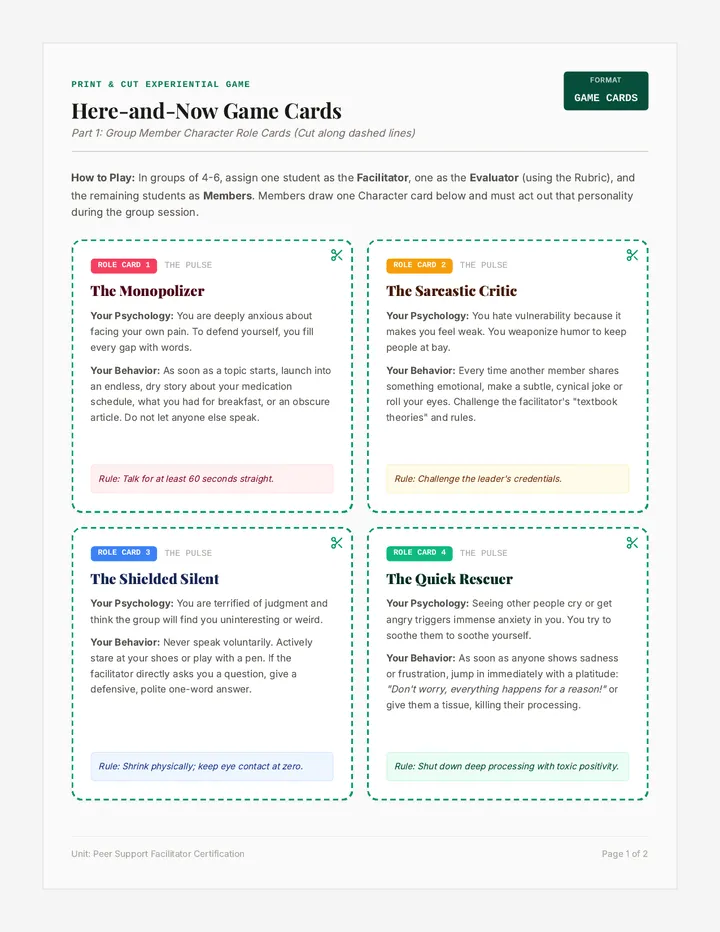
Cognitive Distortion Match-Up Game Cognitive Distortion Match-Up
Teacher Training Activity: Identifying Thinking Traps
Instructions for Groups
Divide into small groups (2-4 teachers).
Cut out the Scenario Cards and Cognitive Distortion Cards below.
Match each scenario to the distortion it best represents.
Discuss your reasoning: What specific words in the scenario gave it away?
Distortion Category Cards
All-or-Nothing Thinking
Overgeneralization
Catastrophizing
Mind Reading
Personalization
Scenario Cards
Scenario A
"A student says: 'I got a B on that test, so I'm completely terrible at science and will never be good at it.'"
Scenario B
"After a classmate doesn't wave back in the hallway, a student thinks: 'They must hate me. Everyone hates me.'"
Scenario C
"A student is presenting a project and stumbles on one word. They immediately think: 'Oh no, I messed up! Everyone thinks I'm stupid now. My whole presentation is ruined!'"
Scenario D
"A teacher gives a general feedback comment to the whole class about turning in homework late. A student thinks: 'They're talking about me. I'm always the one who forgets things.'"
Scenario E
"A student forgets their pencil. They think: 'This is the worst day ever! Nothing is going right, and it's only going to get worse.'"
Teacher Answer Key
A: All-or-Nothing / Overgeneralization | B: Mind Reading / Overgeneralization | C: Catastrophizing / Mind Reading | D: Personalization | E: Catastrophizing
Thought Reframing Worksheet Thought Reframing Worksheet
Catch it, Check it, Change it!
Name:
Date:
1
Catch It! (Identify the ANT)
What is the exact negative thought you are having? (Be specific!)
What feeling does this thought create for you? (e.g., sad, anxious, frustrated)
2
Check It! (Challenge the Thought)
Evidence FOR the thought:
Evidence AGAINST the thought:
Is this thought helpful or productive right now?
What would you tell a friend?
Which "Thinking Trap" is this?
All-or-Nothing
Overgeneralization
Catastrophizing
Mind Reading
Personalization
3
Change It! (Reframe the Thought)
Your New, Balanced, Realistic Thought:
How does this new thought make you feel?
Example Guide
Catch It! (ANT):
"I messed up on that one problem in front of the class, so everyone thinks I'm stupid now."
Check It! (Truth):
"A few classmates were nodding along. My teacher gave me a thumbs up. Everyone makes mistakes sometimes."
Change It! (Reframe):
"I made a small mistake, but I recovered. It doesn't mean I'm stupid. People understand that mistakes happen."
Classroom Poster Design Kit Project Project Brief
Classroom Poster Design Kit
Battling ANTs (Automatic Negative Thoughts)
Project Objective
Design an engaging and informative poster for your classroom that serves as a visual reminder and tool for students to identify and challenge ANTs using the Catch It, Check It, Change It method.
Materials Provided
Large Poster Paper
Markers & Colored Pencils
Scissors & Glue Sticks
Magazines (for images/text)
Must-Have Elements
Kid-Friendly ANT Explanation
e.g., "Mind Weeds" or "Thought Glitches"
3-4 Specific Distortion Types
Clear definitions and simple student examples.
The 3-Step Process
Catch It! -> Check It! -> Change It!
Positive Reframing Examples
Before vs. After thought bubbles.
Instructions & Steps
1
Brainstorm in Groups (3-4 teachers). Who is your target age group? A poster for Kindergarten looks very different from a poster for 8th Grade. Choose your language and visuals accordingly.
2
Draft your Layout. Map out where your explanations, steps, and examples will go. Use metaphors (like gardening for "mind weeds" or technology for "glitches") to make the concept stick.
3
Create & Present. Focus on clarity and engagement. Each group will have 2 minutes to present their design choices and explain how they'll use it in their classroom.
Your Design Will Be Evaluated On:
Clarity
Is the message easy to understand for the chosen age group?
Engagement
Is it colorful and creative enough to catch a student's eye?
Actionability
Does it provide clear, easy-to-follow steps for a student in crisis?
Think about: How can you make the "Catch It, Check It, Change It" process feel like an empowering superpower rather than a chore?