Break Tools & Fidgets Lesson Plan Break Tools & Fidgets
Tier 3 Individual Lesson Plan
Time 25 min
Objective
Students will learn to identify and appropriately use various sensory tools (fidgets, break cards, headphones) to support self-regulation and focus.
Audience
1st Grade Students (Individual Setting)
Why It Matters
Understanding and using sensory tools effectively empowers students to manage their own emotional and sensory needs, leading to increased focus, reduced disruptions, and improved learning outcomes. This skill promotes independence and self-awareness.
Prep
10 MINUTES
Review Slides, Script, and Lesson Plan.
Print/cut Choosing the Right Tool Scenario Cards.
Gather physical fidget tools, break cards, and headphones.
Prepare "My Sensory Tool Box" reading.
Materials List
Slide Deck
Facilitator Script
Warm-Up: Tool Review
Scenario Cards
Fidget Tool Kit
Sensory Toolbox Reading
Scenario Answer Key
Tool Match-Up Game
Lesson Flow
5 min
Warm-Up: Tool Review
Activate prior knowledge. Show visuals of a fidget, a break card, and headphones. Ask: "What are these tools? When might we use them?" Use the script to guide the discussion.
8 min
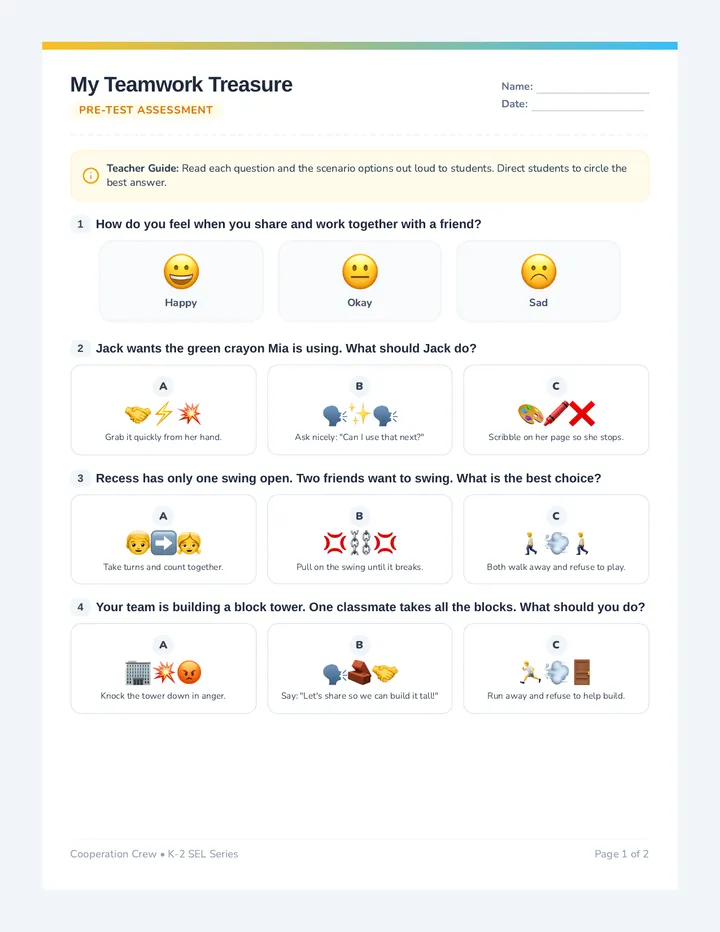
Practice Choosing Tools
Introduce Scenario Cards . Present scenarios one by one. Ask student to identify the most appropriate tool and explain why.
DATA POINT: Tool selection accuracy
7 min
Fidget Tool Exploration
Instruct the student to explore the Exploration Kit . Focus on sensory feel and calming effect. Have them choose their top two favorite tools and articulate why they work for them.
5 min
Practice & Strategy
Practice the sentence starter: "When I need a break, I can ___." Model and practice the Fidget Squeeze + 10-Second Pause coping strategy.
Break Tools & Fidgets Slides Break Tools & Fidgets
Your Superpowers!
How can special tools help us focus and feel calm?
Teacher: Welcome the student. Explain that today they will learn about tools to help them feel calm and focused.
Tool Review: What Are These?
Fidget Toys
Break Cards
Headphones
When do we use them?
Choosing the Right Tool
Different feelings, different tools!
Let's practice picking the best tool for each situation.
Fidget Exploration Time!
1
Try different fidgets.
2
How do they feel?
3
Which two help you feel calm or focused the most?
Touch & Feel
When I Need a Break...
"When I need a break,
I can __________."
Fidget Squeeze!
Squeeze tight, then let go.
10-Second Pause!
Count to 10 slowly.
You're a Tool Master!
Identify break tools
Pick the right tool
Use fidgets to calm
Super coping strategy
Keep using your superpowers!
Break Tools & Fidgets Script Facilitator Script
Break Tools & Fidgets
Teacher Resource
Introduction (1 Minute)
"Hi there! Today, we're going to become 'Tool Masters' ! We'll learn all about special tools that can help us feel calm and focused when we need a little break. These tools are like your superpowers to help you have a great day at school!"
Warm-Up: Tool Review (5 Minutes)
"First, let's look at some things I have here. Can you tell me what these are? (Hold up or point to a fidget toy, a break card, and a pair of headphones)."
Pause for student response. Guide them if needed.
"That's right! We have a fidget, a break card, and headphones. When do you think we might use a fidget? What about a break card? And headphones?"
Listen to their responses, affirming correct answers and gently correcting misconceptions. Emphasize that these are tools to help them, not distractions.
"Great thinking! These are all tools that can help our bodies and brains feel just right. Sometimes when we're wiggly, or feeling a little overwhelmed, or need to concentrate, these tools can be super helpful."
Choosing the Right Tool (8 Minutes)
"Now that we know what these tools are, let's practice choosing the right tool for different times. I have some 'Scenario Cards' here. I'm going to read you a situation, and I want you to tell me which tool you think would be the best choice and why. Are you ready?"
Present the Scenario Cards one by one. Refer to the Answer Key for guidance.
"Scenario 1: You are working on a tricky math problem, and you feel your brain getting a little buzzy, and your fingers want to tap. What tool might help you focus?"
"Scenario 2: You're feeling really frustrated because your block tower keeps falling down, and you feel like you might cry. What tool could help you feel better and take a moment?"
"Scenario 3: The classroom is very noisy, and it's hard for you to hear the teacher read a story. What tool could help you listen better?"
"Excellent job! It's super important to think about how we're feeling and what we need before we choose a tool."
Fidget Tool Exploration (7 Minutes)
"Okay, now for some fun! I have a 'Fidget Tool Exploration Kit' here with lots of different fidgets! Your mission is to explore these fidgets. Pick them up, squish them, squeeze them, roll them – see how they feel in your hands. Notice if they help you feel calm or focused."
Allow the student to explore the fidgets. Circulate and observe, asking open-ended questions like, "How does that one feel?" or "Does that help your hands feel busy?"
"Alright, from all the fidgets you tried, can you pick your top two favorites? The ones that make you feel the most calm or focused?"
Tool Review Warm-Up Warm-Up Activity
Tool Review
Do you know what these special tools are?
Take a look at these pictures. Think about when we might use them to help us at school!
1. Fidget Toy
What is it?
When does it help us?
2. Break Card
What is it?
When does it help us?
3. Headphones
What are they?
When do they help us?
Think about what kind of feelings might make us want to use these tools!
Choosing the Right Tool Scenario Cards Scenario Cards
Choosing the Right Tool
Teacher: Cut along the dotted lines
1
Situation
You are sitting at your desk, and you feel your body getting super wiggly. You want to move, but you need to stay in your seat to listen to the teacher. Your hands feel like they want to tap, tap, tap!
Which tool is best?
A. Fidget Toy
B. Break Card
C. Headphones
Why?
2
Situation
It's group work time, and everyone is talking. The classroom feels very loud, and it's hard for you to hear what your group members are saying, or even think clearly.
Which tool is best?
A. Fidget Toy
B. Break Card
C. Headphones
Why?
3
Situation
You've been working really hard on a challenging activity, and you feel your brain getting tired and a little frustrated. You need a few minutes to reset before you can try again.
Which tool is best?
A. Fidget Toy
B. Break Card
C. Headphones
Why?
4
Situation
You just came in from recess, and you feel super energetic and a little hyped up. You need to settle your body before you start your quiet reading time.
Which tool is best?
A. Fidget Toy
B. Break Card
C. Headphones
Why?
Choosing the Right Tool Answer Key Scenario Answer Key
Choosing the Right Tool
Teaching Tip: This key provides suggested responses. Encourage students to explain their choices, as their reasoning can be more important than a single correct answer.
Scenario 1 Wiggly Body, Tapping Hands
Best Tool: A. Fidget Toy
Reasoning: A fidget toy can give your hands something safe and quiet to do, which can help your body release energy and your brain focus without distracting others or needing to leave your seat. Headphones might block out sounds you need to hear, and a break card might not be necessary if you just need to keep your hands busy.
Scenario 2 Loud Classroom, Hard to Focus
Best Tool: C. Headphones
Reasoning: Headphones (especially noise-canceling ones) can help block out loud noises and create a quieter space for your ears and brain, making it easier to concentrate on your work or listen to your group. A fidget toy might keep your hands busy but won't help with the noise.
Scenario 3 Tired Brain, Need Reset
Best Tool: B. Break Card
Reasoning: A break card is a way to politely ask for a short break from your work or the classroom environment. This allows you to step away, reset your brain, and come back feeling refreshed and ready to try again. A full break addresses frustration better than a fidget alone.
Scenario 4 Super Energetic After Recess
Best Tool: A. Fidget Toy (or B. Break Card)
Reasoning: A fidget toy can help channel that extra energy into a calm, contained movement, allowing your body to settle down without causing disruption. Some students might also benefit from a quick physical break (using a break card) to do a few stretches or deep breaths before returning to quiet time.
Fidget Exploration Activity Activity
Fidget Exploration
Name:
Your Mission: Explore the fidget tools!
How to play
1
Pick up each fidget one by one.
2
Squeeze, squish, roll, or spin it! See how it feels.
3
Choose your top TWO favorites that help you feel calm or focused.
My #1 Favorite
What is it called? (Or describe it)
Why do you like it? How does it help your body?
My #2 Favorite
What is it called? (Or describe it)
Why do you like it? How does it help your body?
Teacher Note: Encourage the student to use descriptive words (squishy, bumpy, smooth, quiet).
My Sensory Tool Box Reading My Sensory Tool Box
Special helpers for your brain and body!
Everyone has different ways to feel calm and focused. Sometimes our bodies need a little help to feel just right. That's where our sensory tools come in!
When to Use Your Tools:
Too Wiggly
Too Tired
Too Loud
Fidget Toys
Fidget toys are small objects you can hold and move in your hands. They can be squishy, bumpy, spiky, or smooth!
How they help: Keeping your hands busy helps your brain focus on listening and learning.
Break Cards
A break card is a quiet way to tell your teacher, "I need a moment to reset." You can use it to ask for a short break.
How they help: A short break helps you calm down if you feel frustrated or overwhelmed.
Headphones
Headphones make your learning space feel quieter. Some just block out sound, and others let you listen to quiet music.
How they help: They help your brain focus on your work instead of all the noises around you.
"Your sensory tool box is for YOU! It's about finding what helps you feel ready to learn."
When I Need a Break Discussion Break Discussion
Talking about our needs
Questions for Thinking
1. "Sometimes, we feel big feelings or our bodies get a little wiggly. Can you think of a time when you felt like that at school?"
2. "When you start to feel that way, what is one thing you can do or one tool you can use to help yourself?"
3. "Why is it important to ask for a break or use a tool when you need it, instead of waiting?"
Practice Time!
The Super Sentence:
"When I need a break,
I can __________."
Your Turn to Say It:
1
2
3
Remember the "Fidget Squeeze + 10-Second Pause"!
Tool Match-Up Game Guide Tool Match-Up
The Ultimate Selection Challenge!
Your Goal
Correctly match a feeling or situation with the best sensory tool!
Materials Needed
Scenario Cards
Physical Fidgets
Headphones
Break Cards
How to Play
1
Lay out the real sensory tools on the table so the student can see them.
2
Take turns drawing a Scenario Card and reading it aloud.
3
The player picks the physical tool that matches the situation best.
4
Explain WHY you chose that tool!
Spice It Up! (Variations)
Role-Play
Act out the scenario before picking the tool!
Feelings Check
How do YOU feel right now? Pick a tool for that feeling!
Create Your Own
Make up a new classroom problem for your partner to solve.