Brain Debugger Slides
SYSTEM v1.0.9 - ACTIVE
SESSION: ACADEMIC_REBOOT
🧠 Metacognitive Toolkit
Brain Debugging
A 9th-grader's systems guide to isolating mind glitches, rewriting error codes, and upgrading academic performance.
MODULE 01
METACOGNITION OVERVIEW
[ PRESS ANY KEY TO INITIALIZE ]
ERROR_DETECTED
SLIDE 02 // 07
What is a
"Mind Glitch"?
In high school, courses get tougher. When your brain gets stuck or frustrated, it isn't a permanent hardware failure—it's just a temporary software glitch.
Metacognition = Running a system diagnostic on your own thinking.
The "I Can't" Infinite Loop
Getting blocked by a hard problem and declaring you are "just not a math/science person" before even investigating the issue.
The Procrastination Lag
Delaying a project because you don't know the first step, mistaking task-confusion for pure laziness.
REFRAMING OBSTACLES AS INSTRUCTIONAL INPUTS
STATUS: REPAIR_RECOMMENDED
SYSTEM_OPTIMIZATION
SLIDE 03 // 07
The Four-Step Brain Debugger
01
LOCATE THE GLITCH
Exactly where did you lose track? Pinpoint the single step or sentence where frustration spiked.
02
DECONSTRUCT
Separate facts from feelings. What do you actually know versus what are you assuming or fearing?
03
REWRITE THE CODE
Switch from a dead-end statement to a question. Swap "I don't get this" with "What rule defines this step?"
04
RUN TEST
Execute a new action: Try one small piece, consult a peer's notes, or ask the teacher for specific input.
FRAMEWORK: ACTIVE PROCESSING
READY FOR EXECUTION
LOG_ANALYSIS_03
SLIDE 04 // 07
CASE STUDY: MATH DECAY
Deconstructing
the Crash
Watch how switching from a emotional mindset to a debugging mindset completely changes how we handle an F on a draft or an impossible homework question.
System Crash
"I got a D- on this algebra quiz. It's because I'm terrible at math and this teacher hates me. There is no point in studying for the next unit."
> ERROR: Growth terminated.
> OUTPUT: Resignation.
System Patched
"I got a D- because I completely missed questions 3, 5, and 8 on quadratics. I misapplied the formula. I need to practice this exact rule."
> FIX: Targeted practice.
> OUTPUT: Mastery update.
EMOTIONAL DISTANCING FROM ERROR CODES
COMPILE: SUCCESSFUL
DATA_EXTRACTION
SLIDE 05 // 07
Mistakes Are Just
Raw Data
When software developers encounter a bug, they don't cry and close the laptop forever. They read the error report.
Your mistakes are neutral feedback, not structural failure.
>_ UPGRADING THOUGHT PATHWAYS NEURAL_REWIRE
| If you think: | Rewire to: |
|---|
| "I don't have the brain for science." | "I haven't unlocked this science concept yet." |
| "This draft is garbage." | "This draft shows me which ideas need a clearer layout." |
NEUROPLASTICITY CORE ENGINE
COMPILER: STANDBY
CO-PROCESSOR_PROTOCOL
SLIDE 06 // 07
Peer Debugging
Session
We are going to split into co-processing groups of three. You will use your **Glitch Prompt Cards** to help a classmate debug an academic hurdle they faced recently.
Pacing: 12 Minutes
3 members per node
CO-PROCESSING WORKFLOW
STEP 1:
Member A shares a recent academic obstacle (the "System Error").
STEP 2:
Members B & C act as "Debugger Consultants," selecting 2 prompt cards to help Member A locate and rewrite their hurdle.
STEP 3:
Member A writes down their final "System Patch" in the Mind Glitch Organizer.
INTERACTIVE COOPERATIVE PROTOCOL
DEVICES CONNECTED
VERIFICATION_PHASE
SLIDE 07 // 07
Ready to Compile?
Your brain is a high-performance system. Do not let minor syntax errors prevent you from achieving total terminal mastery. Let's capture our learnings.
NEXT STEPS IN SYSTEM QUEUE:
- Complete the Mind Glitch Worksheet
- Pick up your Error Reboot Exit Ticket
SYSTEM COMPILATION COMPLETE
READY TO REBOOT
Mind Glitch Worksheet
METACOGNITION PORTAL
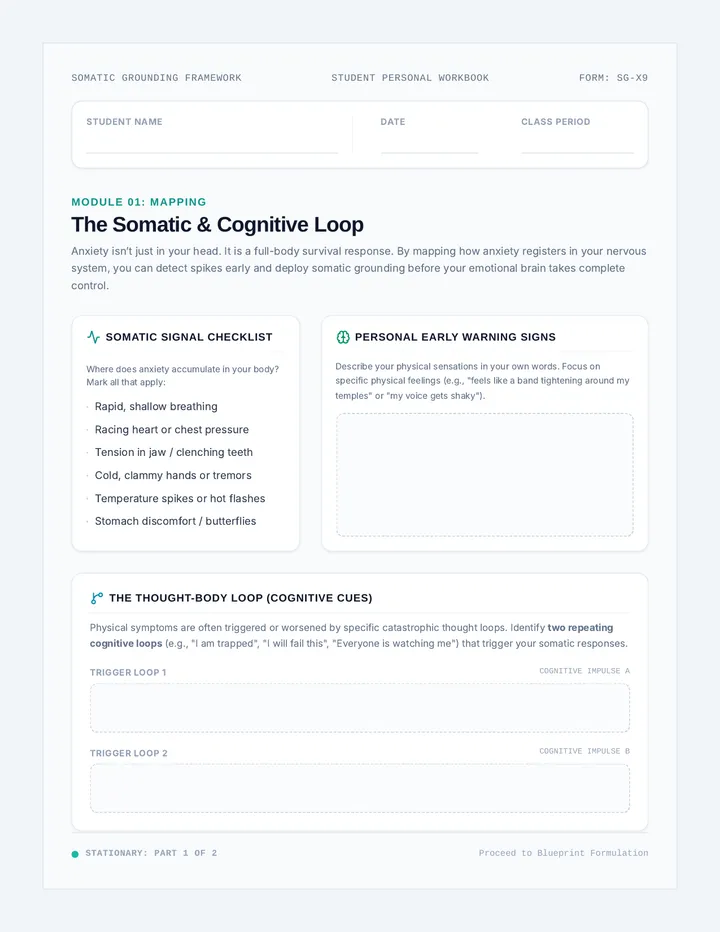
MIND GLITCH DIAGNOSTIC
SYSTEM CODE: MET-01
PAGE 01 OF 02
CO-PROCESSOR (NAME) ________________________
SYSTEM TIME (DATE) ________________________
OPERATING UNIT (CLASS) ________________________
Diagnostic Prompt: When your brain encounters failure, it runs a default survival script. This workbook is your debugger tool to inspect error logs, override default patterns, and rewrite academic software code.
01 ISOLATE THE ERROR CODE (WHAT'S GOING WRONG?)
Describe one specific academic hurdle or block you are currently facing (e.g., "I get lost on multi-step geometry proofs" or "I panic on English essays and delay writing them").
02 DECONSTRUCT THE ERROR LOG
Draw a clear line between dramatic feelings and neutral data points. Map them below.
System Noise (My Feelings / Fears)
What is the anxiety or negative self-talk saying? (e.g., "I'm bad at this")
Hard System Data (The Exact Facts)
What are the literal facts? Which steps or details actually trigger the block?
03 COMPILE THE SYSTEM REWRITE
Take your "System Noise" from step 2 and actively refactor it into an active question or growth statement.
TERMINAL_EDITOR.EXE UNRESOLVED_ERRORS
Old Code (Dead-End Mindset / Fixed Statement):
Refactored Code (Growth-Oriented Question / System Action):
INITIATED BY USER: SYSTEM_REBOOT STATUS: STEP_03_COMPILING
METACOGNITION PORTAL
SYSTEM PATCH PLANNER
SYSTEM CODE: MET-01
PAGE 02 OF 02
Action Protocol: A mental patch is only effective if executed. This planner helps you map specific interventions, resources, and progress check-ins to make sure your brain's software update completes successfully.
04 IDENTIFY THE CO-PROCESSORS (WHO & WHAT CAN HELP?)
Who or what will provide the information needed to resolve this error? State exactly how you will utilize them.
Human Resource (Teacher / Peer)
e.g., Ask Ms. Carter during study hall to review question 5.
System Resource (Tool / Video / Guide)
e.g., Review the unit 2 review packet formulas and YouTube tutorials.
05 DEPLOY THE PATCH (MILESTONES & DEADLINES)
Design 3 micro-milestones to verify that your new neural software is running correctly. Keep steps small!
1
MICRO-ACTION 1
TARGET DATE
2
MICRO-ACTION 2
TARGET DATE
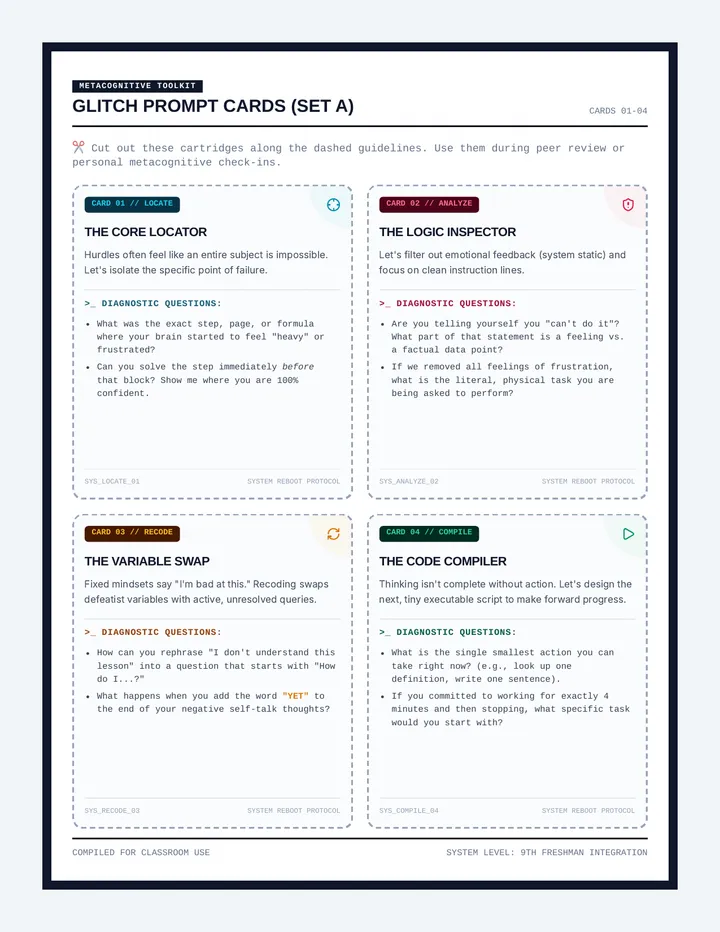
Glitch Prompt Cards
METACOGNITIVE TOOLKIT
GLITCH PROMPT CARDS (SET A)
CARDS 01-04
✂️ Cut out these cartridges along the dashed guidelines. Use them during peer review or personal metacognitive check-ins.
CARD 01 // LOCATE
THE CORE LOCATOR
Hurdles often feel like an entire subject is impossible. Let's isolate the specific point of failure.
>_ DIAGNOSTIC QUESTIONS:
- What was the exact step, page, or formula where your brain started to feel "heavy" or frustrated?
- Can you solve the step immediately before that block? Show me where you are 100% confident.
SYS_LOCATE_01 SYSTEM REBOOT PROTOCOL
CARD 02 // ANALYZE
THE LOGIC INSPECTOR
Let's filter out emotional feedback (system static) and focus on clean instruction lines.
>_ DIAGNOSTIC QUESTIONS:
- Are you telling yourself you "can't do it"? What part of that statement is a feeling vs. a factual data point?
- If we removed all feelings of frustration, what is the literal, physical task you are being asked to perform?
SYS_ANALYZE_02 SYSTEM REBOOT PROTOCOL
CARD 03 // RECODE
THE VARIABLE SWAP
Fixed mindsets say "I'm bad at this." Recoding swaps defeatist variables with active, unresolved queries.
>_ DIAGNOSTIC QUESTIONS:
- How can you rephrase "I don't understand this lesson" into a question that starts with "How do I...?"
- What happens when you add the word "YET" to the end of your negative self-talk thoughts?
SYS_RECODE_03 SYSTEM REBOOT PROTOCOL
CARD 04 // COMPILE
THE CODE COMPILER
Thinking isn't complete without action. Let's design the next, tiny executable script to make forward progress.
>_ DIAGNOSTIC QUESTIONS:
- What is the single smallest action you can take right now? (e.g., look up one definition, write one sentence).
- If you committed to working for exactly 4 minutes and then stopping, what specific task would you start with?
SYS_COMPILE_04 SYSTEM REBOOT PROTOCOL
COMPILED FOR CLASSROOM USE SYSTEM LEVEL: 9TH FRESHMAN INTEGRATION
METACOGNITIVE TOOLKIT
GLITCH PROMPT CARDS (SET B)
CARDS 05-08
✂️ Cut out these cartridges along the dashed guidelines. Use them during peer review or personal metacognitive check-ins.
CARD 05 // RETRIEVE
MEMORY DIAGNOSTIC
Your system has already solved difficult errors in the past. Let's retrieve those stored solutions.