Boundaries Lesson Plan
Tier 2 Social-Emotional
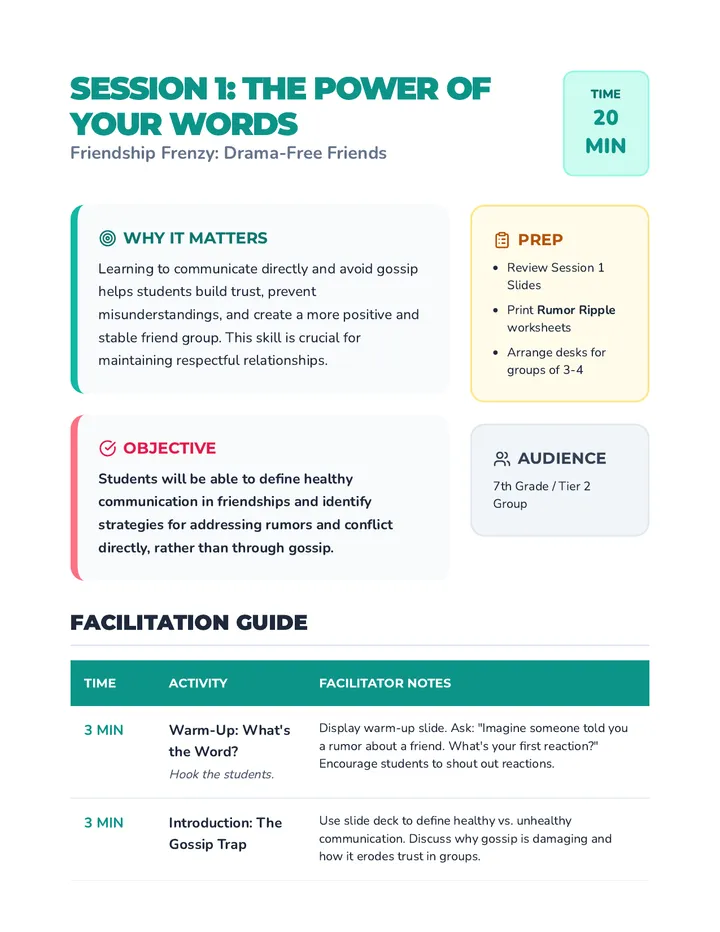
Boundaries: The Invisible Lines
Small Group Facilitation Guide • 7th Grade
Duration
30 Minutes
Audience
7th Grade Students
Approach
Interactive & Discussion-Based
Objective
Students will learn to identify personal boundaries and communicate them effectively, while also understanding and respecting others' boundaries.
Why This Matters
Crucial for social-emotional learning, helping students navigate interpersonal interactions and foster healthy relationships through clear communication and mutual respect.
Preparation
- • Review the "Boundaries: The Invisible Lines" Lesson Plan.
- • Familiarize yourself with discussion prompts and activity materials.
- • Set up a comfortable space for group discussions and activities.
Est. Prep Time 5 Minutes
Lesson Sequence
5m
Warm-Up Activity
- Initiate a brief discussion by asking students what they understand by personal boundaries.
- Encourage students to share examples of times when respecting personal space was important.
15m
Main Activity: Role-Playing
- Conduct an interactive role-playing exercise where students practice stating and respecting personal boundaries.
- Divide students into small groups and provide scenarios they can act out.
- Prompt students to articulate their feelings and listen actively to their peers.
5m
Discussion & Reflection
- Bring the group back together for a reflective discussion on the role of boundaries in daily life.
- Ask open-ended questions to encourage students to share their thoughts on the importance of personal space and mutual respect.
"Boundaries are a sign of self-respect. What you allow is what will continue." Use this session to empower students to define their own 'lines' in a supportive environment.
Boundaries Slide Deck
Social Navigator Series
Boundaries
The Invisible Lines
Understanding and Respecting Personal Space
Teacher Notes: Welcome the students and introduce the session. Explain that today's lesson is about understanding and respecting personal boundaries. Emphasize why this is an essential skill for both personal relationships and a healthy school environment.
Warm-Up Activity
What do personal boundaries mean to you?
Can you share an example when respecting someone’s space made a difference?
Teacher Notes: Initiate the warm-up activity. Ask students to share their ideas or experiences about what boundaries mean and why they're important.
Role-Playing Exercise
Break into small groups to act out scenarios that involve setting and respecting personal boundaries. Use these prompts:
-
1
A scenario in a classroom setting
-
2
A scenario involving shared spaces (e.g., lunch area)
-
3
A scenario with friends hanging out
Teacher Notes: Introduce the main activity. Explain that students will be involved in role-playing exercises to practice stating and respecting personal boundaries in different scenarios. Encourage them to be thoughtful and listen to one another.
Discussion & Reflection
How did it feel to set or respect a boundary?
What strategies helped you communicate effectively?
Why is listening equally important when it comes to boundaries?
Teacher Notes: Facilitate a group discussion after role-playing. Ask various open-ended questions such as how they felt during the exercise, what was challenging, and what was positive. Encourage reflection about the importance of personal boundaries in daily interactions.
Remember
Healthy relationships and respectful interactions start with understanding your own boundaries and acknowledging the boundaries of others.
Teacher Notes: Close the lesson with a summary of key points. Reiterate the importance of understanding and respecting both personal and others' boundaries. Provide encouragement for students to apply these skills in their everyday interactions.
Role Playing Activity Sheet
Role-Playing Scenarios
Social Skills Practice: Setting & Respecting Boundaries
Name: __________________________
Date: ___________________________
Activity Overview
This activity helps you practice how to set and respect personal boundaries. Remember to communicate clearly, use "I" statements, and listen actively to your peers.
3-4 Students per group
15 Minutes
Success Keys
- ✅ Clear "I" statements
- ✅ Active listening
- ✅ Validating feelings
- ✅ Respectful tone
Scenario Cards
Scenario 1: Classroom Space
In a classroom setting, one student feels overwhelmed by a classmate's close proximity during group work. The classmate is leaning over their desk and touching their personal supplies without asking.
Scenario 2: Lunchroom Noise
In the lunchroom, a student needs personal space while eating amidst a noisy crowd. A group of friends wants to sit right next to them and start loud conversations while the student is trying to decompress.
Scenario 3: After-School Time
During a friendly hangout at someone's house, a student asks for a little time alone to focus on homework or just have a quiet moment. Their friend keeps trying to pull them back into playing video games.
Reflection & Strategy
How can you apply the strategies learned today to your own life?
In what ways can understanding someone else's boundaries make your relationships stronger?
What might you do differently the next time you feel uncomfortable in a social situation?
Discussion Points
• How did it feel to express a personal boundary?
• What was challenging about listening to a boundary?
• What words or phrases made the communication smoother?
• How did the other person react when a boundary was set?