Body Compass Educator Guide Educator & Staff Implementation Guide
Body Compass: Sensory Stations & Interoception
Grades: 1–5 / Multi-Tiered
Duration: 50–60 Minutes
Core Objective: Equip teachers, paraprofessionals, and support staff to guide neurodiverse elementary learners in recognizing subtle physiological precursors (racing pulse, clenching, shallow breathing) before behavioral dysregulation occurs, using four active classroom sensory stations.
The Science: Why Interoception Precedes Regulation
1. Visceral Signal
Autonomic shifts activate: heart rate spikes, belly tightens, skin temperature drops.
2. Conscious Notice
Student names the physical cue ("my jaw feels hard as rock") before behavioral escalation.
3. Targeted Reset
Learner chooses a matching sensory input (pressure, breath rhythm, tactile touch) to reset.
Four Classroom Sensory Stations Blueprint
Station 1: Heavy Anchor Proprioception
Signals: Fidgeting, limb vibration, urge to run/bolt, foot bouncing.
Materials: 3-5 lb weighted lap pads, wall push stickers, chair resistance bands.
Station 2: Breath Harbor Vagal Nerve
Signals: Chest tightness, panting, breath-holding, rapid stuttering.
Materials: Finger labyrinth tracing boards, pinwheels, 4-7-8 rhythm timer.
Station 3: Texture Trail Tactile / Thermal
Signals: Overstimulated skin, clenched fists, flushed hot cheeks.
Materials: Chilled smooth river stones, plush fleece swatches, squish gel pads.
Station 4: Center Line Vestibular / Balance
Signals: Spaciness, posture collapse, disoriented spinning or swaying.
Materials: Balance wobble cushion, floor tape balance line, cross-crawl target cards.
The "Rumble Strip" Signal Matrix
Body Zone Silent Bodily Signal (Pre-Crisis) Recommended Sensory Reset Head & Face Clenched teeth/jaw, furrowed brow, hot ears, glassy gaze Chilled stone to temples, rhythmic jaw opening Chest & Breath Ribs stiff, rapid flutter pulse, frequent shallow sighs Finger labyrinth tracing with long vocal hummed exhale Torso & Belly Butterflies, knot feeling, churning nausea, locked stomach Weighted lap pad, forward seated compression hug Hands & Feet White knuckles, tap-footing, picking at skin or pencils Heavy wall push-offs, dual squish squeeze balls
Body Compass Framework • Section 1: Theory & Architecture Page 1 of 2
Staff Delivery & Co-Regulation Protocols
Facilitation Flow & Intervention Guide
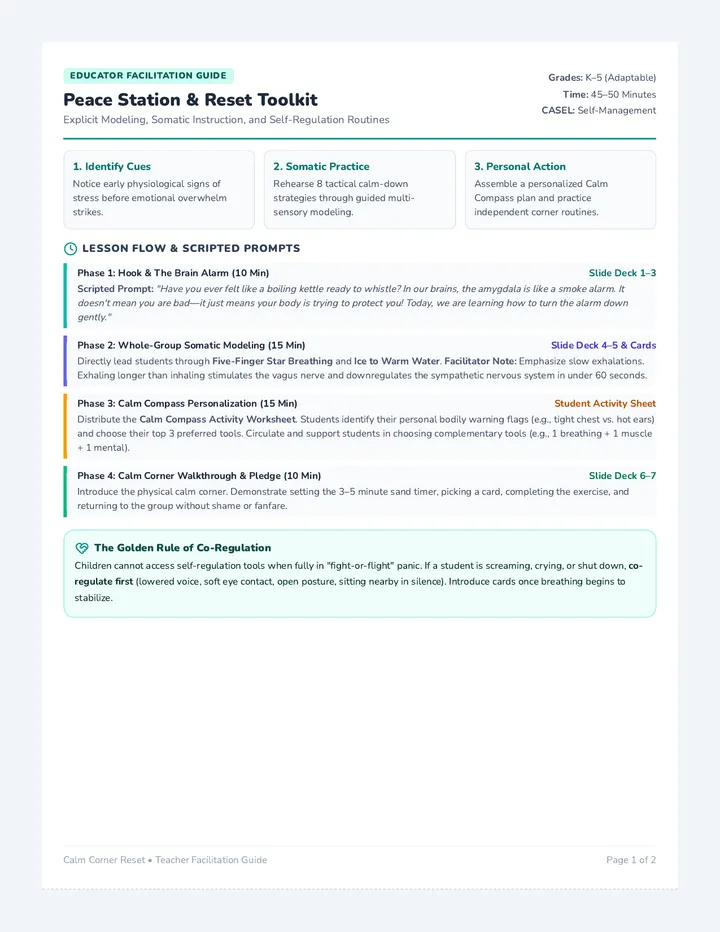
Pacing: 4-Phase Session
Four-Phase Lesson Execution Plan
1
Launch & The "Weather Inside" Check-In
10 mins
Introduce the Body Compass metaphor. Whole group places hand over heart and belly. Ask: "What weather pattern is your body reporting right now? Smooth breeze or electric storm?"
2
Station Tour & Physical Signal Modeling
15 mins
Staff demonstrate how sensory tools change specific body symptoms (e.g., how the heavy anchor slows rapid foot tapping or how cool stones soothe hot cheeks).
3
Station Rotations & Body Clue Mapping
25 mins
Small groups (3-4 students) rotate through stations (5-6 min each). Students log sensations on their Body Clue Map worksheet before and after trying each station tool.
4
Debrief & Personal Compass Card Selection
10 mins
Students identify their "#1 Early Warning Signal" and choose their top sensory tool. Teachers place pocket reset cue cards at desk corners or quiet nooks.
Staff Co-Regulation Scripting (The P.A.U.S.E. Protocol)
P — Protect Physical Space
Lower physical height to student eye level or below. Keep hands open and visible. Do not crowd or trap.
A — Attune & Name the Clue
Say: "I notice your hands are making tight fists. Your body compass is giving a signal. Let's find your anchor."
U — Unload Sensory Burden
Dim overhead fluorescent lights, reduce verbal chatter. Stop asking "why" questions—the thinking cortex is offline.
S & E — Soften & Empower Choice
Offer a forced choice of two stations: "Would your body like the Heavy Anchor wall push, or the cool stone texture?"
Tiered Accommodations & Multi-Sensory Supports
Sensory Defensive
Provide noise-reduction earmuffs during transitions; offer smooth velvet swatches instead of cold stones or rough textures.
Sensory Seeking
Allow max-effort wall pushes, 6-lb weighted shoulder drape, and heavy resistance bands double-looped across desk legs.
Non-Speaking / AAC
Equip learners with color-coded laminated Body Compass symbol cards (Heart, Belly, Hands) for easy point-and-tap expression.
Body Compass Framework • Section 2: Facilitation & Intervention Page 2 of 2
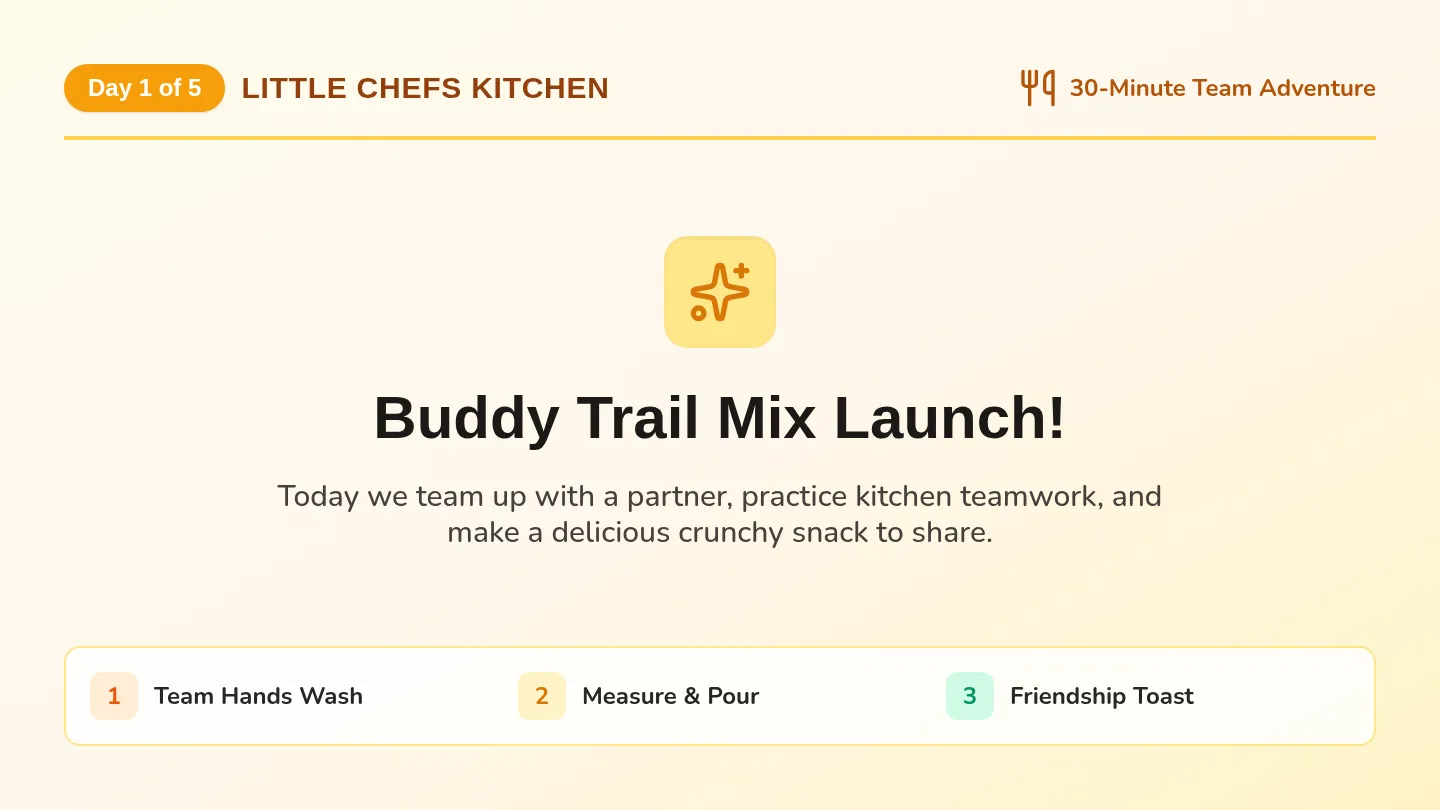
Body Compass Station Slides Sensory Station Expedition
Elementary Interoception Guide
The Body Compass
Listening to Body Clues Before Big Storms Hit
Your body has an internal weather radar. Learn how to spot your rumble strips, visit sensory stations, and steer toward calm waters.
Internal Body Radar Slide 1 of 7
Superpower Science
Slide 2 of 7
Your 8th Sense: Interoception
You know sight, sound, touch, taste, and smell... but what is your inside sense?
Heart & Lungs
Pumping like a racecar engine or flowing like gentle summer waves.
Belly & Muscles
Butterflies fluttering inside, tight rocks in your jaw, or soft relaxed jelly.
Temperature
Cheeks feeling red-hot like an oven or fingers feeling icy and cold.
Interoception sends messages to your brain so you know what you need!
Warning System
Slide 3 of 7
Feel the "Rumble Strips" First
Just like highway bumps warn drivers, bodies warn us before a meltdown.
Early Rumble Strips (Yellow Zone)
Clenched teeth or biting lips
Tapping feet or bouncing knees
Shoulders creeping up to your ears
Breathing gets fast or shallow
BEST TIME TO ACT: Easy to reset!
Full Dysregulation (Red Zone)
Yelling or shutting down completely
Tears, overwhelming frustration
Thinking brain goes offline
Harder to hear comforting words
CATCH IT AT THE RUMBLE STRIP!
When you feel the rumble strip, your compass is saying: "Time for a sensory station!"
Station Tour Part 1
Slide 4 of 7
Stations 1 & 2: Muscle & Breath
Station 1: Heavy Anchor
Deep Pressure & Proprioception
Clues: Bouncing feet, tight fists, feeling like you might explode or run.
Tools: Weighted lap pad, wall push-aways, heavy resistance stretch.
Goal: Pushes calm signals straight into your joints!
Station 2: Breath Harbor
Vagus Nerve & Slow Exhales
Clues: Tight chest, fluttery breath, throat feels choked up.
Tools: Finger labyrinth board, slow pinwheel spins, 4-7-8 timer.
Goal: Long slow exhales slow your racing heartbeat!
Body Clue Map Worksheet Internal Compass Expedition
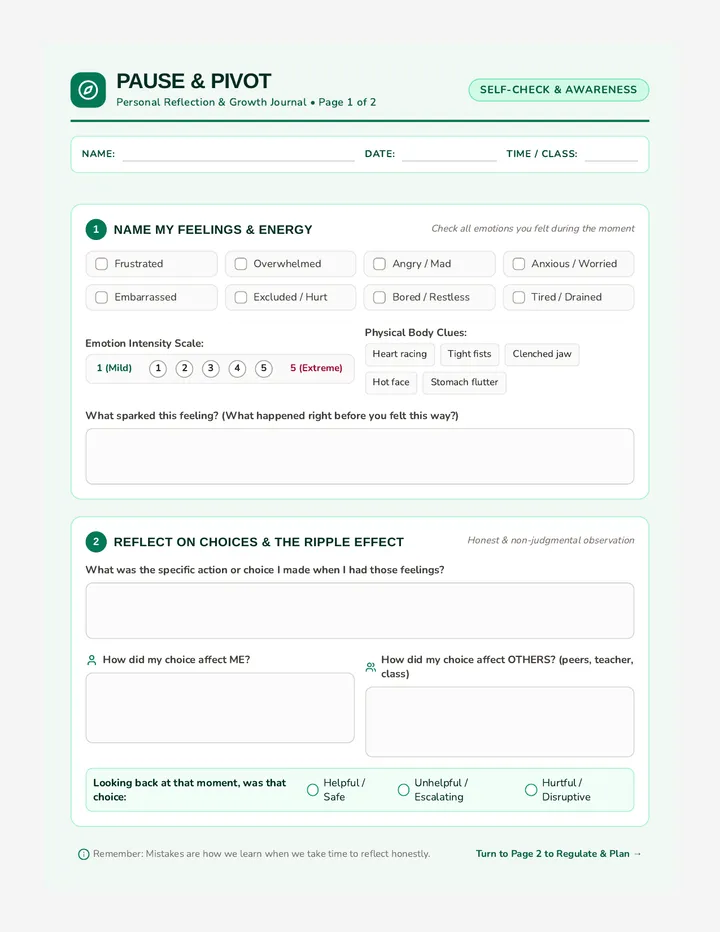
My Body Clue Map
Name:
Date:
Explorer Mission: Your body sends secret whispers before big feelings shout. Use this map to mark where your body feels early warning signals (your "rumble strips").
Signal Color Code
Red / Orange: Hot, racing pulse, buzzing energy
Yellow: Clenched, tight knot, stiff muscles
Blue: Floaty, dizzy, spaced out, chilly
Green: Calm, steady breath, loose & grounded
Check Your Clues
Teeth or jaw grinding Chest fluttering or tight Butterflies or knot in tummy Fists curled tight Feet tapping or pacing Ears or face burning hot
Color or Draw Your Early Clues on this Silhouette
Head & Jaw
Chest & Breath
Tummy & Gut
Legs & Feet
Explorer Field Note: When I start feeling overwhelmed or frustrated, the very FIRST thing my body does is:
Body Compass Student Guide • Station Clue Mapping Page 1 of 2
Lab Rotations
Sensory Station Expedition Log
Rotate through each station & record how your body responds.
Station 1: Heavy Anchor Proprioception
Tool tested: Weighted lap pad or wall push-away
Before tool: My muscles felt...
After tool: My body felt...
Station 2: Breath Harbor Vagal Reset
Tool tested: Finger tracing labyrinth or pinwheel
Before tool: My breathing was...
After tool: My chest & heart felt...
Station 3: Texture Trail Tactile / Cold
Tool tested: Smooth chilled river stone or plush velvet
Before tool: My hands / face felt...
After tool: My skin & thoughts felt...
Station 4: Center Line Balance & Midline
Tool tested: Wobble cushion or floor line balance
Before tool: My focus & balance felt...
After tool: My posture & brain felt...
My Personal Body Compass Action Plan
When I notice my early rumble strips during class, here is what I will choose:
My #1 Warning Clue:
My Favorite Station Tool:
How It Helps My Body Reset:
Body Compass Student Guide • Station Rotations & Action Plan Page 2 of 2
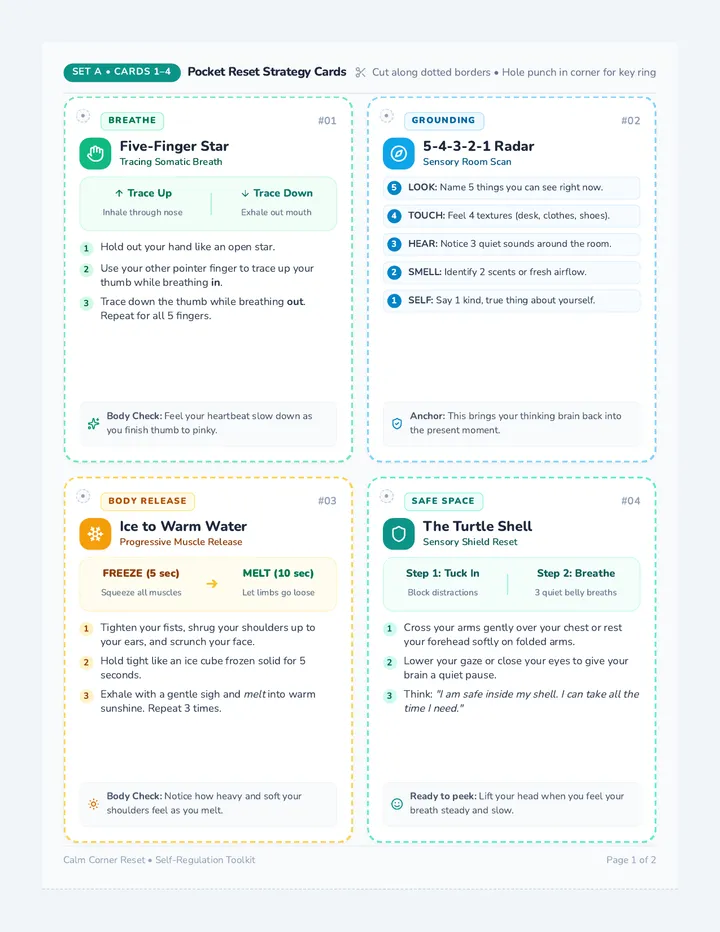
Sensory Reset Cue Cards Printable Sensory Station Cue Cards
Cut along dashed lines & display at station tables
Station 1: Heavy Anchor
PROPRIOCEPTION
Check Your Body: Fidgeting feet? Tight fists? Feeling ready to explode or run?
1
Wall Push-Aways:
Hands flat on wall at shoulder height. Push as hard as a bulldozer for 5 seconds. Repeat 3 times.
2
Weighted Lap Hug:
Place the weighted pad across your thighs. Rest forearms on top. Feel your feet flat on the floor.
3
Joint Squeeze:
Give your own arms a firm "bear hug" squeeze from shoulders down to wrists.
🧭 Body Question: "Do your muscles feel more grounded now?"
Station 2: Breath Harbor
VAGAL RESET
Check Your Body: Fast heartbeat? Gasping breath? Choked-up throat?
1
Finger Labyrinth Trace:
Breathe IN as your finger traces forward. Breathe OUT slowly as your finger curves around.
2
Slow Pinwheel Spin:
Breathe in deep through your nose. Exhale gently through pursed lips so the wheel spins steadily.
3
Humming Bee Exhale:
Take a breath in. On exhale, make a low "Mmmm" hum. Feel your chest vibrate like a gentle purr.
🧭 Body Question: "Has your heart rate slowed down?"
Station 3: Texture Trail
TACTILE / COOL
Check Your Body: Hot flushed cheeks? Itchy skin? Clenched jaw?
1
Chilled River Stone:
Hold the smooth cool stone in your palms. Gently touch it to the sides of your jaw or inner wrists.
2
Squish Gel Rhythm:
Squeeze the textured gel pad slowly. Squeeze tight (1, 2), then let go slowly (1, 2, 3, 4).
3
Plush Velvet Stroke:
Gently glide your fingertips across the velvet swatch. Focus entirely on the soft sensation.
🧭 Body Question: "Do your cheeks and skin feel cooler?"
Station 4: Center Line
BALANCE & FOCUS
Check Your Body: Floaty head? Spaced out? Slumped over desk?
1
Wobble Cushion Balance: