Anxiety Blueprint Teacher Guide Anxiety Blueprint
Counselor Facilitation Guide • Grades 6-12
Mastery
Standards Alignment
ASCA B-SMS 7: Demonstrate effective coping skills when faced with a problem.
CASEL: Self-Management (Stress management, self-discipline).
Session Timing
Duration: 45-60 Minutes
Adaptable for classroom guidance or small groups.
Learning Objectives
Students will differentiate between "helpful" and "harmful" anxiety.
Students will identify 3 personalized physical "alarm signals" of anxiety.
Students will practice and select 2 grounding or reframing techniques for their toolkit.
Preparation Checklist
Anxiety Blueprint Slides
Calm Compass Worksheets
Toolkit Templates
Timer (for breathing exercise)
Facilitator Scripts & Prompts
The Hook (Slide 2)
"If you had to build a blueprint for your brain, where would the 'alarm system' be? Today, we're going to look at why that alarm goes off sometimes when there's no fire."
The Reframing (Slide 7)
"Anxiety is often just a thought that's trying too hard to protect you. How can we talk back to that thought so it knows we're okay?"
Pacing & Procedure
1
The Alarm System (10 mins)
Present Slides 1-3. Explain the amygdala's role in the "Fight-Flight-Freeze" response. Differentiate between Normal Anxiety (motivation for a test) and Overactive Anxiety (stopping you from doing things you want to do).
2
Body Mapping (10 mins)
Distribute Calm Compass Worksheet . Have students complete the Body Scan section. Encourage them to be specific: 'butterfly stomach,' 'tight chest,' 'hot face.'
3
Strategy Lab: Grounding (15 mins)
Guided practice using Slide 5. Lead the 5-4-3-2-1 Grounding Technique.
Tip: For 6-8th grade, use more physical movement. For 9-12th, emphasize the discrete nature of this tool (can be done anywhere without people noticing).
4
The Toolkit (15 mins)
Students complete the Toolkit Creator . This is their personalized reference. They should pick strategies they actually like. No generic answers!
Debrief & Close (5 mins)
Final check-in. Ask: "Which tool feels most helpful for you right now?" Remind students that anxiety is a wave—it will peak, but it always comes down.
Facilitation Tips
If a student becomes visibly anxious during the lesson, allow them to step out or focus solely on the grounding exercise.
Be careful not to dismiss anxiety as "just in your head"—validate that the physical symptoms are very real.
Emphasize that these tools require practice when you're calm to work when you're anxious.
Anxiety Blueprint Slides Anxiety Blueprint
Understanding & Managing Your Internal Alarm
The Alarm System
Meet the Amygdala . It's like a smoke detector in your brain. Its job is to keep you safe from danger.
True Danger
"There is a fire! Run!"
Anxiety
"What if I fail? What if they don't like me?"
Anxiety happens when the alarm goes off for a "false fire."
The Physical Feedback Loop
Body
• Fast Heartbeat
• Tight Chest
• Sweaty Palms
• Stomach Aches
Mind
• Racing Thoughts
• "What If" spirals
• Difficulty focusing
• Forgetfulness
Behavior
• Avoiding things
• Fidgeting
• Snapping at people
• Staying silent
Hack Your Nervous System
Deep breathing tells your brain:
"We are safe. You can turn the alarm off."
BOX
BREATH
1. Inhale (4 secs)
2. Hold (4 secs)
3. Exhale (4 secs)
4. Hold (4 secs)
5-4-3-2-1 Grounding
When your brain is in the future (the "What If"), bring it back to the present (the "What Is").
5
Things you see
4
Things you feel
3
Things you hear
2
Things you smell
1
Thing you taste
Cognitive Reframing
"I am going to fail this test and never get into college."
"This test is hard, but I've prepared. My value isn't based on one grade."
Identify
Catch the "Catastrophic" thought.
Challenge
Is this thought 100% true? What is the evidence?
Build Your Toolkit
Check your worksheet! It's time to map out your own signs and pick the tools that work for YOU.
Body Scan
Grounding
Reframing
Calm Compass Worksheet The Calm Compass
Body & Mind Signal Identification
Name
Date
Step 1: Locate Your Alarm
When anxiety hits, where does your body feel it first? Check all that apply and mark them on the map.
Head (Headaches, racing thoughts)
Chest (Tightness, fast heart rate)
Stomach (Nausea, "butterflies")
Hands/Feet (Shaky, sweaty, cold)
Other physical signs:
Mark your 'Hot Spots' above
Step 2: Flip the Script
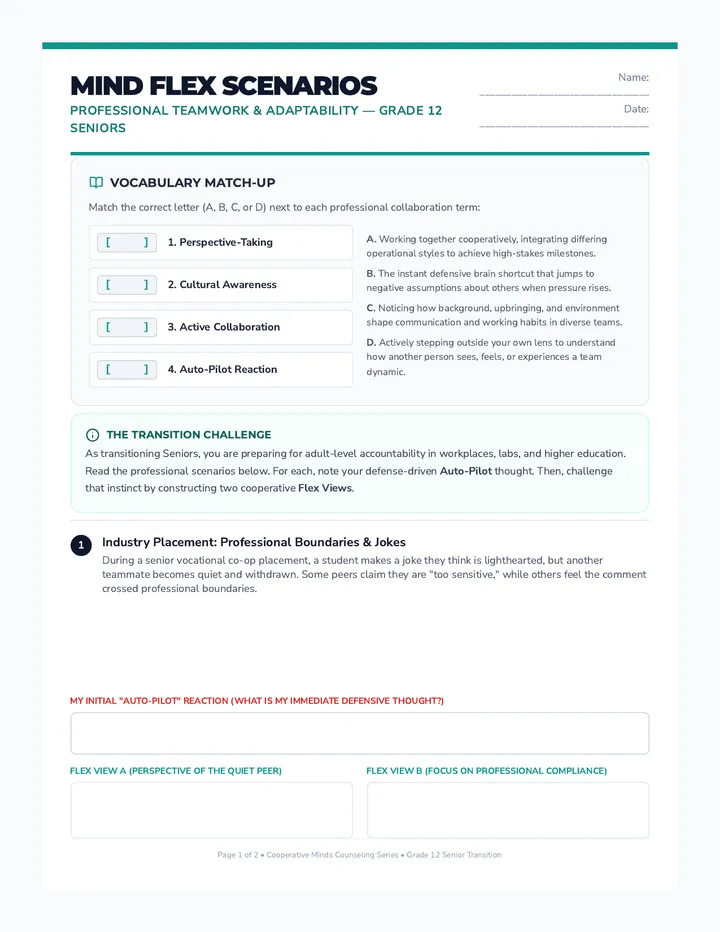
Cognitive reframing is like changing the lens on a camera. It doesn't ignore the problem; it looks at it from a more realistic angle.
Anxious Lens
"I'm going to mess up my lines and everyone will laugh at me."
Realistic Lens
"I might stumble, but I've practiced. Most people are rooting for me."
Anxious Lens
"If I don't get an A on this project, I'm a total failure."
Practice Flip
Your Anxious Thought
Your New Lens
Self-Management Skills | B-SMS 7
Toolkit Creator Guide My Personal Toolkit
Strategies to deploy when the alarm sounds
Sensory & Grounding
Use these to get out of your head and back into your body.
My Favorite Breathing Pattern:
A Calming Physical Sensation (e.g., cold water, fidget tool):
Mindset & Reframing
Use these to talk back to anxious thoughts.
My Go-To Affirmation or "Power Phrase":
A Question to Challenge My Anxiety (e.g., "Will this matter in a year?"):
Action & Support
Use these when you need a distraction or extra help.
One Distraction Activity (e.g., drawing, music):
A Trusted Person I Can Talk To:
Deploy your tools early
Don't wait for the storm to peak.
Status
OPERATIONAL
Reflection
Think about a situation that usually makes you anxious. How will your toolkit change the way you handle it next time?
Confidence Check
How confident do you feel using these tools?
1
Not Very
2
3
4
5
Locked In
This toolkit belongs to someone who is learning to navigate their anxiety with skill and grace. Keep it in your binder, on your phone, or in your locker.