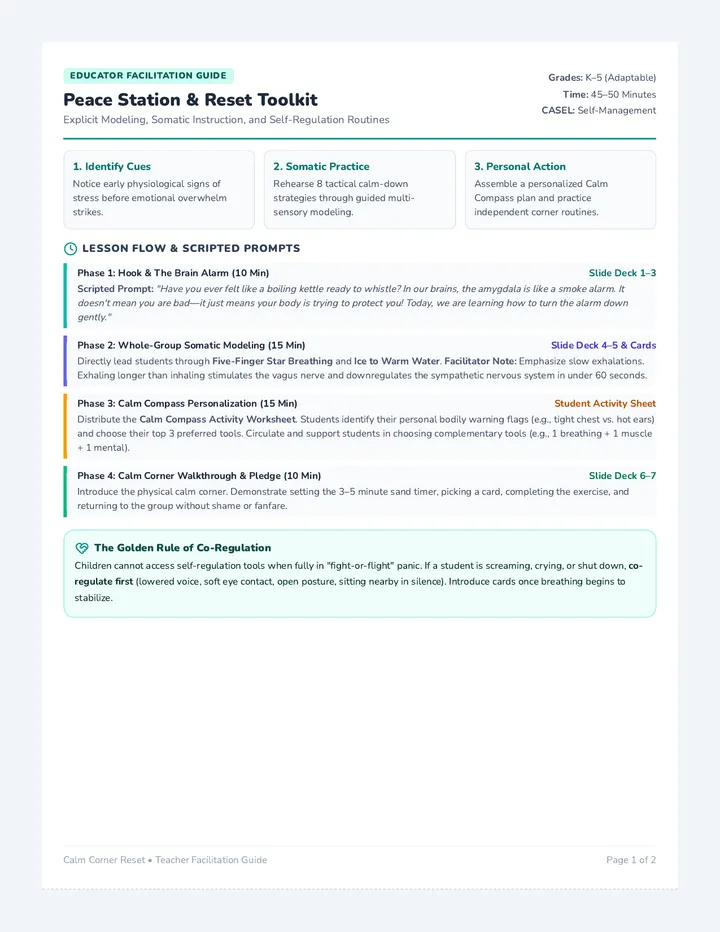
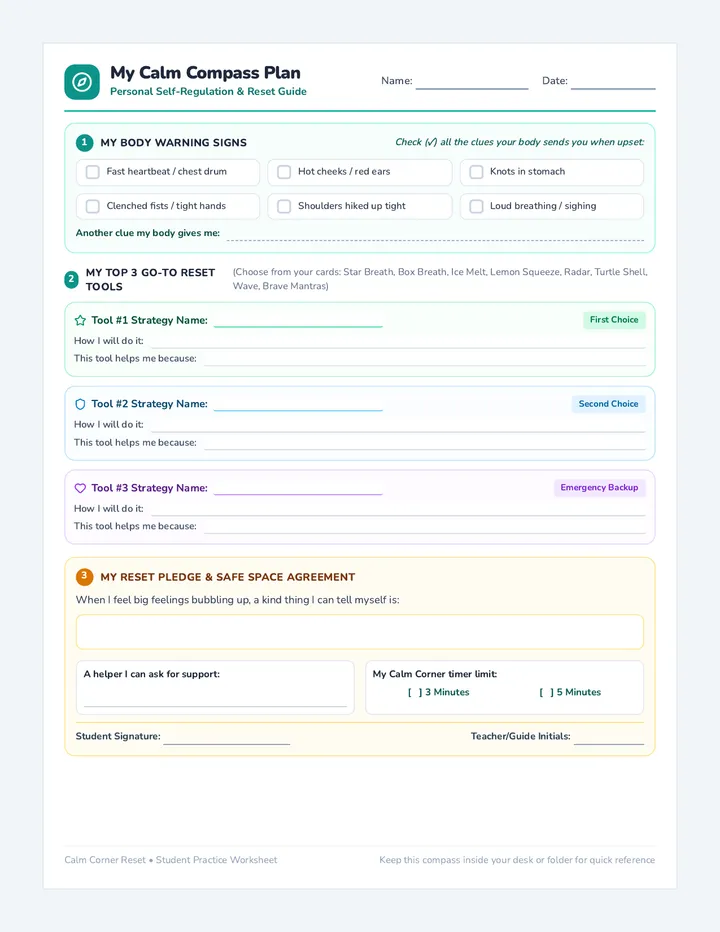
When challenges strike, our emotions can heat up like a volcano. Self-discipline (BLS 2) is knowing how to read our body's warnings before we erupt!
🟢 Cool Calm, in control, relaxed muscles
🟡 Warm Clenched fists, fast heartbeat, distractable
🔴 Hot Shouting, tears, ready to erupt!
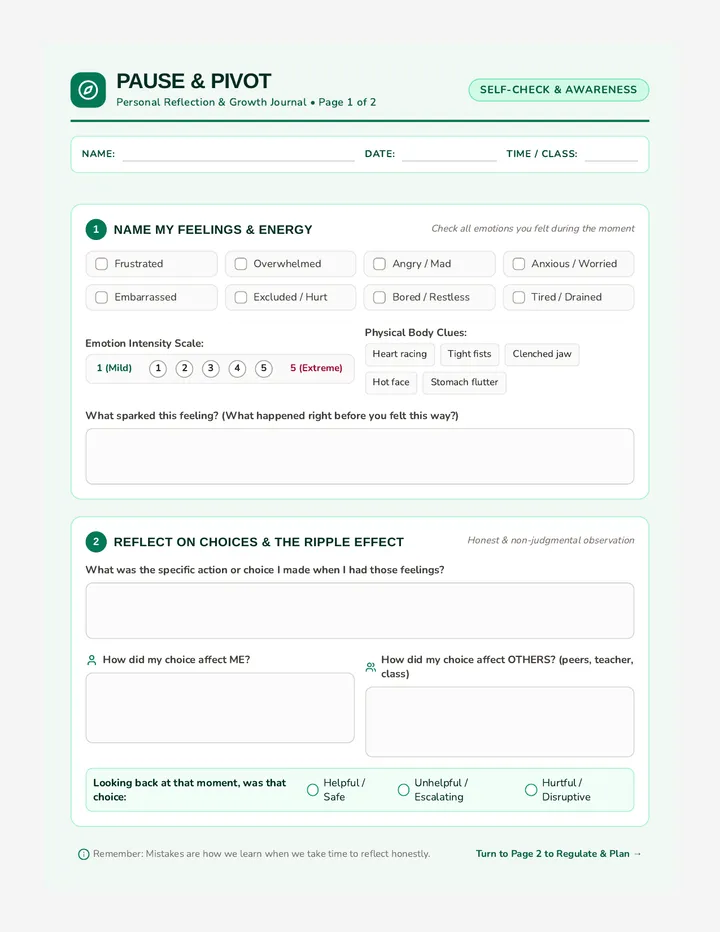
Where do you feel anger or anxiety in your body? (e.g. stomach hurts, shoulders tight, cheeks hot). Draw or write about your body signs on the left, and list your top academic/social "triggers" on the right.
My Body Signs
Draw circles on the body or write where you feel heat:
My Main Triggers
Write down 3 things that trigger your "Warm/Hot" levels:
Resilience Quest 6-Week Workbook Page 4 of 6
Resilience Quest Week 5 • ASCA BLS 2
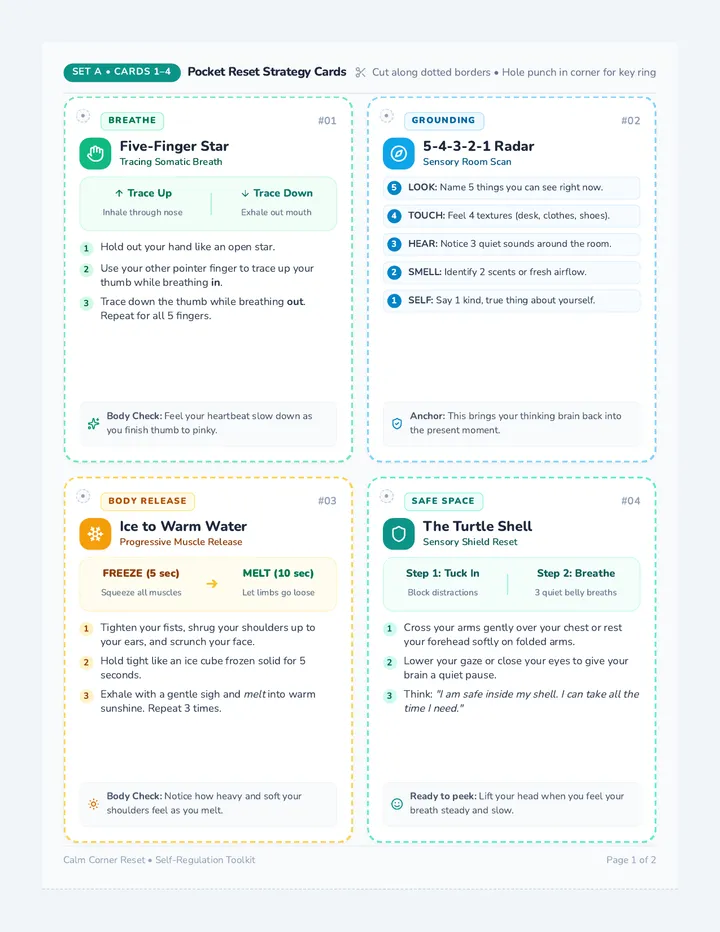
With triggers identified, we must select active self-discipline measures to cool down our volcano! Below are several evidence-based coping skills. Choose your favorite tools to add to your personal toolbox.
Put a check (✓) in the box for the strategies you find helpful:
Inhale 4s, hold 4s, exhale 4s.
Say: "I can handle this tough moment."
Stretch arms high, release physical tension.
Take a slow sip of cold water to ground yourself.
Write down your selected coping skills that you commit to using when triggered:
Resilience Quest 6-Week Workbook Page 5 of 6
Resilience Quest Week 6
A resilient explorer knows exactly who to call for backup. Fill in the names of your support team members below:
Family / Home
Adults at School
Trusted Friends
Design your personal roadmap to conquer your next big challenge with self-discipline and strength:
⛰️ The Mountain: One school task or situation where I want to show more self-discipline is:
🥾 My Next Steps: Two actions I will take to show self-control when that task gets tough:
🔋 My Battery Statement: What I will tell myself to stay motivated:
I sign my name below to show my commitment to growing through challenges.
Explorer:
Resilience Quest 6-Week Workbook Page 6 of 6
The qualitative prompt on the pre-test ("My Hopes") evaluates students' baseline self-awareness of struggles. The post-test prompt ("My Growth Breakthrough") measures their concrete strategy acquisition. Look for a shift from passive, emotional descriptions to actionable, self-directed coping mechanisms (e.g., shifts from "I want school to be easier" to "I will use deep box breathing when my math work feels hard").
Resilience Quest 6-Week Counseling Guide Page 1 of 2
Facilitator Toolset
Interactive Icebreakers, Guiding Prompts, and Differentiation Strategies
Week 1-3 Reframe Prompt:
"When we encounter a mountain that looks too steep to climb, our brains often scream, 'Turn back! This is too heavy!' We are going to learn how to catch those negative thoughts in mid-air, flip them around, and find a resilient thought instead. How does your brain feel when you are in the middle of a struggle? Let's map it out."
Week 4-6 Self-Control Prompt (BLS 2):
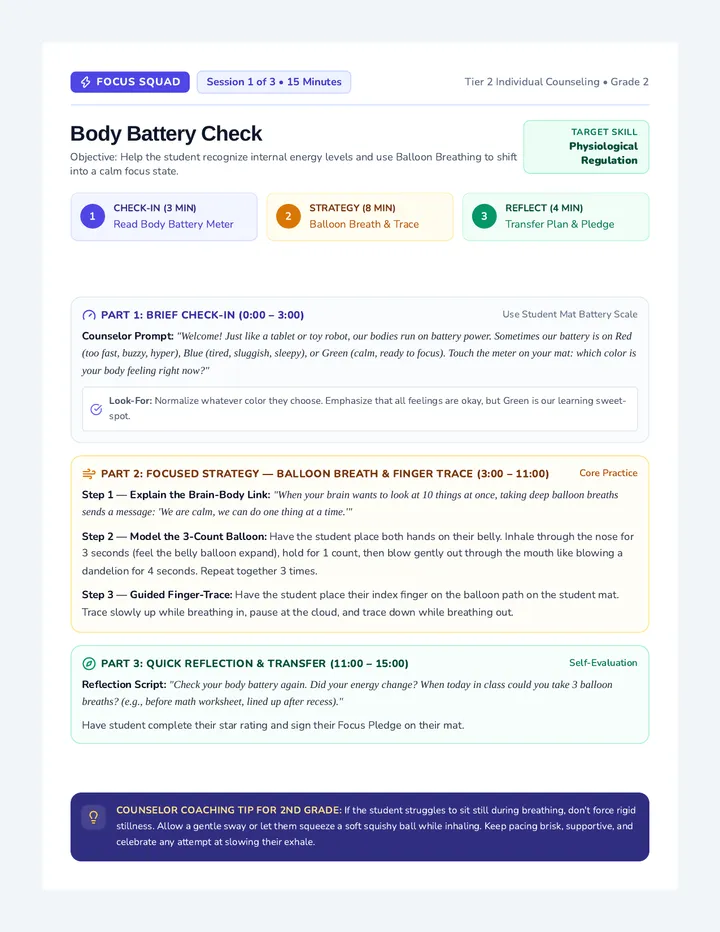
"Feelings like anger or worry are completely natural—but we don't want them erupting in our classrooms. Self-control means checking our internal temperature, identifying our triggers, and using a regulation tool before things blow over. What does Level 2 (Warm) temperature feel like for you?"
Essential Group Debrief Questions:
Icebreaker: The Mistake Ball
Toss a soft foam ball around the circle. When caught, the student shares a funny, minor mistake (e.g. wearing mismatched socks). The group responds with a cheer: "That is how our brains grow!"
Self-Control Freeze (ASCA BLS 2)
Play background music and have kids dance. Suddenly pause the music and call out a distraction: "A loud whisper!" or "An itchy label!". Students must freeze perfectly, exercising physical self-control.
For Younger Students (Grades 1-2): Replace writing expectations with simple icons or colors in their workbooks. Use molding clay to physically demonstrate stretching brain paths.
For Accommodations (IEP/504): Provide pre-printed icon cutouts/stickers for the Coping Toolbox (Page 5) to minimize fine motor writing demands and optimize participation.
Upon completion of Session 6 and administration of the post-test, share a copy of each student's "Resilience Goal Roadmap" (Workbook Page 6) with their classroom teacher. Encourage teachers to use the student's selected "Battery Statement" and "Selected Volcano Controls" as a common, shared verbal cue when the student faces acute frustration during academic tasks.
Resilience Quest 6-Week Counseling Guide Page 2 of 2