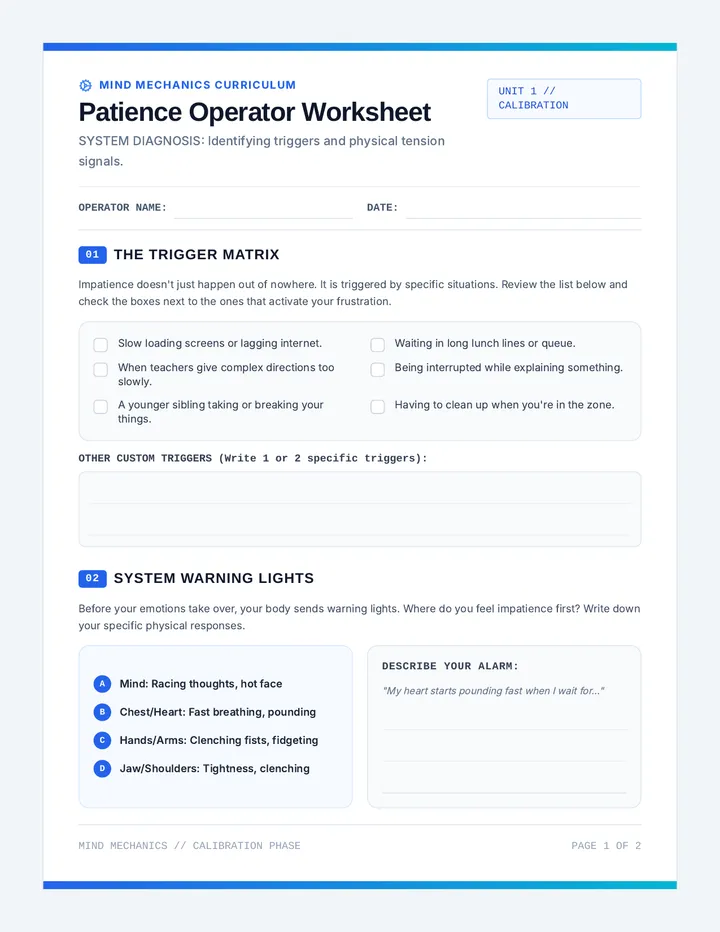
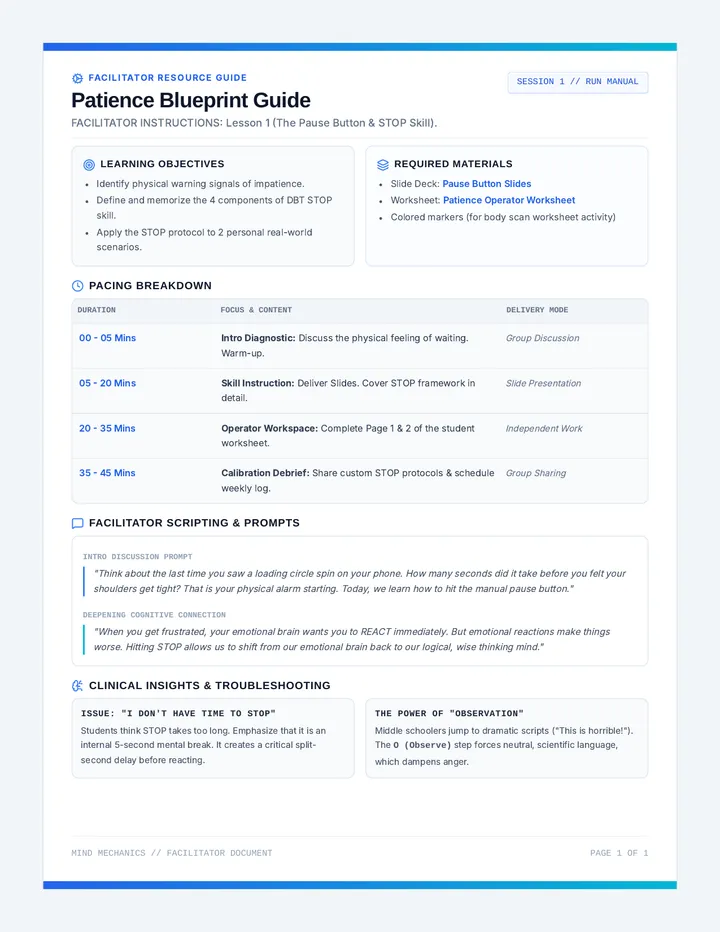
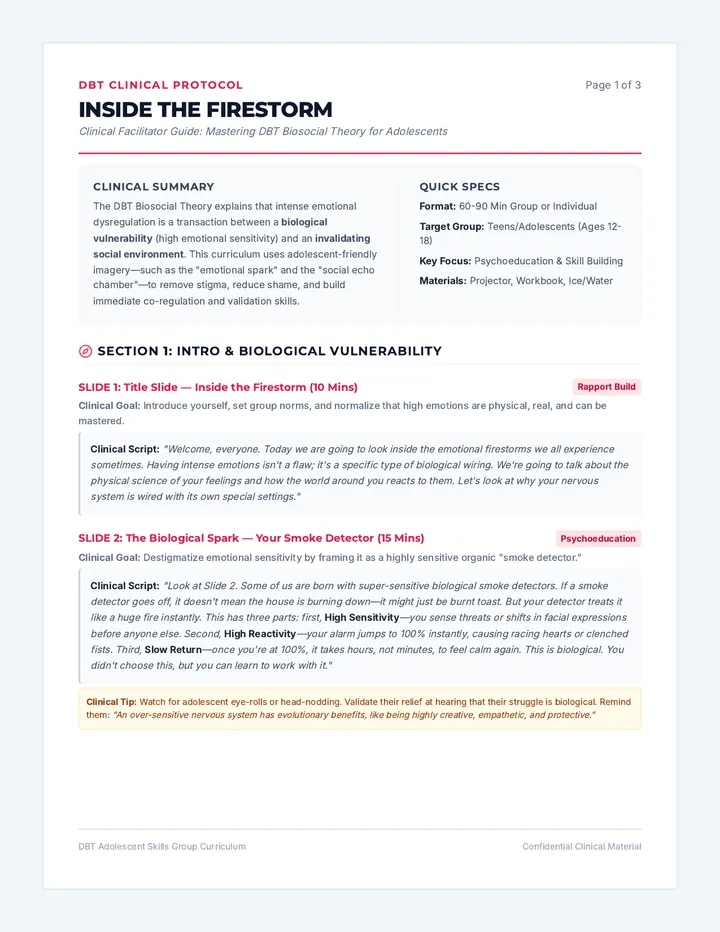
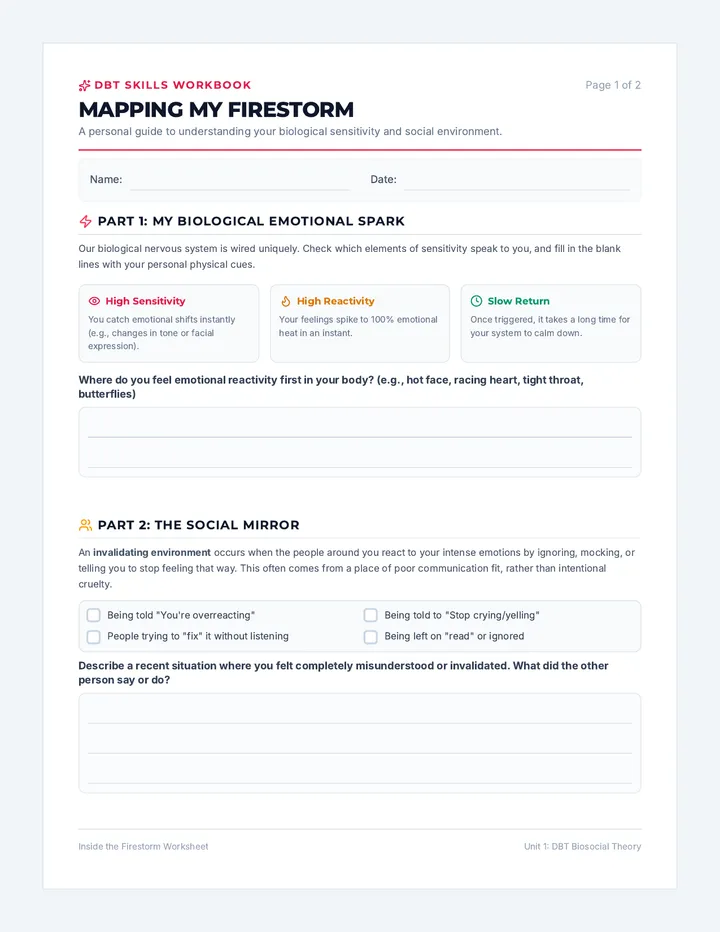
Trap Tagger Activity Classified
Trap Tagger
Evidence Log: Identify the Thinking Trap in each Scenario
Detective Instructions: Below are four "Evidence Files" containing unhelpful thoughts. Use your knowledge of the four Thinking Traps to correctly tag each one!
CASE #001
"I didn't get invited to the party this weekend. This means nobody likes me and I will never have friends again."
Tagged Trap:
CASE #002
"I missed one goal in soccer today. I'm a total failure and I should just quit the team right now."
Tagged Trap:
CASE #003
"The teacher looked at me for a long time. She definitely thinks I'm annoying and wish I wasn't in her class."
Tagged Trap:
CASE #004
"I forgot my science project today. My teacher will fail me, I won't get into a good high school, and my life is ruined!"
Tagged Trap:
The Trap Bank
All-or-Nothing
Overgeneralization
Mind Reading
Catastrophizing
Detective:
Date:
Thinking Traps Slides Case File: #THOUGHT-001
Welcome to
'Thinking Traps'
Have you ever felt stuck in a tricky thought? Sometimes our brains play little tricks on us. Today, we're going to become 'thought detectives' and learn about common thinking traps!
TEACHER_NOTES: Welcome the student and introduce the idea of 'thinking traps'. Explain that these are common patterns of unhelpful thinking that everyone experiences.
Trap #1
All-or-Nothing Thinking
Seeing things as "perfect" or a "total failure" with nothing in between.
Evidence Files:
🏆
"I got a B. I'm a complete failure."
🍪
"I ate one cookie. I've ruined my diet, might as well eat the whole box."
⚽
"I missed the goal once. I'm the worst player on the team."
Trap #2
Overgeneralization
Taking one bad event and believing it will happen every single time .
Evidence Files:
❌
"One person said no. Nobody ever wants to hang out with me."
🧪
"I failed this science lab. I'm not good at anything in school."
🌧️
"It rained on my first day of camp. This whole week is going to be miserable."
Trap #3
Catastrophizing
Blowing a small problem out of proportion and imagining the worst disaster .
Evidence Files:
📱
"They didn't text back. They must hate me and will never speak to me again."
📧
"I made a typo in that email. I'm going to get fired and lose my house."
🤕
"I have a minor headache. It must be a serious medical emergency!"
Trap #4
Mind Reading
Assuming you know what someone is thinking without any proof .
Evidence Files:
👩🏫
"The teacher looks tired. They probably think I'm annoying."
🤐
"Nobody laughed at my joke. They all think I'm weird."
🙅
"They crossed their arms while I was talking. They're definitely mad at me."
Activity: Trap Tagger
Now it's time to put your detective skills to the test!
Investigate
Identify
Capture
"Use your activity sheet to tag the traps in each Case File scenario."
You're a Thought Detective!
01 All-or-Nothing Thinking
02 Overgeneralization
03 Catastrophizing
04 Mind Reading
Recognizing these traps helps us choose different, more helpful thoughts.
Thinking Traps Lesson Plan Thinking Traps
Case Brief: Cognitive Distortions
Duration
15 Minutes
Why This Matters
"Understanding cognitive distortions helps students develop self-awareness, challenge unhelpful thought patterns, and build resilience against negative thinking, leading to improved emotional well-being."
Audience & Approach
Middle School Students (Individual)
Interactive discussion & hands-on application
Materials Needed
Thinking Traps Slide Deck
Counselor Script: Unmasking Thinking Traps
Trap Tagger Activity (Printed)
My Thinking Traps Worksheet (Color or Ink-Friendly)
Counselor Prep (5 min)
Review the Slide Deck and practice the "Trap Tagger" scenario identifications.
Read through the Counselor Script to prepare for transitions between explanation and activity.
Print the activity and choice of reflection sheet (Ink-Friendly recommended for mass printing).
Learning Objective
Students will be able to identify and understand common cognitive distortions (thinking traps) and apply this knowledge to categorize unhelpful thoughts in real-world scenarios.
Session Timeline
2 min
Introduction to Thinking Traps
Begin with a friendly greeting and establish rapport.
Introduce the concept of 'thinking traps' using Slide 1.
5 min
Exploring Common Traps
Go through Slides 2-5 one by one.
Explain each trap clearly with relatable examples from the script.
Briefly check for understanding by asking for a quick "thumbs up" if they've felt it.
4 min
Activity: Trap Tagger
Hand the student the Trap Tagger Activity.
Ask the student to "tag" each scenario with the correct trap from the bank.
Review answers together to solidify definitions before moving to reflection.
3 min
Personal Reflection
Transition to the My Thinking Traps Worksheet (Color or Ink-Friendly).
Facilitate the completion of personal examples and reflection questions.
Discuss strategies for 'escaping' traps (e.g., asking "is this really true?").
1 min
Wrap-up
Thank the student for being an excellent detective.
Thinking Traps Ink Friendly Worksheet My Thinking Traps
Official Detective Case File • Ink-Friendly Version
Detective:
Date:
Thinking traps are sneaky ways our brains trick us. As a thought detective , your job is to spot these traps and find the truth!
1. All-or-Nothing Thinking
Seeing things as only "perfect" or a "total failure."
Evidence A:
"If I don't get an A, I'm a complete failure."
Evidence B:
"I ate one cookie, so my whole diet is ruined."
Have you ever felt this way? Describe a time:
2. Overgeneralization
Believing one bad event will happen every single time.
Evidence A:
"I struck out today, so I'm terrible at all sports forever."
Evidence B:
"Nobody invited me today; nobody ever likes me."
Have you ever felt this way? Describe a time:
3. Catastrophizing
Blowing a small problem into the worst disaster possible.
Evidence A:
"My friend didn't text back; they must hate me forever."
Evidence B:
"I have a headache; it must be a medical emergency!"
Have you ever felt this way? Describe a time:
4. Mind Reading
Assuming you know what someone is thinking without proof.
Evidence A:
"My teacher gave me a weird look; they think I'm stupid."
Evidence B:
"Nobody is talking to me; they all think I'm weird."
Have you ever felt this way? Describe a time:
Final Reflection
Which thinking trap do you think you fall into most often?
How do these thoughts make you feel?
What's one small thing you can try to do when you catch yourself in this trap?
(Hint: Ask yourself, 'Is this really true? Is there another way to look at this?')
Counselor Script Unmasking Thinking Traps Internal Use Only • Case Study 101
Unmasking Thinking Traps
Counselor Facilitation Script & Interaction Guide
Session Protocol
Individual / Tier 3
Part 1
Introduction to Thinking Traps (2 min)
Facilitation Notes
Counselor: "Hi [Student's Name]! Thanks for coming in today. How are you doing?"
[Allow for brief response and check-in]
Show Thinking Traps Slide Deck - Slide 1
Counselor: "Today, we're going to talk about something really interesting that happens in all our brains sometimes. We call them 'thinking traps.' Have you ever noticed that sometimes your thoughts can get a bit stuck, or they might make you feel worse, even when things aren't actually that bad?"
Part 2
Exploring Common Traps (5 min)
Counselor: "Let's look at some of the most common thinking traps. As we go through them, I want you to think if you've ever caught yourself falling into one of these."
Slide 2: All-or-Nothing
Counselor: "Our first trap is 'All-or-Nothing Thinking.' This is when we see things in only black and white. For example, if you don't get an A on a test, you might think you're a complete failure. Have you ever felt like it has to be perfect or it's just plain bad?"
Slide 3: Overgeneralization
Counselor: "Next is 'Overgeneralization.' This is when one bad thing happens—like striking out in a game—and you assume you're 'terrible at all sports forever.' You take one event and make it a rule for everything."
Slide 4: Catastrophizing
Counselor: "Then there's 'Catastrophizing.' This is making a mountain out of a molehill. Like forgetting your project and thinking, 'My life is ruined!' Do your thoughts ever jump straight to the worst-case scenario?"
Slide 5: Mind Reading
Counselor: "Finally, 'Mind Reading.' Assuming you know what someone is thinking—usually something negative—without any proof. Like assuming a teacher thinks you're annoying just because they're having a busy day."
Part 3
Activity: Trap Tagger (4 min)
Action: Hand student the "Trap Tagger Activity"
Counselor: "Now that you know the four main traps, it's time to put your detective skills to the test. I have four evidence files here. Take a look at these thoughts and see if you can 'tag' them with the right trap from the list at the bottom."
[Allow student 2-3 minutes to categorize the four scenarios. Provide hints if they get stuck.]
My Thinking Traps Worksheet My Thinking Traps
Official Detective Case File
Detective:
Date:
Thinking traps are sneaky ways our brains trick us. As a thought detective , your job is to spot these traps and find the truth!
1. All-or-Nothing Thinking
Seeing things as only "perfect" or a "total failure."
Evidence A:
"If I don't get an A, I'm a complete failure."
Evidence B:
"I ate one cookie, so my whole diet is ruined."
Have you ever felt this way? Describe a time:
2. Overgeneralization
Believing one bad event will happen every single time.
Evidence A:
"I struck out today, so I'm terrible at all sports forever."
Evidence B:
"Nobody invited me today; nobody ever likes me."
Have you ever felt this way? Describe a time:
3. Catastrophizing
Blowing a small problem into the worst disaster possible.
Evidence A:
"My friend didn't text back; they must hate me forever."
Evidence B:
"I have a headache; it must be a medical emergency!"
Have you ever felt this way? Describe a time:
4. Mind Reading
Assuming you know what someone is thinking without proof.
Evidence A:
"My teacher gave me a weird look; they think I'm stupid."
Evidence B:
"Nobody is talking to me; they all think I'm weird."
Have you ever felt this way? Describe a time:
Final Reflection
Which thinking trap do you think you fall into most often?
How do these thoughts make you feel?
What's one small thing you can try to do when you catch yourself in this trap?
(Hint: Ask yourself, 'Is this really true? Is there another way to look at this?')
Trap Tagger Answer Key Solved
Trap Tagger
Confidential Answer Key: For Counselor Use Only
CASE #001
"I didn't get invited to the party this weekend. This means nobody likes me and I will never have friends again."
Correct Identification:
Overgeneralization
Why: Student is taking one specific rejection and applying it to "nobody" and "forever."
CASE #002
"I missed one goal in soccer today. I'm a total failure and I should just quit the team right now."
Correct Identification:
All-or-Nothing Thinking
Why: Seeing the day as either perfect or a total failure, with no middle ground for a single mistake.
CASE #003
"The teacher looked at me for a long time. She definitely thinks I'm annoying and wish I wasn't in her class."
Correct Identification:
Mind Reading
Why: Assuming negative thoughts in others' minds without any concrete proof or conversation.
CASE #004
"I forgot my science project today. My teacher will fail me, I won't get into a good high school, and my life is ruined!"
Correct Identification:
Catastrophizing
Why: Jumping from a small mistake (one project) to a life-ruining disaster.
Detective Debriefing Tips
• If a student confuses Overgeneralization and All-or-Nothing , explain that Overgeneralization is about frequency ("always/never"), while All-or-Nothing is about category ("perfect/failure").
• Remind students that these traps are sneaky —we don't realize we're in them until we stop and examine the evidence.
• Use Case #003 to discuss how "Mind Reading" often creates anxiety where there is none.