Making First Move Lesson Plan THE COR
Behavioral Group
September Social Skills Curriculum • Lesson Plan 1
Theme: Social Connections Booster
September: Lesson 1 — Making the First Move (Teen Focus)
Objective
Clients will demonstrate how to initiate an age-appropriate self-introduction to a new peer in a school or extracurricular setting by stating name, identifying an environmental anchor, and making eye contact in 4/5 role-plays.
Materials Needed
"Anchor Scan" Cards
Role-Play Scenario Cards
Self-Intro Script Sheets
Environmental Anchor Posters
Timer & Peer Feedback Form
Group Procedure
Transition clients from free-choice tables to the active circle area. Ensure all members are settled and seated in a semi-circle with clear line of sight to the presenter.
Notes & Adaptations
For Anxiety: Allow client to write out the introduction script before verbalizing. Peer responder should use extra encouraging cues.
Increase Challenge: Play low background noise to simulate a busy school hallway, requiring vocal adjustment.
Introduction
Introduce self-introductions. Explain that starting a conversation is easier using an Environmental Anchor —something in the shared room (e.g., posters, a sports game, a cool outfit) to build a natural bridge.
Clarifying Questions: "How does it feel to talk to a stranger?" & "What is one thing in this room right now that you could make a comment on?"
Interactive Activity: Anchor Scan
Out-of-Seat Challenge: BCBA scatters 6 environmental posters/objects around the room (e.g., Gaming Setup, Comic Poster, Sports Rack). Clients move around, find an item with a partner, and practice identifying a physical detail. They draft an icebreaking comment based on that detail (e.g., "I noticed your shirt, is that from the new movie?" ) while maintaining proper posture and eye contact.
Role Play #1: Structured Scenarios
Divide group into pairs and hand out role-play task cards. Clients practice a structured 3-step script: Approach/Eye Contact → Anchor Comment → Name Exchange .
1 Peer wearing a cool graphic tee in the hallway.
2 Sitting next to an unfamiliar classmate in Art Workshop.
3 Peer checking out club flyers at the school board bulletin.
4 Peer playing a multiplayer mobile game in the lobby.
5 A soccer classmate putting on cleats before practice starts.
Role Play #2 (Interactive): Club Fair
Open-Ended Simulation: BCBA sets up 3 club booths (Gaming, Anime, Chess). Clients role-play entering a bustling club fair. They must stand near a booth, notice an item or classmate, and execute an impromptu conversation using the 3 steps, negotiating organic turn-taking.
Closure & Reflection
Reiterate the three anchors: Approach, Anchor, Name . Ask clients: "How does looking at an environmental object rather than starting directly with eye contact help lower your nerves before speaking?"
THE COR BEHAVIORAL GROUP © 2026 Confidential Clinical Lesson Guide • Social Skills Track
First Move Role Play Cards Social Connections Booster
First Move Role-Play Cards
Student Name
Date
How to Use These Cards
Practice initiating self-introductions in pairs. Cut out these cards. The Initiator must execute three steps: (1) Make smooth eye contact, (2) Point out/remark on the Environmental Anchor , and (3) Introduce themselves. The Responder follows their cue script!
Scenario 1
The Graphic Tee Hero
Environmental Anchor A peer is wearing a cool comic poster graphic shirt in the hallway.
Initiator Role: Approach, make calm eye contact, point gently to shirt, and deliver opener: "Hey, that's an awesome shirt. Did you see the new movie?"
Responder Cue: Smile and say: "Yeah, I saw it last Friday! It was so good. I'm Marcus, by the way."
Focus: Hallway Anchor Eye Contact
Scenario 2
Art Workshop Neighbor
Environmental Anchor A classmate is drawing with detailed dual-tip brush markers.
Initiator Role: Turn to classmate, glance at their drawing pad, and ask: "Those markers are really bright. Are they easy to blend with?"
Responder Cue: Lift marker to show and say: "Yeah, they blend great! I got them online. I'm Chloe."
Focus: Table-sharing Anchor Turn-taking
Scenario 3
Mobile Game Lobby
Environmental Anchor A peer is playing a competitive mobile game in the lobby.
Initiator Role: Sit nearby, wait for them to look up, and smile: "Oh nice, is that Brawl Stars? Who is your favorite character to play?"
Responder Cue: Pause screen and say: "Yeah! I love playing Colt. He has awesome range. What's your name?"
Focus: Shared Hobby Anchor Voice Control
Scenario 4
Soccer Prep Bench
Environmental Anchor A teammate is putting on new neon soccer cleats before practice.
Initiator Role: Sit on soccer bench, look at cleats, and deliver: "Those neon cleats look super fast. Do they have good grip on the field?"
Responder Cue: Look up, smile, and say: "Yes, they're super light. I'm Toby, nice to meet you."
Focus: Extracurricular Anchor Warm Stance
Breaking Ice Lesson Plan THE COR
Behavioral Group
September Social Skills Curriculum • Lesson Plan 2
Theme: Social Connections Booster
September: Lesson 2 — Breaking the Ice (Teen & Adult Focus)
Objective
Clients will identify and apply 3 baseline self-introduction strategies tailored to different environments (school classroom, community center, or workplace) to initiate conversation with an unfamiliar peer across 3 interactive practice scenarios.
Materials Needed
"Icebreaker Strategy" Cards
Zone Floor Markers
Low-Pressure Script Guides
Visual Environment Prompts
Timer & Peer Feedback Sheet
Group Procedure
Transition group to the main desk area. Ensure all members are seated. Distribute environment-specific script sheets and place designated zone markings on the room floor.
Notes & Adaptations
For Adults: Emphasize workplace boundary scripts. Focus heavily on Task-Focused openers that transition naturally into light social topics.
Modification: Allow clients to read scripts directly off of reference sheets for first 2 role-plays, then gradually fade them out.
Introduction
Explain that context matters. How we start a conversation changes based on location. Introduce the 3 Base Strategies : Shared Context (School), Passive Observational (Community/Recreation), and Task-Focused (Workplace).
Clarifying Questions: "Would you ask a coworker about their homework?" & "How can we start a conversation without making a personal comment first?"
Interactive Activity: Zone Jumping
Out-of-Seat Challenge: BCBA labels three zones on the floor: "School", "Community", and "Work". BCBA reads a scenario prompt (e.g., "You are standing by the copier machine at a new internship" ). Clients must physically walk or jump into the correct zone and deliver a corresponding strategic opener.
Role Play #1: Structured Scenarios
Pairs are formed. Clients are handed task cards and take turns selecting the appropriate strategy and practicing scripts for the following scenarios:
1 Sitting next to an employee in the breakroom (Workplace).
2 Looking at a chess game at the community center (Community).
3 Sitting down at a shared computer desk in the library (School).
4 Standing next to someone in the local gym lobby (Community).
5 Greeting a peer outside your new project meeting (Workplace).
Role Play #2 (Interactive): Context Speed-Dates
Common Ground Lesson Plan THE COR
Behavioral Group
September Social Skills Curriculum • Lesson Plan 3
Theme: Social Connections Booster
September: Lesson 3 — The Common Ground Hunt (Teen Focus)
Objective
Clients will practice sharing 2 personal interests (e.g., gaming, music, sports) and asking 2 reciprocal questions to discover shared hobbies or common ground with a new peer during a structured group mingle activity.
Materials Needed
"Common Ground" Worksheets
Reciprocal Question Bank
Tennis Ball (visual prompt)
Interest Cards (with icons)
Timer & Markers
Group Procedure
Have the group transition from tables to two concentric standing circles, with clients in the inner circle facing partners in the outer circle for active mingling.
Notes & Adaptations
For Non-Verbal: Utilize pictorial interest cards. Clients point to their interest, and peer points to matching or non-matching card with a "yes/no" indicator.
The Pivot Rule: Teach that if a peer does not share an interest, the client should use a backup topic rather than forcing the issue.
Introduction
Explain "Common Ground" using a Venn diagram analogy: it is the shared space where our interests overlap. Introduce the concept of a Reciprocal Question —tossing the conversation ball back (e.g., "What about you?" ) after stating your own interest.
Clarifying Questions: "What happens if only one person talks during a conversation?" & "How can we find out what someone likes without interviewing them?"
Interactive Activity: Venn Diagram Mingle
Out-of-Seat Challenge: Give each client a mini-whiteboard with a blank Venn diagram. Clients walk around the room with music playing. When the music stops, they must high-five the nearest peer, share two personal hobbies, ask two reciprocal questions, and write any shared interests in the overlapping zone.
Role Play #1: Structured Interest Swaps
Pairs use structured cue cards to practice exchange. Client A shares an interest from their card, then immediately asks a reciprocal question. Client B answers and returns another question:
1 Sharing a passion for video games & asking about their favorite game.
2 Discussing a favorite food or restaurant & asking what they like to eat.
3 Sharing a music artist/genre & asking what songs they listen to.
4 Discussing weekend plans/activities & asking how they spend free time.
Classmate Project Pairing Lesson Plan THE COR
Behavioral Group
September Social Skills Curriculum • Lesson Plan 4
Theme: Social Connections Booster
September: Lesson 4 — Classmate & Project Pairing (Teen & Adult Focus)
Objective
Clients will demonstrate how to politely approach a classmate or colleague to partner up for a group project using professional/respectful language and clear task-oriented communication in 3 simulated scenarios.
Materials Needed
"Skill Matching" Card Deck
Partner Pitch Script Handouts
Acceptance/Refusal Cue Cards
Project Brief Sheets
Timer & Peer Feedback Forms
Group Procedure
Transition clients to tables designed to represent "classrooms" or "conference tables". Ensure all members are settled before beginning.
Notes & Adaptations
Refusal Resilience: Emphasize that being turned down for a partnership is common (they might already have a partner) and not a personal rejection.
Anxiety: Use the "Partner Application Card" where clients can fill in their project strengths and hand it over as a conversation starter.
Introduction
Explain the high social pressure of partnering for a project. Introduce the 3-Step Partner Proposal Formula : 1. Polite Greeting, 2. Status Inquiry ("Do you have a partner yet?" ), 3. Low-Pressure Proposal ("Would you want to team up?" ). Introduce professional refusal coping scripts.
Clarifying Questions: "How do you feel when a teacher says 'find a partner'?" & "What is a polite way to react if someone says they are already paired?"
Interactive Activity: Skill Matchmaker
Out-of-Seat Challenge: Assign each client a specialized "Skill Card" (e.g., "Good at Research", "Slide Designer", "Public Presenter"). Clients must walk around, pitch their skill to others, and combine forces in pairs of two complementary roles using professional partnership proposals.
Role Play #1: Structured Scenarios
Pairs take turns acting out the 3-step proposal formula. BCBA hands out role play cue cards with predetermined positive/negative responses:
1 Approaching an unfamiliar peer in a college chemistry lab.
2 Pitching collaboration to a workspace colleague for a slide deck.
3 Asking a graphic design classmate who is looking around the room.
4 Approaching an active group of two to ask if they can form a group of three.
5 Gracefully handling a polite refusal (e.g., "I'm working with Sarah today").
Acquaintance Friend Lesson Plan THE COR
Behavioral Group
September Social Skills Curriculum • Lesson Plan 5
Theme: Social Connections Booster
September: Lesson 5 — Acquaintance vs. Friend (Teen Focus)
Objective
Clients will categorize 8 social scenarios to differentiate between the traits of an acquaintance (e.g., wave in hallway) and a friend (e.g., hang out outside of school) with 85% accuracy on a visual sorting task.
Materials Needed
"Circles of Closeness" Board
16 Social Scenario Cards
Velcro Sort Boards
Boundary Response Scripts
Timer & Score Tracking Sheet
Group Procedure
Transition clients to tables in teams of two. Hand out relationship sort cards and sorting mats. Ensure glue sticks/Velcro pieces are distributed.
Notes & Adaptations
Common Misconception: Teens often label everyone they see regularly at school as a "friend." Emphasize that having acquaintance relationships is healthy, safe, and normal.
Visual Support: Use color-coded borders for card sorts (blue for school-only, yellow for multi-environment).
Introduction
Introduce relationship boundaries. Explain that not everyone we interact with is a "Friend"—some are "Acquaintances". Define Acquaintance : school-only contact, light topics, no out-of-school hangs. Define Friend : shared interests, mutual effort, contact in multiple environments.
Clarifying Questions: "Is the grocery store cashier a friend or acquaintance?" & "Why do we keep some topics (like family problems) only for true friends?"
Interactive Activity: Island Sort Game
Out-of-Seat Challenge: Draw two chalk circles on the floor: "Acquaintance Island" and "Friend Forest". BCBA hands clients large prompt cards. Clients must walk up, read their card aloud, walk to the correct floor circle, and state one key reason they belong in that category.
Role Play #1: Sorting Scenarios
Pairs read, analyze, and physically categorize the following cards onto their visual boards, answering clinical check questions:
1 Waving hello to the bus driver every morning (Acquaintance).
2 Inviting a classmate to hang out at the arcade on Saturday (Friend).
3 Sharing a highly personal worry about a family member (Friend).
4 Borrowing a highlighter from someone sitting next to you in science (Acquaintance).
5 Texting a lab partner only to ask when the assignment is due (Acquaintance).
Social Boundaries Relationships Lesson Plan THE COR
Behavioral Group
September Social Skills Curriculum • Lesson Plan 6
Theme: Social Connections Booster
September: Lesson 6 — Social Boundaries & Relationship Levels (Teen & Adult Focus)
Objective
Clients will identify key behavioral milestones (e.g., consistent positive interactions, shared trust, mutual effort) that signal when a social connection shifts from acquaintance to friend across 4 guided case studies.
Materials Needed
Case Study Activity Sheets
"Green Light" Milestone Cards
Relationship Thermometer Map
Diagnostic Highlighters
Timer & Peer Feedback Sheet
Group Procedure
Transition clients to desks with individual case folders. Hand out green, yellow, and red highlighters for coding social interactions and milestones.
Notes & Adaptations
Clinical Focus: This lesson target helps prevent "social rushing"—the tendency for neurodivergent individuals to push for immediate high-disclosure friendships before trust is earned.
Adaptation: Simplify case studies to short comic strip style formats for visual learners.
Introduction
Explain that friendships are built, not born. They progress through milestones. Introduce the 3 Friendship Milestones : 1. Consistent Positive Interactions, 2. Shared Trust (confidences kept), 3. Mutual Effort (both reach out).
Clarifying Questions: "If you are the only one texting, is it mutual effort?" & "How many positive chats do you need before inviting someone to your house?"
Interactive Activity: Relationship Escalator
Out-of-Seat Challenge: Mark floor lines from 0 to 4 (Stranger to Close Friend). BCBA reads social interaction logs (e.g., "David has lunch with John for the 4th time and they discover a shared love for comic books" ). Clients physically step forward or backward on the escalator.
Role Play #1: Case Study Analysis
Pairs read 4 written case logs. They highlight Green Light Milestones and diagnose the current relationship stage (Acquaintance vs. Friend):
1 Case A: School corridor waves. No outside school chats (Acquaintance).
2 Case B: Gaming peers who text on weekends & team up (Friend).
3 Case C: Classmate who only texts when they need homework answers (Acquaintance).
4 Case D: Peer group that eats together & shares personal jokes (Friend).
5 Transition scenario: Moving from acquaintance to friend via a low-pressure invite.
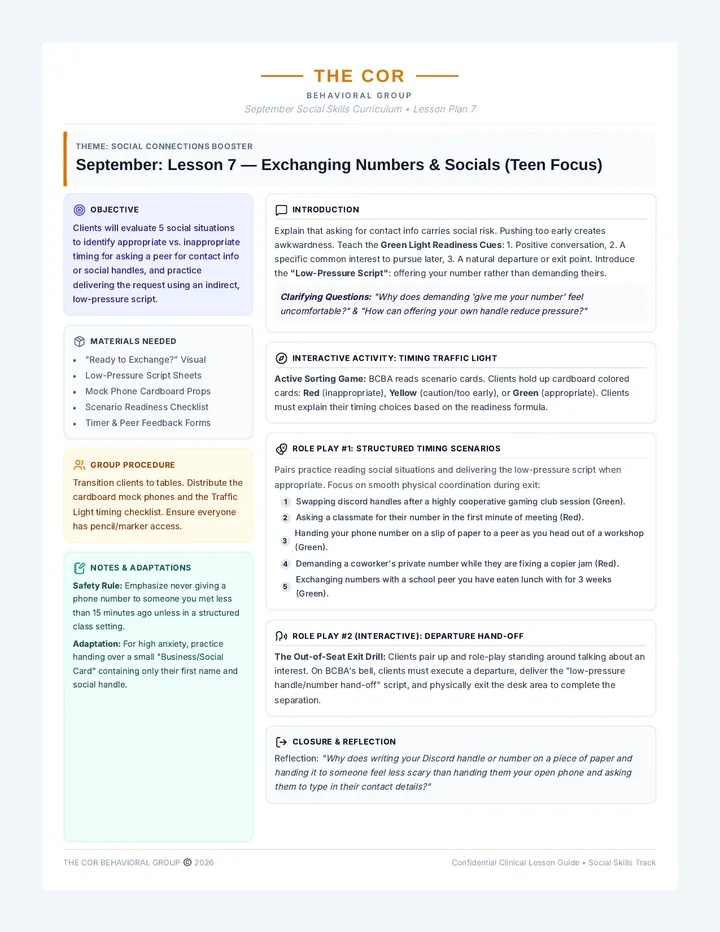
Exchanging Numbers Socials Lesson Plan THE COR
Behavioral Group
September Social Skills Curriculum • Lesson Plan 7
Theme: Social Connections Booster
September: Lesson 7 — Exchanging Numbers & Socials (Teen Focus)
Objective
Clients will evaluate 5 social situations to identify appropriate vs. inappropriate timing for asking a peer for contact info or social handles, and practice delivering the request using an indirect, low-pressure script.
Materials Needed
"Ready to Exchange?" Visual
Low-Pressure Script Sheets
Mock Phone Cardboard Props
Scenario Readiness Checklist
Timer & Peer Feedback Forms
Group Procedure
Transition clients to tables. Distribute the cardboard mock phones and the Traffic Light timing checklist. Ensure everyone has pencil/marker access.
Notes & Adaptations
Safety Rule: Emphasize never giving a phone number to someone you met less than 15 minutes ago unless in a structured class setting.
Adaptation: For high anxiety, practice handing over a small "Business/Social Card" containing only their first name and social handle.
Introduction
Explain that asking for contact info carries social risk. Pushing too early creates awkwardness. Teach the Green Light Readiness Cues : 1. Positive conversation, 2. A specific common interest to pursue later, 3. A natural departure or exit point. Introduce the "Low-Pressure Script" : offering your number rather than demanding theirs.
Clarifying Questions: "Why does demanding 'give me your number' feel uncomfortable?" & "How can offering your own handle reduce pressure?"
Interactive Activity: Timing Traffic Light
Active Sorting Game: BCBA reads scenario cards. Clients hold up cardboard colored cards: Red (inappropriate), Yellow (caution/too early), or Green (appropriate). Clients must explain their timing choices based on the readiness formula.
Role Play #1: Structured Timing Scenarios
Pairs practice reading social situations and delivering the low-pressure script when appropriate. Focus on smooth physical coordination during exit:
1 Swapping discord handles after a highly cooperative gaming club session (Green).
2 Asking a classmate for their number in the first minute of meeting (Red).
3 Handing your phone number on a slip of paper to a peer as you head out of a workshop (Green).
Exchanging Numbers Script Sheet Social Connections Booster
Low-Pressure Script Sheets
Student Name
Date
The Low-Pressure Departure Strategy Always share your information instead of demanding theirs. This leaves the control in their hands, respects boundaries, and takes away all social anxiety. Use these fill-in-the-blank scripts below to practice!
1
The Gaming Partner Hand-off
Fill in the blanks to draft your personalized gaming club exit script:
"Hey, I had a blast playing ______________________ (name of game) today. I'm actually heading out now, but if you want to game together some time, you can add me on ______________________ (app name). My username is ______________________ (your tag)!"
2
The Project Collaborator text
Fill in the blanks to draft your partner slide coordination script:
"Hey, we got a lot done on ______________________ (topic of project) today! If you want to coordinate on the slide designs later, I can write down my ______________________ (number or email) so you can text me. It's ______________________ (your info)!"
3
The Quick Bus-Stop Departure
Fill in the blanks to draft your rapid interest slip hand-off:
"Hey, my bus is here so I've got to run, but we should totally talk about ______________________ (shared interest) again! Here is my ______________________ (Discord/Number): ______________________. Add me if you'd like!"
Partner Reflection Checklist
After practicing with your partner, evaluate their exchange using the checkboxes below:
Eye contact was smooth
Voice tone was calm
Used a departure phrase
Write one nice thing about how your partner handed over their script:
THE COR BEHAVIORAL GROUP © 2026 Worksheet Checklist Resource • Safe Socialization Track
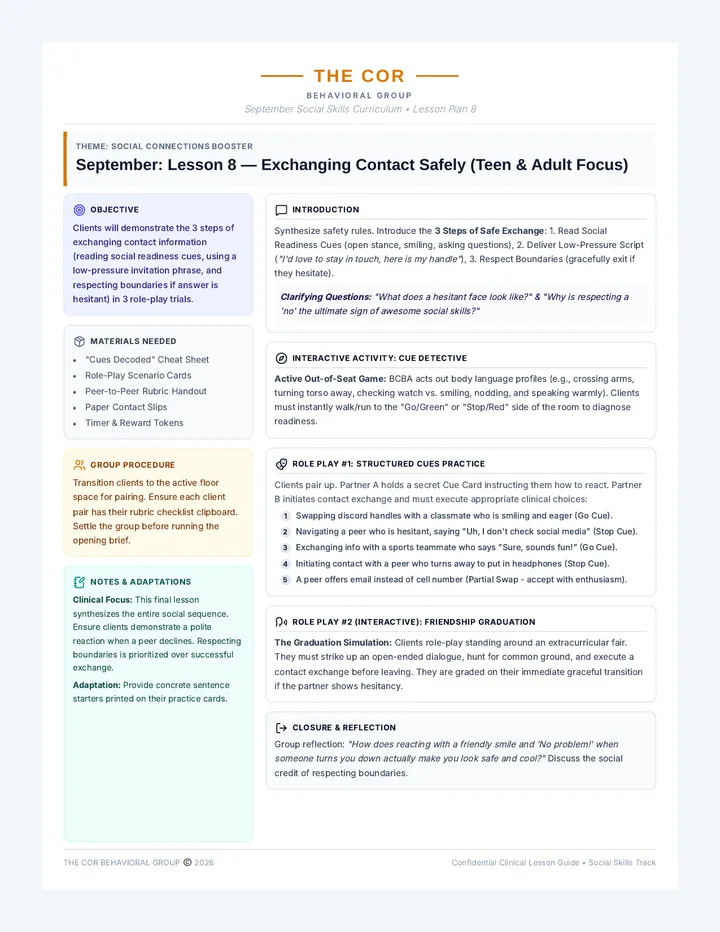
Exchanging Contact Safely Lesson Plan THE COR
Behavioral Group
September Social Skills Curriculum • Lesson Plan 8
Theme: Social Connections Booster
September: Lesson 8 — Exchanging Contact Safely (Teen & Adult Focus)
Objective
Clients will demonstrate the 3 steps of exchanging contact information (reading social readiness cues, using a low-pressure invitation phrase, and respecting boundaries if answer is hesitant) in 3 role-play trials.
Materials Needed
"Cues Decoded" Cheat Sheet
Role-Play Scenario Cards
Peer-to-Peer Rubric Handout
Paper Contact Slips
Timer & Reward Tokens
Group Procedure
Transition clients to the active floor space for pairing. Ensure each client pair has their rubric checklist clipboard. Settle the group before running the opening brief.
Notes & Adaptations
Clinical Focus: This final lesson synthesizes the entire social sequence. Ensure clients demonstrate a polite reaction when a peer declines. Respecting boundaries is prioritized over successful exchange.
Adaptation: Provide concrete sentence starters printed on their practice cards.
Introduction
Synthesize safety rules. Introduce the 3 Steps of Safe Exchange : 1. Read Social Readiness Cues (open stance, smiling, asking questions), 2. Deliver Low-Pressure Script ("I'd love to stay in touch, here is my handle" ), 3. Respect Boundaries (gracefully exit if they hesitate).
Clarifying Questions: "What does a hesitant face look like?" & "Why is respecting a 'no' the ultimate sign of awesome social skills?"
Interactive Activity: Cue Detective
Active Out-of-Seat Game: BCBA acts out body language profiles (e.g., crossing arms, turning torso away, checking watch vs. smiling, nodding, and speaking warmly). Clients must instantly walk/run to the "Go/Green" or "Stop/Red" side of the room to diagnose readiness.
Role Play #1: Structured Cues Practice
Clients pair up. Partner A holds a secret Cue Card instructing them how to react. Partner B initiates contact exchange and must execute appropriate clinical choices:
1 Swapping discord handles with a classmate who is smiling and eager (Go Cue).
2 Navigating a peer who is hesitant, saying "Uh, I don't check social media" (Stop Cue).
3 Exchanging info with a sports teammate who says "Sure, sounds fun!" (Go Cue).
4 Initiating contact with a peer who turns away to put in headphones (Stop Cue).