Social Radar Student Workbook Student Activity Log
My Social Radar
Name
Date
How to Use Your Social Radar
We use our Social Radar to understand how our friends are feeling. Instead of just hearing their words, we look for physical clues:
Eyes
Watch body & face clues
Ears
Listen to voice tone & speed
Heart
Think: "How would I feel?"
Part 1: Read the Clues
Read each friend's description. Use your radar to identify their emotion and write a helpful response.
1
Sam sits alone on the bench with crossed arms, looking down at the ground.
What is Sam's body language telling you? What is a kind question you could ask?
2
Mia runs up to you with wide eyes and a huge smile, talking super fast about recess.
What is Mia's energy telling you? How can you show her you are excited too?
SOCIAL RADAR SERIES — STUDENT LOG PAGE 1 OF 2
Practice Lab
Radar Partner Lab
Part 2: Active Listening Partner Log
Use your social radar during your partner role-play. Fill out this simple check-sheet together:
My Partner's Name:
Their Scenario Topic:
1. The physical clues I saw:
Heavy sigh or deep breathing
Fidgeting with hands/pencil
Smiling / excited posture
Looking down or crossed arms
2. Based on these cues, I think they felt:
Write down their feeling word (e.g. Nervous, Sad, Excited):
3. What is a helpful active listening question you asked them?
Part 3: Empathy Reflection
How does it feel when someone uses their social radar to really listen to you? Why does it help build friendships?
SOCIAL RADAR SERIES — STUDENT LOG PAGE 2 OF 2
Social Radar Teacher Guide Teacher Facilitation Guide
Social Radar Lesson
Active Listening & Empathy Mastery (Grades 4-5)
UNIT 1 • LESSON 1
Learning Objectives
Students will identify three categories of non-verbal cues (Eyes, Ears, Heart).
Students will use follow-up questions to display active empathy.
Preparation checklist
Print the Student Workbook (1 per student) and cut out the Social Radar Scenario Cards .
STEP 1
Hook: The Out-of-Sync Radio (5 Mins)
Teacher Script: "Imagine you're trying to listen to your favorite song, but the radio is full of static. You can only hear every third word. Is it easy to understand the song? No! Sometimes, when we talk to our friends, we aren't fully tuned in. Our 'Social Radar' is off, and we miss key signals. Today, we're becoming Radar Operators, learning to tune in perfectly to what others are saying and feeling."
STEP 2
Direct Instruction: The 3 Sensors (15 Mins)
Introduce the concept of Social Radar . Write the three core sensors on the board:
1. Eyes (See)
Watch their posture, facial expressions, and movements.
2. Ears (Hear)
Listen to their tone of voice (excited, quiet, shaky) and speed.
3. Heart (Feel)
Think: "How would I feel if this happened to me?"
Distribute page 1 of the Student Workbook . Guide students to check off the three active sensory units at the top, then model how to decode the scenarios together as a whole class before letting them write.
SOCIAL RADAR SERIES — TEACHER COMPANION PAGE 1 OF 2
PRACTICE & EVALUATION
Radar Calibration
STEP 3
Guided Practice: Partner Lab (20 Mins)
Group students into pairs. Distribute Scenario Cards (one set per pair).
Role Instructions:
Transmitter (Speaker): Chooses a card and reads the prompt. They must act out the scenario's emotion using their body language and tone of voice without explicitly saying the word.Receiver (Listener): Uses page 2 of the workbook to track clues, check off behaviors they see, and formulate a high-empathy response.
Social Radar Observation Rubric
Skill Needs Practice On Track Exceeds Goal Cue Reading Struggles to identify basic non-verbal cues. Identifies obvious cues (e.g., crossed arms, smile). Notices subtle details (e.g., voice speed). Empathy Tuning Does not label feelings correctly. Labels major emotions (happy, sad, nervous). Links complex behaviors to root feelings. Active Responses Replies with off-topic remarks. Asks direct follow-up questions. Matches energy and offers kind support.
Support & Inclusion Tips
Some students find direct eye contact challenging. Reinforce that "using eyes" can simply mean turning their shoulders toward the speaker, focusing on hands/gestures, or showing they are quiet and listening through their physical spacing.
SOCIAL RADAR SERIES — TEACHER COMPANION PAGE 2 OF 2
Social Radar Scenario Cards Social Radar Cards
Cut along the dotted lines • Practice active listening in pairs
PARTNER TOOLS
CARD 01
The Left-Out Game
The Story:
Your friends are playing a new game at recess and didn't ask you to join. You feel left out.
Cues to Act Out:
Hold your elbows, stand alone, watch the court, look sad.
Empathy Starter:
"Hey, I noticed you were standing by yourself. Do you want to play with me?"
CARD 02
The Division Test
The Story:
You have a big math test in 5 minutes and you don't know the division steps. You are scared.
Cues to Act Out:
Fidget with a pencil, bite your lip, bounce your foot nervously.
Empathy Starter:
"You look a little worried about the test. Do you want to review the rules together?"
CARD 03
The Awesome Gift
The Story:
Your mom surprised you with the exact video game you wanted. You are super excited!
Cues to Act Out:
Big smile, talk super fast, bounce on your toes.
Empathy Starter:
"Wow, your face is glowing! Tell me all about it, what game is it?"
CARD 04
The Lost Lunch Card
The Story:
You can't find your school lunch pass and you're worried you won't get to eat. You're anxious.
Cues to Act Out:
Rub your head, speak in a quiet voice, search your pockets fast.
Empathy Starter:
"Don't worry, the office can always get you a guest pass! Let me help you search your backpack."
CARD 05
The Spilled Water
The Story:
You accidentally knocked over your water cup and it spilled on your friend's drawing. You feel terrible.
Cues to Act Out:
Cover your mouth, look wide-eyed, apologize really fast.
Empathy Starter:
"It was an accident! Let's get some paper towels quickly and clean it up."
CARD 06
The Lost Puppy
The Story:
Your puppy slipped out of the yard this morning and is missing. You feel really sad and tired.
Cues to Act Out:
Heavy sighing, slouching back in your chair, staring off into space.
Empathy Starter:
"That is so stressful. I'm here if you want to talk, and I can help search after school."
SOCIAL RADAR SERIES — SCENARIO CARDS PAGE 1 OF 1
Drivers Seat Student Workbook SELF-REGULATION LOG
The Driver's Seat
DRIVER'S NAME
DATE
Checking Your Dashboard
To stay in control of your behaviors, look at your body's dashboard. What gear are you in right now?
BLUE GEAR Slow Engine
Sad, tired, bored, or slow moving
GREEN GEAR Cruising
Focused, calm, content, ready
YELLOW GEAR Fast Engine
Anxious, silly, frustrated, wiggly
RED GEAR Overheated
Angry, screaming, or shut down
Activity 1: Spotting Your Roadblocks (Triggers)
Identify what shifts your engine out of the green zone and into yellow or red:
A) School Roadblocks (Check all that apply):
Loud noises or bright classroom lights
Changes in my daily school schedule
Writing long paragraphs or hard work
Having to wait my turn or wait in line
Losing a game or making a mistake
Other Roadblock:
B) How My Body Warns Me (Check your signs):
Hands/fingers tapping or squirming
Face or ears feel hot or red
Heart beating fast or tight chest
Wanting to cover my ears or hide
Clenching my jaw or locking my hands
Other Body Sign:
LIFE DRIVERS SERIES — DRIVER MANUAL PAGE 1 OF 2
EMOTIONAL CONTROLS
Steering & Braking
Activity 2: Visual Breathing Path (Pressing Your Brakes)
Place your finger on the star. Trace the square outline with your finger, breathing along the path:
START HERE 1. INHALE DEEPLY (4 SECONDS) ———> CORNER
4. PAUSE (4s) TRACING SQUARE 2. HOLD IT (4s)
CORNER <——— 3. EXHALE SLOWLY (4 SECONDS) CORNER
Activity 3: Selecting My Safe Detours
When your dashboard is in the Yellow Gear , which safe actions do you want to choose to control your behavior? Select 2 detours that work best for you:
Take a Quiet Break Go to the calming desk for 2 minutes
Use Sensory Tools Squeeze an eraser or play with putty
Noise Decompression Put on noise-canceling headphones
Get Water hydration Take a short walk to the water fountain
Positive Reminders Read my desk "Dashboard Cards"
Silent Counting Count backward slowly from 10
Drivers Seat Teacher Guide TEACHER COMPANION
The Driver's Seat
Self-Regulation & Behavioral Control (Neurodiverse Differentiated)
UNIT 1 • LESSON 2
LESSON OBJECTIVES
Students will identify bodily warning signs of dysregulation (Interoception).
Students will perform a tactile box-breathing technique to return to a calm "Green Gear."
AUTISM ACCOMMODATIONS
• Uses concrete checklists instead of complex writing prompts.
STEP 1
Hook: Running Engine vs. Braking (5 Mins)
Interactive Activity: Have students stand. Tell them to tap their desks or move their fingers rapidly to show a "Fast Engine." Then shout "Red Light!" Students freeze silently in place. Repeat twice.
Teacher Script: "When our engine is running really fast, it can feel hard to stop. In our school day, sudden noises, changes, or hard tasks can make our body engines race. Today, we're becoming the drivers of our own minds, learning where our 'Emotional Brakes' are so we can stay safely in the calm, ready Green Gear."
STEP 2
Direct Instruction: Defining the Gears (15 Mins)
Draw the 4 gears on the board. Emphasize that all gears are natural , but we can steer our actions in any gear.
BLUE: Slow Engine
GREEN: Cruise Gear
YELLOW: Fast Engine
RED: Overheated
Literal Language Tip (Crucial for Autistic Learners): Avoid using abstract metaphors like "be a good boy/girl" or "calm down." Use mechanical language: "Your physical warnings tell us your engine is in Yellow. Let's engage our brakes to shift down to Green."
LIFE DRIVERS SERIES — TEACHER COMPANION PAGE 1 OF 2
PRACTICE & INTEGRATION
Sensory Steering Systems
STEP 3
Workbook Practice (20 Mins)
Distribute The Driver's Seat Workbook . Point out the checkboxes designed to help students quickly circle and select behaviors without getting stuck during writing blocks.
How to Teach the Tactile Breathing Path:
Many autistic students find traditional breathing instruction too abstract. Use page 2 of their workbook:
Have students place their index finger on the star in their workbook.
Inhale for 4 seconds as their finger slowly slides across the top edge.
Drivers Seat Dashboard Cards Dashboard Desk Helpers
Cut out and tape to desks as a daily physical reminder for behavioral control
DESK ACCESSORIES
BRAKING SPEED
Emergency Brake
When you feel your engine racing into the Yellow Gear , apply the brakes:
THE 4-4-4 BREATH:
Inhale for 4 seconds. Hold for 4 seconds. Exhale slowly for 4 seconds. Repeat 3 times.
SLow Down Your Engine
GEAR BOX
Gear Shifter Check-In
What gear is your engine in right now? Check your emotional gauges:
BLUE: Low/Tired
GREEN: Focused
YELLOW: Restless
RED: Overheated
Steer Back To Green
SAFETY ROUTE
Positive Detours
When you hit a roadblock, choose a detour instead of an impulse reaction:
Ask your teacher for a 2-minute water break.
Squeeze your hands or a desk eraser tightly.
Count backward silently from 20.
Doodle simple swirls on scrap paper.
Avoid Behavioral Crashes
MIND ENGINE
Positive Self-Talk Shield
What you tell your brain is how you steer. Try saying these words silently to yourself:
"This is hard, but I can handle it step-by-step."
"It's okay to feel upset. I can stay calm."
"I have control over how I choose to react."
You Control the Wheel
TENSION DISCHARGE
The 5-Second Squeeze
Release high nervous energy safely from your body silently at your desk:
Squeeze your fists as hard as you can for 5 seconds. Now release them completely. Feel the energy leave your hands. Repeat twice.
Silent Energy Release
DRIVER CONTRACT
My Driver Contract
I agree that I am the driver of my actions. No one else can steer my behaviors.
DRIVER SIGNATURE:
Keep the Green Gear
LIFE DRIVERS SERIES — DASHBOARD TOOLS PAGE 1 OF 1
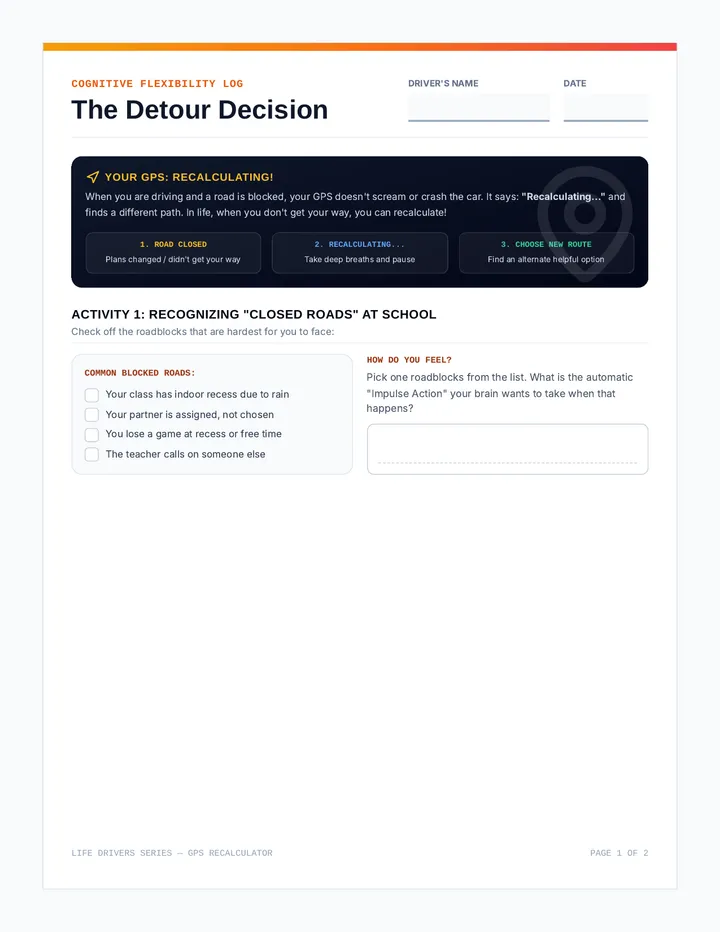
Detour Decision Student Workbook COGNITIVE FLEXIBILITY LOG
The Detour Decision
DRIVER'S NAME
DATE
Your GPS: Recalculating!
When you are driving and a road is blocked, your GPS doesn't scream or crash the car. It says: "Recalculating..." and finds a different path. In life, when you don't get your way, you can recalculate!
1. ROAD CLOSED
Plans changed / didn't get your way
2. RECALCULATING...
Take deep breaths and pause
3. CHOOSE NEW ROUTE
Find an alternate helpful option
Activity 1: Recognizing "Closed Roads" at School
Check off the roadblocks that are hardest for you to face:
Common Blocked Roads:
Your class has indoor recess due to rain
Your partner is assigned, not chosen
You lose a game at recess or free time
The teacher calls on someone else
How do you feel?
Pick one roadblocks from the list. What is the automatic "Impulse Action" your brain wants to take when that happens?
LIFE DRIVERS SERIES — GPS RECALCULATOR PAGE 1 OF 2
GPS INTERVENTIONS
Recalculating...
Activity 2: Finding Alternate Routes
Read these common roadblocks. Decide on the automatic "Crash Choice" (unhelpful reaction) and find a "Recalculated Choice" (helpful alternate plan).
ROADBLOCK #1: Recess Disappointment
"Your friends want to play four-square, but you really wanted to play kickball. They refuse to switch."
The Crash Choice (What to avoid):
Yelling at friends, storming off, or sitting on the bench crying.
The Recalculated Choice:
ROADBLOCK #2: Game Over
"You are playing a board game with your family and you land on a square that sends you back to the start. You lose the game."
The Crash Choice (What to avoid):
Flipping the board, quitting, saying "This game is stupid."
The Recalculated Choice:
GPS Operator Mission Reflection
Why does recalculating make you the true driver of your actions, instead of letting your disappointments control you?
LIFE DRIVERS SERIES — GPS RECALCULATOR PAGE 2 OF 2
Detour Decision Teacher Guide TEACHER COMPANION
The Detour Decision
Cognitive Flexibility & Managing Disappointment (Grades 4-5)
UNIT 1 • LESSON 3
LESSON OBJECTIVES
Students will identify behavioral differences between a "Crash Choice" and a "Recalculated Choice."
Students will demonstrate positive, calm adaptations when rules, situations, or groups change.
PREPARATION & TIMING
Duration: 45-50 MinutesMaterials: Detour Workbook, a roll of blue painter's tape for the physical hook game.
STEP 1
Hook: The Blocked Hallway (10 Mins)
Before class, lay a thick stripe of blue painter's tape across the floor near your desk. When students stand to line up or move, point to the tape and say: "Road closed due to construction! You cannot walk this way." Have students brainstorm 3 quick, alternative paths to get to the other side of the room without stepping on the tape.
Teacher Script: "When you found out the regular path was closed, did you crumple up and cry, or did you just find a different way around? You found a different way around! But sometimes, when things don't go our way in a game, in partner work, or in our schedules, we can feel like throwing a fit. Today, we're practicing how to 'recalculate' our path like a smart GPS so we stay in control of our day."
STEP 2
Direct Instruction: GPS Recalculation (15 Mins)
Explain: "When you don't get your way, your brain feels an automatic signal of disappointment. This is normal. But if we react instantly, we make a 'Crash Choice.' Instead, we need to activate our GPS system and follow 3 concrete steps:"
1. Name It
Say: "I feel disappointed because plans changed."
2. Pause Engine
Take three trace-breaths to keep your engine in Green Gear.
3. Recalculate
Pick an alternate plan: "Option B is..."
LIFE DRIVERS SERIES — TEACHER COMPANION PAGE 1 OF 2
PRACTICE & INTEGRATION
Navigating Closed Roads
STEP 3
Workbook Navigation & Group Discussion (20 Mins)
Distribute The Detour Decision Workbook . Support students in listing roadblocks and formulating recalculated options.
Classroom Discussion Questions:
"When you don't get your way, why does throwing a fit actually keep you stuck instead of getting you to a fun option?"
"How can a teacher recalculate their route when a lesson is interrupted or technology fails?"