A comprehensive 3-day curriculum sequence for early childhood educators focusing on establishing classroom community, self-regulation, language development, and fine motor skills based on the Texas Pre-Kindergarten Guidelines. Designed with clear administrative outlines, student rotation plans, and structured activities.
Large Group 1: Read-Aloud & Sharing Scripts 8 Minutes
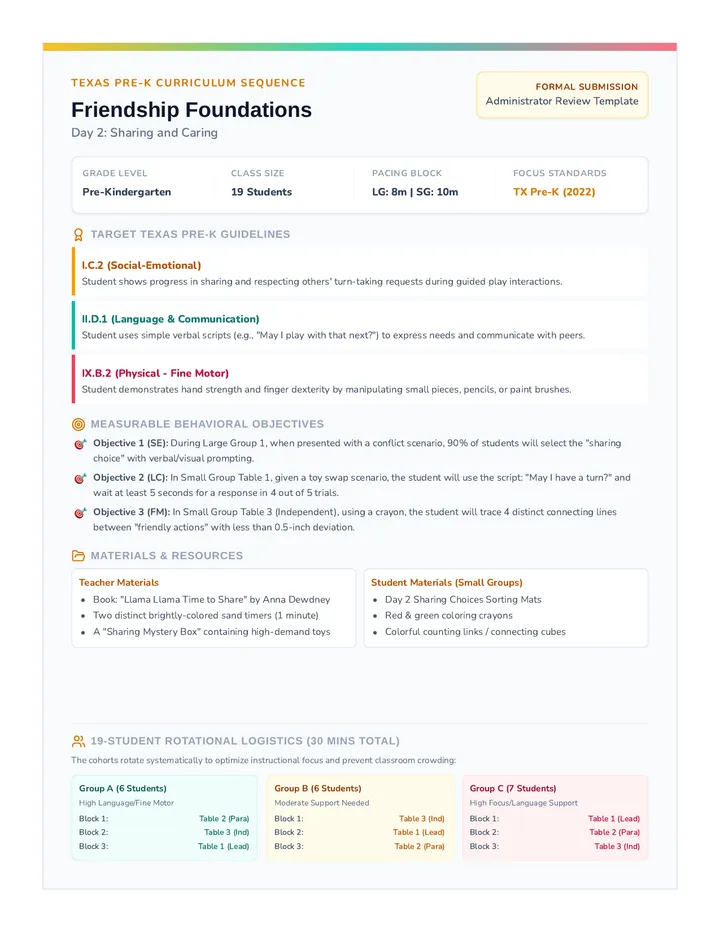
Hook & Launch: Gather students in a circle. Hold up the "Sharing Mystery Box." Inside is a highly desirable red firetruck. Read "Llama Llama Time to Share". Procedure: Act out a conflict using two hand puppets (Puppet A grabs the truck, Puppet B cries). Stop and ask: "What can Puppet B say?" Teach the verbal sharing script: "May I have a turn when you are finished?" Have the class echo the script together three times with expressive hand gestures.
Large Group 2: The Hot Potato Share-Pass 8 Minutes
Hook & Launch: Turn on a cheerful class background tune. Introduce the "Hot Potato" passing rules. Procedure: Pass a soft ball around the circle. When the music pauses, the child holding the ball must make eye contact with a peer, say their name, and pass the ball saying, "Here is a turn for you!" The peer must reply, "Thank you, friend!" Teach and monitor the eye contact.
Small Group Rotation Tables (10 Mins Each)
Table 1 [Teacher-Led]: Sand Timer Toy Exchange Roleplay Teacher Directed
Objective: Practice wait times and verbal scripts with tactile aids (sand timers). Process: Distribute one cool toy to student A. Student B must use the verbal script to ask for a turn. Once requested, student A flips a 1-minute blue sand timer. Student B waits patiently while watching the sand fall. Swap and repeat.
Table 2 [Co-Teacher/Para-Led]: Fine Motor Sharing Chain Para-Professional
Objective: Practice physical peer cooperation and finger-linking fine motor skills. Process: Students work in pairs to construct a continuous link of colorful connecting cubes or chains. Students must alternate colors and explicitly "pass" each piece to their partner to snap together, practicing fine motor strength and cooperative sharing.
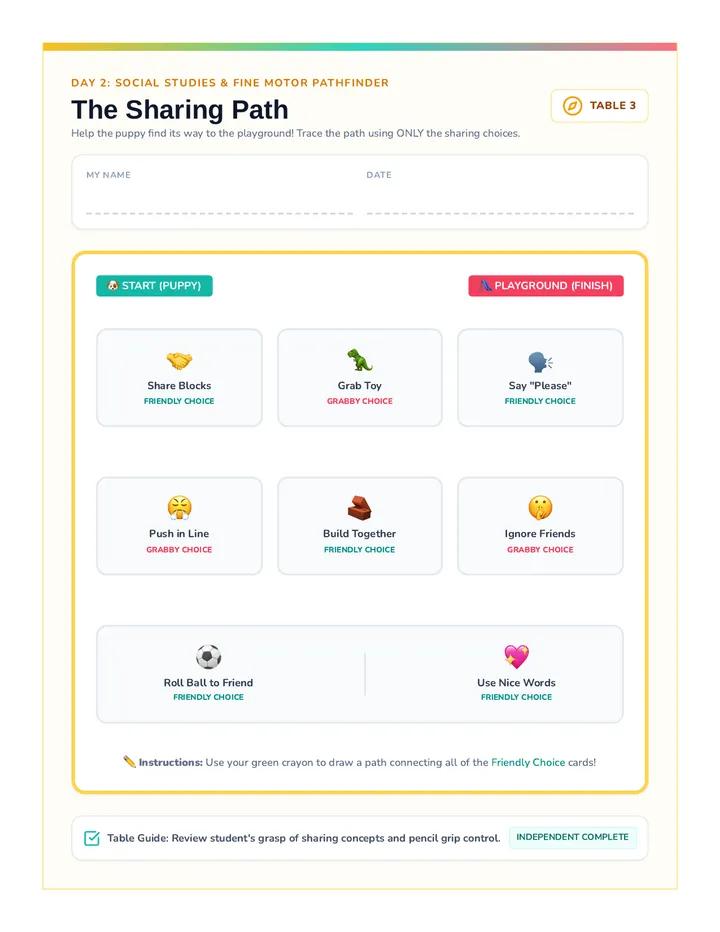
Table 3 [Independent]: Sharing Choices Pathfinder Mat Student Led
Objective: Independently identify friendly/sharing choices vs unfriendly behaviors. Process: Distribute Day 2 Pathfinder Workmats. Students look at pictures of happy/cooperating children vs children arguing. They use their crayons to trace friendly paths and color green/red borders around options.
Differentiation Strategies
ELLs: Provide a visual script card with icons for "May I" (hand out), "play" (blocks), and "please" (heart). High-Support: Use physical hand-over-hand prompting to help children snap linking cubes together at Table 2.
Assessment & Accountability
Observational Recording: Teacher and Para track whether students grab toys or use verbal negotiation scripts during the small group sessions, marking "Independent", "Prompted", or "Not Yet".
Instructional Procedures & Chronology
Day 3: Comprehensive Lesson Breakdown
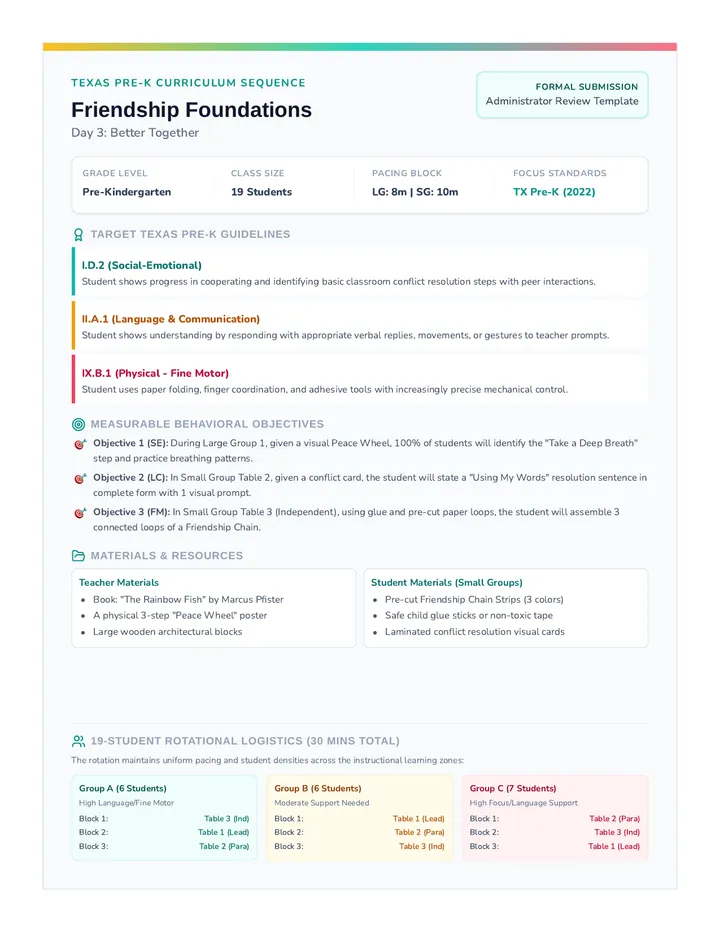
Total Instructional Time: 46m
Large Group Instruction (Whole Group rug)
Large Group 1: The Peace Wheel Launch 8 Minutes
Hook & Launch: Gather students. Hold up the "Peace Wheel" poster. Read a selective page from "The Rainbow Fish" highlighting sharing struggles. Procedure: Introduce the 3 peace steps: 1. 💨 Stop & Breathe, 2. 💬 Use Kind Words ("I feel sad when you take that"), 3. 🤝 Solve (Trade or Share). Lead students in breathing out slow deep breaths. Model this with a classmate.
Large Group 2: The Friendship Clasp Chant 8 Minutes
Hook & Launch: Gather students standing. Lead the body coordination chant: "High-five up high, clasp hands real low. Together we build, together we grow!" Procedure: Have students pair off on the rug and practice the coordinated movements: high-five, clasping hands, and giving a friendly nod, integrating gross motor, rhythm, and warm friendship greetings.
Small Group Rotation Tables (10 Mins Each)
Table 1 [Teacher-Led]: The Collaborative Block Bridge Teacher Directed
Objective: Collaborate on structural blocks and practice solving assembly disputes. Process: Challenge students to work as a team to construct a single block bridge spanning the center table. Encourage them to decide who places each block, prompting them to say: "May I put this block here?"
Objective: Apply the 3 conflict resolution steps to real sandbox-scenario cards. Process: Guide students in identifying emotions on conflict card faces. Prompt students to practice acting out a happy outcome, modeling the "Use Kind Words" verbal scripts using complete sentence formats.
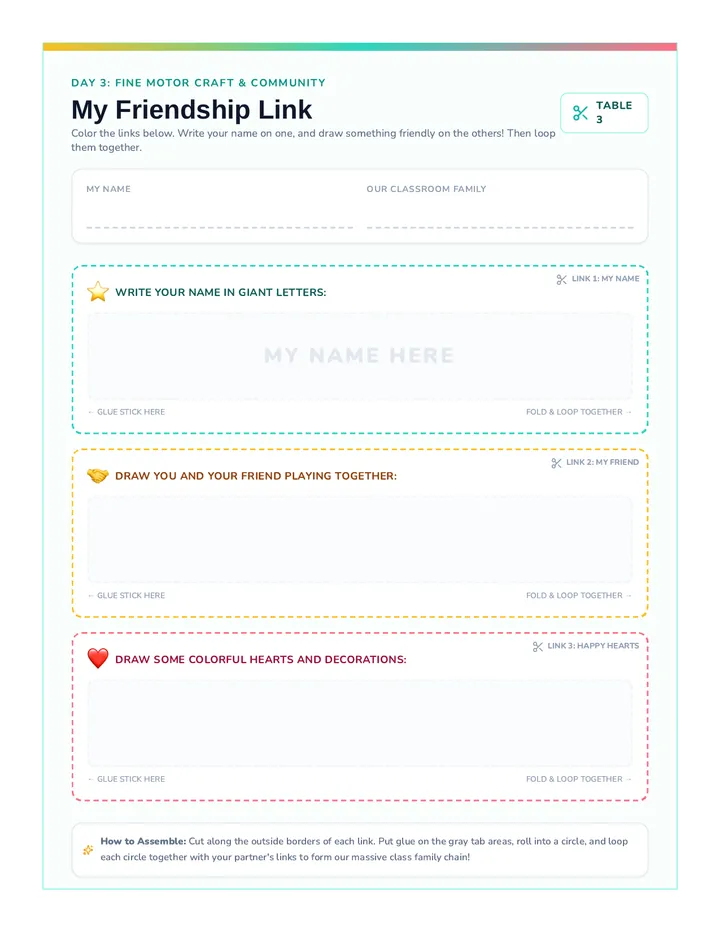
Table 3 [Independent]: The Friendship Chain Assembly Student Led
Objective: Practice fine motor coordination (wrapping paper, sticking tabs) in a team setting. Process: Provide pre-cut colorful friendship chain strips. Students loop strips, apply adhesive sticks, and interconnect chains with their adjacent partner, modeling fine motor control and building a combined classroom chain.
Differentiation Strategies
ELLs: Provide 1-step visual symbols for Peace Wheel stages (e.g., cloud for breathing). High-Support: At Table 3, use pre-taped sticky tabs so children do not struggle to apply glue sticks independently.
Assessment & Accountability
Log: Check completed student-formed paper chains for motor precision, note any recurring conflict during cooperative construction at the block table, and update social behavior reports.