A dynamic presentation deck introducing real estate definitions, distinguishing between real and personal property, exploring the four major types of real estate, and discussing its economic significance.
A comprehensive facilitation guide for the two-lesson sequence, providing instructional steps, key vocabulary, and teacher tips for delivery.
A set of printable desk cards and break area reminders for middle school students, reinforcing the 'Social Navigator' steps of anchoring and calm steering.
A comprehensive answer key and teacher guide for the "Spin Factor" sequence materials.
A summative assessment requiring students to evaluate real-world consumer scenarios based on external influences, advertising techniques, and consumer rights/responsibilities.
A presentation for Lesson 2 that covers consumer rights and responsibilities, the impact of social media, and how to identify when rights are being violated.
A worksheet for Lesson 1 where students identify persuasive techniques in political and commercial advertising and analyze their impact on consumer behavior.
An updated slide deck for Lesson 1 focused on consumer spending, exploring the psychological triggers and marketing tactics that lead to impulse purchases and status spending.
An adapted facilitator's guide for teaching students with language-based learning disabilities, focusing on visual scaffolding, chunking, and reduced text density. Includes the 5 hook types and the model essay. Now with increased font sizes.
A simplified exemplar essay with reduced language and clear visual markers, designed for students with language-based learning disabilities. Optimized to fit on a single page.
A simplified, high-visual slide deck for students with language-based learning disabilities, including the hook types, thesis formula, and a complete model essay. Now includes Day 2 instructions and fixed layouts.
A reflection and planning worksheet for middle school students to practice identifying physical triggers of anger and drafting calm alternative responses to "roasting" and social friction.
A 6-page social story booklet for middle schoolers, using a 'Social Navigator' theme and a roasting/teasing scenario to teach self-regulation and calm communication strategies.
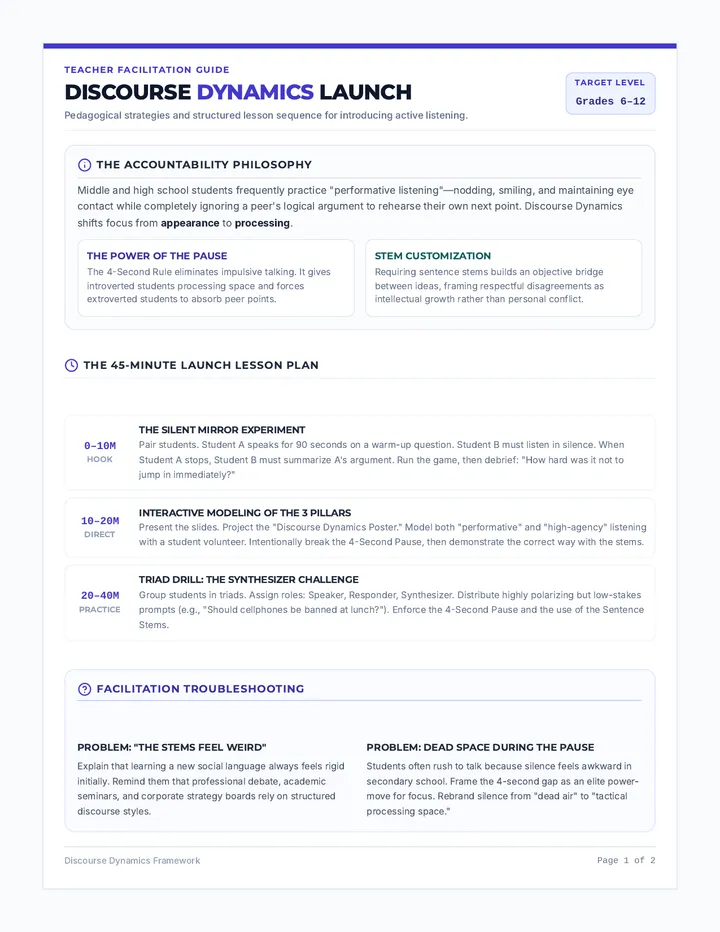
A teacher facilitation guide for using the Social Navigator materials, providing instructional strategies, pacing tips, and professional advice for managing middle school social-emotional learning.
An updated teacher-facing facilitation guide incorporating ADL principles on bias, identity, and the Pyramid of Hate into the restorative process.
An updated two-page reflective worksheet incorporating ADL principles, including prompts for identifying assumptions, community safety, and identity-based harm.
A set of four classroom scenarios for staff to practice applying restorative language and de-escalation strategies.
A visually engaging slide deck for staff training on restorative practices and de-escalation of big emotions.
A comprehensive staff training handout detailing the neuroscience of big emotions, the Three R's of regulation, and practical restorative language for school staff.
An updated teacher facilitation guide including artifact mapping and pacing for all 10 units of the Instructional Practices Scope and Sequence.
A planning worksheet for students to draft their Philosophy of Education and their long-term teacher certification pathway.
Expanded presentation slides for the Digital Legacy Portfolio, now highlighting the inclusion of all 10 units and providing updated artifact lists.
An updated comprehensive project guide and rubric for the end-of-year Digital Legacy Portfolio, now including all 10 units from the Scope and Sequence.
A teacher's facilitation guide for a restorative justice lesson, including learning objectives, step-by-step instructions, and a restorative questioning script.
A student reflection worksheet for identifying the impact of actions on others and developing a personalized cool-down plan to manage emotions.
A slide deck introducing restorative principles, specifically focusing on identifying impact versus intent and providing concrete cool-down strategies for self-regulation.
A teacher facilitation guide for the 'Thought Detective' lesson, providing instructional steps, example walkthroughs, and troubleshooting tips for the evidence for/against technique.
Visual instructional slides for the 'Thought Detective' lesson, introducing the difference between facts and opinions and the cross-examination process.
A student-facing journal worksheet designed as a 'Thought Investigation' to help students practice the evidence for/against CBT technique.
A teacher facilitation guide for the Goal Blueprint lesson, featuring a SMART goal breakdown, modeling examples, and discussion prompts for student success.
A blueprint-themed worksheet for students to draft academic and personal goals using the SMART framework, including specific sections for refining vague goals into actionable plans.
A teacher guide for facilitating the Weekly Momentum reflection. Revised to fit on a single page and improve content grouping.
A weekly reflection worksheet with a doodle-style aesthetic, focusing on social-emotional wins, stress management, and academic focus habits. Revised for layout and readability.
A teacher guide for facilitating the Weekly Momentum reflection, including timing, implementation steps, and discussion prompts.
A weekly reflection worksheet with a doodle-style aesthetic, focusing on social-emotional wins, stress management, and academic focus habits.
A set of four realistic scenario cards used for role-playing practice. Each card presents a common conflict with authority, identifies the "Fast Brain" impulse, and challenges the student to use a "Pivot Script".
A desk-top or pocket-sized reference guide containing specific scripts for students to use when accepting feedback, disagreeing respectfully, or needing emotional space.
A student self-reflection worksheet designed to identify personal triggers and practice rewriting impulsive "Fast Brain" reactions into calm, respectful "Pivot" responses.
A high-impact visual presentation explaining the physiological concept of the "Fast Brain" and the three-step "Pause and Pivot" strategy for managing impulsive reactions.