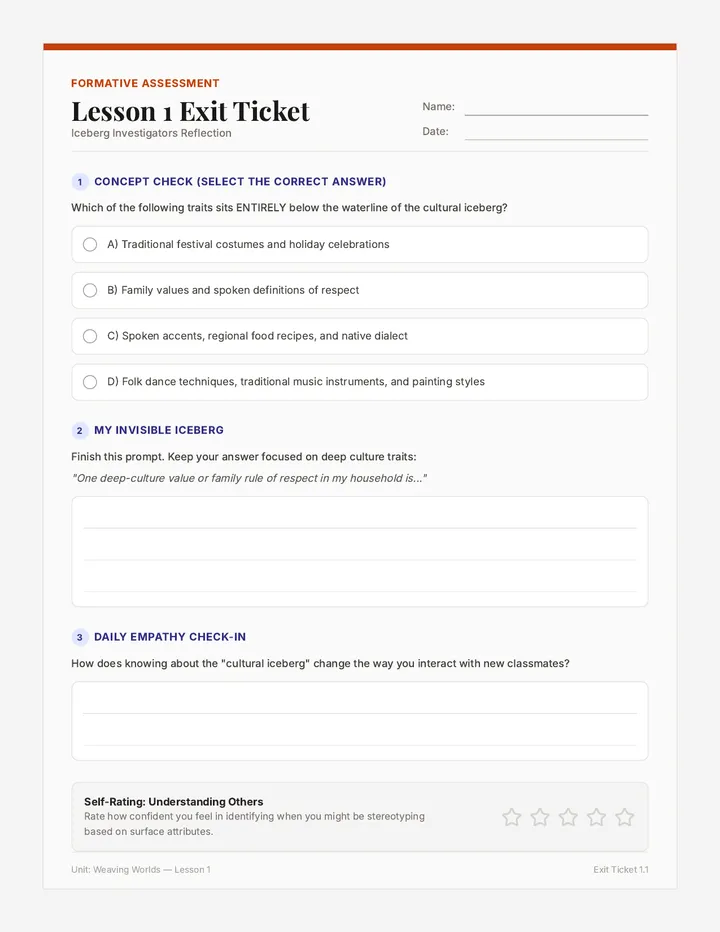
A set of exit tickets (three per page) for students to reflect on a key takeaway or a personal goal for practicing inclusivity after the lesson.
The answer key for the Pressure Points Quiz, providing correct answers and acceptable response criteria for short-answer questions. Revised to fit on a single page with improved formatting.
A 2-page quiz for the Pressure Points lesson, featuring multiple choice, true/false, and short answer questions covering key concepts and strategies. Revised for improved page breaks and contrast.
A teacher facilitation guide for the Pressure Points lesson, including a pacing guide, discussion prompts, and role-playing tips.
A 2-page student worksheet featuring self-assessment tools, refusal strategy scripts, brain science reflections, and real-world scenario analysis. Revised for improved spacing and student work area sizing.
A 12-slide modern presentation on peer pressure designed for middle and high school students, featuring high-contrast visuals, refusal strategies, and brain science explanations. Revised for better slide transitions and contrast.
A slide-by-slide script for teachers to use alongside the 'Quiet Heroes' presentation. It includes specific 'Teacher Actions' for modeling stealth behaviors and a playful, secret-agent themed script to keep students engaged.
A practical guide for teachers to deliver the 'Quiet Heroes' lesson. It includes the lesson objective, a 'hook' strategy, a step-by-step 15-20 minute flow, and classroom management tips for maintaining silence during testing weeks.
A student-facing activity sheet to reinforce quiet behaviors during testing. It includes a sound-identification task, a creative drawing space for students to visualize themselves as 'Quiet Heroes', and a short reflection on why respect is important.
A high-energy, 'Secret Agent' themed slide deck designed to teach 3rd and 4th graders why and how to be quiet during testing times. It covers specific behaviors for the hallway, bathroom, and classroom using clear, large visuals and engaging prompts.
A teacher guide for the 'Feeling Detectives' lesson. Includes lesson duration, learning objectives, read-aloud discussion prompts, and step-by-step activity instructions for the worksheet and slides.
A 6-slide presentation for first grade students to accompany the 'Feeling Detectives' lesson. Features interactive discussion prompts and visual 'case files' for Anger, Sadness, and Anxiety, illustrating both internal and external physical clues.
A two-page student worksheet designed for first graders to identify and record physical clues (facial expressions and body sensations) for four primary emotions. Features a detective-themed layout with drawing areas and checkbox clues.
A reflective counseling worksheet designed for students in grades 4-8 to help them understand the psychology of procrastination, identify their personal 'time thieves,' and apply practical strategies to get started on difficult tasks.
Updated Motivation Explorer worksheet now featuring a "Applying a Motivation Spark" section where students can choose a strategy from the handout to address a difficult task.
Updated lesson plan for Session 1 of Motivation Masters, now including a 10-minute segment dedicated to "Motivation Sparks" strategies and internal/external drivers.
Updated slide deck for Session 1 of Motivation Masters, now including a slide on "Motivation Sparks" strategies to help students jumpstart their drive.
A handout listing six practical strategies (Motivation Sparks) for students to increase their drive for school tasks, including setting tiny goals, environment changes, and social support.
A set of 4 visual anchor posters for the classroom, defining the 4 P's Performance Stack with high-impact icons and simplified 'clue' questions. Ideal for supporting non-native speakers with permanent visual references.
A visual flowchart 'Glitch Decoder' to help non-native speakers and all students quickly identify which tool from the 4 P's Performance Stack they need based on their current feelings or obstacles.
A guide for parents explaining the Mastery Mode framework. Revised to include specific "Home Clues" for each module and practical support strategies for parents. Theme updated to light mode.
A comprehensive facilitator's guide for Lesson 8 (Mastery Legacy), including skills briefing, pacing, and verbatim talk-tracks. Theme updated to light mode.
A comprehensive facilitator's guide for Lesson 7 (Habit Hacker), including skills briefing, pacing, and verbatim talk-tracks. Theme updated to light mode. Fixed page breaks.
A comprehensive facilitator's guide for Lesson 6 (Blocker Busters), including skills briefing, pacing, and verbatim talk-tracks. Theme updated to light mode.
A comprehensive facilitator's guide for Lesson 5 (Mindset Matrix), including skills briefing, pacing, and verbatim talk-tracks. Theme updated to light mode.
A comprehensive facilitator's guide for Lesson 4 (Performance Architecture), including skills briefing, pacing, and verbatim talk-tracks. Theme updated to light mode.
A comprehensive facilitator's guide for Lesson 3 (Purpose Drive), including skills briefing, pacing, and verbatim talk-tracks. Theme updated to light mode.
A comprehensive facilitator's guide for Lesson 2 (Passion Engine), including skills briefing, pacing, and verbatim talk-tracks. Theme updated to light mode.
A 'Mastery Glossary' handout for non-native speakers and students who need vocabulary support. Revised to include a 'My Translation' column for bilingual support. Added 'Usage Clues' to help students understand when to use each term.
A peer-review checklist to help teens give and receive feedback on their habit trackers and action plans. Focuses on the 'Micro-step' rule and clear triggers to ensure system effectiveness. Theme updated to light mode.