A visually-rich scavenger hunt checklist for office and vocational lab environments, featuring large icons and bold uppercase labels for literacy support.
A tri-fold style parent brochure providing an overview of the Mind Skills Pathfinders program, explaining the four pillars and the benefits of the Mind Mechanics approach for children. Revised for better panel spacing, text fitting, and contrast.
A comprehensive curriculum map for the 12-session Mind Skills Pathfinders Junior program, outlining the English mechanics and emotional regulation skills covered in each lesson. Revised for single-page fit.
A student workbook page for Lesson 1, featuring a 'Mind Machine' drawing space and a self-awareness 'Gear Gauge' to help children recognize their internal state and practice basic decoding. Revised for better page breaks, contrast, and corrected text content.
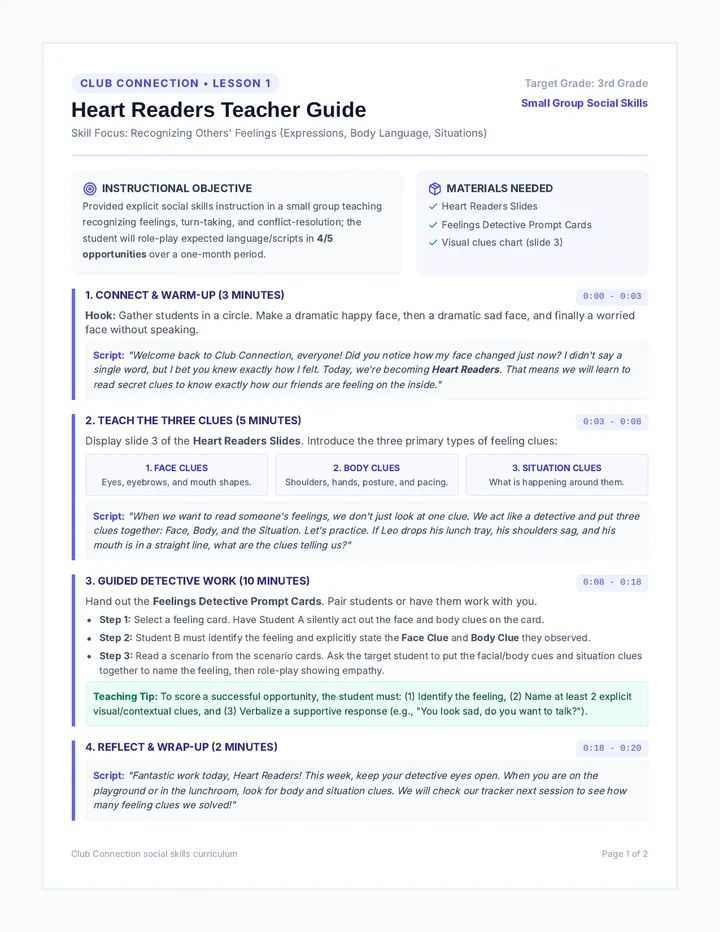
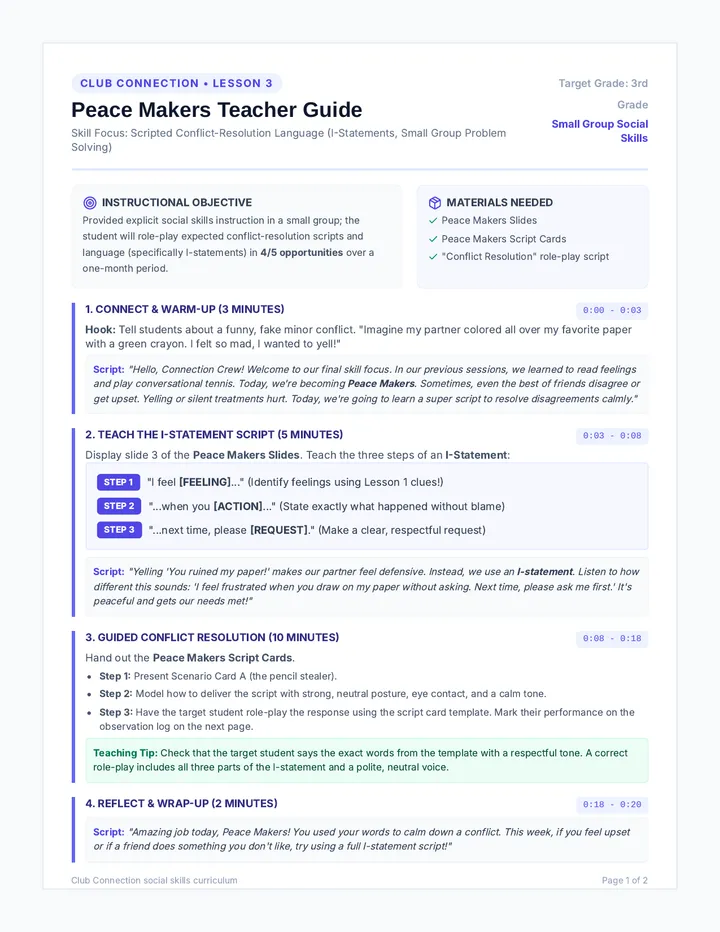
A detailed facilitator script for Lesson 1: Mission Launch, including time-coded sections, word-for-word prompts, and teaching strategies for introducing the Mind Mechanics framework to children aged 6-8. Revised for better page breaks and contrast.
A professional 1-page informational brochure for parents explaining the Mind Skills Pathfinders program, its methodology, and the benefits for different age groups.
A 2-page printable student workbook for Lesson 1: Brain Compass, including self-reflection activities and a home mission log.
Instructional presentation slides for Lesson 1: Brain Compass, introducing Mind Mechanics and the thinking directions for Junior students.
A detailed 2-page facilitator script for the first lesson of the Mind Skills Pathfinders Junior program, covering self-awareness, the mind mechanics concept, and the Brain Compass tool.
Facilitator script for Lesson 1 (Junior 6-8) of the Mind Mechanics program. Focuses on introducing brain "parts" using simple language, an ELL-friendly story review, and a basic grammar focus on prepositions "in" and "on." Includes Habit 1 integration.
Facilitator script for Lesson 12 of the Mind Mechanics program. Focuses on the final "Master Mechanic" certification ceremony, self-reflection using Habit 7 (Sharpen the Saw), and present perfect grammar review. Includes the Mechanic's Oath.
Visual anchor chart for Lesson 11, summarizing the "Master Workflow". Revised for single-page layout, addition of requested checkboxes, and fixed visual continuity for the connection line. High-contrast industrial design.
Puzzle-style student logbook sheet for Lesson 11. Includes an assembly flowchart integrating multiple "Mind Mechanic" tools (Reaction Engine, Coolant, POV, Choice), a grammar zone for sequence markers, and a Habit 6 reflection check. Industrial, heavy-duty design.
Facilitator script for Lesson 11 of the Mind Mechanics program. Focuses on integrating all previous skills into a final "Assembly Line" project. Includes sequence grammar, 60-minute breakdown, and Habit 6 integration.
Visual anchor chart for Lesson 10, outlining the "Choice Circuit" logic. Includes a flowchart for decision mapping and Habit 3 integration with checkboxes for student engagement. High-contrast electrical theme.
Puzzle-style student logbook sheet for Lesson 10. Includes a circuit mapping challenge to link choices to consequences, a grammar zone for conditionals (if/then), and a Habit 3 reflection check. High-contrast electrical theme.
Facilitator script for Lesson 10 of the Mind Mechanics program. Focuses on evaluating choices and consequences using the "Choice Circuit" metaphor. Includes tiered prompts, simple language for ELL, and Habit 3 integration.
Visual anchor chart for Lesson 9, illustrating "The Logic Loom" weaving process for solving "Why" and "How" questions. Includes requested checkboxes and high-contrast technical aesthetics.
Puzzle-style student logbook sheet for Lesson 9. Includes a thread-weaving investigation task matching evidence to schema, a grammar zone for causal connectors (because/since), and a Habit 2 reflection check. Theme-consistent with weaving/loom visuals.
Facilitator script for Lesson 9 of the Mind Mechanics program. Focuses on inferential reasoning and answering "Why" questions by "weaving" text evidence and personal knowledge (schema). Includes tiered prompts and Habit 2 integration.
Visual anchor chart for Lesson 8, illustrating the "POV Goggles" metaphor and providing the "Switch Protocol" for perspective-taking. Includes checkboxes for student engagement and high-contrast, professional "Mind Mechanic" aesthetics.
Puzzle-style student logbook sheet for Lesson 8. Includes a split-drawing perspective challenge, a grammar zone for contrast markers (but/however), and a Habit 4 (Think Win-Win) reflection audit. Theme-consistent with cyan/blue lens visuals.
Facilitator script for Lesson 8 of the Mind Mechanics program. Focuses on empathy and perspective through the "POV Goggles" metaphor. Includes tiered prompts for 6-14 year olds, simple language for ELL, and Habit 4 integration.
Visual anchor chart for Lesson 7, detailing "Social Frequencies" (Red, Yellow, Blue) and providing a step-by-step guide for scanning social signals with checkboxes for student engagement. High-contrast, technical "Mind Mechanic" aesthetics.
Puzzle-style student logbook sheet for Lesson 7. Includes a silent signal clue hunt, a social frequency scan activity, a grammar zone for descriptive signal translation, and a Habit 5 reflection check. Theme-consistent with radar and scanning visuals.
Facilitator script for Lesson 7 of the Mind Mechanics program. Focuses on identifying character emotions through non-verbal signals and body language. Includes tiered prompts, simple language for ELL, and Habit 5 integration.
Visual anchor chart for Lesson 6, showing the "Upgrade Station" process and how to reframe feedback as a positive "tool" for improvement. Includes requested checkboxes and high-contrast technical aesthetics.
Puzzle-style student logbook sheet for Lesson 6. Includes an upgrade log comparing old vs. new work, a grammar zone for comparative adjectives/contrast markers, and a Habit 6 (Synergize) reflection check. High-contrast orange theme.
Facilitator script for Lesson 6 of the Mind Mechanics program. Focuses on reframing feedback as "Toolbox Upgrades" and managing emotional reactions to suggestions. Includes 60-minute breakdown, tiered prompts, and Habit 6 integration.
Visual anchor chart for Lesson 4, defining "Personal Safety Gear" (Helmet, Goggles, Armor, Boots) and inspection protocols with checkboxes for student engagement. High-contrast, defensive green theme.
Puzzle-style student logbook sheet for Lesson 4. Includes a gear inventory task matching strengths to safety equipment, a grammar zone for character traits/reflexive pronouns, and a Habit 1 reflection check. Protective, high-contrast green theme.
Facilitator script for Lesson 4 of the Mind Mechanics program. Focuses on building self-esteem through "Safety Gear" (strengths) identification. Includes 60-minute breakdown, tiered prompts, and Habit 1 integration.
Puzzle-style student logbook sheet for Lesson 5. Includes a skill blueprint drawing area, a "NOT YET" stamp visual, a grammar zone for future tense/modals, and a Habit 4 (Think Win-Win) reflection check. Blueprint-themed design.
Facilitator script for Lesson 5 of the Mind Mechanics program. Introduces growth mindset through "The Growth Blueprint" and the power of "Yet." Includes a 60-minute breakdown, tiered prompts, and Habit 4 integration.
Visual anchor chart for Lesson 3, displaying "Coolant Systems" (Oxygen, Time-Out, Support, Hydration) and emergency procedures with checkboxes for student engagement. Arctic-themed, high-contrast professional design.
Puzzle-style student logbook sheet for Lesson 3. Includes a coolant toolkit inventory, a grammar zone for instruction writing (imperatives/adverbs/complex sentences), and a Habit 3 reflection check. Cool, arctic-themed design.
Facilitator script for Lesson 3 of the Mind Mechanics program. Focuses on "Coolant Systems" (calming strategies) through reading and a toolkit audit. Includes tiered age prompts and Habit 3 integration.
Visual anchor chart for Lesson 2, featuring the "Reaction Gauge" to help students identify emotional temperature zones (Blue, Orange, Red). Includes an engine inspection checklist and high-contrast, technical "Mind Mechanic" aesthetics.
Puzzle-style student logbook sheet for Lesson 2. Includes a circuit mapping challenge to link triggers to signals, a heat level visualization, a grammar zone for descriptive language/conditionals, and a Habit 2 integration reflection.
Facilitator script for Lesson 2 of the Mind Mechanics program. Focuses on identifying "Reaction Engine" triggers and signals through reading and a circuit-mapping activity. Includes tiered age prompts and Habit 2 integration.
Final student reflection logbook for Lesson 12, summarizing their learning journey and officially documenting their 'Master Mechanic' status. Revised for single-page layout, significantly larger writing areas (120px+), and fixed alignment for the signature and seal areas.
Final student reflection logbook for Lesson 12. Revised for single-page layout, significantly larger writing areas (120px+), and fixed alignment for the signature and seal areas.
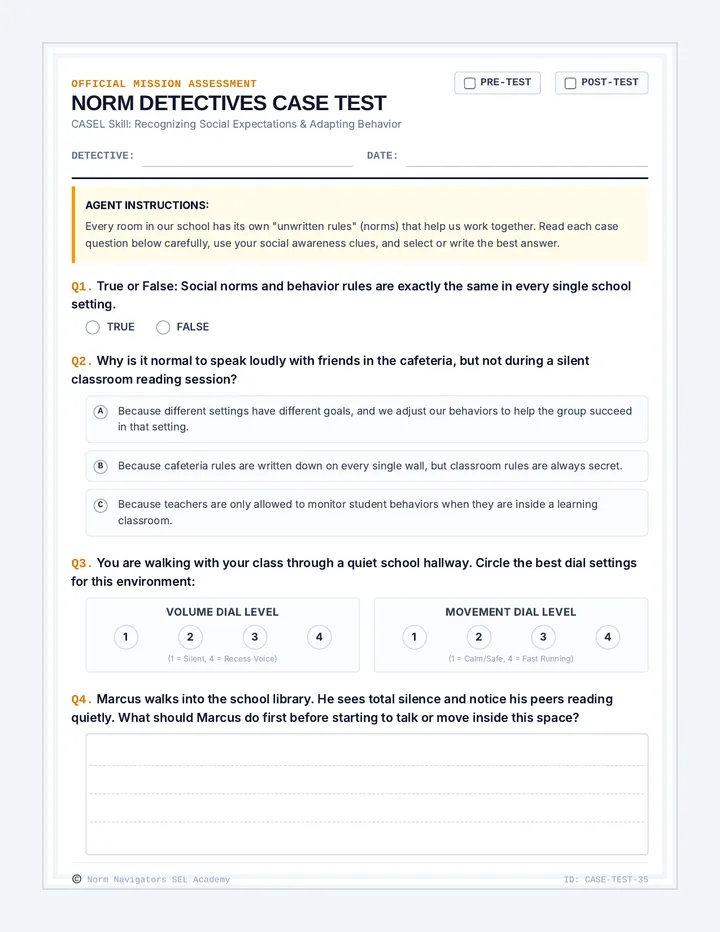
A student exit ticket to assess understanding of the difference between mean behavior and bullying. Optimized to fit on a single page with ample writing space.
A teacher guide for the 30-minute lesson, featuring pacing, materials, the 'RIP' test explanation, game answer key, and debriefing questions. High-contrast labels for teacher use.
A printable sorting game where students cut out scenario cards and place them into 'Just Mean' or 'Bullying' categories. Includes large evidence folders for gluing.
A 7-slide visual presentation for 2nd graders that defines 'mean' and 'bullying' using a 'Detective' theme and the RIP (Repeated, Intended, Power) acronym. Includes a practice case study.
Final student reflection logbook for Lesson 12, summarizing their learning journey and officially documenting their 'Master Mechanic' status.
Facilitator script for Lesson 3, introducing 'Coolant Systems'—calming strategies for handling stress and mistakes during learning.
The final 'Master Mechanic' certificate of completion. Revised for perfect single-page fit, improved text visibility for tools, and fixed signature area alignment.
Student workbook page for Lesson 11, the 'Assembly Line' project. Revised for single-page layout, increased contrast for zone titles, and improved identity field spacing.