Presentation for Lesson 3 on hierarchical outlining, focusing on using indentation to show the relationship between main ideas and supporting details.
A teacher facilitation guide for the 'Thought Detective' lesson, providing instructional steps, example walkthroughs, and troubleshooting tips for the evidence for/against technique.
Visual instructional slides for the 'Thought Detective' lesson, introducing the difference between facts and opinions and the cross-examination process.
A student-facing journal worksheet designed as a 'Thought Investigation' to help students practice the evidence for/against CBT technique.
A comprehensive teacher guide for facilitating the 'Signal Scanners' lesson. Includes a 30-minute pacing guide, key SEL vocabulary, discussion prompts tailored for 7th graders, and professional facilitation tips.
A creative, high-utility student worksheet for building a physical 'Signal Scanner' tool. It includes a cut-out scanner card and a signal strip for students to illustrate their emotional states and regulation strategies. Design is tech-inspired to appeal to 7th graders.
A high-energy, modern slide deck for a 30-minute SEL station or lesson. It uses the 'Window of Tolerance' framework (Overheated, The Zone, Shutdown) to help 7th graders identify emotional states and learn regulation strategies.
A teacher facilitation guide for the Goal Blueprint lesson, featuring a SMART goal breakdown, modeling examples, and discussion prompts for student success.
A blueprint-themed worksheet for students to draft academic and personal goals using the SMART framework, including specific sections for refining vague goals into actionable plans.
A teacher guide for facilitating the Weekly Momentum reflection. Revised to fit on a single page and improve content grouping.
A weekly reflection worksheet with a doodle-style aesthetic, focusing on social-emotional wins, stress management, and academic focus habits. Revised for layout and readability.
A teacher guide for facilitating the Weekly Momentum reflection, including timing, implementation steps, and discussion prompts.
A weekly reflection worksheet with a doodle-style aesthetic, focusing on social-emotional wins, stress management, and academic focus habits.
A teacher answer key for the 'Bridge Safety Quiz' assessment, providing correct answers and scoring criteria for the restorative apology framework.
A student assessment titled 'Bridge Safety Quiz' that tests understanding of the 4-part restorative apology framework and the ability to identify ineffective apologies.
A student worksheet titled 'Repair Project Planner' that helps middle schoolers plan a real-life restorative apology using the 4-part bridge framework.
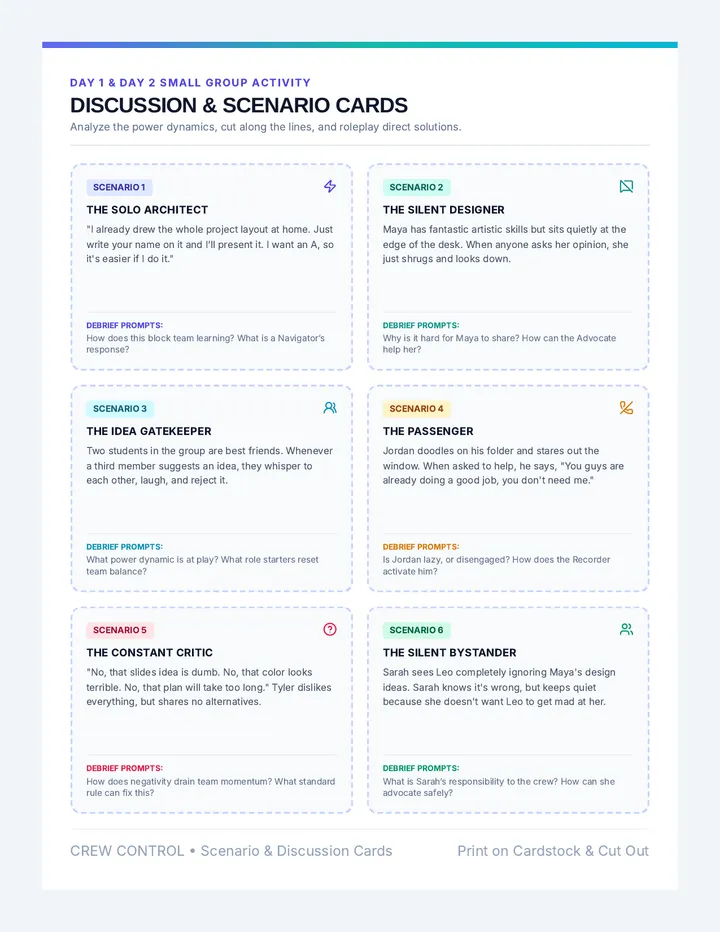
A set of scenario cards for a restorative dialogue activity, presenting common middle school social conflicts as 'broken bridges' that require structural repair.
A student worksheet titled 'Blueprint for Repair' that guides middle schoolers through deconstructing a weak apology and building a 4-part restorative apology for a real-life scenario.
A detailed facilitator script for the Restorative Bridge workshop, providing slide-by-slide narration and engagement prompts for teachers.
Visual presentation for the Restorative Bridge workshop, featuring the bridge metaphor, the 4-part apology framework, and practical examples of restorative dialogue.
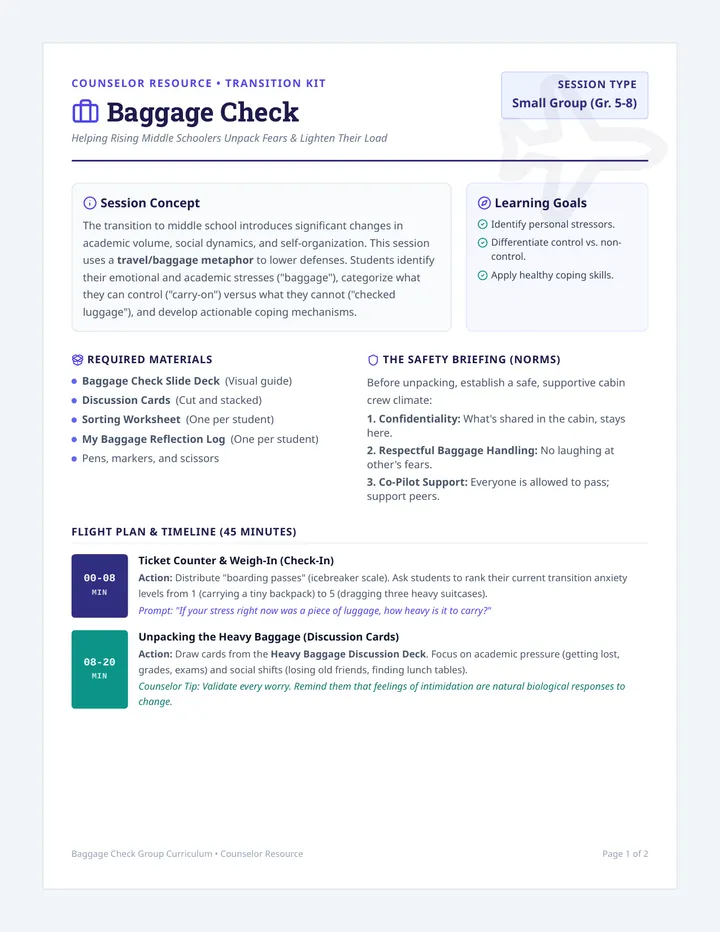
A comprehensive teacher's guide for the Restorative Bridge workshop, featuring learning objectives, a 4-part framework, and a step-by-step facilitation guide.
Printable activity cards featuring realistic middle school conflict scenarios, categorized by type, to be used for restorative dialogue practice.
A student worksheet designed to guide learners through drafting a restorative apology using the '4 Pillars' framework, including a peer-feedback 'Bridge Test' section.
A facilitation script for teachers to demonstrate the difference between shallow and restorative apologies through roleplay and guided discussion prompts.
A visual presentation for middle school students exploring the '4 Pillars of Repair' in restorative justice, moving from shallow apologies to meaningful restitution.
Comprehensive teacher lesson plan for 'The Restorative Bridge' workshop, featuring learning objectives, a detailed pacing guide, and pedagogical tips for middle school social-emotional learning.
A set of four realistic scenario cards used for role-playing practice. Each card presents a common conflict with authority, identifies the "Fast Brain" impulse, and challenges the student to use a "Pivot Script".
A desk-top or pocket-sized reference guide containing specific scripts for students to use when accepting feedback, disagreeing respectfully, or needing emotional space.
A student self-reflection worksheet designed to identify personal triggers and practice rewriting impulsive "Fast Brain" reactions into calm, respectful "Pivot" responses.
A high-impact visual presentation explaining the physiological concept of the "Fast Brain" and the three-step "Pause and Pivot" strategy for managing impulsive reactions.
A detailed facilitation guide for teachers to lead a 45-60 minute social skills lesson on impulsivity and conflict resolution. Includes hooks, modeling steps, and tips for handling student resistance.
A comprehensive guide for teachers to facilitate 'The Resilient Mind' lesson, including pacing, discussion prompts, and strategies for addressing common student misconceptions.
A scenario-based worksheet where students apply the P.I.V.O.T. technique to academic, social, and personal setbacks typical of the end of the school year.
A visually striking slide deck following a blueprint/engineering theme. It introduces neuroplasticity and teaches the P.I.V.O.T. technique for reframing end-of-year setbacks.
An informative reading passage using the metaphor of bridge engineering to explain neuroplasticity and cognitive flexibility to middle school students.
A blueprint-themed warm-up document where students assess their current stress levels and identify a specific 'obstacle' contributing to end-of-year burnout.
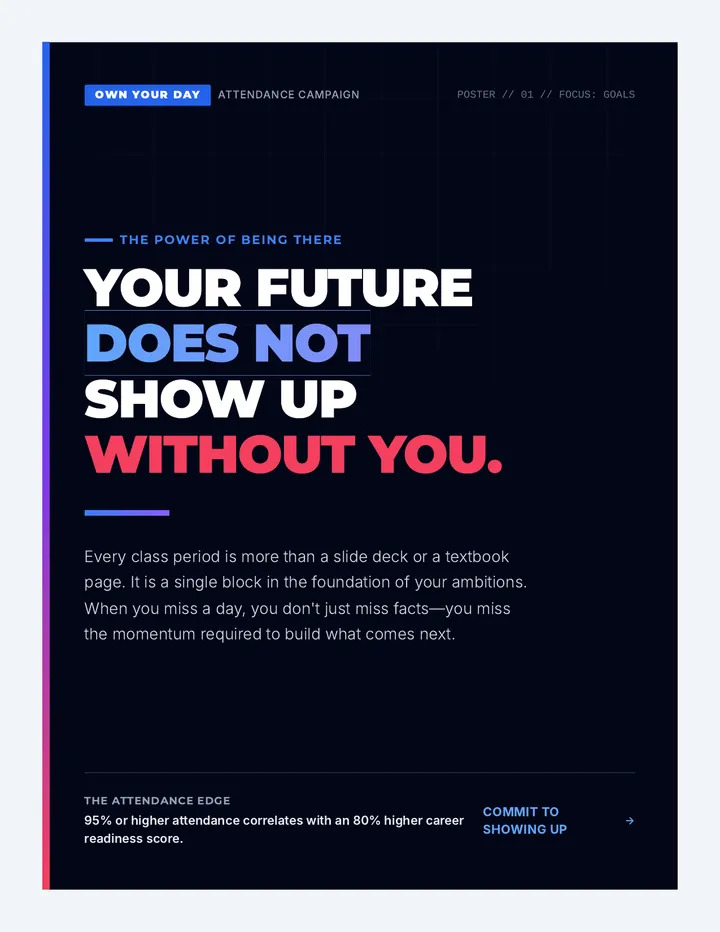
A bright, colorful incentive slide for a middle school attendance competition. It outlines two rounds of the contest and highlights the prize of a cupcake decorating lesson.
A printable student task sheet for ranking digital behaviors, updated with UCSD Chromebook Policy language on 'Ownership' and 'Monitoring' to emphasize professional agency. Improved typography and guide lines for student input.
Visual presentation for the Grade 8 Agency Experts lesson, updated with UCSD Chromebook Policy language regarding 'Equipment Ownership' and 'Monitoring' to promote professional agency. Improved contrast and visual hierarchy for classroom readiness.
Teacher lesson plan for Grade 8, focusing on digital agency and professional branding, updated to include UCSD Chromebook Policy language on 'Equipment Ownership' and 'Monitoring'. Includes instructional pacing and page-break protection.
A printable student task sheet for analyzing classroom tasks and gear shifts, updated to include explicit connections to the UCSD Chromebook Policy.
Visual presentation for the Grade 7 Switch Gears lesson, updated with references to the UCSD Chromebook Handbook's 'Educational Purpose' rule. Polished typography and spacing for high-impact classroom presentation.
Teacher lesson plan for Grade 7, focusing on 'Switching Gears' between digital modes, updated to align with UCSD Chromebook Policy Part One and Three. Includes page-break protection for discussion prompts.
A printable student task sheet for mapping out digital accountability goals, updated with a specific reference to UCSD Chromebook Policy Rule #1.
Visual presentation for the Grade 6 Attention Map lesson, updated with explicit references to the UCSD Chromebook Policy Rule #1 regarding 'educational purposes'. Polished typography and visual contrast for classroom clarity.