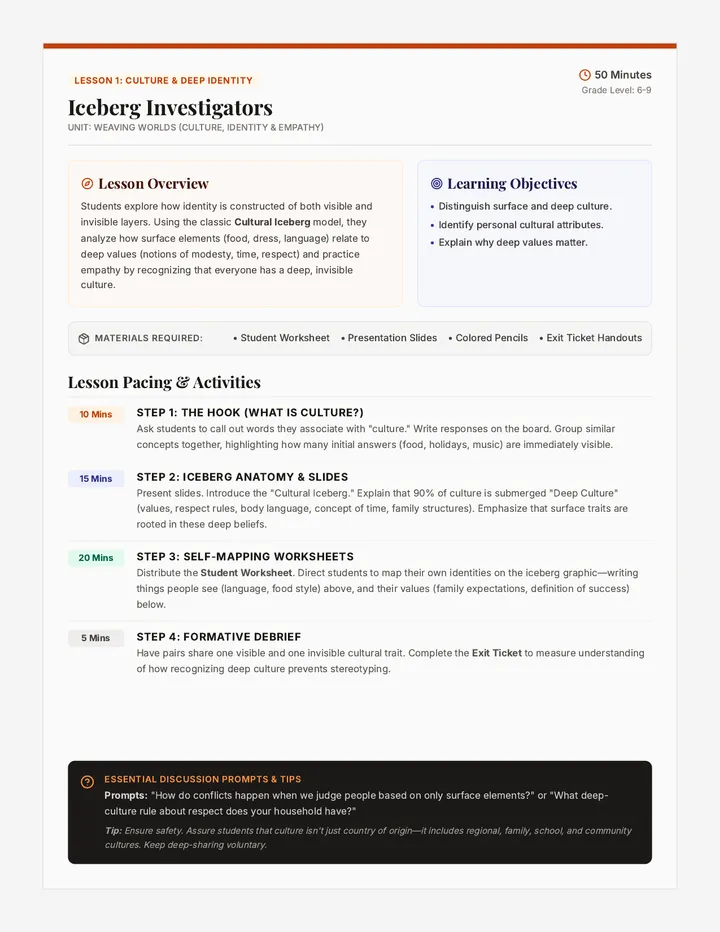
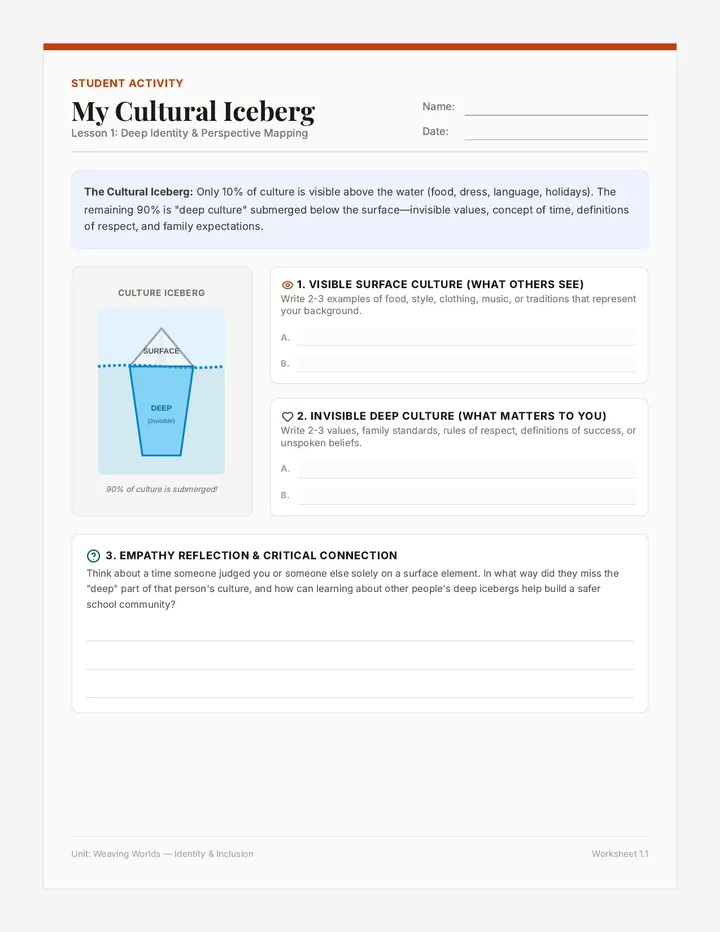
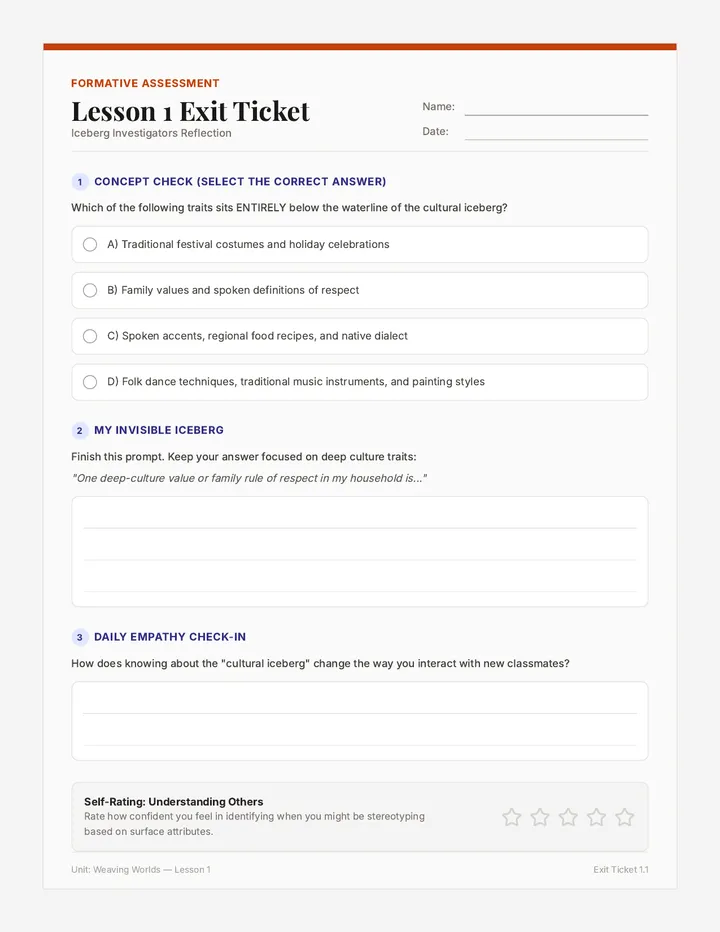
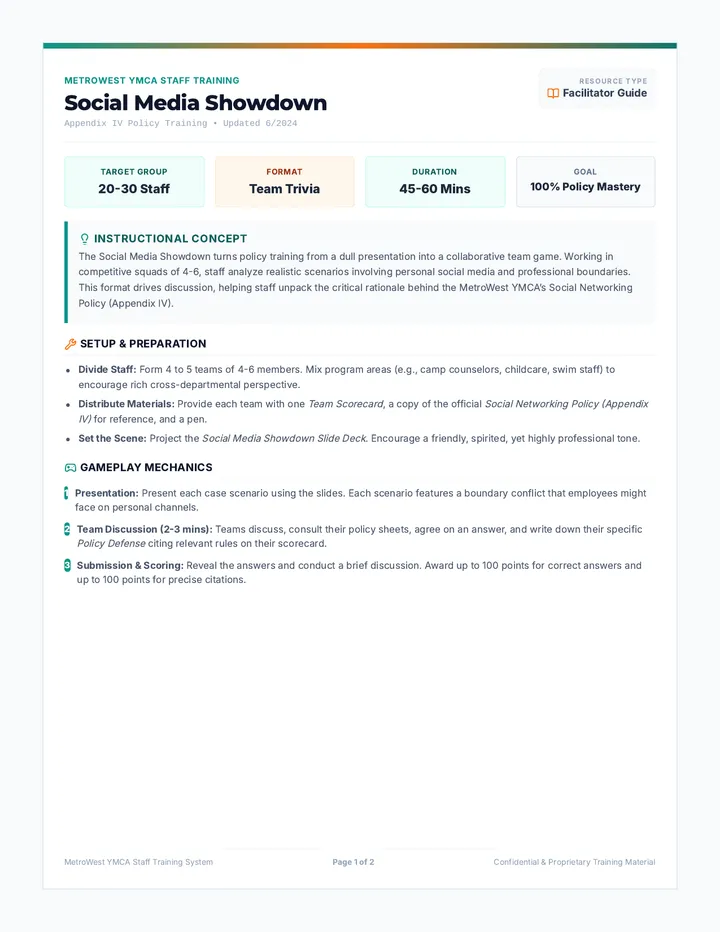
Worksheet for students to draw a snapshot of their 'Brain Movie' after visualizing a 2-step instruction, reinforcing the connection between mental imagery and physical action.
A tri-fold style parent brochure providing an overview of the Mind Skills Pathfinders program, explaining the four pillars and the benefits of the Mind Mechanics approach for children. Revised for better panel spacing, text fitting, and contrast.
A comprehensive curriculum map for the 12-session Mind Skills Pathfinders Junior program, outlining the English mechanics and emotional regulation skills covered in each lesson. Revised for single-page fit.
A student workbook page for Lesson 1, featuring a 'Mind Machine' drawing space and a self-awareness 'Gear Gauge' to help children recognize their internal state and practice basic decoding. Revised for better page breaks, contrast, and corrected text content.
A detailed facilitator script for Lesson 1: Mission Launch, including time-coded sections, word-for-word prompts, and teaching strategies for introducing the Mind Mechanics framework to children aged 6-8. Revised for better page breaks and contrast.
A professional 1-page informational brochure for parents explaining the Mind Skills Pathfinders program, its methodology, and the benefits for different age groups.
A 2-page printable student workbook for Lesson 1: Brain Compass, including self-reflection activities and a home mission log.
Instructional presentation slides for Lesson 1: Brain Compass, introducing Mind Mechanics and the thinking directions for Junior students.
A detailed 2-page facilitator script for the first lesson of the Mind Skills Pathfinders Junior program, covering self-awareness, the mind mechanics concept, and the Brain Compass tool.
A teacher guide for the 'Feeling Detectives' lesson. Includes lesson duration, learning objectives, read-aloud discussion prompts, and step-by-step activity instructions for the worksheet and slides.
A 6-slide presentation for first grade students to accompany the 'Feeling Detectives' lesson. Features interactive discussion prompts and visual 'case files' for Anger, Sadness, and Anxiety, illustrating both internal and external physical clues.
A two-page student worksheet designed for first graders to identify and record physical clues (facial expressions and body sensations) for four primary emotions. Features a detective-themed layout with drawing areas and checkbox clues.
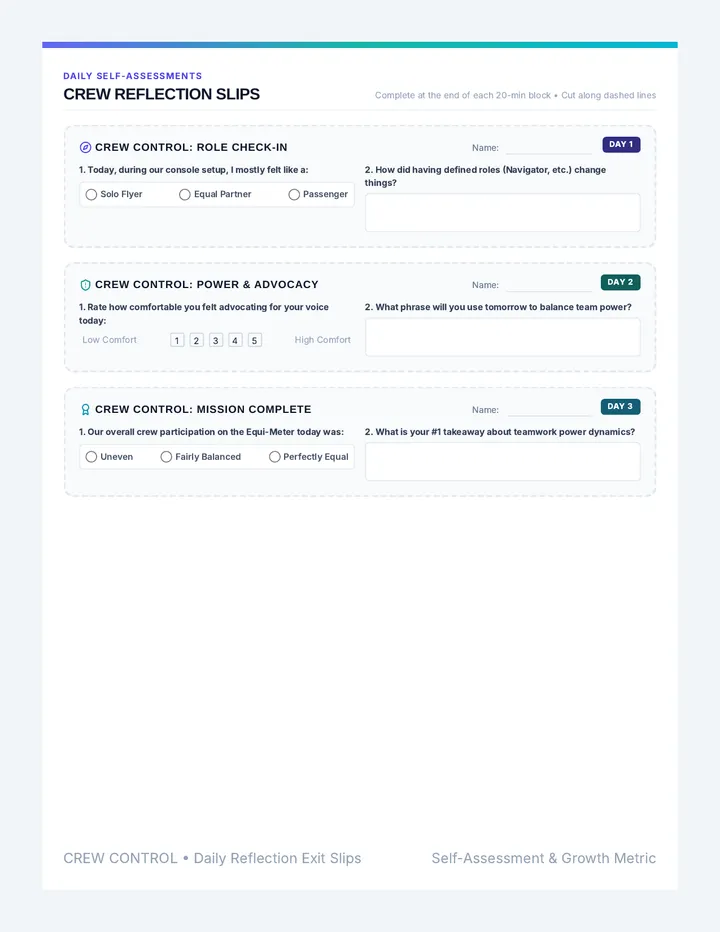
A printable 'Smooth Sailing' exit ticket that allows students to pick a focal 'cardinal point' for their daily kindness goals and commit to a specific action.
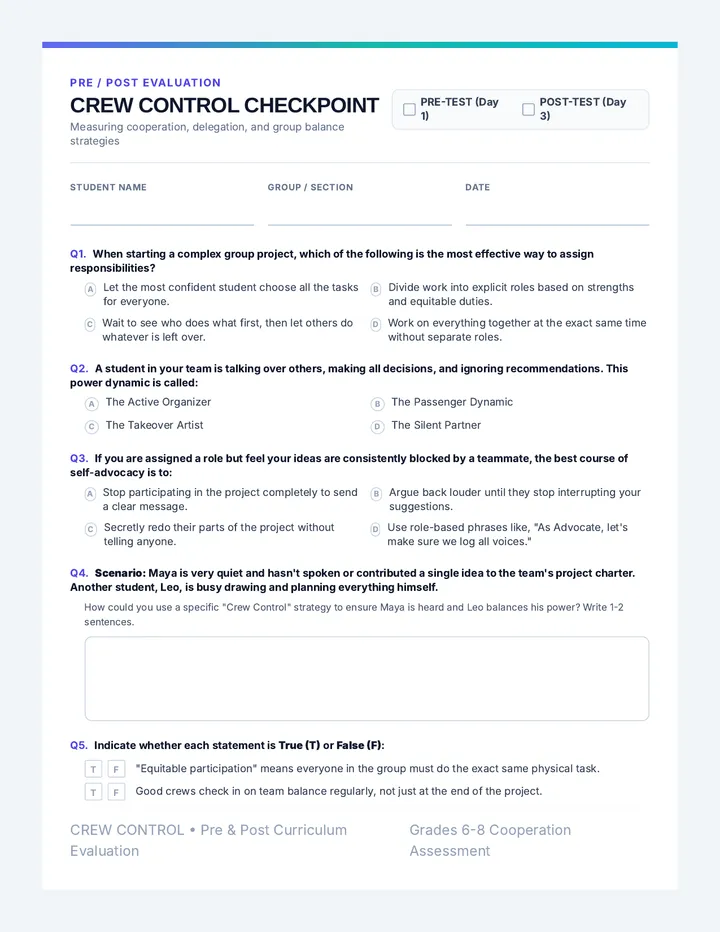
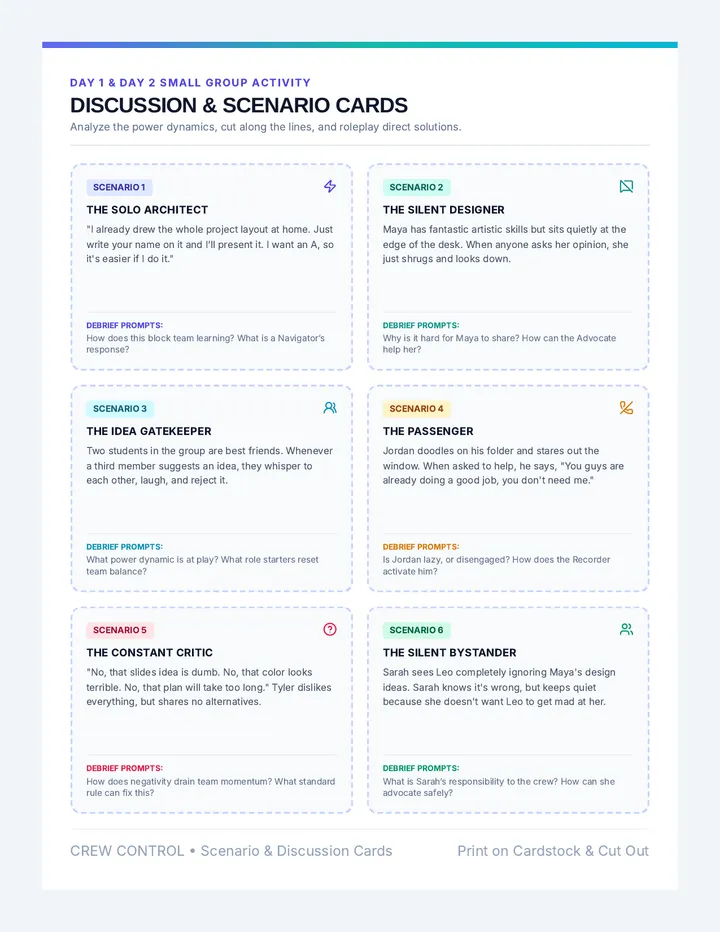
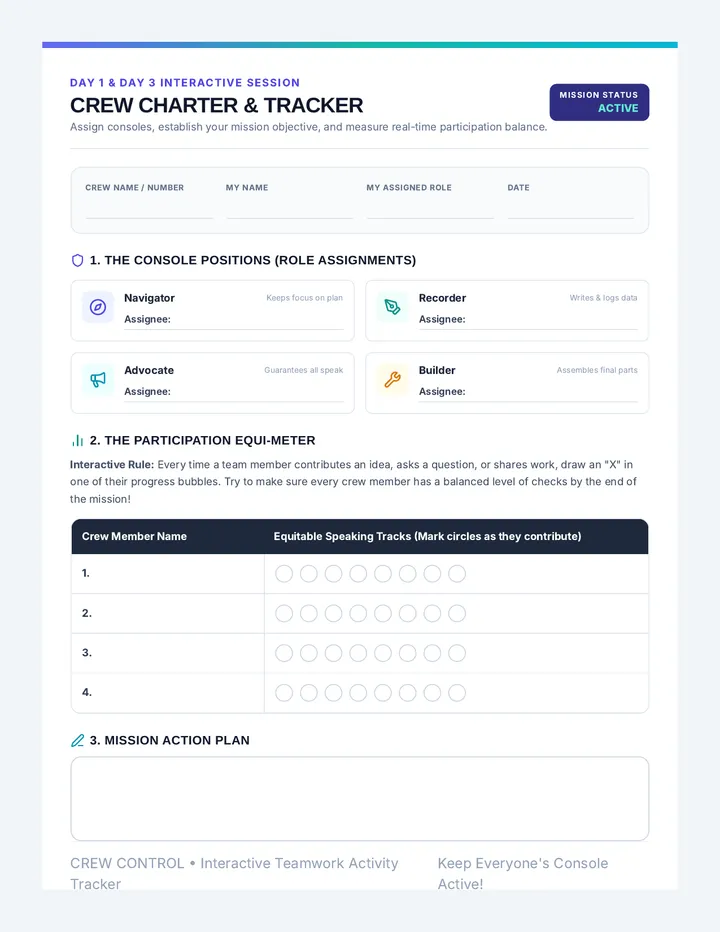
Four printable scenario cards designed to prompt small-group discussions where students apply the Connection Compass framework to real-world classroom situations.
A student-facing 'Compass Quest' worksheet designed for K-5 students to visualize and plan four specific acts of kindness and inclusion using the NSEW framework.
A visually engaging 16:9 slide deck for 'The Connection Compass' lesson, utilizing a nautical theme to teach the NSEW social-emotional framework with high-contrast text and clear examples.
A comprehensive teacher facilitation guide for 'The Connection Compass' lesson, featuring a clear NSEW framework for social-emotional navigation and a detailed 5-phase lesson sequence.
Instructions for an active learning game that modifies 'Red Light, Green Light' to help K-2 students practice physical responses to social non-verbal cues.
A student worksheet for K-2 children to practice identifying and drawing non-verbal social signals. Includes coloring, facial expression drawing, and simple choice-based assessment of social responses. Tightened layout ensures one-page printing.
A set of printable teacher-led scenario cards for K-2 students to practice identifying social traffic signals (Green, Yellow, Red) in various playground and lunchroom situations. Neutral styling ensures the answer is not given away. Tightened layout fits one page.
A visual presentation for K-2 students that introduces the traffic light metaphor for social cues. Features bright colors, large text (24px+), and clear iconography for Green, Yellow, and Red social signals.
A comprehensive facilitator's guide for the Social Signal Light lesson, including objectives, materials, and a step-by-step instructional sequence designed for K-2 educators.
Consolidated teacher answer key for Missions 03, 06, 11, and 12. Provides solutions for adjective identification, emotion reading, and detailed reasoning for boundary scenarios. Revised for 12px font legibility and expanded logic context.
Learner workbook for Mission 10: Resource River. Features a need vs. want sorting activity and financial decision scenarios (Mum, Stranger, Friend). Revised for content completeness, handwriting space, and layout stability.
Learner workbook for Mission 08: Decision Bridge. Features "If/Then" logic practice across social situations (Dad, Friend, Stranger) and a multi-step problem-solving grid for exam stress. Revised for practice depth, handwriting space, and layout balance.
Learner workbook for Mission 05: Memory Map Meadow. Features word grouping for memory retention, and expanded scenarios involving parents, strangers, and exam stress. Revised for sorting space, content balance, and single-page rendering.
Learner workbook for Mission 04: Steady Breath Basecamp. Features a fear vs. panic matching activity, safety scenarios (Stranger, Friend, Mum), and 5-4-3-2-1 grounding practice. Revised for content completeness and page balance.
Learner workbook for Mission 03: Confidence Summit. Features adjective circling, the Power of Yet, and social boundary scenarios (Dad, Stranger, Friend). Revised for content completeness, darker handwriting lines, and single-page layout.
Learner workbook for Mission 10: Resource River. Features a need vs. want sorting activity and a financial decision scenario involving safe boundary choices with parents. Revised for content completeness, handwriting space, and layout stability.
Learner workbook for Mission 08: Decision Bridge. Features "If/Then" logic practice and a step-by-step problem-solving grid for managing exam-related panic. Revised for content completeness, handwriting space, and layout stability.
Learner workbook for Mission 05: Memory Map Meadow. Features word grouping for memory retention, a visual trail sketch area for detail recall, and a social decision scenario involving helpful memory tasks for parents. Revised for content completeness, handwriting space, and layout stability.
Learner workbook for Mission 04: Steady Breath Basecamp. Features a fear vs. panic matching activity, the 5-4-3-2-1 grounding countdown, and a safety scenario for setting boundaries with strangers. Revised for content completeness, handwriting space, and layout stability.
Learner workbook for Mission 03: Confidence Summit. Features adjective circling, reflective goal-setting on a "Summit Map," and a self-acceptance pledge. Revised for content completeness (Self-Acceptance, Confidence focus), handwriting space, and layout stability. No "ninja" references.
Learner workbook for Mission 07: Test Trek. Revised for better alignment, expanded scenarios (forgetting words, peer pressure to cheat), and managing exam stress. No "ninja" references. Fixed layout and rebalanced whitespace.
Learner workbook for Mission 02: Self-Control Canyon. Features social decision scenarios (Stranger, Dad, Friend) and the Pathfinder Pause sequencing task. Revised to include uniform styling for choices and corrected word tracking. No "ninja" references.
Facilitator script for Mission 11: Boundary Borders. Focuses on setting boundaries through scenario analysis (Strangers, Family, Friends, Self) and role-playing "Strong No" and "Brave Yes" responses. Revised for more scenario depth, teacher answer keys, and explicit SEL keywords.
Learner workbook for Mission 11: Boundary Borders. Condensed to a single page with expanded decision-making scenarios (Stranger, Dad, Friend, Mum) and vocabulary matching. Revised for contrast, handwriting space, and missing keyword integration. No pre-filled "NO!".
Teacher answer key for Mission 11: Boundary Borders. Provides specific solutions for the 4 decision-making scenarios (Stranger, Dad, Friend, Mum) and vocabulary definitions. Includes pedagogical guidance on the "Strong No."
Facilitator script for Mission 11: Boundary Borders. Focuses on setting boundaries through expanded scenario analysis (Strangers, Family, Friends, Self) and role-playing "Strong No" and "Brave Yes" responses. Revised for more scenario depth and teacher answer keys.
Learner workbook for Mission 11: Boundary Borders. Condensed to a single page with expanded decision-making scenarios (Stranger, Dad, Friend, Mum) and vocabulary matching. Revised for contrast and additional practice.
Learner workbook for Mission 09: Resilience Ridge. Features a "Beautiful Oops" drawing canvas, a "Data Collection" reflection area for learning from mistakes, and vocabulary definitions. Revised to emphasize failure as data and include vocabulary matching. No "ninja" references.
Facilitator script for Mission 09: Resilience Ridge. Teaches students to reframe failure as "learning data" and practice cause-and-effect thinking. Revised to emphasize the concept of failure as a learning opportunity. No "ninja" references.
Learner workbook for Mission 11: Boundary Borders. Condensed to a single page with explicit scenario decision-making (Strangers, Family, Friends) and vocabulary matching. Revised for contrast, handwriting space, and missing keyword integration. No pre-filled "NO!".
Learner workbook for Mission 02: Self-Control Canyon. Revised to include uniform styling for choices, increased writing space for creative reflection, and the requested parent/stranger scenarios. No "ninja" references. No telegraphing answers with colors.
Facilitator script for Mission 02: Self-Control Canyon. Revised to remove "ninja" references, include full 60-minute duration, and add the requested social scenarios for parents and strangers. No self-referential draft notes.
Learner workbook for Mission 11: Boundary Borders. Condensed to a single page with explicit scenario decision-making (Strangers, Family, Friends) and vocabulary matching. Revised for contrast, handwriting space, and missing keyword integration.
Facilitator script for Mission 07: Test Trek. Revised for better spacing, full 60-minute duration, and removed "ninja" references. Includes core concepts of Self-Awareness, integrity scenarios with Mom/Dad/Friends, and Exam Stress.
Learner workbook for Mission 06: Empathy Echo. Features emotion detection based on body language clues and new "Yes/No" inclusion decision scenarios. Revised to remove pre-filled answers and fill the full page.
Learner workbook for Mission 02: Self-Control Canyon. Revised to include uniform styling for choices, increased writing space for creative reflection, and the requested parent/stranger scenarios. No "ninja" references.
Learner workbook for Mission 01: Persistence Trail. Features corrected vocabulary matching, increased font sizes for clues, and expanded writing areas for student goals. Revised to include exam stress scenarios and data-based reframing. No reference to "ninja" term.
A student-friendly completion certificate for the Pathfinders Program. Revised for clear handwriting space, darker signature lines, and centered content. Fits on a single page and includes keywords like Power of Yet, Self-Awareness, and Problem-Solving.