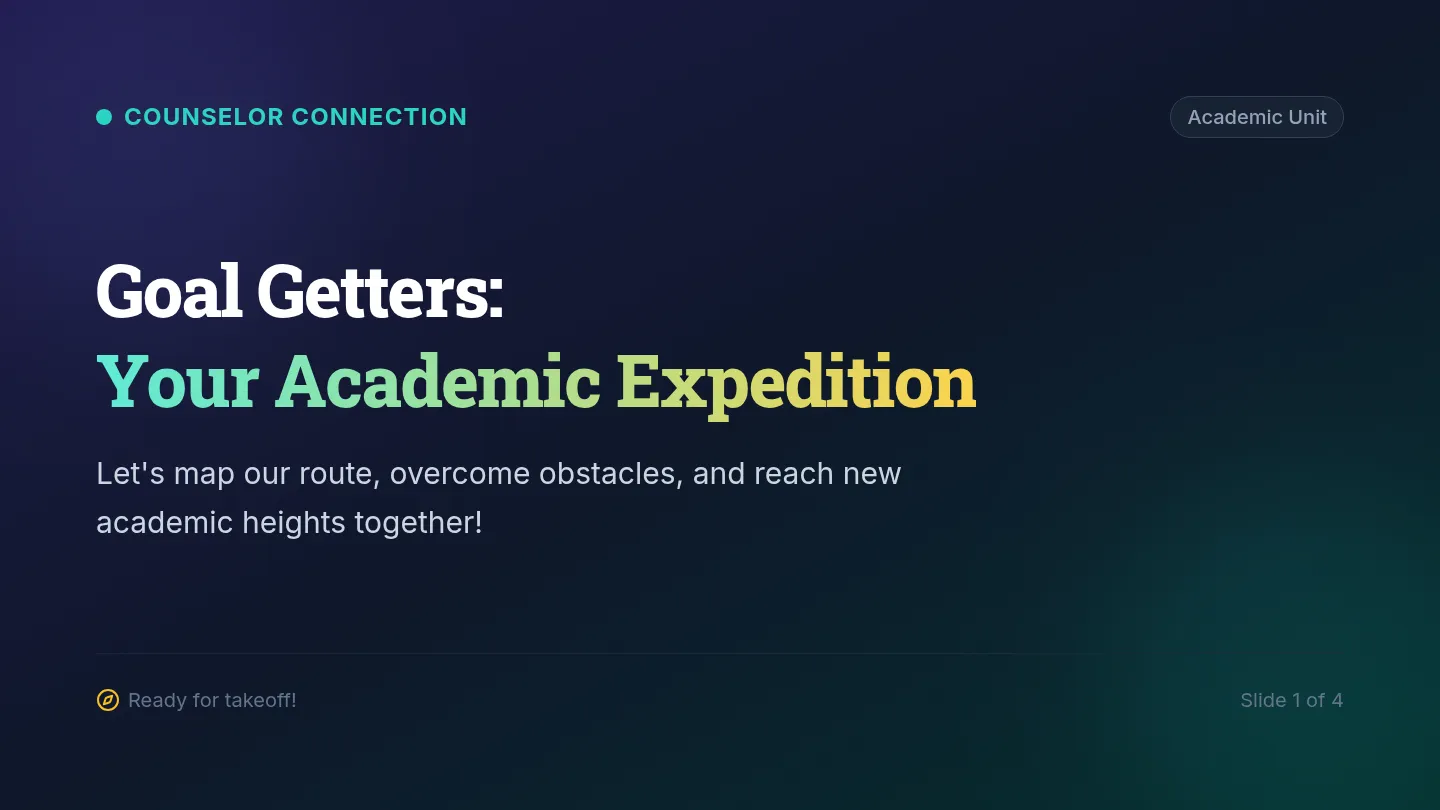
The Integrity Code Slides
The Integrity Code
Owning Your Work in a Digital World
6th Grade Academic Integrity
What is Academic Integrity?
"Integrity is doing the right thing, even when no one is looking."
In school, it means:
- Doing your own thinking
- Giving credit when you use others' ideas
- Being honest about what you know
When you learn with integrity, you build a brain that can solve real problems.
The Copy-Paste Trap
What is Plagiarism?
Taking someone else's work or ideas and passing them off as your own.
Copying text from a website
Downloading an image without credit
Using a friend's answer as your own
Why does it matter?
If you don't do the work, you don't get the "mental muscle" from the exercise. It's like someone else going to the gym for you—they get stronger, but you don't!
Quick Tip:
If you didn't think of it or write it yourself, you need to cite it!
Source Savvy
1
Quote It
Put "quotation marks" around words that aren't yours.
2
Name It
Tell us WHO wrote it and WHERE you found it.
3
Explain It
Say why this info helps your argument or point.
Example Cite:
According to National Geographic, "volcanoes can change the weather" (NationalGeographic.com).
The AI Frontier
Is using AI cheating?
AI tools like ChatGPT are powerful, but using them requires integrity.
Help with ideas or outlines (if allowed!)
Letting AI write your entire essay
Copying AI answers into a worksheet
The Golden Rule of AI:
Always ask your teacher before using AI for an assignment.
If you don't disclose it, you're claiming the AI's "brain" is yours. That's plagiarism!
The Homework Hustle
Copying is...
- Trading answers on the bus
- Sending a photo of your math page
- Dividing work: "I'll do 1-5, you do 6-10"
Learning is...
- Explaining a concept to a friend
- Reviewing notes together
- Everyone doing the work themselves first
The Test Test:
If you couldn't do the same problem on a test by yourself, the way you did it for homework probably wasn't "integrity-friendly."
Teamwork or Theft?
Collaborating
Building ideas together.
"Hey, how did you solve this problem? I'm stuck."
"I used the area formula. Remember, you have to find the height first!"
Copying
Stealing answers.
"Hey, can I see your worksheet for a second?"
"Sure, just don't make it look exactly like mine."
If one person does the thinking, it's copying.
If both people do the thinking, it's collaborating.
Scenario Sorter
Case #1:
"Leo is writing a report on sharks. He finds a cool paragraph on Wikipedia, changes three words, and puts it in his paper without a citation."
Plagiarism
Case #2:
"Maya and Sam are working on separate science labs. Maya shows Sam how to set up the graph, but they each plot their own data."
Collaboration
The Integrity Pledge
"I choose to be a creator, not a copier."
"I choose to build my brain, not just my grades."
"I choose integrity because my work is a reflection of ME."
Encryption Status: SECURE
The Integrity Code Challenge Worksheet
The Integrity Code
Academic Integrity Challenge
Name:
Date:
"Integrity is doing the right thing, even when no one is looking."
Part 1: The Code Breaker
Draw a line to match each term with its correct definition.
1. Plagiarism
2. Citation
3. AI Usage
4. Collaboration
Giving credit to the original creator of information.
Using computer programs to help with schoolwork.
Taking someone's work and passing it off as your own.
Working with others to build ideas and understand concepts.
Part 2: Truth Detector
Read each scenario. Decide if it shows Integrity or is Dishonest. Briefly explain why.
Scenario A: The Group Chat
"You forgot to do your math homework. Your friend sends a picture of their completed worksheet to the group chat so you can write down the answers before class starts."
INTEGRITY
DISHONEST
Explain why:
Scenario B: The AI Research
"You are writing a report on Mars. You use ChatGPT to help you come up with five interesting sub-topics to research, but you write all the paragraphs yourself."
INTEGRITY
DISHONEST
Explain why:
Part 3: Master the Cite
Rewrite the following information using quotation marks and a citation.
Source Information:
Article Title: The Secrets of the Deep Sea
Website: OceanExplorer.edu
Fact: Giant squids have eyes the size of basketballs.
The Integrity Pledge
"I understand that academic integrity is about more than just grades. It's about respecting my teachers, my classmates, and myself. I promise to do my own work and give credit to others when it's due."
Signed:
The Integrity Code Teacher Guide
The Integrity Code
Teacher Facilitation Guide
Target Grade
6th Grade
Learning Objectives
- Define academic integrity and its importance in the learning process.
- Identify and differentiate between plagiarism, collaboration, and copying.
- Apply ethical decision-making to AI usage (ChatGPT) and peer interactions.
Materials Needed
- "The Integrity Code" Slides
- "Code Challenge" Worksheet
- Pens/Pencils
Instructional Guide
Slides 1-2: Hook & Definitions
Start with the definition of integrity. Ask: "Why does it matter if we do our own work?"
Key Discussion Prompt:
"If a professional athlete had someone else do all their training for them, would they still be good at their sport?"
Slides 3-4: Plagiarism & Citing
Focus on the 'mental muscle' metaphor. Explain that plagiarism is 'brain-theft'.
Common Pitfall: 6th graders often think changing 1-2 words makes it "their own." Emphasize that the idea must be cited if it isn't common knowledge.
Activity: Have students practice the "Quote, Name, Explain" method out loud using a simple fact (e.g., "The sky is blue").
Slide 5: The AI Frontier
AI is the new gray area. Be explicit about your specific classroom policy here.
- Analogy: AI is like a calculator. It helps with math, but you still need to know how to add and subtract. If you don't know the basics, the calculator is just a crutch.
- Action: Tell students they must *always* ask before using AI, and if they do use it, they must cite it like any other source.
Slides 6-7: Collaboration vs. Copying
This is where most 6th-grade honesty issues occur (social copying).
Look for:
Talking, explaining, pointing to notes, different wording on papers.
Watch out for:
Silence, looking at screens/papers, identical mistakes, handing over a worksheet.
Worksheet Answer Key
Part 1: Match Key
- 1. Plagiarism → Taking someone's work...
- 2. Citation → Giving credit to the original...
- 3. AI Usage → Using computer programs...
- 4. Collaboration → Working with others to build...
Part 2: Truth Detector
Scenario A: Dishonest. Reason: The student is not doing the thinking; they are just copying answers to get the grade.