Feelings Respect Lesson Plan Spotting Feelings & Respect
Lesson Facilitation Guide
Duration
30 Minutes
Audience
Kindergarten
Goal
Emotional Literacy & Respect
The Why
Developing emotional literacy helps young children understand their own feelings and those of others, leading to better self-regulation and empathy. Learning about respect fosters positive social interactions and a harmonious classroom environment.
Prep & Materials
Whiteboard or projector
Spotting Feelings & Respect Slide Deck
Printouts of emotion spots (optional)
Drawing paper and crayons
Emotion Charades Cards
Learning Objective
Students will identify and name basic emotions (happy, sad, angry, calm) and understand the concept of showing respect to themselves and others.
Instructional Path
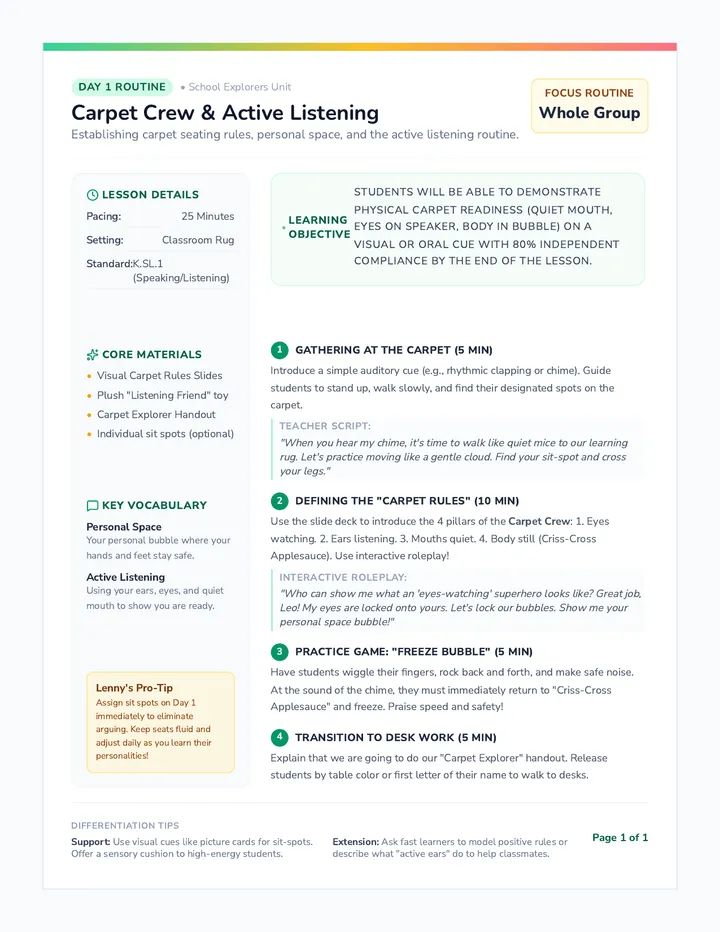
1
5 Min
Introduction: What Are Feelings?
Begin by asking students what feelings are. Use Slide 1 and Slide 2 to introduce the idea of 'spots' for emotions. Ask: "How do you feel right now?" and encourage a few students to share.
2
10 Min
Explore Emotion Spots
Introduce the Little Spot of Happiness, Sadness, Anger, and Calmness using Slides 3-6 .
Briefly describe each emotion.
Ask for examples of when they feel that emotion.
Make faces that show that emotion.
Emphasize that all feelings are okay .
3
8 Min
Meet the Spot of Respect
Transition using Slide 7 . Explain respect simply: "Treating others and ourselves kindly." Discuss Slide 8 regarding friends, teachers, and themselves.
Ask: "What does respect look like in our classroom?" (e.g., listening, sharing, kind words).
4
7 Min
Activity: Show Your Spot!
Engage students in a quick reflection. Ask them to name one emotion spot they feel often and one way they can show respect today. If time allows, have them draw their favorite spot or play Emotion Charades .
Feelings Respect Slide Deck Spotting Feelings & Respect
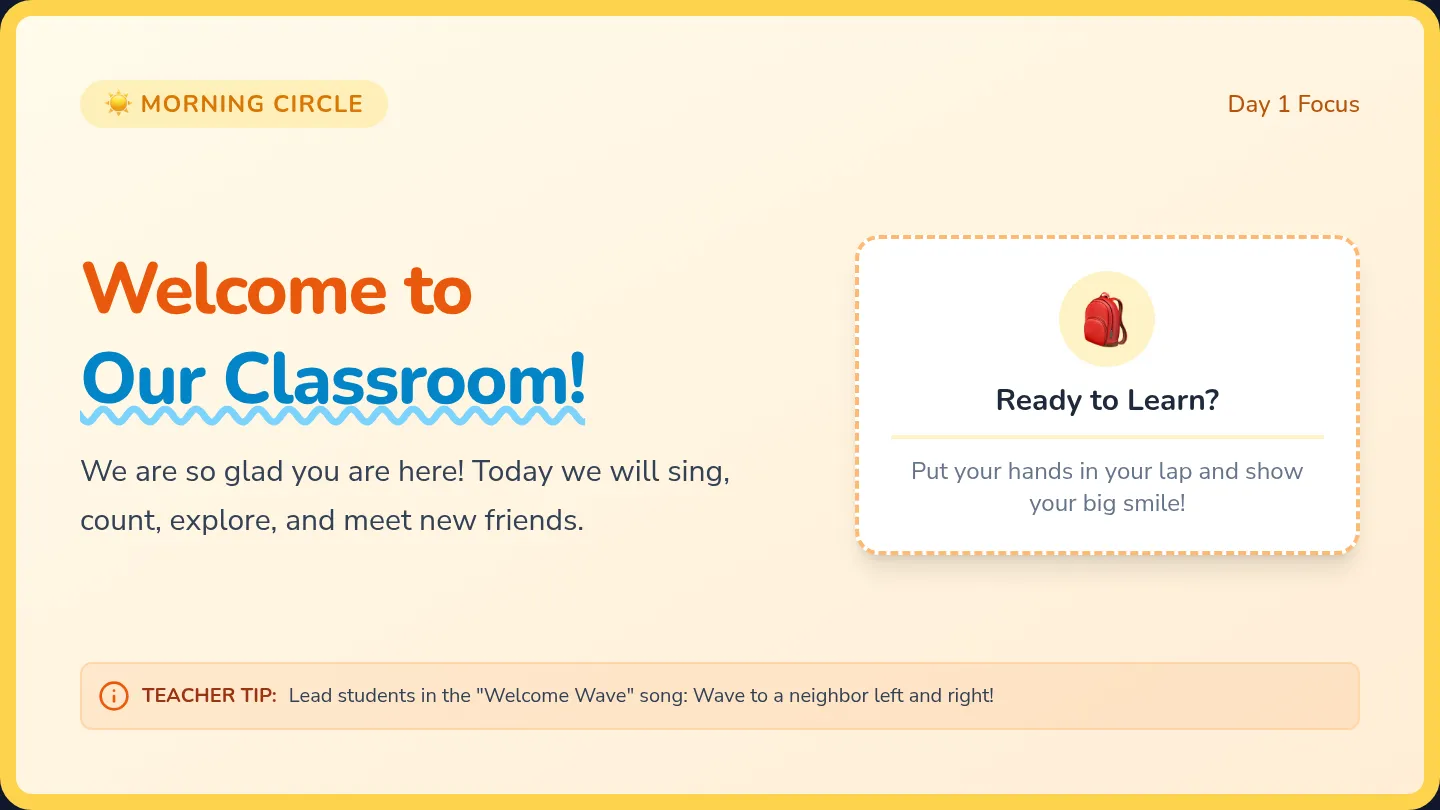
Let's explore our emotions and learn how to be kind!
Teacher Notes
Welcome students and introduce the exciting topic of feelings and respect. Ask them what they think 'feelings' are.
What Are Our Feeling Spots?
We all have different feelings inside us, like little colorful spots!
They help us understand ourselves and the world around us.
Teacher Notes
Explain that sometimes our feelings can feel like little 'spots' inside us. Everyone has them, and they can change!
😊
The Happy Spot!
This is our Happy Spot! It feels bright and bubbly.
When do you feel happy?
What does happiness look like?
Teacher Notes
Introduce the Happy Spot. Ask students what makes them feel happy and to show a happy face.
😔
The Sad Spot...
Sometimes we have a Sad Spot. It might feel a little heavy.
It's okay to feel sad, and it's important to talk about it.
What makes you feel sad?
Teacher Notes
Introduce the Sad Spot. Explain that it's okay to feel sad sometimes. Ask students to show a sad face.
😡
The Angry Spot!
Uh oh! Here's the Angry Spot! It can feel hot and fiery. 🔥
How can we calm down?
Deep Breaths
Counting
Teacher Notes
Emphasize that anger is a normal feeling. Ask students to show an angry face, then discuss calm-down strategies.
😌
The Calm Spot
Ahhh, the Calm Spot. It feels peaceful and quiet. 🌳
This spot helps us feel relaxed and ready to learn.
What helps your Calm Spot grow?
Teacher Notes
Discuss how this spot helps us think clearly. Ask students what helps them feel calm.
The Spot of Respect!
Beyond our feelings, there's another very important spot!
This spot helps us be kind and fair to everyone and everything.
Teacher Notes
Transition to respect. Explain that respect means treating everyone and everything with care.
How Do We Show Respect?
✨
Using kind words
👂
Listening to others
🤝
Sharing our toys
🏫
Caring for the room
🫂
Being gentle
Your ideas?
Teacher Notes
Discuss concrete examples of showing respect. Ask students for their ideas.
Our Amazing Spots!
Remember, all your feelings are okay, and you have the power to show respect every day!
Keep Spotting!
Teacher Notes
Conclude the lesson. Encourage students to remember their feelings spots and the importance of respect.
Feelings Check In Warm Up How Are You Feeling?
Morning Check-In Warm-Up
Instructions for Students
1
Think about how you are feeling right now .
2
Point to the Emotion Spot that best matches your feeling!
😊
Happy Spot
Smile and point up!
😔
Sad Spot
Frown and point down!
😡
Angry Spot
Scrunched face and fists!
😌
Calm Spot
Relaxed palms together!
Teacher Notes
Observe student responses to quickly gauge the overall mood of the class.
Acknowledge a few students verbally: "I see some happy spots today!"
Remind them that all feelings are okay .
Feelings Respect Lesson Script Spotting Feelings & Respect
Instructional Script
Section 1
Warm-Up (5 Minutes)
Teacher:
"Good morning, wonderful learners! Let's start our day with a quick check-in. Look at your Feelings Check-In . Think about how you are feeling right now. Are you feeling like a happy spot, a sad spot, an angry spot, or a calm spot? Show me with your fingers or point to the spot on the board."
(Allow students to respond. Acknowledge a few: "I see some happy spots today! That's wonderful!" or "It looks like some of us have a calm spot, ready to learn.")
Teacher:
"Remember, all our feelings are okay, and we're going to talk more about them today!"
Section 2
Introduction (5 Minutes)
[Slide 1]
Teacher:
"Look at our first slide! Our lesson today is all about 'Spotting Feelings & Respect.' Have you ever thought about what feelings are? What does it mean to feel something?"
(Listen to student responses.)
[Slide 2]
Teacher:
"That's right! Feelings are like little colorful spots inside us. They help us understand ourselves and what's happening around us. They can change throughout the day, just like the weather!"
Section 3
Explore Emotion Spots (10 Minutes)
[Slide 3]
Teacher:
"This is our Happy Spot! It feels bright and bubbly, like when you're playing with your best friend. What makes your Happy Spot light up? Show me your happy face!"
[Slide 4]
Teacher:
"Sometimes, we have a Sad Spot . It's totally okay to feel sad. It's important to talk about it with a grown-up or a friend. What makes your Sad Spot feel heavy? Show me your sad face."
[Slide 5]
Teacher:
"Uh oh! Here's the Angry Spot ! When our Angry Spot gets too big, we need to know how to calm it down. What are some things we can do? (Take deep breaths, count to five). Show me your angry face, then show me how you calm it down."
[Slide 6]
Teacher:
"Ahhh, the Calm Spot . It feels peaceful and quiet. This spot helps us feel relaxed and ready to learn. What helps your Calm Spot grow?"
Section 4
Spot of Respect (8 Minutes)
[Slide 7]
Teacher:
"The Spot of Respect means treating others, ourselves, and everything around us with kindness and care. It reminds us to be good friends!"
Feelings Respect Reflection Sheet Name:
Date:
My Feeling Spot
Reflect and Draw
1. Which feeling spot did you feel the most today? Draw it here!
My Spot
2. Draw a and show how you will use your Spot of Respect today!
Kindness
"I can identify my feelings and treat others with respect!"
Emotion Charades Activity Guide Emotion Charades
Activity Guide
Fun Game!
Objective
Students will practice identifying and expressing different emotions through non-verbal communication (using just their faces and bodies!).
How to Play
1
Introduce & Demo
"We act out feelings without talking . Watch me!" (Act out Happy: big smile, jumping, arms up). "What spot am I?"
2
Choose a Mode
Pick how you want to play with your class:
Option A: Whole Class
One student comes to the front. Whisper an emotion or show them a card. The class guesses!
Option B: Small Groups
Divide students into groups. They take turns acting for their friends. Keep it quiet and fun!
3
The Wrap Up
Ask: "How did you know what feeling your friend was showing?"
Pro Tip
If students get stuck, give them a hint: "Think about what your eyebrows do when you're angry" or "How does your body feel when you're calm?"
Emotion Spot Cards Game 😊
HAPPY
Feeling Spot
😔
SAD
Feeling Spot
😡
ANGRY
Feeling Spot
😌
CALM
Feeling Spot
💜
RESPECT
The Super Spot