Respect Radar Lesson Plan Teacher Facilitation Guide
RESPECT RADAR
Tuning into Peer-to-Peer Respect & Conflict Resolution
Grade 5 • 45 Mins
Core Lesson Objective
Students will learn to recognize verbal and non-verbal cues of respect, practice a "Three-Step Signal" active listening strategy, and utilize a "Conflict Radar" framework to navigate playground disputes peacefully.
Materials Needed
Respect Radar Slides
Student Worksheets
Anchor Chart Paper
Highlighters/Markers
Part 1 Warm-Up: Interference & Tuning In
8 Mins
Hook: Play a game of "Static Signal." Whisper a message to a student, but tap on the desk or hum to create background "interference." Ask the class why the signal didn't get through perfectly.
Teacher Script: "Fifth graders, just like walkie-talkies or radar dishes, our brains can experience 'social interference.' When we don't listen fully, when we ignore body language, or when we are defensive, our communication drops to zero bars. Today we are activating our Respect Radars to keep our signals clean and strong!"
Part 2 Core Instruction: The 3 Respect Signals
12 Mins
Use the Interactive Slide Deck to introduce the 3 Respect Signals (Tuning, Tracking, & Transmitting) . Walk students through how respect is built on sending clear positive signals and catching others' signals carefully.
Signal 1: Tuning
Eye contact and direct body posture. Eliminating digital and physical distractions.
Signal 2: Tracking
Active mental tracking. Listening for emotions, not just words. Notice body language.
Signal 3: Transmitting
Responding thoughtfully. Mirroring back what you heard to show understanding.
Respect Radar Guidance Series Page 1 of 2
Teacher Facilitation Guide
RESPECT RADAR
Tuning into Peer-to-Peer Respect & Conflict Resolution
Part 3 & 4
Part 3 Guided Practice: Signal Check Scenarios
15 Mins
Divide students into pairs. Display the playground scenarios from the slide deck. Each pair must analyze whether the characters' radars are showing Green (Positive Signal) , Amber (Weak/Fading Signal) , or Red (Complete Outage) .
Key Discussion Prompts:
"When a teammate doesn't pass the ball, is that a red signal or an accident? How do we check our radar before reacting?"
"How does active listening act like a signal booster during an argument?"
"What does it physically look like when someone has turned off their radar?"
Part 4 Independent Work: Respect Radar Mission
7 Mins
Distribute the Respect Radar Student Worksheet . Students map out their personal "radar range," identify active listening strategies, and write responses to playground scenarios. Walk the room to check for understanding.
Part 5 Closing & Debrief: System Logged Out
3 Mins
Have 2-3 students share one way they will tune their radars during recess today. Conclude by reinforcing that respect is a daily habit.
Teacher Takeaway Statement: "Awesome work today, agents. Remember, conflict is normal, but running out of respect is optional. Keep your radars active, tune in to your friends, and have an incredible week!"
Instructional Differentiation
For Students Needing Support: Provide pre-written "radar response" sentence starters (e.g., "I hear you saying..."). Allow verbal instead of written reflection.
For Students Needing Challenge: Have them act as "Respect Mediators" during playground practice, co-facilitating conflict resolution scenarios.
Respect Radar Guidance Series Page 2 of 2
Respect Radar Slides SYSTEM ONLINE: ACTIVE
CODE: G5-RESPECT
RESPECT RADAR
Tuning into Others & Resolving Playground Conflicts
5th Grade Guidance Lesson Signal strength: 100%
System Intro
Slide 02/06
What is "Respect Radar"?
Just like a navigation system scanning the skies, your Respect Radar scans your social environment.
It helps you detect how other people are feeling, what they need, and how to communicate clearly without sending "scrambled signals."
Transmitting Respect
Sending clear, positive signals with your words, voice tone, and body posture.
Receiving Cues
Tuning in to other people's feelings, reactions, and physical boundaries.
Is your social radar currently switched on? Let's check.
Signal Blockers
Slide 03/06
What Blocks the Signal?
Sometimes, "social static" makes it hard for us to show respect or understand others.
The Screen Blur
Staring at devices or daydreaming when someone is trying to talk to you directly.
The Megaphone
Talking over others, interrupting, or planning your reply instead of actually listening.
The Defensive Wall
Getting immediate attitude or making defensive excuses before getting all the facts.
💬 Partner Share: Which of these "blockers" are you most guilty of when you are tired?
System Protocol
Slide 04/06
The 3 Active Listening Signals
Boost your radar signal quality with these three simple actions:
01
Tuning In
Face the person directly. Drop the distractions. Use your eyes, ears, and posture to show you are ready.
Radar Status: Aligned
02
Tracking Cues
Observe body language and tone of voice. Are they angry? Tired? Hurt? Track the feelings beneath the words.
Radar Status: Scanning
03
Transmitting Back
Say what you heard in your own words to check if you got the message right before you defend yourself.
Radar Status: Replying
When all three are active, peer conflict drops by 90%!
Scenario Simulation
Slide 05/06
⚡ Recess Incident
"Your kickball team misses a catch. A teammate shouts, 'Why did you even try? You ruined the entire game!' and walks off kicking the ground."
Scan the Radar Cues:
Respect Radar Anchor Chart System Protocol Overview
THE RESPECT RADAR
Tuning in to others is how we navigate our classroom and playground peacefully!
1. The 3 Respect Signals
1 TUNING IN
Aim your eyes and body at the speaker. Close screens, drop items, and show you are fully present.
2 TRACKING CUES
Scan body language, tone, and facial expressions. Try to detect the emotion under the words.
3 TRANSMITTING BACK
Mirror their feelings. Say: "I hear you saying..." or "It sounds like you feel..." before responding.
2. Signal Quality Check
STRONG SIGNAL (Green)
Eye contact is steady, voices are calm and conversational, and minds are open. Mutual respect is high.
WEAK SIGNAL (Yellow)
Distracted listening, rolling eyes, or a tone that's getting too loud/sarcastic. Warning!
SYSTEM OUTAGE (Red)
Yelling, interrupting, blaming, or walking away completely. Action: Reset & recalibrate!
CONFLICT INTERFERENCE DECODER
When arguments block your signal, pause and ask: "Is my radar on right now?"
Code: Reset-Recess
Classroom Resource • Respect Radar Series Guidance Systems Co.
Respect Radar Worksheet Classroom Diagnostic Tool
RESPECT RADAR CHALLENGE
Calibrate your social signals and tune into respectful peer communication.
Diagnostic: Open
Agent Name ___________________________
Date ___________________________
Signal Class ___________________________
Part 1: System Calibration Scan
Check the boxes below to scan your current respectful connection levels.
I listen actively to others even when they are talking about something I find boring.
[ ]
I notice my classmates' tone of voice and expressions to see if they are frustrated.
[ ]
I double check what a classmate meant before launching an immediate reaction.
[ ]
Part 2: Signal Blocker Decoder
Write down which "Signal Blocker" is active in each playground situation: (Choose: The Screen Blur, The Megaphone, The Defensive Wall )
"Sarah keeps checking her smartwatch and looking at other groups while Liam tries to tell her about his science project."
Active Blocker:
________________________
"Ben interrupts Marcus twice to say that his own soccer team is better, without asking Marcus how his game actually went."
Active Blocker:
________________________
"Maya starts shouting, 'It wasn't my fault!' the instant her group partner mentions that they need to fix their poster project."
Active Blocker:
________________________
Part 3: Playground Recalibration Challenge
Incoming Transmission:
"During recess, your group is deciding on a four-square game rule. Aiden shouts, 'We are playing by my rules, or I am taking my ball back inside!' His face is red and his arms are tightly crossed."
1. Track the Cues: What is Aiden's body language and tone of voice telling you about how he is feeling?
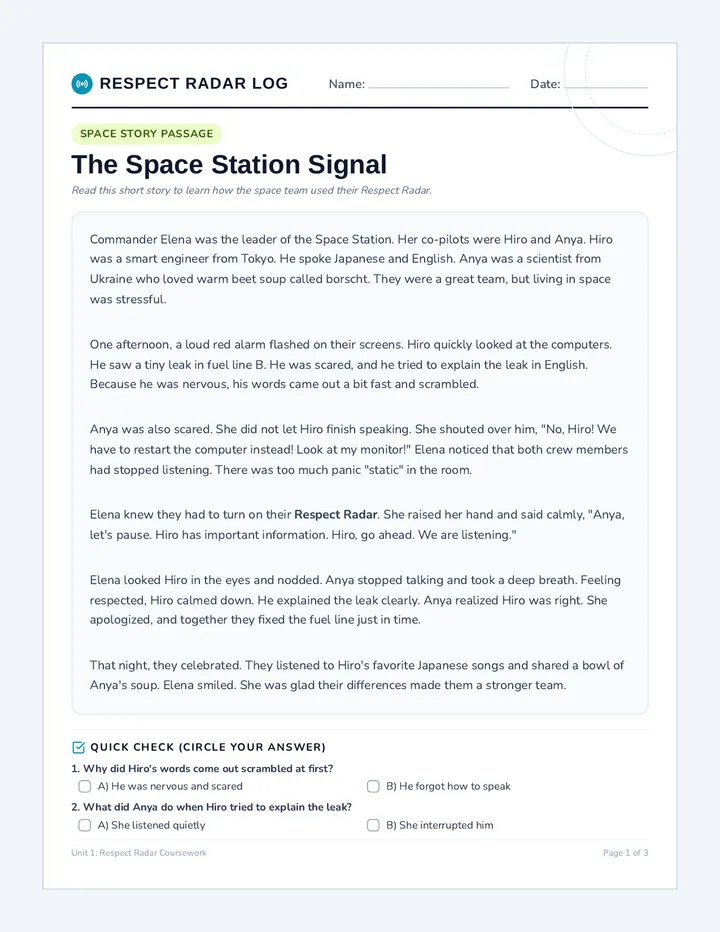
2. Transmit Back: Write a respectful response using the 3 Respect Signals (Tuning, Tracking, & Transmitting).
Student Mission Protocol • Respect Radar Guidance Guidance Systems Co.