Reflect and Reset Lesson Plan Teacher Guide Reflect & Reset
Lesson Plan • Tier 1 Behavioral Intervention
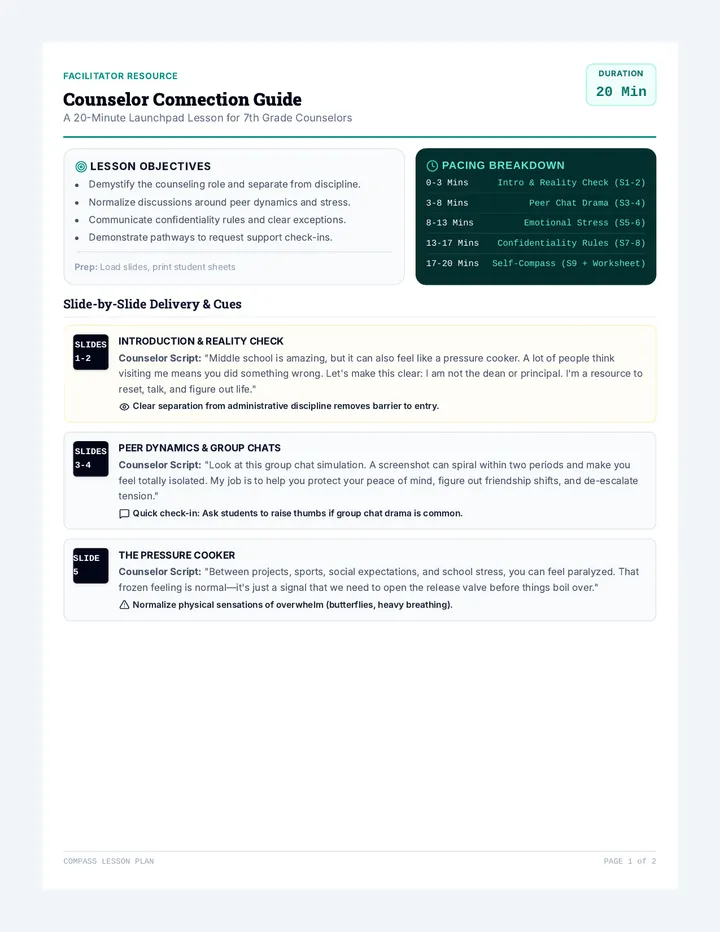
Duration
30 MIN
Objective
Students will recognize moments they felt upset, identify what triggered their feelings, express those feelings through drawing or simple words, and choose one calm-down strategy to use next time.
Audience & Approach
7th Grade Students (Tier 1 Support)
Guided discussion, drawing, and strategy selection
Why This Matters
Early emotional awareness and self-regulation help students understand their feelings, build social-emotional skills, and make positive choices when upset.
Teacher Preparation
Review the Reflection Worksheet and note spots for student input.
Print enough copies of the worksheet and Exit Ticket Template .
Display the Behavior Triggers Poster at student eye level.
Gather crayons, markers, and a timer/visual countdown.
Instructional Sequence
1
Introduction & Warm-Up
5 MIN
Show the Behavior Triggers Poster and explain that a trigger is something that makes us feel upset or angry.
Use a smiling/frowning face chart and ask students to point to how they feel when upset.
Prompt: “What made you feel mad or sad today?” Invite 2–3 volunteers to share.
2
Guided Reflection
10 MIN
Hand out the Reflection Worksheet .
Explain they can draw the moment they felt upset and/or use one sentence to describe what happened.
Support students in labeling emotions (e.g., mad, frustrated, overwhelmed).
Emphasize: No right or wrong answers—we are just learning.
3
Trigger Discussion
5 MIN
Students share their drawing/trigger with a partner.
Ask pairs to name one common trigger and share aloud.
Write common triggers on chart paper (e.g., Noise, Teasing, Hard Work).
4
Strategy Selection
7 MIN
Distribute the Goal-Setting Chart .
Prompt: “Pick one thing you can do to calm down.”
Students draw/write their strategy and 1–2 steps.
5
Cool-Down & Exit Ticket
3 MIN
Distribute the Exit Ticket .
Students circle a feeling face and draw their chosen strategy.
Collect as they leave to identify who may need more support.
Reflect and Reset Slides Tier 1 Support
Reflect & Reset
BIP Reflection Activities for 7th Grade
Self-Awareness
Accountability
Goal Setting
Teacher Note: Welcome everyone! Today we’ll learn how to reflect on our behavior in real time, identify what sets us off, and set goals to make better choices. Emphasize that this is a safe space for honest reflection.
Today's Agenda
1
Warm-Up: What is a Trigger?
2
Guided Reflection Activity
3
Trigger Identification Discussion
4
SMART Goal Setting
5
Cool-Down & Exit Ticket
30 MIN
Teacher Note: Quickly walk through the flow so students know what to expect. Keep energy high.
Warm-Up: Understanding Triggers
A trigger is any event, person, or feeling that leads to a reaction.
Feeling rushed
Teasing/Conflict
Loud Noises
Notice the Spark!
Knowing your triggers helps you catch your feelings before they turn into big reactions.
Teacher Note: Define “trigger” in your own words then share examples. Display the Behavior Triggers Poster on screen or chart paper.
Guided Reflection
Activity Time
On your Reflection Worksheet, break down a recent moment:
Behavior: Describe what happened.
Trigger: What led to it?
Reaction: How did you respond?
Consequence: What was the outcome?
Privacy & Honesty
This is for your growth.
Teacher Note: Distribute the Reflection Worksheet. Model filling out one row with a generic example (e.g., forgetting homework). Encourage privacy and honesty.
Trigger Identification
Share your trigger and reaction with a partner.
Note any triggers you both experienced.
Add new triggers to our class poster.
Teacher Note: Have students pair up and share only their triggers and reactions. Provide chart paper for them to list any common patterns. Refer back to the poster for additional ideas.
Setting a Reset Goal
SMART
Reflect and Reset Worksheet Reflect & Reset
Student Reflection Worksheet
Name:
Date:
Let's think about a time you felt upset at school. Use the space below to draw and write to help you understand your feelings.
1 Draw a picture of when you felt upset:
2 What happened?
3 How did you feel? (Circle one)
😊 Happy
😞 Sad
😡 Angry
😢 Hurt
😕 Confused
4 What can you do to calm down next time?
"Great job! Remember, it’s okay to feel big feelings. You can use your calm-down idea anytime you need it."
Goal Setting Chart Activity Strategy Chart
Goal Setting for Behavioral Resets
Action Plan
When we feel upset, having a plan helps us stay calm. Choose one strategy from our discussion and draw or write how you will use it in the space below.
My Calm-Down Strategy:
How I will do it (Action Steps):
1
2
3
Teacher's Tip:
"Practice these steps when you are feeling calm. This makes them much easier to use when you feel a trigger starting!"
Student Initials:
Behavior Triggers Poster Activity Behavior Awareness
BEHAVIOR TRIGGERS
Knowing your triggers helps you notice your feelings sooner!
Loud Noises
Fire alarms, loud bells, sudden shouts, or crowded hallways.
Unkind Words
Teasing, name-calling, or feeling left out by classmates.
Hard Tasks
When school work feels too difficult or confusing.
Your Turn
Draw or write one thing that makes you feel upset or frustrated:
Catch the spark before the fire!
Reflect and Reset Exit Ticket Exit Ticket
Reflect & Reset
1. How do you feel right now?
😊
🙂
😐
🙁
😢
2. Draw your calm-down strategy:
"Thank you for sharing! Your teacher will use this to help you stay calm and ready to learn."
Student:
Date: