Pause Power Lesson Plan Social-Emotional Learning • Grade 4
Pause Power: The Art of Patient Choices
Lesson Focus: Self-Management, Impulsive Reaction vs. Patient Response
45-50 Minutes
Core Skill Emotional Regulation
Grouping Whole Class & Pairs
Strategy Pause • Breathe • Choose
Materials Slides & Worksheet
Learning Objectives
• Identify: Name at least 2 physical cues of impatience (racing heart, clutched fists, restlessness).
• Apply: Demonstrate the 3-step Pause-Breathe-Choose reset during a simulated wait scenario.
• Reflect: Contrast short-term impulse reactions with long-term patient solutions.
Key Vocabulary
Patience:
The quiet strength to wait calmly without getting upset or losing control.
Impulse:
A sudden urge or quick reaction before the brain has time to think.
The Pause Button:
Taking a 5-second mental break before speaking or reacting.
Lesson Flow: Warm-Up & Instruction
1. Hook: The 60-Second Stillness Challenge
8 Minutes
Ask students to sit completely silent without moving their hands or talking for exactly 60 seconds while watching a countdown on the slide deck.
Teacher Prompt: "Notice what your brain and body wanted to do. Did you feel itchy? Did you want to look at your neighbor? That buzzing feeling is what happens right before impatience takes over."
2. Direct Instruction: The 3-Step "Pause Power" Strategy
12 Minutes
Present the 3 key phases on the slide deck. Model hand gestures that students will practice together:
Step 1: Press Pause Hold both hands flat over chest. Freeze physical movement for 3 counts.
Step 2: Box Breathe Breathe in for 4 counts, hold for 2, release for 4 to cool down the nervous system.
Step 3: Choose Next Ask: "Will what I do right now solve the problem or make it harder?"
Pause Power Lesson Plan • 4th Grade Social-Emotional Learning Page 1 of 2
Pause Power: Guided Practice & Wrap-Up
Instructional Implementation Guide
3. Guided Simulation: "What Would You Do?" Scenarios
12 Minutes
Project scenario cards from the slide deck. Have student pairs role-play the impulsive choice versus the patient choice:
Scenario A (Recess Waiting): You have been in line for the swing for 6 minutes, and the student on the swing won't get off even after the whistle.
Scenario B (Partner Project): Your group partner writes much slower than you and erased the title three times. You are running out of class time.
4. Student Worksheet & Reflection
10 Minutes
Distribute the Pause Power Worksheet . Students independently analyze their personal patience triggers, map out a response to a real-life situation, and sign their personal "Patience Pledge." Circulate and confer with students to check for genuine self-awareness.
5. Debrief & Exit Ticket
5 Minutes
Close with a quick verbal whip-around or silent exit ticket. Each student shares one phrase:
"When I feel myself rushing or feeling frustrated today, I will pause by _________________."
Support Strategies
• Provide tactile fidgets or sensory beads during wait practice.
• Allow students to draw their patience trigger instead of writing.
• Pair with a supportive peer during the scenario role-play.
Extension Strategies
• Have students design a classroom "Patience Station" or reminder poster.
• Write an alternate ending to a story where a character lacked patience.
• Track patience victories in a daily personal journal over one week.
Pause Power Lesson Plan • 4th Grade Social-Emotional Learning Page 2 of 2
Pause Power Slides Life Skills • Grade 4
The Art of Waiting
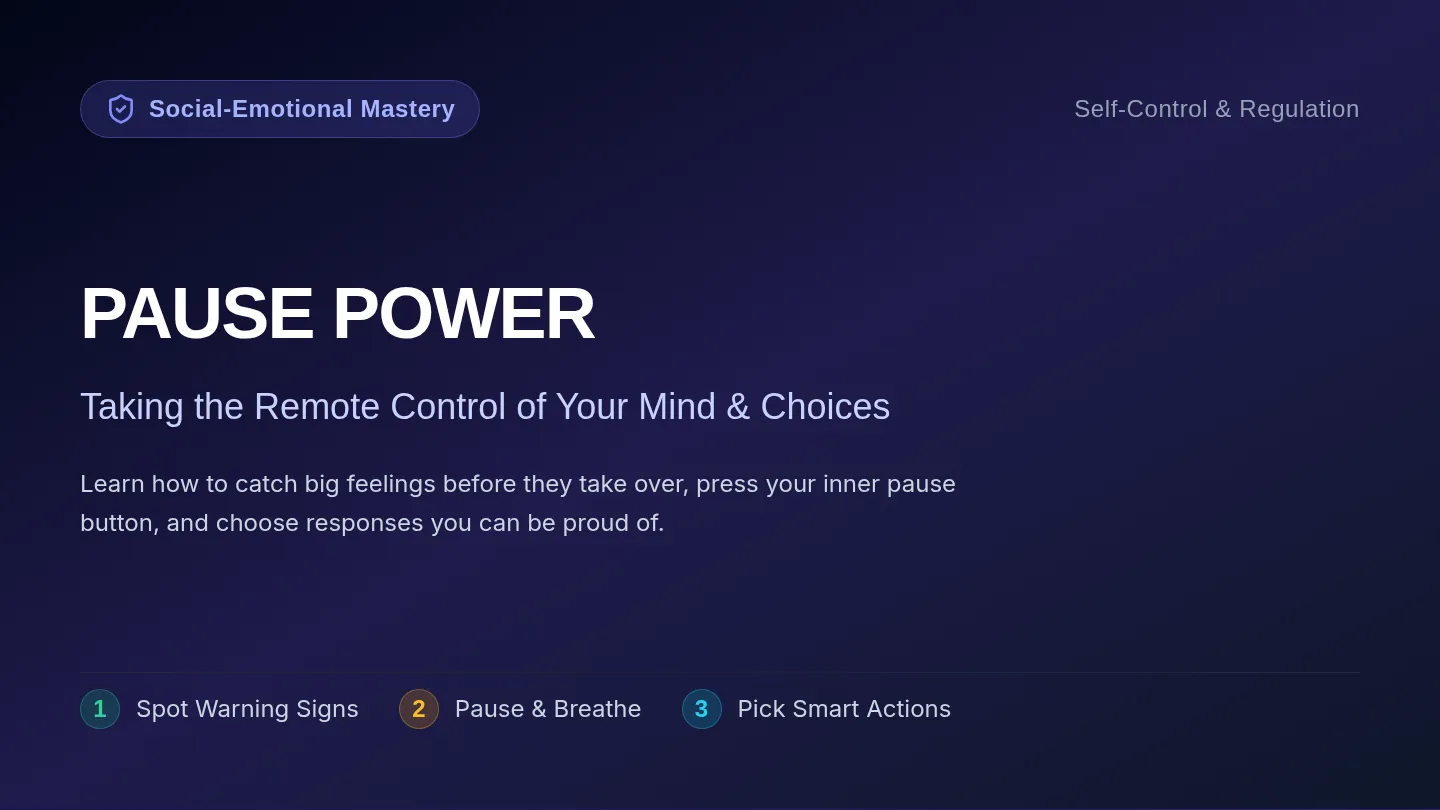
Pause Power
How to stop, cool down your brain, and make smart choices when waiting is hard.
Calm Body
•
Deep Breath
•
Patient Choice
Body Awareness
What Does Impatience Feel Like?
Racing Heart
Your chest feels tight and your blood pumps fast, urging you to act immediately.
Buzzing Hands
Your fingers twitch, your feet tap, or your jaw clenches with restless energy.
Rush Brain
A loud inner voice says: "I need it right now! I can't wait another second!"
These signals are normal! They are alarms telling you it is time to hit pause.
The Strategy
The 3-Step Pause Formula
STEP 1
Pause
Freeze your body for 3 seconds. Stop talking and keep your hands still.
Press Freeze
STEP 2
Breathe
Inhale deeply for 4 counts, hold gently, then slowly exhale to reset your brain.
Cool Down
STEP 3
Choose
Ask: "Will my reaction fix this or make things worse?" Then choose wisely.
Smart Action
Practice with your teacher: Freeze... Inhale 2, 3, 4... Exhale 2, 3, 4... Think!
Real Classroom Scenario
Impulsive Reaction vs. Patient Choice
Situation: The computer website is loading slowly during your science quiz, and the timer is ticking.
Impulsive Reaction
• Rapidly click the reload button 10 times.
• Complain loudly to your neighbor.
• Result: The computer freezes completely!
Patient Response
• Take a deep breath and wait 15 seconds.
• Silently raise your hand if it stays stuck.
• Result: The page loads smoothly and you stay calm.
Key Question: Which choice actually saves you time and energy?
Next Steps
Time for Your Pause Power Worksheet!
On your worksheet, you will:
1 Identify your #1 personal patience trigger.
2 Solve 2 real-life waiting dilemmas.
3 Sign your personal classroom Patience Pledge.
The Patience Rule
"Patience is not just waiting. It is
Pause Power Worksheet Name:
Date:
Class / Room:
Life Skills Activity Sheet
Pause Power: My Patience Action Plan
Discover your patience triggers and practice making calm, smart choices.
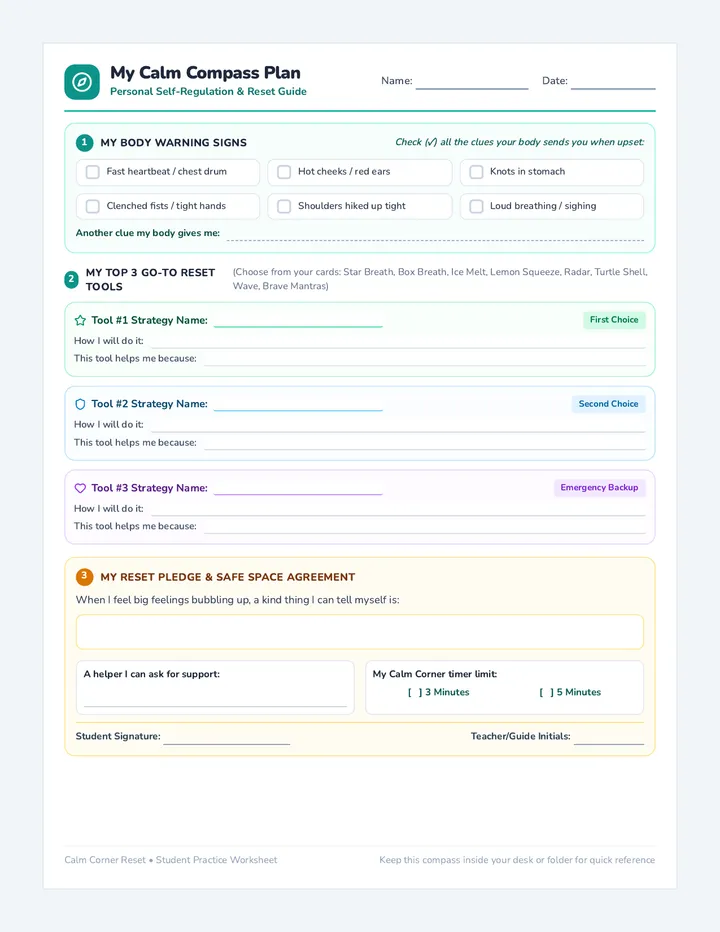
Part 1: My Personal Patience Radar
A. Check the situations where waiting is the toughest for you:
Waiting for my turn to speak in class
Standing in long cafeteria lines
When slow internet or tech acts up
When someone works slower than me
B. What physical clue (heart beating fast, clenching fists, fidgeting) tells you that you are losing patience?
Part 2: The 3-Step Pause Formula
1. PAUSE Freeze movement & mouth
2. BREATHE 4 counts in, 4 counts out
3. CHOOSE Ask: What helps most?
Practice Case: You are waiting to use the class pencil sharpener. The student in front of you is sharpening 6 colored pencils one by one, and the bell will ring in two minutes.
Write what you will do during Step 1 (Pause), Step 2 (Breathe), and Step 3 (Choose):
Pause Power Activity Worksheet • Page 1 of 2 Turn over for Part 3 & Pledge
Name:
Pause Power Worksheet • Section 2
Part 3: Reaction vs. Patient Response
Read each scenario. Turn the impulsive reaction into a patient, calm solution!
Scenario 1: Group Project Snag Impulse: Grabbing the paper
Your partner is drawing the poster title very slowly and making mistakes. You want to snatch the marker and do it yourself.
My Patient Response:
Scenario 2: Waiting for the Teacher Impulse: Calling out repeatedly
Your hand has been raised for three minutes during math class. The teacher is helping another student who is confused.
My Patient Response:
My 4th Grade Patience Pledge
"I know that patience is a quiet strength. When waiting is difficult or frustrating, I have the power to control my own actions."
One specific place I promise to practice my Pause Power this week:
Student Signature:
Date of Commitment:
Pause Power Activity Worksheet • 4th Grade Social-Emotional Learning Page 2 of 2