Note Taking Methods Quiz
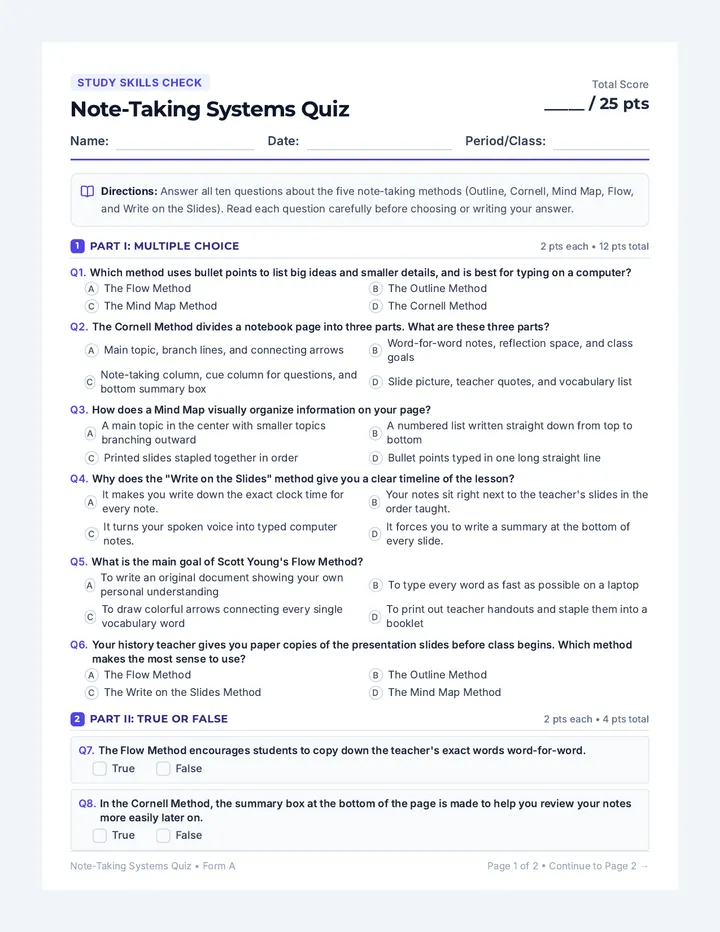
Study Skills Check
Note-Taking Systems Quiz
Total Score _____ / 25 pts
Name:
Date:
Period/Class:
Directions: Answer all ten questions about the five note-taking methods (Outline, Cornell, Mind Map, Flow, and Write on the Slides). Read each question carefully before choosing or writing your answer.
1 Part I: Multiple Choice
2 pts each • 12 pts total
Q1. Which method uses bullet points to list big ideas and smaller details, and is best for typing on a computer?
A The Flow Method
B The Outline Method
C The Mind Map Method
D The Cornell Method
Q2. The Cornell Method divides a notebook page into three parts. What are these three parts?
A Main topic, branch lines, and connecting arrows
B Word-for-word notes, reflection space, and class goals
C Note-taking column, cue column for questions, and bottom summary box
D Slide picture, teacher quotes, and vocabulary list
Q3. How does a Mind Map visually organize information on your page?
A A main topic in the center with smaller topics branching outward
B A numbered list written straight down from top to bottom
C Printed slides stapled together in order
D Bullet points typed in one long straight line
Q4. Why does the "Write on the Slides" method give you a clear timeline of the lesson?
A It makes you write down the exact clock time for every note.
B Your notes sit right next to the teacher's slides in the order taught.
C It turns your spoken voice into typed computer notes.
D It forces you to write a summary at the bottom of every slide.
Q5. What is the main goal of Scott Young's Flow Method?
A To write an original document showing your own personal understanding
B To type every word as fast as possible on a laptop
C To draw colorful arrows connecting every single vocabulary word
D To print out teacher handouts and staple them into a booklet
Q6. Your history teacher gives you paper copies of the presentation slides before class begins. Which method makes the most sense to use?
A The Flow Method
B The Outline Method
C The Write on the Slides Method
D The Mind Map Method
2 Part II: True or False
2 pts each • 4 pts total
Q7. The Flow Method encourages students to copy down the teacher's exact words word-for-word.
True False
Q8. In the Cornell Method, the summary box at the bottom of the page is made to help you review your notes more easily later on.
True False
Note-Taking Systems Quiz • Form A Page 1 of 2 • Continue to Page 2 →
Note-Taking Systems Quiz • Section B Student Name:
3 Part III: System Matching
1 pt each • 5 pts total
Q9. Match each note-taking method (1–5) to what it does best (A–E). Write the correct letter in each box.
Note-Taking Methods
1. Outline Method
2. Cornell Method
3. Mind Map Method
4. Flow Method
5. Write on Slides Method
What Each Method Does
A. Main topic in the center with related ideas branching out
B. Bullet points that sort big ideas and smaller details; great for typing
C. Print slides before class and write notes directly on them
D. Three-part page layout (notes column, question column, and summary)
E. Focuses on writing your own understanding, not copying word-for-word
4 Part IV: Applied Skill Question
4 pts total • Short Answer
Q10. Classroom Scenario: Marcus on his Laptop
Marcus is typing notes on his laptop during history class. His teacher talks quickly, sharing big topics with smaller facts listed under each one.
A. Which note-taking method should Marcus use? (2 pts)
Method Name:
B. Explain ONE reason why this method works well when typing on a computer. (2 pts)
This method is great for typing because...
Note-Taking Systems Quiz • Form A Page 2 of 2 • End of Assessment
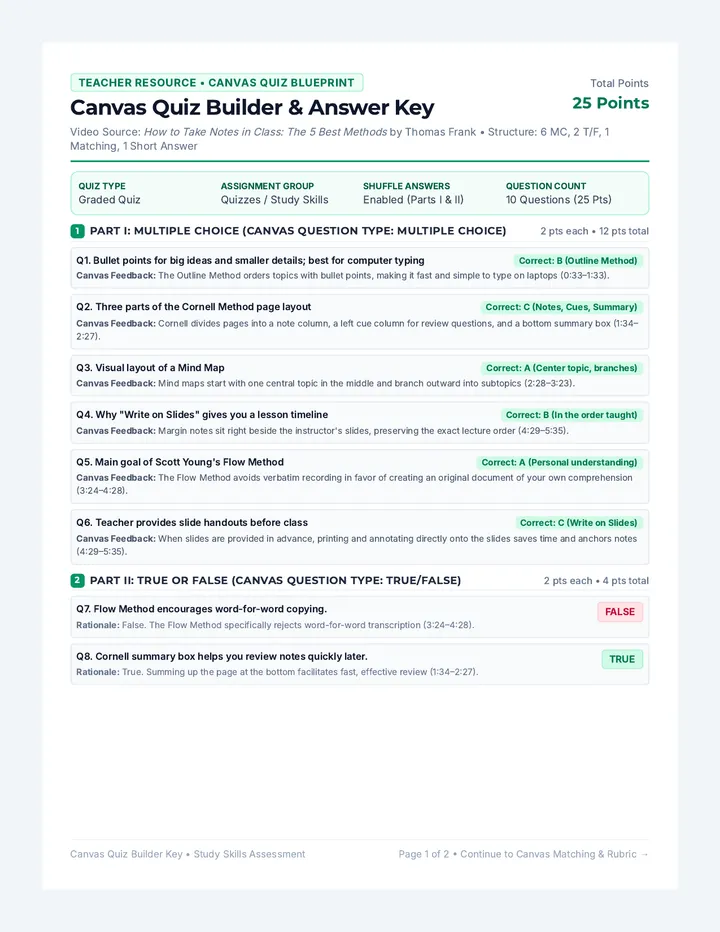
Canvas Quiz Answer Key
Teacher Resource • Canvas Quiz Blueprint
Canvas Quiz Builder & Answer Key
Total Points 25 Points
Video Source: How to Take Notes in Class: The 5 Best Methods by Thomas Frank • Structure: 6 MC, 2 T/F, 1 Matching, 1 Short Answer
Quiz Type Graded Quiz
Assignment Group Quizzes / Study Skills
Shuffle Answers Enabled (Parts I & II)
Question Count 10 Questions (25 Pts)
1 Part I: Multiple Choice (Canvas Question Type: Multiple Choice)
2 pts each • 12 pts total
Q1. Bullet points for big ideas and smaller details; best for computer typing Correct: B (Outline Method)
Canvas Feedback: The Outline Method orders topics with bullet points, making it fast and simple to type on laptops (0:33–1:33).
Q2. Three parts of the Cornell Method page layout Correct: C (Notes, Cues, Summary)
Canvas Feedback: Cornell divides pages into a note column, a left cue column for review questions, and a bottom summary box (1:34–2:27).
Q3. Visual layout of a Mind Map Correct: A (Center topic, branches)
Canvas Feedback: Mind maps start with one central topic in the middle and branch outward into subtopics (2:28–3:23).
Q4. Why "Write on Slides" gives you a lesson timeline Correct: B (In the order taught)
Canvas Feedback: Margin notes sit right beside the instructor's slides, preserving the exact lecture order (4:29–5:35).
Q5. Main goal of Scott Young's Flow Method Correct: A (Personal understanding)
Canvas Feedback: The Flow Method avoids verbatim recording in favor of creating an original document of your own comprehension (3:24–4:28).
Q6. Teacher provides slide handouts before class Correct: C (Write on Slides)
Canvas Feedback: When slides are provided in advance, printing and annotating directly onto the slides saves time and anchors notes (4:29–5:35).
2 Part II: True or False (Canvas Question Type: True/False)
2 pts each • 4 pts total
Q7. Flow Method encourages word-for-word copying.
Rationale: False. The Flow Method specifically rejects word-for-word transcription (3:24–4:28).
FALSE
Q8. Cornell summary box helps you review notes quickly later.
Rationale: True. Summing up the page at the bottom facilitates fast, effective review (1:34–2:27).
TRUE
Canvas Quiz Builder Key • Study Skills Assessment Page 1 of 2 • Continue to Canvas Matching & Rubric →
Canvas Quiz Key • Parts III & IV Specifications Matching & SpeedGrader Short Answer Rubric
3 Part III: Matching Setup (Canvas Question Type: Matching)
1 pt per pair • 5 pts total
Canvas Setup: Enter each Method on the left; enter each matching description on the right. Canvas automatically shuffles choices in student dropdowns.
| Left Item (Method) |
Correct Match (What It Does) |
Pts |
| 1. Outline Method |
B. Bullet points that sort big ideas and smaller details; great for typing |
1 pt |
| 2. Cornell Method |
D. Three-part page layout (notes column, question column, and summary) |
1 pt |
| 3. Mind Map Method |
A. Main topic in the center with related ideas branching out |
1 pt |
| 4. Flow Method |
E. Focuses on writing your own understanding, not copying word-for-word |
1 pt |
| 5. Write on Slides Method |
C. Print slides before class and write notes directly on them |
1 pt |
4 Part IV: Applied Skill Question (Canvas Question Type: Essay / Short Answer)
4 pts total • SpeedGrader Rubric
Q10. Marcus's Laptop Scenario (Two-Part Short Answer) 4 Points Total
Prompt in Canvas: Marcus is typing notes on his laptop in history class. His teacher talks quickly, sharing big topics with smaller facts listed under each one.
A. Which note-taking method should Marcus use? (2 pts)
B. Explain ONE reason why this method works well when typing on a computer. (2 pts)
Part A: Method Name (2 pts)
Correct Answer: Outline Method (or Outline).
• 2 pts: Correctly names Outline Method.
• 0 pts: Any other method or blank.
Part B: Reason for Typing (2 pts)
Model Answer: "It is easy and fast to create bullet points and indent details using Tab when typing on a laptop."
• 2 pts: Clear reason (bullets, indents, fast typing, clean lists).
• 1 pt: Partially explained reason.
• 0 pts: Off-topic or blank.
SpeedGrader Tip: Accept any phrasing that mentions bullet points, tabs/indents, fast keyboard shortcuts, or ordering main ideas and sub-points.
Canvas Quiz Builder Key • Study Skills Assessment Page 2 of 2 • Ready for Canvas SpeedGrader & Question Banks