Learning Voice Slides Self-Advocacy Skills
Own Your Learning
My Learning Voice
Discovering how you learn best and speaking up for the support you need to succeed.
Today's Mission
"I can describe my learning needs and how to communicate them."
What is Self-Advocacy?
01 / DISCOVERY
Passive
Staying silent when confused, hoping someone else notices, or simply giving up without asking.
"I'll just pretend I get it..."
Self-Advocacy Goal
Understanding how you learn, recognizing obstacles, and respectfully asking for what helps you thrive.
"Here is what helps me learn best."
Blaming
Blaming the teacher, complaining about tests, or demanding changes without offering a solution.
"This class is unfair!"
Self-advocacy is a partnership between you and your teacher, not a confrontation.
4 Dimensions of Learning Needs
02 / SELF-KNOWLEDGE
1. Environment
Seating position, lighting, quiet workspace, fidget tools, or minimal background distractions.
2. Input Style
Visual diagrams, written outlines, step-by-step model examples, or hands-on practice.
3. Processing Time
Time to think before answering aloud, chunked multi-step tasks, or frequent check-ins.
4. Demonstration
Showing understanding through oral explanation, visual graphics, or structured writing outlines.
"No two brains learn exactly the same way—knowing yours is your superpower."
The 3-Step Advocacy Formula
03 / STRATEGY
Step 1
The Strength & Goal
Start on common ground. Share what you care about and what you want to achieve.
"I really want to do well on this project..."
Step 2
The Specific Need
Name the exact obstacle without blaming anyone. Be concrete and honest.
"...but I get overwhelmed when instructions have 6 steps at once."
Step 3
The Actionable Idea
Offer a practical strategy or ask for a specific accommodation.
"Could I get a checklist to track my progress?"
Formula: [Goal] + [Challenge] + [Proposed Solution]
Anatomy of Your Advocacy Letter
04 / LETTER STRUCTURE
PART 1
Greeting & Positive Tone
Address your teacher warmly and express your excitement or commitment to the class.
"Dear Mr. Vance, I'm excited for science this term..."
PART 2
My Strengths
Highlight what you do well: creativity, curiosity, group discussion, or perseverance.
"I learn best when we do hands-on labs and visual diagrams..."
PART 3
My Growth Needs
Explain what is tricky and the specific support or setup that helps you do your best work.
"It really helps me when I can review slide notes before tests..."
PART 4
My Commitment
State what you will do to take responsibility, and thank them for partnering with you.
"I promise to ask questions right away when I'm stuck..."
Teachers love receiving these letters because it helps them teach you better!
Mentor Example in Action
05 / MENTOR TEXT
Dear Ms. Jackson,
I am writing because I want to do my absolute best in algebra this semester. Strength I learn best when I see worked-out visual examples on the board before working independently.
Need Sometimes I feel rushed when copying notes from slides while listening to explanations at the same time. Solution It would help me a lot if I could sit near the front and access a printed guided-notes sheet.
Commitment On my end, I will review my notes each evening and come to Friday office hours if I have questions. Thank you for helping me grow!
Sincerely,
Clear & respectful Specific actionable request Shows personal accountability
Your Turn: Write Your Letter
06 / YOUR VOICE
1
Explore
Complete the Learning Needs Checklist on Page 1 of your activity sheet.
2
Draft
Use the guided sentence stems to craft your 4-part advocacy letter.
3
Deliver
Share your letter with your teacher to build your collaborative learning team.
"Your voice is your greatest learning tool. Use it with pride!"
Dear Teacher Letter Activity Learning Needs Navigator
Self-Advocacy & Student Voice Guide
Name: ___________________
Date: _____________
Class: __________________
Period: ___________
Target: "I can describe my learning needs and how to communicate them."
Part 1: Profile
1 How Do I Learn Best? (Check 2–3 in each category that describe you)
Best Learning Environment
Sitting near the front of the room Quiet space with minimal visual clutter Ability to move, stand, or use a fidget tool Working next to a focused partner
Best Input & Instruction
Visual diagrams, flowcharts, or slides Teacher modeling an example step-by-step Written instructions I can re-read anytime Hands-on trial and error or demonstrations
Processing & Pace Needs
Wait time to think before being called on Chunked directions (1–2 steps at a time) A checklist to track multi-part tasks Mid-task check-in to confirm I'm on track
Showing What I Know
Explaining my reasoning aloud or one-on-one Using graphic organizers or sentence frames Creating visual posters, slides, or models Extra time on tests or quiet testing room
2 The 3-Step Self-Advocacy Formula (Prep Your Core Message)
Clear • Respectful • Solution-Focused
Step A: State your Strength or Goal Stem: "I learn best when..." or "My goal this quarter is to..."
Step B: Name the Specific Challenge or Need Stem: "I sometimes struggle when..." or "It's difficult for me if..."
Step C: Propose a Workable Solution Stem: "It would help me if we could..." or "Could I try..."
Turn to Page 2 to draft your complete letter to your teacher. Page 1 of 2
Dear Teacher: How I Learn Best
Student Advocacy Letter Template
Teacher's Name: ___________________
Subject: ___________________
Use your notes from Page 1 to write a polite, honest, and proactive letter.
✓ Strengths ✓ Needs ✓ Strategy ✓ Commitment
Dear ____________________________________,
1. Opening & How I Learn Best (What are your strengths and preferred learning style?)
2. My Learning Need & What Helps Me (What is challenging, and what specific strategy helps?)
3. My Action Plan & Commitment (What will YOU do to take ownership of your learning?)
Thank you for partnering with me this school year!
Sincerely,
(Your signature & printed name)
Self-Advocacy Quality Checklist
Tone is respectful, collaborative, and sincere Identifies at least one clear learning strength Names a specific challenge without blaming Proposes a realistic, workable solution
Teacher Tip: Keep this letter in your conference folder or schedule a 2-minute check-in with your teacher. Page 2 of 2
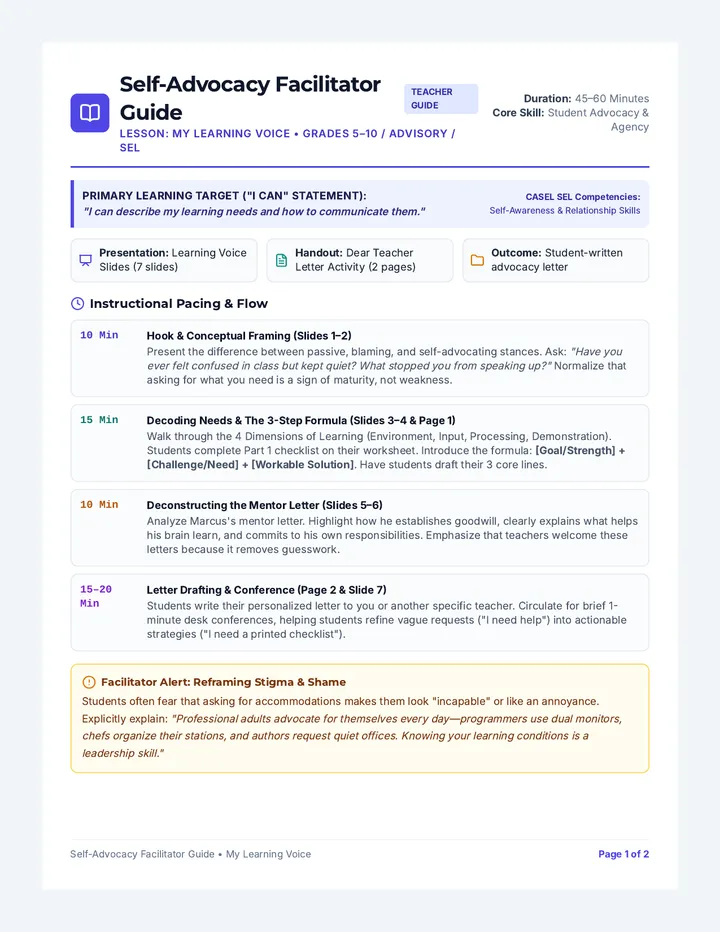
Self Advocacy Teacher Guide Self-Advocacy Facilitator Guide
Teacher Guide
Lesson: My Learning Voice • Grades 5–10 / Advisory / SEL
Duration: 45–60 Minutes
Core Skill: Student Advocacy & Agency
Primary Learning Target ("I Can" Statement):
"I can describe my learning needs and how to communicate them."
CASEL SEL Competencies: Self-Awareness & Relationship Skills
Presentation: Learning Voice Slides (7 slides)
Handout: Dear Teacher Letter Activity (2 pages)
Outcome: Student-written advocacy letter
Instructional Pacing & Flow
10 Min
Hook & Conceptual Framing (Slides 1–2)
Present the difference between passive, blaming, and self-advocating stances. Ask: "Have you ever felt confused in class but kept quiet? What stopped you from speaking up?" Normalize that asking for what you need is a sign of maturity, not weakness.
15 Min
Decoding Needs & The 3-Step Formula (Slides 3–4 & Page 1)
Walk through the 4 Dimensions of Learning (Environment, Input, Processing, Demonstration). Students complete Part 1 checklist on their worksheet. Introduce the formula: [Goal/Strength] + [Challenge/Need] + [Workable Solution] . Have students draft their 3 core lines.
10 Min
Deconstructing the Mentor Letter (Slides 5–6)
Analyze Marcus's mentor letter. Highlight how he establishes goodwill, clearly explains what helps his brain learn, and commits to his own responsibilities. Emphasize that teachers welcome these letters because it removes guesswork.
15–20 Min
Letter Drafting & Conference (Page 2 & Slide 7)
Students write their personalized letter to you or another specific teacher. Circulate for brief 1-minute desk conferences, helping students refine vague requests ("I need help") into actionable strategies ("I need a printed checklist").
Facilitator Alert: Reframing Stigma & Shame
Students often fear that asking for accommodations makes them look "incapable" or like an annoyance. Explicitly explain: "Professional adults advocate for themselves every day—programmers use dual monitors, chefs organize their stations, and authors request quiet offices. Knowing your learning conditions is a leadership skill."
Self-Advocacy Facilitator Guide • My Learning Voice Page 1 of 2
Differentiation & Delivery Strategies
Implementation, Accommodations & Teacher Feedback
Part 2: Support
Differentiated Supports for Diverse Learners
Students with IEP / 504 Plans
Use this activity prior to annual ARD/IEP review meetings. Have students compare their letter to their official accommodation sheet so they learn the legal names of their supports (e.g., preferential seating, chunked assignments).
Multilingual Learners (ML / ELL)
Provide translated sentence starters and bilingual vocabulary banks for learning styles. Allow students to draft in their heritage language and translate with a peer or audio speech-to-text tool.
Executive Function & ADHD
Encourage students to ask for structural scaffolds (visual timers, assignment rubrics with checkboxes, verbal reminders 5 minutes before transitions) rather than simply "more time."
Reluctant or Anxious Writers
Allow students to submit their letter via digital email, a recorded voice memo, or by annotating the Page 1 checklist and highlighting their top 2 requests rather than writing full paragraphs.
Closing the Loop: How to Respond to Student Letters
Self-advocacy only thrives when students receive affirming, actionable feedback. Use this 3-part response protocol:
1. Validate & Thank
"Thank you for sharing your learning style with me. I appreciate your honesty and self-awareness."
2. Confirm Action
"I moved your seat to table 2 and printed the unit slides. Let's try this for two weeks."
3. Set Follow-Up
"Let's check in for 2 minutes next Friday to see how this setup is working for you."
Classroom Mentor Letter Sample Grade 7 ELA Example
Dear Mr. Gomez, I enjoy our class discussions and read-alouds because hearing different perspectives helps me understand stories. However, when we write independent essays, I struggle with organizing my thoughts and get stuck staring at a blank screen.
It would help me immensely if I could use a graphic organizer or talk through my thesis with you for one minute before starting. On my part, I will complete my brainstorm at home and arrive to class with my key points ready. Thank you for helping me become a stronger writer! — Jordan Lee
Self-Advocacy Facilitator Guide • My Learning Voice Page 2 of 2